
You must not park within 3 metres of a fire hydrant in Ontario, and there's no general exception for a quick stop. The measurement is read along the curb or roadway edge, not diagonally from the hydrant to your vehicle.
You're pulling up outside a shop, you spot a hydrant near the curb, and someone in the passenger seat says, “It'll only take a minute.” That's exactly the kind of moment that causes trouble. The safest response is to choose another place, check the local rule, and keep the hydrant and its approach clear.
Why Fire Hydrant Parking Rules Matter on the G1 Test
A hydrant question can look simple because it often appears to ask for one distance. The real test is whether you can apply that distance when the situation includes a short stop, a waiting passenger, an unpainted curb, or a hydrant that looks unused.
The rule exists because firefighters need fast, unobstructed access to water. A vehicle close to the hydrant can block the connection point, restrict the hose route, or force emergency crews to spend time working around it. A driver who thinks, “I'm still in the car,” may be focusing on convenience instead of access.
Toronto's enforcement record shows that this isn't a rare technical issue. The city recorded 30,851 tickets for parking within three metres of a fire hydrant in 2025, representing 1.44% of the cited parking category, according to Toronto's administrative-penalty data.
The roadside decision
Suppose you arrive at a convenience store and see a hydrant near the front entrance. You could:
- pull up beside it while someone runs inside;
- wait in the driver's seat with the engine running;
- stop farther away and walk back;
- use a legal space on another side of the street.
Only the last two choices give you a reliable safety margin unless a specific local rule clearly says otherwise. Ontario learners should build the habit of treating the hydrant area as unavailable, not as a convenient loading zone.
The MTO handbook's parking guidance should be part of your core study, alongside the explanations in this Ontario G1 parking rules guide. The point isn't to memorise a number and forget the reason. It's to recognise the hazard quickly enough that you don't debate it beside the curb.
Practical rule: If you're asking whether a quick stop is “probably fine,” choose a different location.
The Ontario 3-Metre Rule and How to Measure It
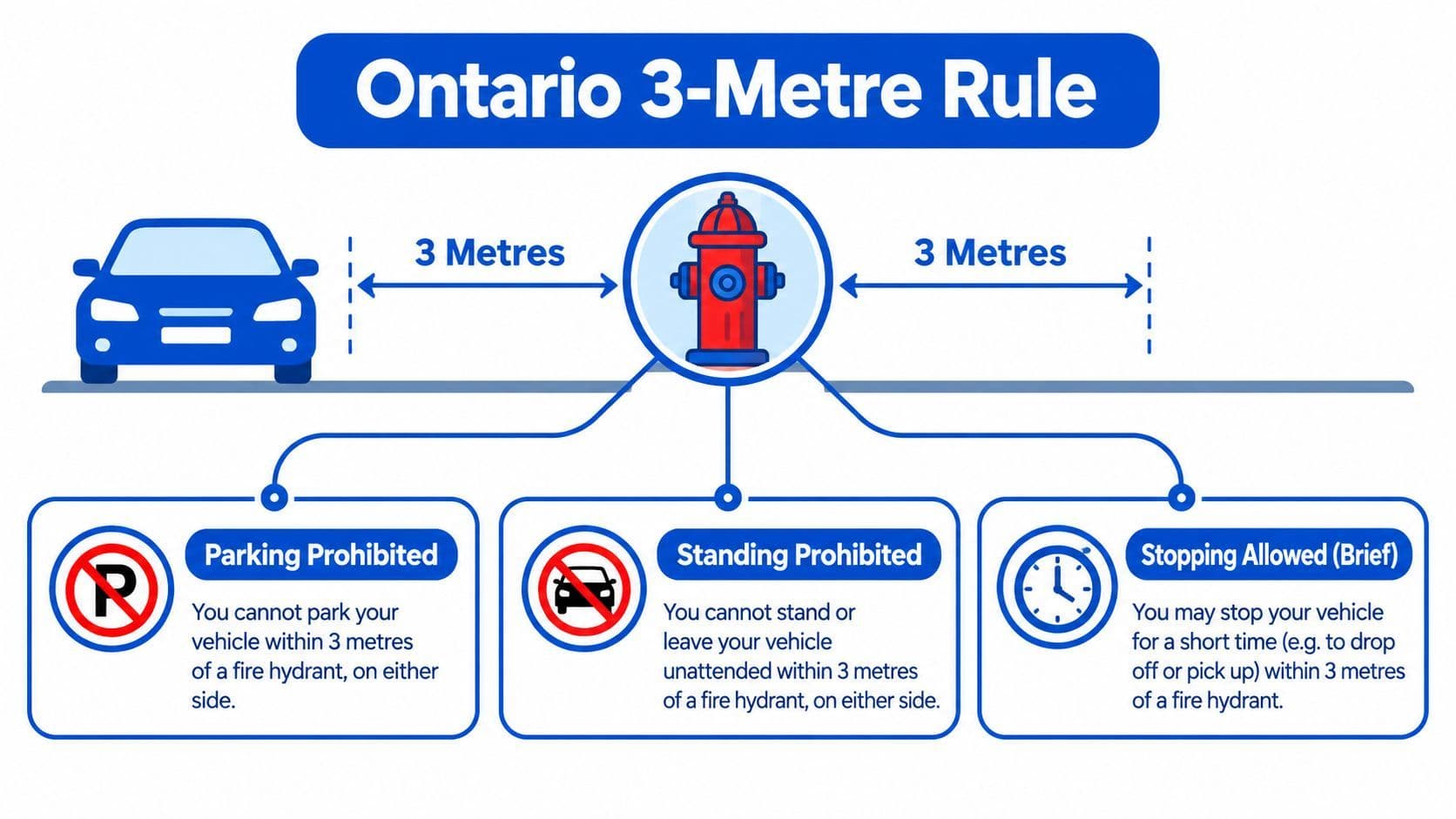
The Ontario Ministry of Transportation Driver's Handbook states that drivers must not park within 3 metres of a fire hydrant as a general Ontario road-safety requirement. You can review the rule in the official MTO parking guidance.
That gives you the number, but you also need to know how the distance is read. Toronto's municipal rule measures from the point on the curb or roadway edge opposite the hydrant, then follows the curb to the vehicle. It isn't a diagonal measurement from the hydrant itself.
Read the curb, not the diagonal
Imagine the hydrant is close to the curb, while your vehicle is angled slightly away from the road. A diagonal line from the hydrant to your front bumper might appear longer than the required clearance. Toronto's curb-based method can still place your vehicle inside the restricted area because the relevant path follows the curb from the opposite point.
Use this simple mental process:
- Find the hydrant's position beside the curb.
- Identify the point on the curb or roadway edge opposite it.
- Follow the curb in the direction of your vehicle.
- Keep the vehicle outside the required setback.
Don't use hydrant colour, curb paint, or visual guessing as your main test. Paint can be missing or unclear, and a hydrant's appearance doesn't tell you whether the restriction applies. The legal and safe question is where your vehicle sits in relation to the applicable rule.
The measurement also relates to the vehicle's position, not the driver's seat. If the front or rear of your vehicle extends into the restricted area, moving your seat farther away won't solve the problem.
A short visual lesson can help you connect the distance to the roadside layout:
Provincial Rule Versus Municipal By-Laws
The familiar 3-metre rule is the key Ontario handbook answer, but it isn't the whole legal picture. Ontario Regulation 604 applies that rule on the King's Highway and on highways within 100 metres of an intersection with it, unless a municipal by-law applies instead. That means the road's jurisdiction matters.
A local government can set a different restriction for roads under its authority. Haldimand County, for example, prohibits parking within 1.5 metres of a hydrant under its municipal parking by-law. The difference doesn't mean the handbook is wrong. It means learners need to distinguish the general provincial rule from a local rule that governs a particular road.
Jurisdiction Setback Applies Where Ontario provincial rule 3 metres The King's Highway and highways within 100 metres of an intersection with it, unless a municipal by-law applies Haldimand County local rule 1.5 metres Locations governed by the county's municipal parking by-law
How to decide on an unfamiliar street
If you're driving across Ontario, use this order of attention:
- Read posted signs first. Signs can identify local parking restrictions or special access requirements.
- Identify the road context. A provincial highway and a local municipal street may be governed differently.
- Apply the stricter visible rule. If the sign, by-law, or road condition requires more clearance, follow it.
- Don't assume a memorised number overrides local law. The handbook gives you the exam-oriented provincial rule, not every municipal variation.
This matters for newcomers and students who practise in one community but take the test or drive in another. A learner may confidently remember three metres and still miss the fact that the local by-law controls the location. A review of new driving rules in Ontario can help place this topic beside other rules that change with signs, road authority, or local regulation.
The safest fallback is straightforward: keep the area clear, obey the visible restriction, and check the municipality when you're unsure.
Stopping, Standing, and Quick Stop Scenarios
Learners often treat parking, standing, and stopping as interchangeable. They aren't always used identically in everyday conversation, but a one-minute stop near a hydrant shouldn't be treated as automatically legal just because you haven't left the vehicle.
Use these roadside examples:
“I'm only stopping for a minute”
You pull over, keep the engine running, and run into a shop. That's not a dependable exemption. Ontario's provincial regulation doesn't create a general exception based on a quick stop, loading, unloading, the colour of the hydrant, or whether the hydrant appears to be working.
“I'm staying in the driver's seat”
You're waiting for a friend with the vehicle idling. Remaining in the car doesn't turn the hydrant area into a legal waiting space. The question is whether the vehicle is within the prohibited setback under the applicable rule, not whether you can move quickly if someone asks.
“The hydrant looks out of service”
Don't make that judgment yourself. A hydrant may look old, covered, hidden, or unused, but its apparent condition isn't a general permission to park beside it. Emergency access remains the practical reason to leave the space open.
“The curb isn't painted”
Unpainted concrete isn't a safe signal that parking is allowed. Markings can help drivers, but learners should follow the legal distance, signs, and municipal by-law rather than relying on colour.
A brief stop can still put your vehicle in the exact place firefighters need to reach.
For a G1 scenario question, reject answers that rely on convenience. “Only for a minute,” “the driver remains inside,” and “the hydrant looks unused” are distractors unless a clearly applicable local rule provides a specific exception.
Fines, Tickets, and Enforcement Reality
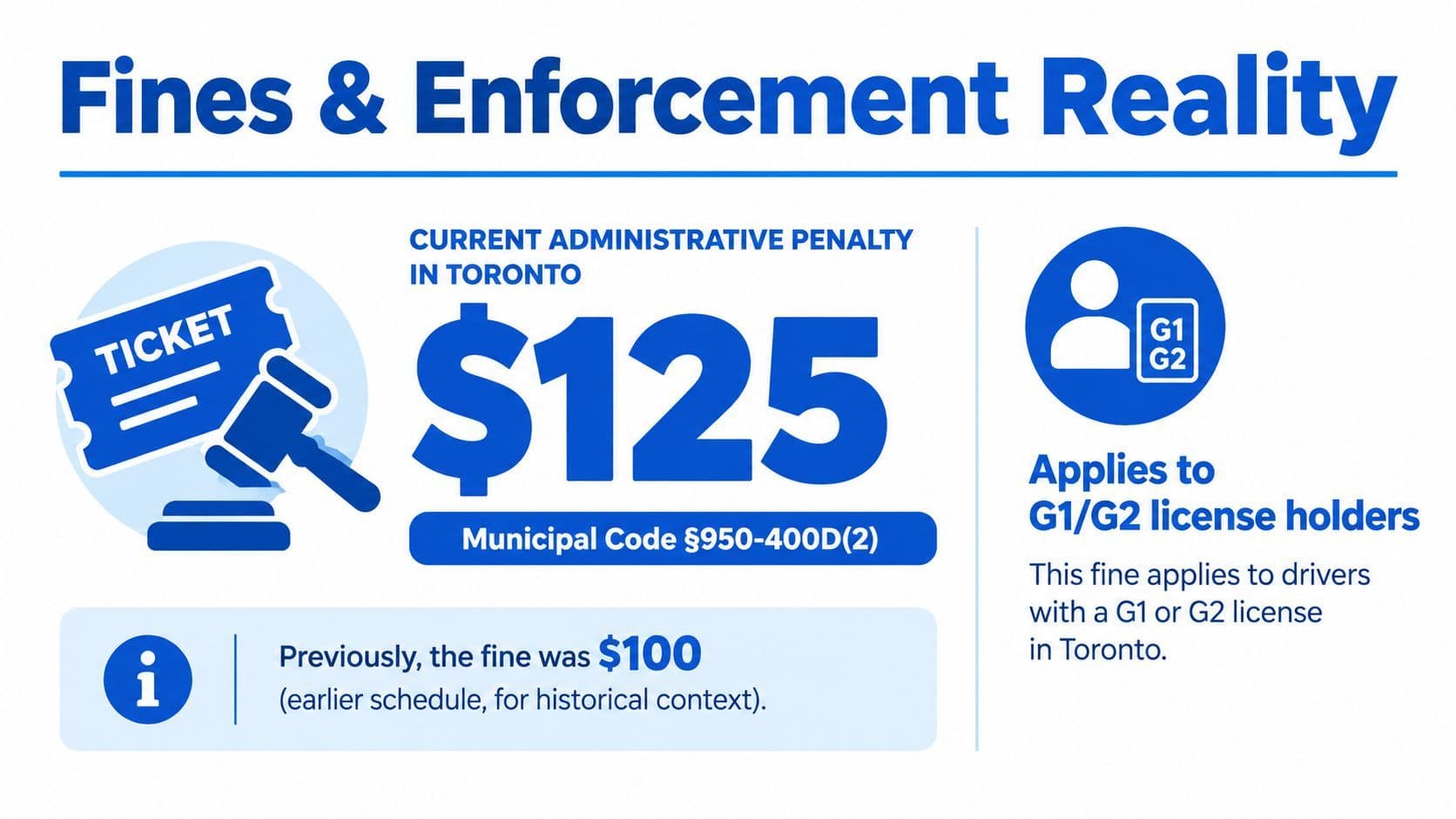
Hydrant parking can lead to a municipal ticket, and the amount depends on the municipality and its current schedule. Toronto's 2024 by-law schedule lists a $125 administrative penalty for parking within three metres of a hydrant under Municipal Code §950-400D(2). You can verify that amount in Toronto's 2024 by-law schedule.
Earlier Toronto materials listed the same offence at $100, which shows why learners shouldn't treat one city's fine as a permanent Ontario-wide amount. The distance rule is the stable study point. The penalty is a local administrative detail that can change.
Toronto has also treated the offence as an actively enforced life-safety matter. A separate City report noted approximately 25,000 fire-hydrant parking offences issued annually when officials evaluated fine increases, as recorded in Toronto's report on hydrant parking enforcement.
What happens beyond the ticket
A ticket isn't the only possible consequence. Local enforcement systems may issue the penalty, and the vehicle may be removed under the municipality's authority. The practical cost and process depend on where the vehicle was parked and which by-law applies.
Before relying on an old forum answer or a friend's experience, check your municipality's current parking by-law or penalty schedule. Search the city or county website for its hydrant setback, administrative penalty, towing policy, and any rules for private property.
Don't confuse this offence with demerit points. Parking penalties and driving-conviction consequences are separate topics, so use a focused resource on Ontario demerit points rather than assuming every ticket affects your licence in the same way.
The Safety Reason Behind the Distance
The space beside a hydrant isn't reserved only for the metal body. Firefighters may need to reach outlet connections, turn the operating nut, attach equipment, and move hose toward the fire lane or building. A vehicle that blocks one part of that route can make the whole setup slower.
California fire-planning guidance offers a useful visual comparison for understanding equipment access. It says hydrants should be within 3 feet of the edge of a fire lane, remain visually and operationally unobstructed, and have at least 3 feet of clear space around the hydrant perimeter, while vehicles should stay outside the 15-foot approach zone. Those are California requirements, not Ontario's legal measurement, but they show why a simple curb-distance rule protects a larger working area. See the Chula Vista fire-access guidance.
Think about the equipment zone
A driver may stop just far enough from the hydrant body to feel comfortable, yet still leave a bumper, mirror, snowbank, or vehicle side blocking the connection. The visual gap can look acceptable from inside the car while the working path remains difficult for a crew carrying hose.
That's why the Ontario rule should guide your whole decision, not just your tape-measure estimate. Leave the approach open, keep the hydrant visible, and avoid treating the curb beside it as a temporary loading space.
During an emergency, firefighters may use whatever means are necessary to gain access. Ordinary violations can still be cited outside an emergency. The safest driver gives emergency crews room before they arrive, rather than expecting them to work around a vehicle.
How to Memorize the Rule for Test Day
Use one sentence as your memory hook:
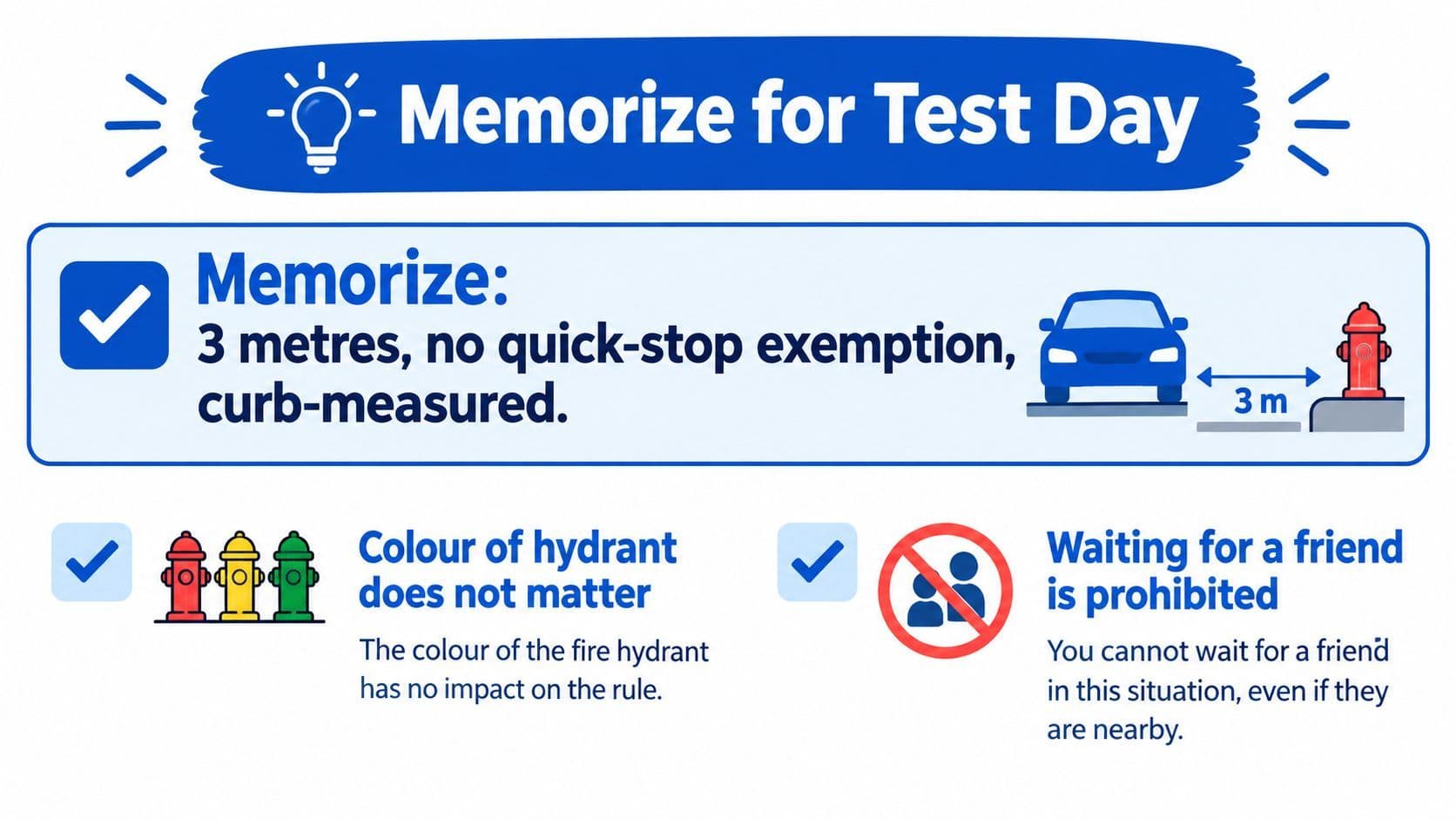
Three metres, no general quick-stop exemption, measured along the curb.
That sentence covers the number, the common trap, and the measurement method. Repeat it when you review parking questions, then test yourself with scenarios rather than copying the number alone.
Remove the distractors
When a practice question mentions a hydrant, check whether the answer depends on one of these misleading details:
- The hydrant's colour: Colour doesn't replace the distance rule.
- The time stopped: A short wait isn't a general exemption.
- The driver's location: Sitting in the vehicle doesn't automatically make the space legal.
- The diagonal gap: Toronto's method follows the curb or roadway edge.
- The hydrant's apparent condition: Don't decide that an unused-looking hydrant can't matter.
The MTO handbook also separates hydrant parking from other prohibited locations, including parking on or within 100 metres of a bridge and within 6 metres of a public entrance to an open hotel, theatre, or public hall. Reviewing these rules together can help you avoid mixing up distances, as shown in the printable MTO handbook.
Practise the decision, not only the fact
Take a targeted parking quiz first, then use mixed questions that combine hydrants with signs, right-of-way, and stopping restrictions. A timed G1 simulator is useful after you understand the rule because it tests whether you can recognise the right answer under pressure.
G1ready.ca provides registration-free practice exams, targeted quizzes, mixed tests, a diagnostic test, marathon practice, and an exam simulator with explanations and progress tracking. If you miss a hydrant question, write down the reason, such as “used diagonal distance” or “assumed one minute was allowed,” and retest that mistake until the wording no longer catches you.
Common Questions About Hydrant Parking in Ontario
Does the rule apply in a private parking lot?
The MTO handbook rule is framed around roads and parking guidance, while private lots can also have local, property, fire-access, or posted restrictions. Don't assume a private lot is automatically exempt. If a hydrant is beside an access route, keep it clear and follow the signs and instructions for the property.
What if the curb is painted a different colour?
Curb colour isn't a reliable substitute for the applicable distance and local rule. If the curb marking is absent, faded, or different from what you expected, don't treat that as permission to park beside the hydrant.
Can a passenger stay in the car?
A passenger can remain in the car, but that fact doesn't create a general hydrant exemption. The driver's safest choice is to move the vehicle outside the restricted area rather than rely on someone being ready to respond.
Is the rule the same on every Ontario street?
No. The MTO handbook gives the key provincial learner rule, while Ontario Regulation 604 describes where the provincial rule applies and allows a municipal by-law to govern instead. Haldimand County's local setback is an example of why you should check the road authority and posted restrictions.
What should I do on the King's Highway?
Start with the provincial rule, then check signs and the surrounding road context. The provincial regulation covers the King's Highway and highways within 100 metres of an intersection with it, unless a municipal by-law applies instead. If you're uncertain, leave more room and don't park beside the hydrant.
What's the safest answer on the G1 test?
Choose the answer that protects the hydrant's access, follows the applicable sign or by-law, and doesn't rely on a quick stop, vehicle occupancy, colour, or diagonal measurement. In real driving, the same habit keeps your decision simple: find another legal space.
Use G1ready.ca to practise targeted parking-rule quizzes, mixed G1 tests, and realistic exam simulations that explain why an answer is correct. Visit G1ready.ca and drill the hydrant rule until “three metres, curb-measured, no quick-stop exemption” comes to mind automatically.


