
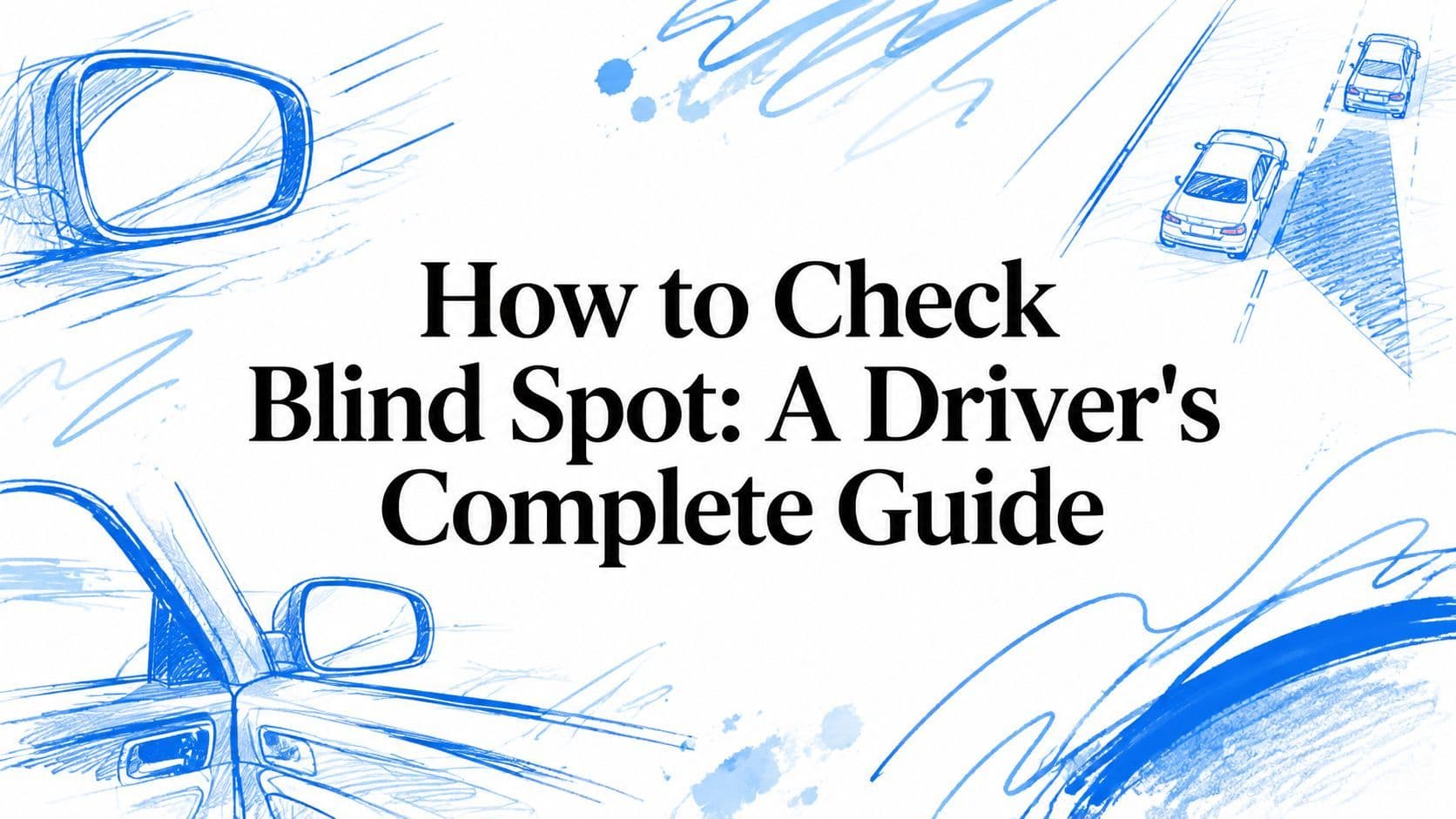
You signal, glance at the mirror, and start moving over. Then a sedan appears beside your rear door, close enough to make your stomach tighten. The same surprise can happen with a cyclist near a bike lane, a motorcycle in evening traffic, or a pedestrian hidden beside the vehicle. Learning how to check blind spot properly means replacing that rushed glance with a complete routine: set the mirrors, scan continuously, check at the right moment, and move only when the space is confirmed.
Why Blind Spot Checks Matter More Than Most Drivers Think
A blind spot is the area beside and slightly behind your vehicle that falls outside the useful field of the rear-view and side mirrors. In most vehicles, Ontario's official handbook identifies blind spots to the back left and back right. On some vehicles, the area can be large enough for another road user to disappear from view entirely. Ontario's official driver handbook also warns that cyclists may be hidden in blind spots approaching from behind, particularly near bike lanes, sidewalks, and trails.
The danger usually appears during a decision that feels routine. You're approaching a highway merge, your signal is on, and the gap looks open. A vehicle moves into the rear quarter of your car while you're watching the lane ahead. If you rely on one mirror glance, you may never see it. A quick shoulder check can reveal the vehicle, but only if you perform it immediately before moving and turn far enough to see the area the mirrors miss.
Blind spots can also become situational. A head restraint, a thick pillar, tinted glass, a passenger, or the shape of a larger vehicle can obstruct part of your view. These obstructions change what you can see from the driver's seat, so mirror adjustment reduces the problem but doesn't remove the need to look.
Ontario's collision data provide the broader reason to take visibility seriously. The Ontario Road Safety Annual Report 2021 recorded 561 fatalities and 32,507 personal-injury collisions. Its condition breakdown recorded 201 fatal collisions associated with darkness, representing 38.7% of fatal collisions in that breakdown. Darkness doesn't create the blind spot, but it makes a hidden cyclist, pedestrian, or vehicle harder to recognise.
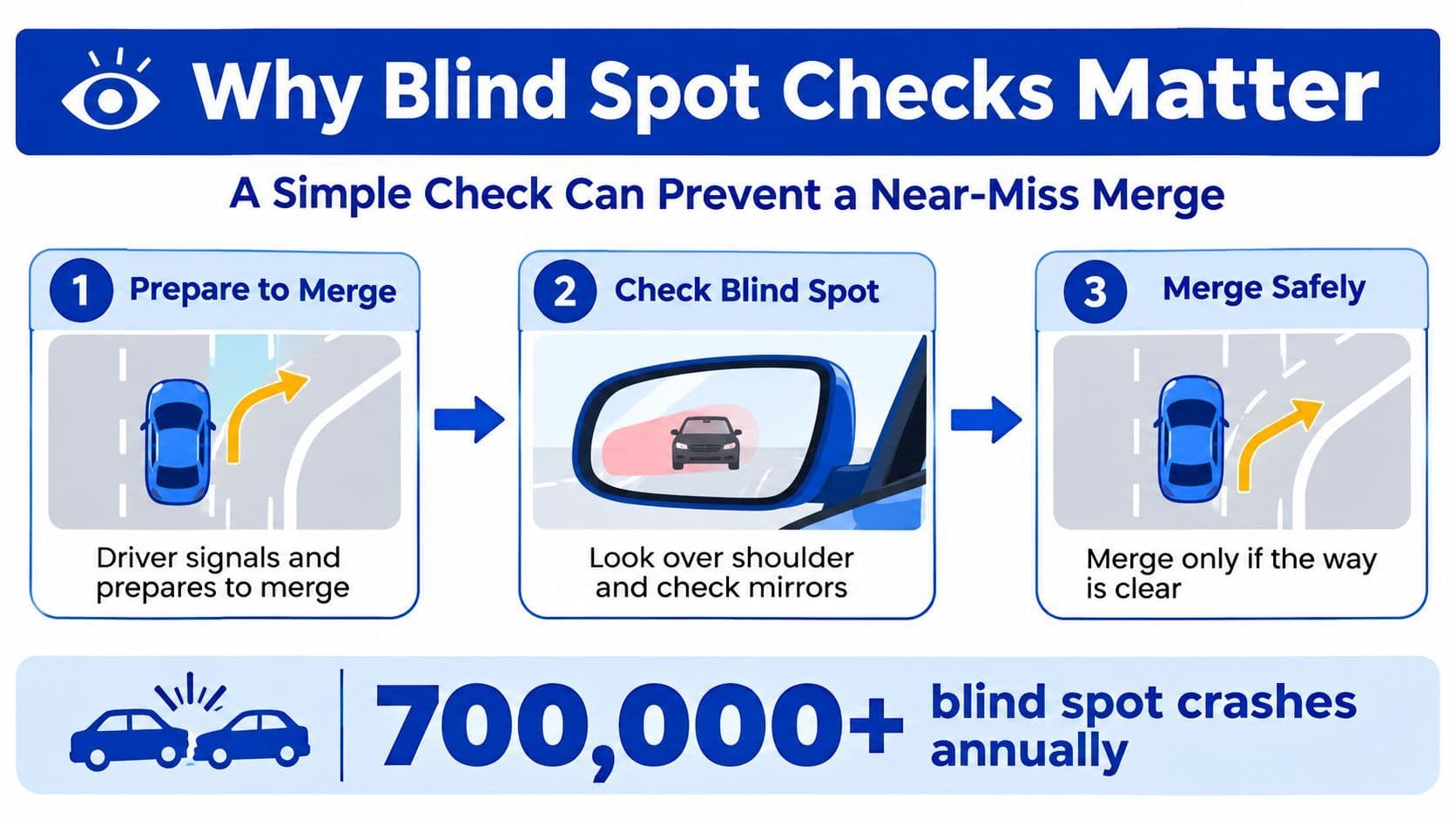
The cost of a failed check can be a collision, an insurance claim, a dangerous G-test error, or a rider disappearing from view at exactly the wrong moment. The practical answer isn't a heroic head turn. It's a repeatable sequence that works in a parking lot, at dusk, and under pressure. For related guidance on sharing space with cyclists, review these bicycle safety rules for Ontario drivers.
Setting Up Your Mirrors to Shrink the Blind Spot
Mirror adjustment starts before the engine does. Set your seat so you can reach the pedals comfortably while keeping a clear view over the steering wheel, then position the head restraint properly. Your eyes need to sit in the same place each time, because a mirror setting that works for one seating position may be misleading after the seat moves.
Start with the interior mirror. The Ontario handbook's mirror guidance says to position it so the centre of the mirror shows the centre of the rear window. You should see directly behind the vehicle without leaning or stretching.
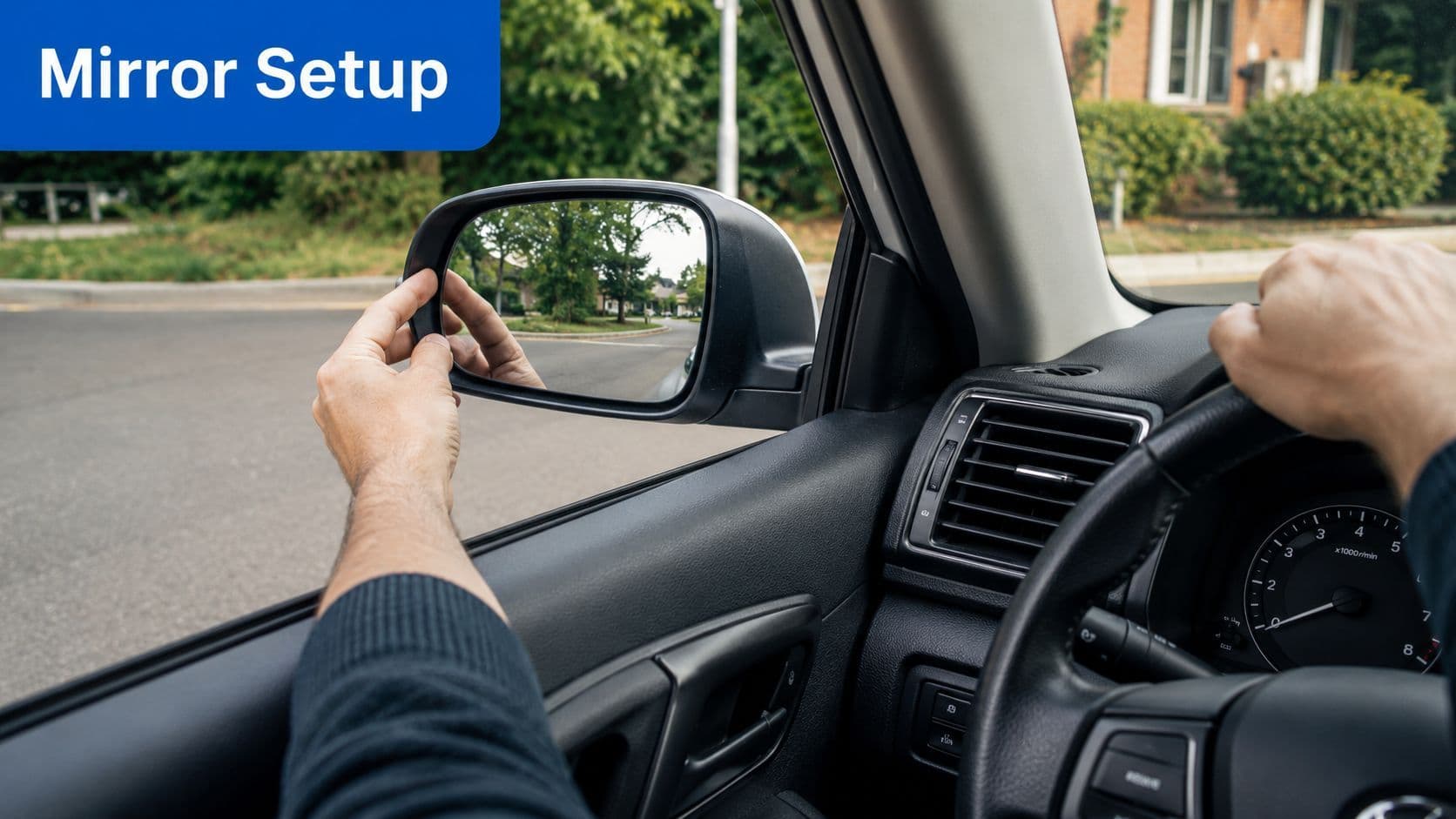
Next, adjust the outside mirrors using the lean-and-glance method:
- Left mirror: Lean your head toward the driver's window. Adjust the mirror until you can just see the rear of your car.
- Right mirror: Lean toward the centre of the vehicle. Set the mirror until you can just see the rear of the car.
- Return to your normal position: The vehicle should occupy only a narrow edge of the side mirror, not most of it.
This setting gives the side mirrors a wider view of the adjacent lanes and creates a useful transition from the interior mirror into the outside mirror. You're not trying to make the blind spot vanish. You're making it smaller and easier to monitor before the shoulder check confirms the space.
Test the transition before driving
Use a parked vehicle positioned diagonally behind you, where it can be seen from different mirror angles. As the vehicle's position changes, it should move from the rear-view mirror toward the side mirror and then become visible through a head turn. It shouldn't disappear because you moved your eyes from one mirror to the next.
Two setup errors appear often. Drivers angle the mirrors downward so they can watch the kerb, or push them outward because a wider-looking view feels safer. Both settings can leave the rear quarter poorly covered. If you can see a large portion of your own car, move the mirror outward slightly. If you've lost the rear edge completely, bring it back until you can just see it.
How to Do a Proper Shoulder Check
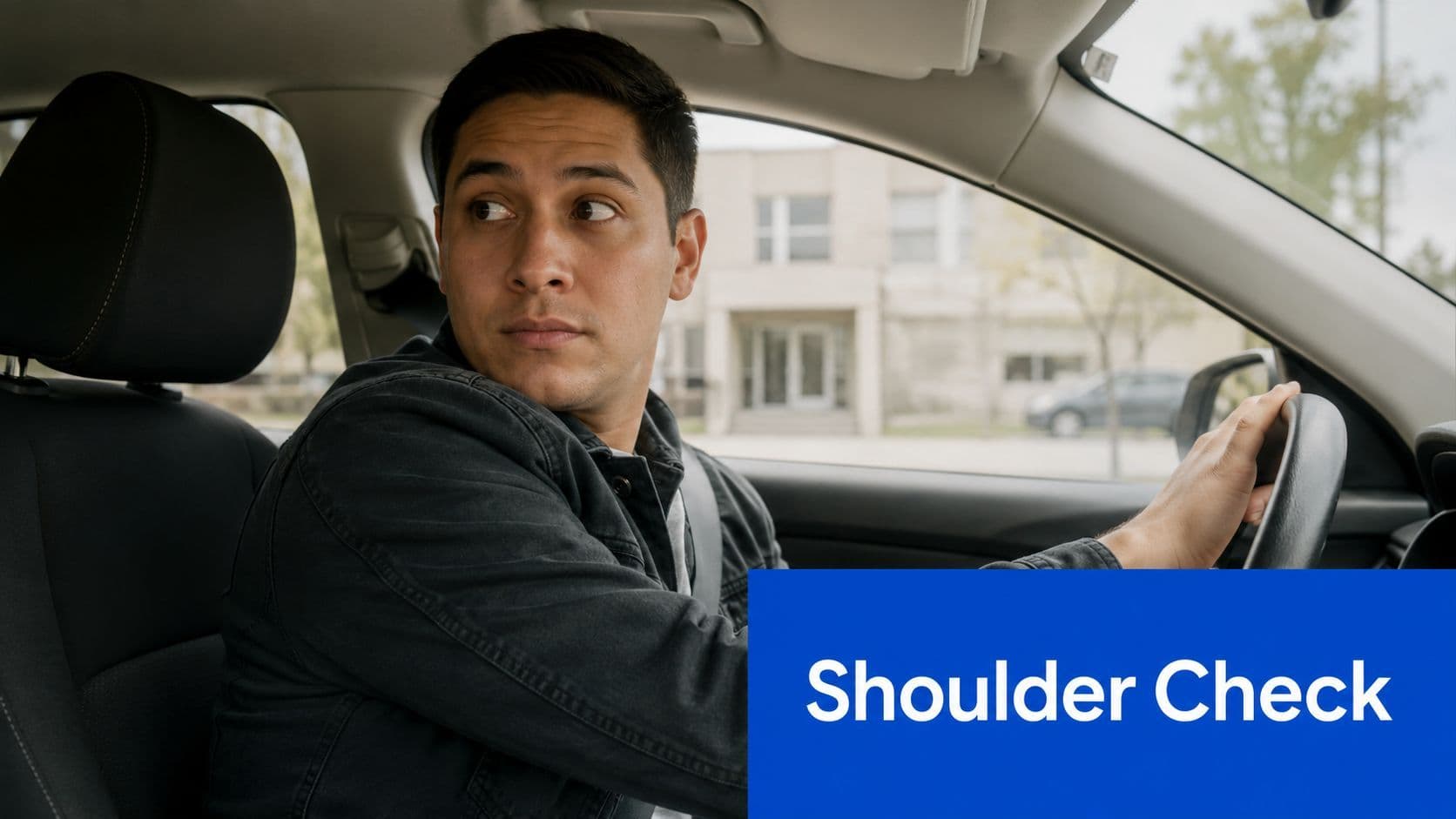
A shoulder check isn't a glance at the side window. It's a deliberate head movement toward the space your vehicle is about to enter. Practise it while parked first, with the steering wheel straight and your eyes returning forward after every check.
Rehearse the motion in four parts
First, signal your intention. The signal tells nearby road users what you may do, but it doesn't make the move safe by itself. A vehicle or cyclist can still be occupying the target space.
Second, check the relevant mirrors. For a left move, check the interior mirror and then the left side mirror. For a right move, check the interior mirror and then the right side mirror. Look for the lane's traffic, not just an empty patch of road.
Third, turn your head toward the direction of travel. Turn left for a left move and right for a right move. Keep the movement controlled, and look over the shoulder far enough to register a vehicle's shape, colour, and movement in the blind zone. You don't need to twist your entire torso. Excessive torso rotation can pull your hands off their intended steering position and still leave your eyes aimed too far forward.
Fourth, return your eyes to the road ahead before steering. The shoulder check confirms the gap. Your forward view controls the vehicle as you move into it. The check should happen just before lateral movement, not during a long period of preparation.
Practical rule: Check early enough to plan, then check again immediately before the vehicle moves.
Timing separates a useful check from a performance that only looks correct. If you check too early, another car or bicycle can enter the space before you steer. If you turn your head after beginning the steering input, you're asking the vehicle to change direction before you've confirmed the lane.
Shorter drivers may need to adjust the seat and mirrors again if the head turn reveals a pillar or head restraint instead of the lane. Taller drivers should avoid leaning so far that the check changes their control position. In a right-hand-drive vehicle, the principle stays the same, but the driver must identify the side of travel and the relevant shoulder from the seating position.
For a concise sequence that combines the actions, use this mirror, shoulder-check, and signal guide.
Building a Continuous Mirror Scanning Rhythm
Blind-spot awareness should run in the background, not switch on only when you decide to change lanes. Ontario's handbook tells drivers to check mirrors about every five seconds or so, while another section gives a range of every five to 10 seconds. That guidance establishes a continuous habit rather than a single event. Ontario's driving-along guidance also advises drivers to change speed to keep other vehicles out of their blind spots and not to travel in another driver's blind spot.
A practical loop looks like this:
- Rear-view mirror: See what is approaching from behind.
- Left mirror: Check the left-side lane and rear quarter.
- Road ahead: Re-centre your attention on steering and hazards.
- Right mirror: Check the right-side lane and rear quarter.
- Road ahead and instruments: Confirm your path, speed, and vehicle information.
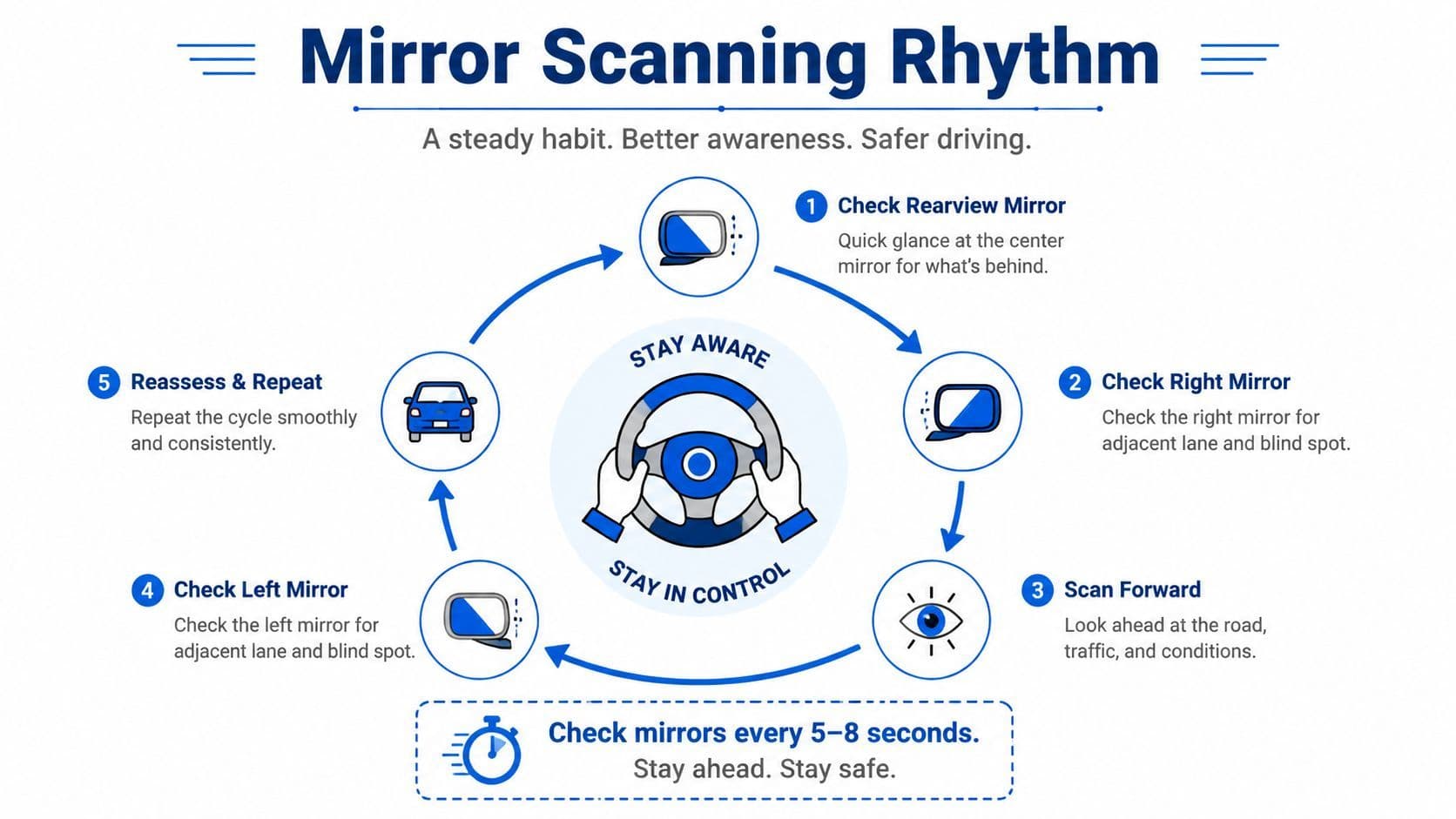
The exact order can adapt to the road, but the important feature is repetition. On a quiet road, the loop keeps a vehicle from appearing beside you without warning. In dense traffic, you may need to scan more frequently because speed and position change quickly. A shoulder check then becomes confirmation of a space you've been monitoring, rather than a desperate search made at the last second.
Keep your speed steady while checking. A sudden lift from the accelerator or unnecessary steering correction can create a new problem while you're looking away from the forward view. Scanning also helps you manage following distance and road position, because you know whether traffic is closing behind or occupying the lane beside you.
Blind Spot Checks for Lane Changes, Merges, and Curbside Pullouts
The head movement looks similar in each situation, but the timing is different. A lane change on a steady road gives you time to identify a gap. A highway merge compresses the decision because traffic is moving faster. Pulling away from a kerb adds cyclists, doors, parked vehicles, and a narrow side space to the problem.
Maneuver When to Check Mirror Order Head-Turn Urgency Lane change After choosing a gap and immediately before lateral movement Rear-view, destination-side mirror Quick confirmation just before steering Highway merge While building a plan for the gap, then again before joining the lane Rear-view, destination-side mirror, forward view High, because traffic can close the space quickly Curbside pullout Before releasing the vehicle from the kerb and again before steering away Interior mirror, door-side mirror High on the kerb side, especially where cyclists may approach
For a normal lane change, use the sequence mirror, signal, shoulder check, gap confirmation, smooth steering. The signal communicates your intention, but you still need to judge whether the other driver is maintaining speed, accelerating, or already occupying the blind zone.
A merge requires earlier planning, not an earlier final check. Watch the traffic pattern while you approach, select the gap you intend to join, and keep your speed predictable. Then perform the final shoulder check immediately before moving across. Searching at the last possible instant leaves little room to respond if the gap closes.
Pulling away from a parallel-parked position deserves its own discipline. Check the side beside the kerb before opening your path, because a cyclist or pedestrian can approach close to the vehicle. Keep the vehicle stationary while confirming the space, then make the steering input only after the side area remains clear. The same principle applies when leaving a curbside stop in city traffic.
Common Blind Spot Mistakes and How to Fix Them
Most blind-spot errors aren't caused by a lack of intelligence or courage. They're habits that feel efficient until the road presents a vehicle in the one place the driver didn't look.
Trusting mirrors alone
Properly adjusted mirrors reduce the blind area, but they can't display every part of the rear quarter. Ontario's official guidance combines mirror adjustment with a shoulder check because people and cyclists may remain hidden outside the mirror view.
Correction: Treat the mirrors as the first scan, never the final confirmation. If the destination lane isn't clear in the mirror, don't begin the move. If it looks clear, turn your head immediately before steering.
Checking too early
A driver may signal, check the mirror, wait while judging traffic, and then move without looking again. The mirror picture is stale by the time the vehicle crosses the line.
Correction: Separate planning from confirmation. Use the earlier scan to understand the traffic, then complete the shoulder check at the moment the vehicle is ready to move.
Rotating the torso instead of the head
Twisting your body can feel dramatic, but it may not direct your eyes into the blind zone. It can also disturb your hands and steering control.
Correction: Keep both hands near a stable steering position, turn your head toward the lane you're entering, and return your eyes forward before steering. The movement should be brief and purposeful.
Sitting beside another vehicle
Holding position beside a car, van, or truck leaves you in the other driver's blind spot while also making your own escape route smaller. Ontario advises drivers not to drive in another vehicle's blind spot and to change speed to avoid staying there.
Correction: Create separation. Either move ahead so you're visible in the other driver's mirrors, or fall back until you're clear of the vehicle's side area. Don't linger beside a larger vehicle while waiting for a lane change opportunity.
A corrected repetition builds the skill. A lucky miss doesn't.
Practise one correction at a time. Notice whether the problem is mirror position, timing, head movement, or lane positioning, then repeat the manoeuvre under calm conditions.
Your One-Week Blind Spot Practice Plan
A short, organised practice schedule can turn the routine into a habit without forcing a learner straight into stressful traffic. Use a qualified supervising driver where required, and choose locations that match your current ability. The practice driving guide can support the broader preparation around these exercises.
Day 1, reset the mirrors. Sit in your normal position and use the lean-and-glance method for both outside mirrors. Record what each mirror shows so you can recognise when a family member or driving partner changes the settings.
Days 2 and 3, practise while parked. Keep the vehicle stationary and rehearse signal, mirror, head turn, forward re-orientation. Practise left and right checks without twisting the torso or moving the steering wheel.
Day 4, work in an empty lot. Rehearse a curbside pullout and a controlled change of road position where there's generous space. Focus on checking the relevant side immediately before the vehicle moves.
Day 5, build the scan. During ordinary driving, use a steady mirror rhythm based on Ontario's guidance to check mirrors about every five seconds or so. Keep the checks brief and return your attention to the road ahead.
Day 6, practise a supervised lane change. Choose a quiet arterial road with clear markings. Plan the gap early, signal, check the mirrors, perform the final shoulder check, and steer smoothly only when the lane is clear.
Day 7, apply the routine to a highway merge. Have the supervising driver watch your mirror rhythm, speed control, gap choice, and final shoulder check. Don't rush the head turn, but don't make it so late that the vehicle begins moving before you've confirmed the space.
Write down one observation each day. You might notice that the right mirror is mis-set, that you check too early, or that a parked vehicle hides a cyclist's approach. That small record turns a vague concern into a specific correction.
For Ontario learners preparing both their road habits and knowledge, G1ready.ca offers registration-free G1 practice exams, targeted quizzes, mixed tests, a diagnostic test, a marathon option, and an exam simulator with immediate explanations and progress tracking. Visit G1ready.ca to practise the rules that support safer mirror, signal, and shoulder-check decisions before test day.


