Ontario's G1 learning licence test has 40 questions split into two sections of 20, and you need at least 16 correct in each section (80%) to pass. Your result appears on screen straight after the test.
You might be practising on your phone while a parent asks whether you're ready to go to DriveTest. Recognising familiar answers feels reassuring, but readiness means something more specific: you can explain why a trip is permitted, and identify the condition that would make it unlawful.
Ontario G1 Test at a Glance Before You Study
The G1 knowledge test is the first knowledge check in Ontario's graduated licensing system. It checks road signs and rules of the road, including restrictions that apply specifically to learner drivers.
Applicants aged 16 or older take the computer-based test at a DriveTest centre. Before making travel arrangements, confirm the centre's current knowledge-test service, identification requirements and fees directly with DriveTest. Don't assume that appointment arrangements for road tests also apply to knowledge tests.
Ontario G1 knowledge test at a glance
Item Ontario G1 knowledge test Total questions 40 questions Road signs section 20 questions, at least 16 correct to pass Rules of the road section 20 questions, at least 16 correct to pass Pass mark 80% in each section; failing either section fails the test Result timing Shown on screen immediately after finishing Minimum age 16 Location and format Computer-based, at a DriveTest centre Fee Check the current G1 application package and any applicable retest fee directly with DriveTest before attending
Understand what a passing score means
Each section must stand on its own. Strong sign recognition doesn't compensate for weak knowledge of road rules, so keep separate practice records for both areas.
Within the rules section, divide mistakes again by topic. A learner who struggles with right of way needs different revision from someone who confuses the learner's responsibilities with the accompanying driver's responsibilities.
Practice target: Reach at least 80% on practice sets, then consider booking only after that standard holds across two timed runs, with neither section below its pass threshold.
Treat that target as a minimum checkpoint, not permission to ignore recurring mistakes. If you keep guessing correctly about supervision, you still need to study supervision.
Who Qualifies and Who Can Supervise a G1 Driver
Start with the applicant, not the person offering driving lessons. You must meet Ontario's learner eligibility requirements, including residence and minimum age, and bring identification accepted by DriveTest.
Check the accepted-document list before attending. Don't assume that a school card, a photograph of a document or identification accepted by another organisation will satisfy the licensing requirements. The G1 test requirements guide can help you organise the questions to resolve before your visit.
Check the accompanying driver separately
A parent, sibling or friend isn't automatically an eligible supervisor. Check that the person:
- Holds the appropriate full licence. Being allowed to drive independently isn't the same as meeting every accompanying-driver requirement.
- Has sufficient driving experience. Check qualifying experience rather than judging by age or confidence.
- Sits beside the learner. Someone offering directions from the back seat isn't fulfilling the same role.
Newcomers have a document task as well as a study task
Ontario's regulatory backgrounder describes strengthened requirements in 2026 for applicants from countries without a licence-exchange agreement: credit for up to 12 months of verified foreign driving experience, completion of the vision and knowledge tests and both road tests, and at least 12 months between the G2 and G tests.
Experience credit isn't a substitute for knowing Ontario rules. An experienced driver may handle a vehicle confidently while still misunderstanding local signs, learner restrictions or intersection rules.
Ask what evidence DriveTest will accept before arranging documents. Check whether a driving record or licence-history document establishes the experience you want credited, and confirm translation requirements for anything not in English or French. If documents are unavailable, ask how that affects your licensing path rather than assuming your experience will automatically count.
Keep test preparation and licensing-path verification on separate checklists. Also track your novice-licence expiry: passing the knowledge test doesn't remove the need to complete the graduated process or address requalification before you lose driving privileges.
Why the G1 Test Checks Conditions, Not Just Good Driving
Say you've been practising with an older sibling. They drive confidently, know your neighbourhood and give useful advice, so you assume their presence makes any practice trip acceptable.
Then a question changes the time of the trip or puts the accompanying driver in a different seat. Your answer stays the same, even though the legal conditions have changed.
The Official MTO Driver's Handbook describes the G1 as a conditional privilege requiring an accompanying driver with at least four years of driving experience; the learner must also maintain zero blood-alcohol concentration and cannot drive between midnight and 5 a.m.
Think of a door with several locks
Every lock must open before you can go through. For study purposes, use these rule families in this order:
- Supervision lock. The accompanying driver must meet the eligibility requirements and occupy the correct seat.
- Sobriety lock. The learner and accompanying driver have separate alcohol requirements.
- Time lock. The trip must fall within the permitted driving period.
- Passenger lock. Front-seat occupancy and rear-seat belt capacity must comply.
- Vehicle and roadway lock. The vehicle and route must be permitted for the learner's licence.
An adult's presence alone doesn't establish that every condition has been met.

This is why the learning licence test is best approached as a rules-classification and constraint-recall assessment, not just a general driving quiz. Broad advice about being careful won't answer a question about a precise licence restriction.
A G1 trip is permitted only when every applicable condition is satisfied at the same time.
Turn mistakes into a useful diagnosis
After a wrong answer, label the rule family before attempting another question. Record what you believed, the condition you missed and the change that would make the scenario compliant.
For example, repeated mistakes about late-night practice belong under time restrictions. They don't mean you're weak at every aspect of driving knowledge, and another large batch of sign questions won't fix them.
Parents and instructors can help by changing one fact in a scenario. Keep the driver and vehicle unchanged, then alter the seating arrangement and ask the learner to explain whether the answer changes.
Topics on the Test and the Traps in Each
The questions come from road signs and rules of the road. The rules block includes both general driving decisions and G1-specific restrictions, so a learner needs more than sign recognition to prepare.
Use the topic table to identify what you're really practising. A quiz score is more useful when you can connect missed answers to a particular decision.
Test topics and the trap in each
Topic What the questions check Common trap Road signs (20 questions) Regulatory, warning and information signs Mixing up shape and colour with the sign's message Right of way Intersections, pedestrians and turning traffic Assuming the vehicle on the right always goes first Speed and school zones Posted limits and reduced-speed areas Using a remembered general limit instead of the applicable posted limit Lanes and passing Lane changes, passing rules and merging Treating permission to pass as independent of markings, visibility and other restrictions Lights and signals Headlight use, turn signals and emergency vehicles Forgetting lighting requirements in poor visibility G1 restrictions Roadway class, time window and supervision Believing supervision alone makes a trip legal
Why the route can invalidate an otherwise suitable trip
Ontario's new-driver guidance identifies restrictions on 400-series highways and high-speed expressways, including Highway 401, the Queen Elizabeth Way and the Gardiner Expressway.
For an ordinary practice trip with a parent or friend, an eligible accompanying driver doesn't by itself authorise a restricted route. Roadway eligibility is a separate question. When studying this topic, also read the official guidance on the exception involving an Ontario-licensed driving instructor rather than treating every form of supervision as interchangeable.
Consider a learner planning a trip to a shopping centre. The passenger arrangement and accompanying driver may be suitable, but the navigation app suggests an expressway. The learner must evaluate the route, not merely accept the fastest option.
Separate recognition from interpretation
Study a sign's shape and colour before reading its message. Then practise explaining what action the sign requires, warns about or helps you plan.
For right-of-way questions, describe the movement of each road user before choosing an answer. A memorised slogan can fail when the question changes the control device, introduces a pedestrian or asks about turning traffic.
Say it aloud: Identify the permitted action and the condition that permits it.
That explanation should work even when the answer choices disappear. If you can only remember where the correct option appeared on a previous quiz, you haven't learned a transferable rule.
Pitfalls That Cost Learners the Pass
Say a teenage learner practises with a friend who has only recently become fully licensed. After a family dinner, the learner has had wine and assumes the friend can supervise because the friend drank less.
On a practice question, the learner remembers that the accompanying driver has an alcohol threshold and applies it to themselves. They've confused different people's obligations, while also failing to check whether the friend qualifies to supervise.
Keep the learner and supervisor rules separate
Under Ontario Regulation 340/94, the G1 driver must maintain zero blood-alcohol concentration, while the accompanying driver must be below 50 milligrams per 100 millilitres of blood.
Don't translate those rules into a personal estimate of how many drinks might be acceptable. For the learner, the rule isn't a reduced drinking allowance.
The regulation also requires working seat belts for occupants, limits rear passengers to available operable belt assemblies and reserves the other front seat for the accompanying driver. Count usable restraints and check seating positions, not just how many people can physically fit.
Replace unproductive practice habits
- Doing full tests without reviewing mistakes. Stop after the set and explain each missed rule before starting again.
- Memorising answer wording. Rewrite the scenario with a different passenger, route or time and solve it again.
- Skipping the restricted-roadway material. Practise route decisions as well as individual road names.
- Cramming the night before. Spread revision across focused sessions and leave room to revisit difficult topics.
- Retaking without reviewing the error pattern. Diagnose the weak family before arranging another attempt.
There's also a quieter pitfall: guessing correctly and counting that answer as mastered. Mark uncertain answers during practice, then review them alongside the wrong ones.
An instructor or parent can ask the learner to explain why the other choices fail. This exposes confusion that a correct selection alone can hide.
Build a Study Plan and Book When Scores Hold
Use a clear booking rule: achieve at least 80% on two timed simulator runs, with each section meeting its own pass threshold, and complete mixed practice without a repeated error type. This is a study recommendation, not a guarantee of an official pass.
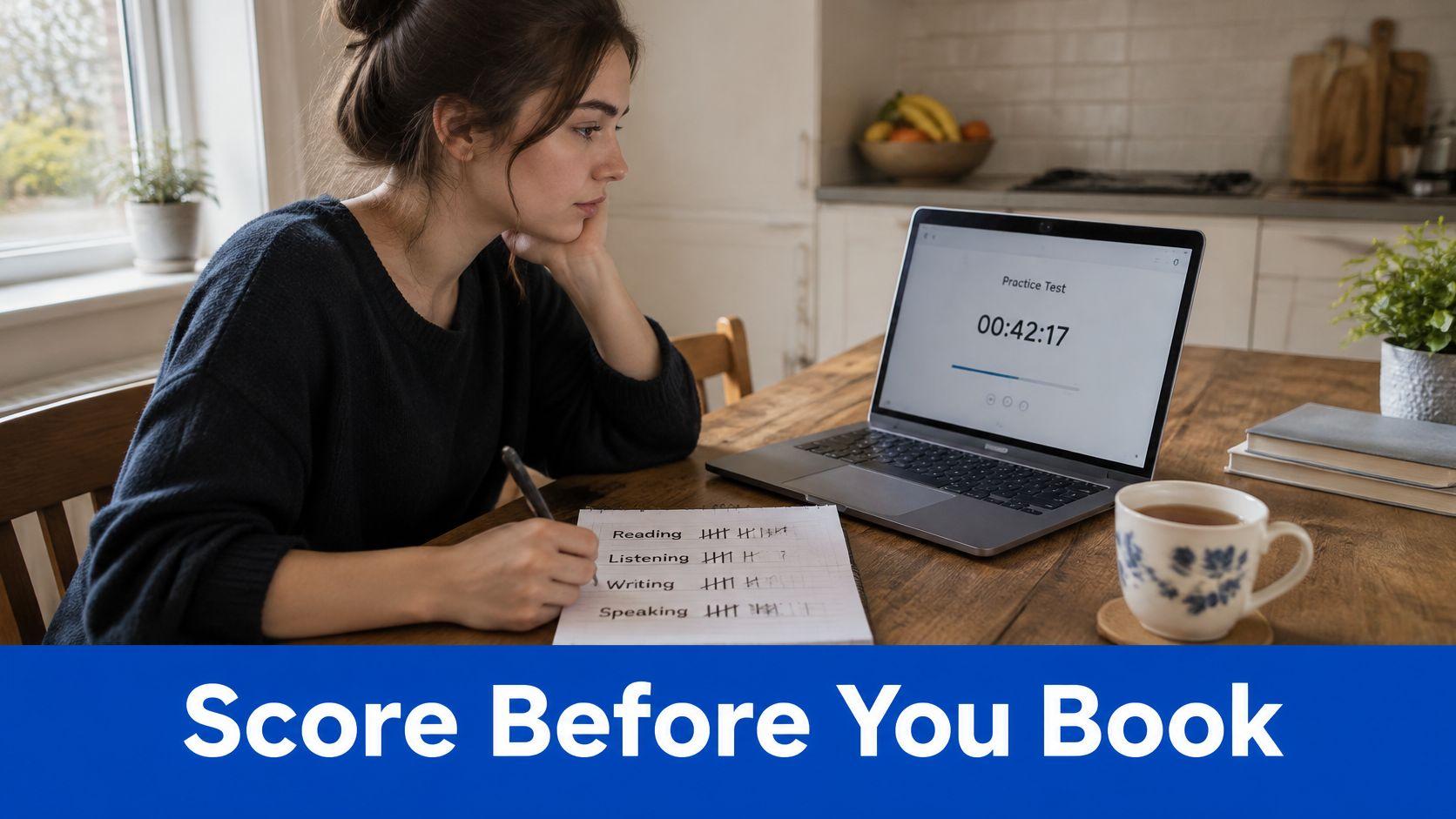
Set up your practice space so you can read carefully without interruptions.
Give each practice tool a distinct job
Alongside the official handbook and instructor-led review, G1ready.ca offers diagnostic practice, targeted quizzes, broad mixed tests, marathon practice and an exam simulator. Use the tools in a sequence rather than choosing whichever test looks familiar.
Two-week G1 study plan with G1ready.ca tools
Days Focus G1ready.ca tool Target before moving on Days 1–2 Baseline across all rule families Diagnostic test A score by rule family, not just an overall percentage Days 3–5 Road signs and right of way Targeted topic quizzes 16 or more out of 20 on each practice block Days 6–8 Supervision, sobriety, time and passengers Targeted quizzes with hints and explanations Each wrong answer explained by the rule it broke Days 9–10 Mixed scenarios across all rules Comprehensive mixed test At least 80% with no repeated error type Days 11–12 Timed full-length runs G1 exam simulator Two runs at 80% or higher, with each section meeting its threshold
The diagnostic establishes where to spend your effort. Targeted quizzes then let you isolate a difficult family and use hints and explanations to correct the misunderstanding.
Mixed practice checks whether you can apply those rules when the questions stop announcing their topic. The simulator serves a different purpose: practising sustained attention and composure without pausing to look up each answer.
Review explanations before using unlimited retakes
Immediate feedback helps only when you read it and change your reasoning. Progress tracking by weak area can show whether a particular misunderstanding keeps returning, while activity history helps you choose what to revisit.
Use marathon practice to clear remaining gaps after targeted work, not to avoid it. Unlimited retakes are useful for checking improvement, but repeating remembered answers can make your score look stronger than your understanding.
Practice can fit around school or work on a phone, tablet or desktop. For the final timed runs, choose a quiet setting and avoid switching between messages and questions.
Use the accompanying video as a separate review activity, then return to active practice.
Keep the longer licensing deadline visible
The MTO handbook on keeping your licence sets a five-year completion window for novice drivers in the G1, G2 and M2 classes, excluding M1, and describes requalification by passing a test and paying the five-year licensing fee.
If the licence expires without completion or requalification, you no longer have a licence to drive and must reapply for a Level One licence. That administrative deadline is separate from the conditions governing individual practice trips.
Use the study-plan guide to organise sessions around your weak areas. After a failed attempt, rerun the diagnostic before making another booking decision.
Choose a tentative date two weeks out and start your diagnostic today. Keep that date flexible, and arrange the official test only when your practice results and explanations support it.
How to Book and Sit the Test at a DriveTest Centre
Treat the centre visit as an administrative task followed by a reading-and-reasoning task. Preparing your documents and checking the service arrangements beforehand lets you focus on the questions when you arrive.
Use this process overview as a reminder, but confirm whether your chosen centre requires or offers an appointment for the knowledge test.
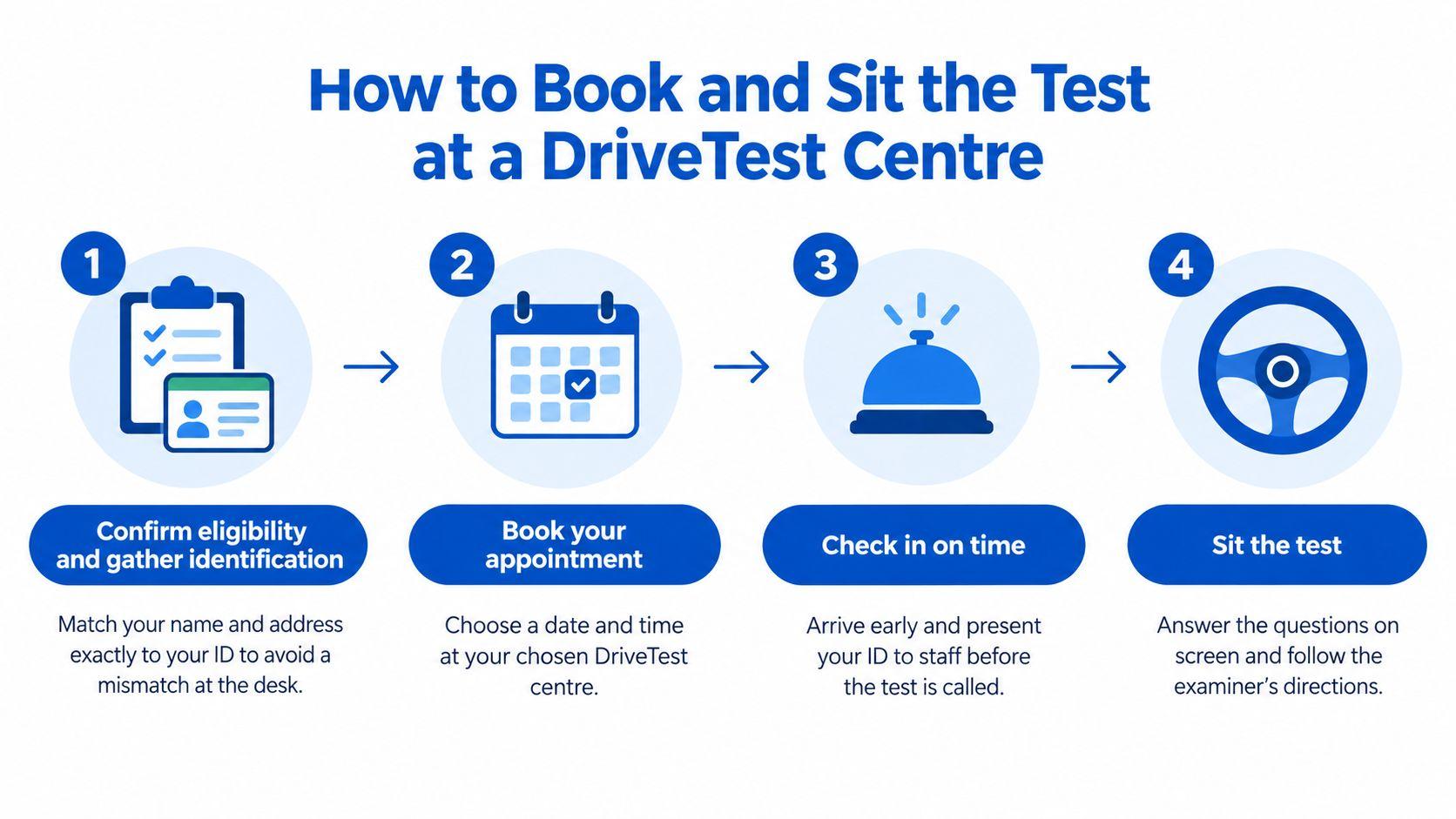
Prepare for the desk and the screen
- Confirm eligibility and gather identification. Check the accepted documents and how your personal details must be established. A common slip is bringing a document that seems official but isn't accepted for the application.
- Check the current fee and attendance method. Confirm knowledge-test arrangements directly with DriveTest, including payment and any appointment process. Don't rely on an old article or confuse knowledge-test attendance with road-test booking.
- Choose a time when you're alert. Allow enough time to read carefully and complete the centre's application steps. Avoid squeezing the visit between school, work and another commitment.
- Arrive with a buffer and required documents. Account for travel, queues and check-in. Arriving at the last possible moment adds pressure before you've answered anything.
- Read each question fully. Notice words such as “only”, “must” and “except”, then identify whose obligation the question tests. Familiar wording isn't a reason to skip the final clause.
- Read the displayed result carefully. Check the section outcomes rather than relying on how confident you felt. Ask staff to clarify anything you don't understand about the result or next steps.
- Choose the next action deliberately. If you pass, follow the licensing directions given at the centre. If you don't, return to diagnostic practice and resolve the recurring error family before arranging another attempt.
The G1 test booking guide can help you organise the visit. Keep a short checklist for documents, payment, centre arrangements and travel, then put it aside when the test begins.
On test day: Answer the scenario on the screen, not the similar question you remember from practice.
G1ready.ca offers diagnostic tests, topic quizzes and timed practice to help you identify the conditions you're still confusing. Visit G1ready.ca to start with a diagnostic, review your weak rule families and build towards a test-day decision you can explain.