You're driving through a quiet suburban intersection, scanning for traffic as usual, when amber lights start flashing overhead and a pedestrian steps toward a marked crossing you don't recognize. It's not a traffic light. It's not a stop sign. You have a second or two to decide whether you must stop, slow down, or keep going, and guessing isn't good enough.
That's why new driving signs matter in Ontario. Municipalities keep adding pedestrian crossovers, roundabouts, photo enforcement zones, and dedicated bike lanes, and each one brings signs that expect an immediate, correct response. The Official MTO Driver's Handbook explains that applicants must be at least 16 years old, pass a vision test, and pass a knowledge test covering road rules and traffic signs, and that the full licensing process takes at least 20 months. Sign recognition isn't a small part of that process. It's tested before you drive on your own, and it stays with you through the G1 and G2 stages.
This guide teaches each sign recognition first. You'll learn what you'll see, what the law requires, and a quick practice angle to help the sign stick. Read for the action, not just the name, and you'll start spotting these signs early enough to respond calmly.
1. Pedestrian Crossover (PXO) Sign
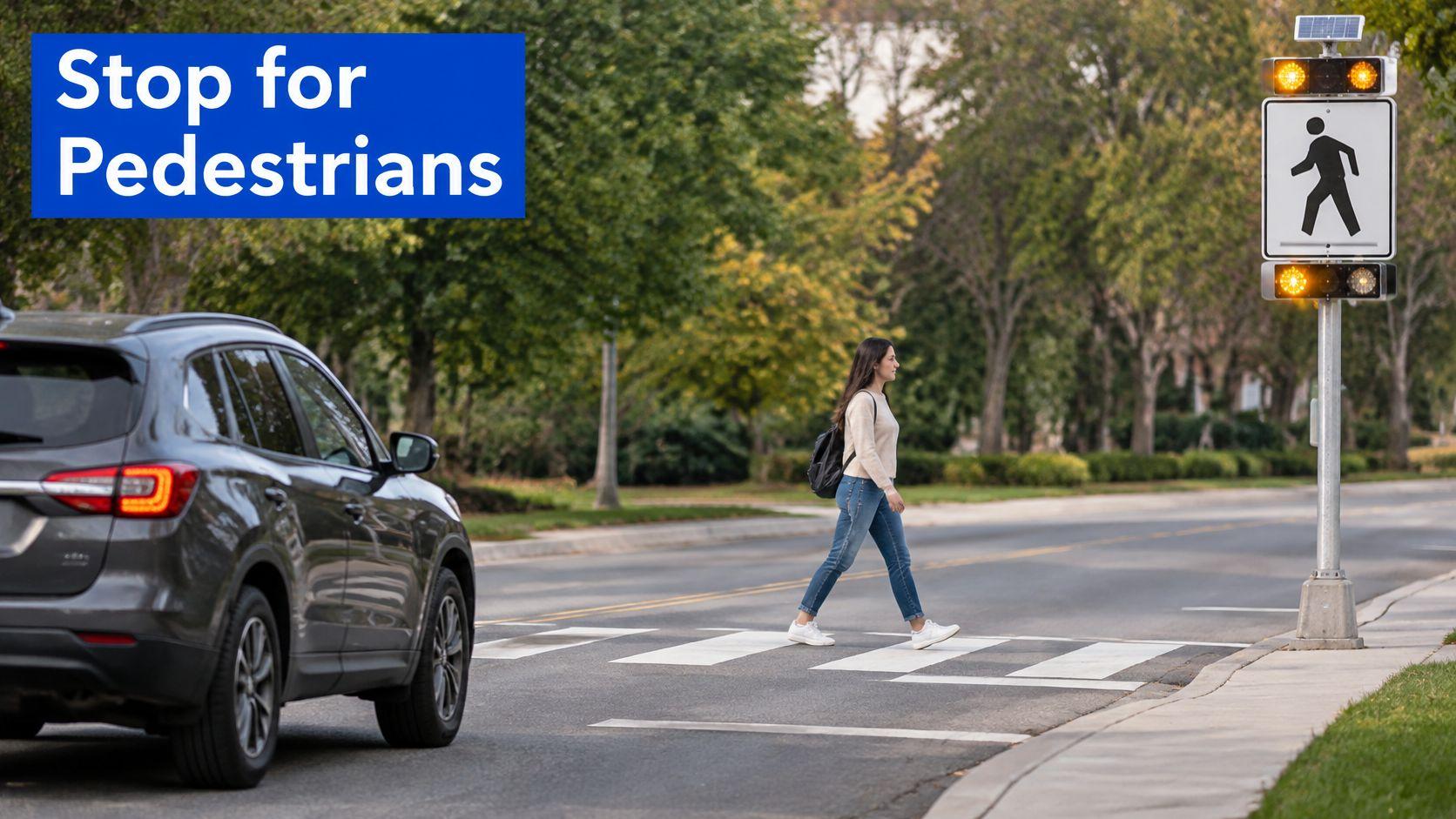
Look for a marked crosswalk that's paired with a pedestrian crossover sign and strong pavement markings. Many PXOs also have overhead amber flashing beacons that start flashing when a pedestrian is about to cross. You'll see them mid-block near schools and parks, and on busy residential and arterial streets in places like Toronto and Ottawa.
The flashing lights aren't a suggestion to be careful. They mean a pedestrian is claiming priority at this crossing and you must stop. Stop before the crosswalk line, not on top of it, and stay stopped until the pedestrian has fully cleared your half of the road. If you creep forward too soon, you can block the pedestrian's path or hide them from drivers beside you.
What to watch for before the lights flash
Watch the curb, not just the beacons. A person standing at the edge, facing the road, may be about to activate the crossing or step out. Slow early so you can stop smoothly.
- Stop line first: Brake before the marked crosswalk so pedestrians have a clear path.
- Full clear rule: Wait until the pedestrian has finished crossing your half before you move.
- Second pedestrian check: Scan both curbs again before accelerating, since another person may follow.
Pedestrian signals work on a similar timing idea, and the MTO handbook page on pedestrian signals notes that a white walking-person symbol means pedestrians may walk, while a flashing or steady orange hand means they must not begin crossing. For test practice, review the details in our guide to pedestrian crossing rules in Ontario, then ask yourself one question for every PXO image. Has the pedestrian cleared my half yet? If the answer isn't yes, you're still stopped.
2. Roundabout Signs
A roundabout announces itself before you reach the circle. First you'll often see a warning sign with circular arrows showing traffic moving around a central island. At the entry itself, a yield sign tells you who goes first, and it isn't you if traffic is already circulating.
Ontario builds more roundabouts in growing suburban areas, and you'll also meet multi-lane versions on major regional roads. Traffic inside moves counterclockwise around the island. Drivers already in the roundabout have the right of way, so entering drivers yield, especially to vehicles approaching from the left.
Watch how the entry, yield, and exit work together in motion before you try to memorize the sequence from a still image.
A simple entry routine
Slow down on approach and pick your exit early. Look left for a safe gap, yield if a vehicle is coming around, then enter without stopping inside the circle unless traffic forces it. Signal your exit so drivers waiting to enter know you're leaving, and don't change lanes inside the roundabout unless signs direct you to.
Say you're entering a two-lane roundabout and a car on your left hasn't signalled off yet. You wait. That pause feels slow, but it's exactly what the yield sign requires, and it's safer than squeezing in and hoping the other driver exits.
Recognition shortcut: Circular arrows mean prepare to yield and go around, not stop and wait for a green light.
For G1 questions, the trap is usually right of way. Study the entry signs in our roundabout road signs guide and practise answering who yields. If you're outside the circle looking in, you're the one who waits.
3. Community Safety Zone Signs
This sign doesn't warn you about a curve or a hill. It tells you that you've entered an area a municipality has designated for extra protection, such as a school area, a playground, or a seniors' residence. The wording is plain, but learners sometimes treat it as general information and keep their speed. That's the mistake.
A community safety zone means road safety is a particular concern here and fines for certain offences, including speeding, are higher than usual. The sign itself is your cue to check your speed right away. Don't wait for another speed limit sign to confirm that you should slow down.
Where you'll meet these zones
You'll see them on residential streets near schools across Ontario, and around seniors' residences and community centres. Expect children darting toward a crossing, older pedestrians who need more time, cyclists, parked cars pulling out, and buses stopping. Arrival and dismissal times make school areas especially busy.
Speed signs and zone signs work together. The MTO handbook section on driving along states that when no limit is posted, the default maximum is 50 km/h in cities, towns, and villages and 80 km/h elsewhere, and that drivers must still choose a speed that lets them stop safely. A posted number is a maximum, not a target you must hit.
Try this practice angle. You enter a community safety zone on a clear, dry street and the posted limit looks easy to maintain. Now add rain, parked cars, and children near the curb. Your legal duty hasn't changed, but your safe speed has. Slowing before the hazard appears is the behaviour this sign is built to trigger.
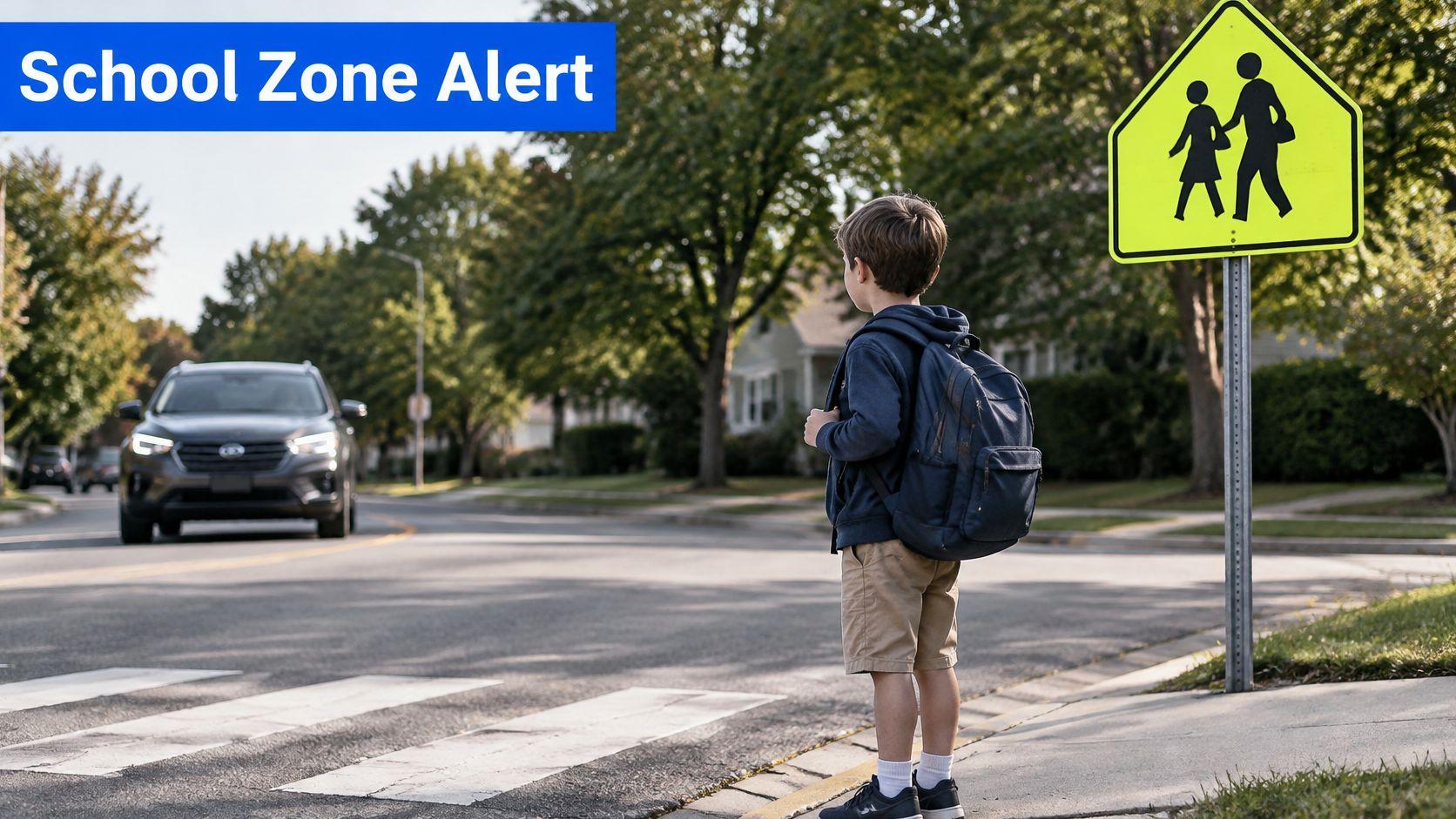
4. Fluorescent Yellow-Green School and Pedestrian Warning Signs
Colour is the first clue here. Fluorescent yellow-green is bright in daylight and at dusk, and Ontario uses it for warnings tied to schools, school crossings, and pedestrian activity. When that colour catches your eye, your brain should supply the next word before you even read the symbol. Children.
These are warning signs, not regulatory signs. They don't set a speed by themselves. They tell you to anticipate kids near elementary schools, families heading to parks, and pedestrians around community centres. Reduce speed during school hours, scan sidewalks and driveways, and be ready to stop for a school crossing guard holding a sign.
Reading a newer school zone sign in order
Some school speed signs now combine several pieces of information at once. Ontario's 2025 sign regulation allows a sign that shows the speed limit with a km/h legend, a bilingual SCHOOL ZONE / ZONE SCOLAIRE tab in designated French-language-service areas, and flashing amber signals during the effective hours set by by-law.
Read it in a fixed order so you don't miss a piece at speed.
- Number first: What's the posted speed limit?
- Designation second: Does the tab confirm this is a school zone?
- Lights third: Are the amber signals flashing, showing the warning period is active?
The flashing beacon reinforces timing. It doesn't replace the numeric limit. Adjust your speed before you enter the controlled area, not with a hard brake beside the sign. On a practice question, separate those jobs. The number tells you how fast, the tab tells you why, and the lights tell you the period is active.
5. Photo Enforced Speed Zone Signs
A photo enforced sign can make learners ask the wrong question. They wonder where the camera is, or whether a ticket will really arrive. Focus on the simpler message first. This is an area where speed matters enough that automated enforcement and extra warning signs are being used to get drivers to comply.
Ontario's framework changed, and the details matter for what you should and shouldn't assume. The province's page on reducing speeding in real time explains that, effective November 14, 2025, municipalities can no longer issue Provincial Offences Act tickets or administrative penalty orders from municipal speed-camera captures, while municipalities with existing school-area cameras must install larger warning signs. Ontario also committed $210 million to a Road Safety Initiatives Fund for traffic calming and enhanced signage.
What hasn't changed for you as a driver
The posted speed limit still applies. A larger warning sign doesn't mean you can speed until some enforcement point begins. It means you're entering a higher attention area, often near a school or within a community safety zone, and you should already be at a safe speed.
Don't treat a camera warning as the start of the rule. The speed limit sign is the rule, wherever it stands.
Say you see a school zone tab, flashing amber lights, and a large camera warning sign on the same stretch. Don't try to rank them while you drive. Read the numeric limit, slow before the zone, and watch for children. That's the correct response on the road and the safest way to answer scenario questions too.
For study, keep the categories separate in your head. Regulatory signs state what you must do. Warning signs raise your attention. A camera related sign explains enforcement context, but it never cancels the limit printed on the regulatory sign.
6. Bicycle Lane and Share the Road Signs
A bicycle symbol on a sign or painted in a lane changes how you should use the space beside you. In a dedicated bike lane, that space is set aside for cyclists. On a share the road section, there's no separate lane, so you're expected to share the same road space safely instead of squeezing past.
You'll find protected bike lanes in Toronto and Ottawa, and share the road signs on rural and suburban routes where cycling is common. Both versions deliver the same early warning. Expect a cyclist near your right side, possibly where your mirror check is weakest if you're rushing a turn.
The right turn check that prevents trouble
Most close calls happen at predictable moments. You're turning right across a bike lane, pulling over to park, or opening a door after stopping. Slow down, check your mirrors, and do a shoulder check for a cyclist coming up beside you. When you pass, leave at least one metre of space where practical.
- Before a right turn: Signal, check the mirror, then check your blind spot for a cyclist in the lane.
- When passing: Change your position early instead of drifting close and correcting late.
- When parking: Look again before you cross or block a bike lane.
Say you're about to turn into a plaza and a cyclist is travelling straight through the bike lane beside you. Yielding for a few seconds is the right move, even if no car is behind the cyclist. Our Ontario bicycle rules guide can help you connect the sign to that decision. As a practice angle, describe the sign's job in one sentence. It's telling you a cyclist may be in space you were about to use.
7. Flashing Red Light and Stop Arm School Bus Signs
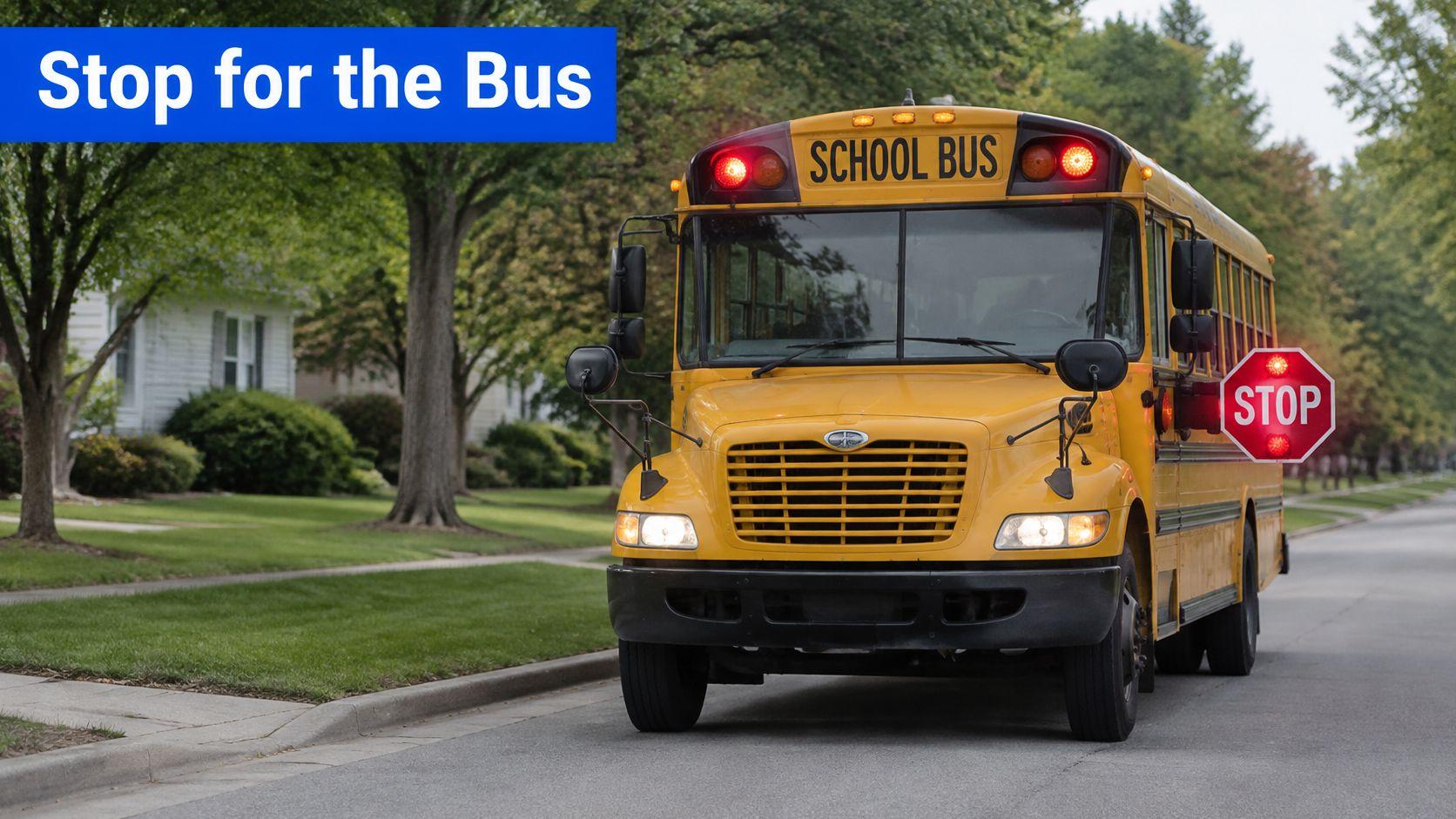
You don't need to read words on this one. A stopped school bus shows flashing red lights and extends a stop arm from its side. That combination means children are loading or unloading, and traffic must stop. This is not optional, and it doesn't matter whether you're approaching from behind the bus or coming from the front.
The one exception learners need to keep straight is the median. If you're on the opposite side of a road that's separated by a physical median, you don't have to stop. Without that physical separation, you stop and remain stopped until the lights turn off and the stop arm retracts. Painted lines alone don't create the exception.
Why the wait feels longer than you expect
Children don't always cross in a neat, predictable line. A child may hurry back for a dropped bag, cross in front of the bus where the driver is watching, or emerge from behind the bus on your side. Staying stopped until the arm is fully in protects the child you can't see yet.
Be especially alert during morning and afternoon school hours on rural and urban bus routes throughout Ontario. If you see the bus slowing and its warning lights starting, prepare to stop rather than accelerating to get past before the door opens. That impulse is exactly what the rule is designed to stop.
For a practice question, picture two roads. On the first, you're behind the bus on a two-lane street. You stop. On the second, you're travelling the other way beyond a raised physical median. You may proceed with care. The sign and lights look the same, but the road layout changes your duty.
8. Electronic Variable Message Signs (VMS)
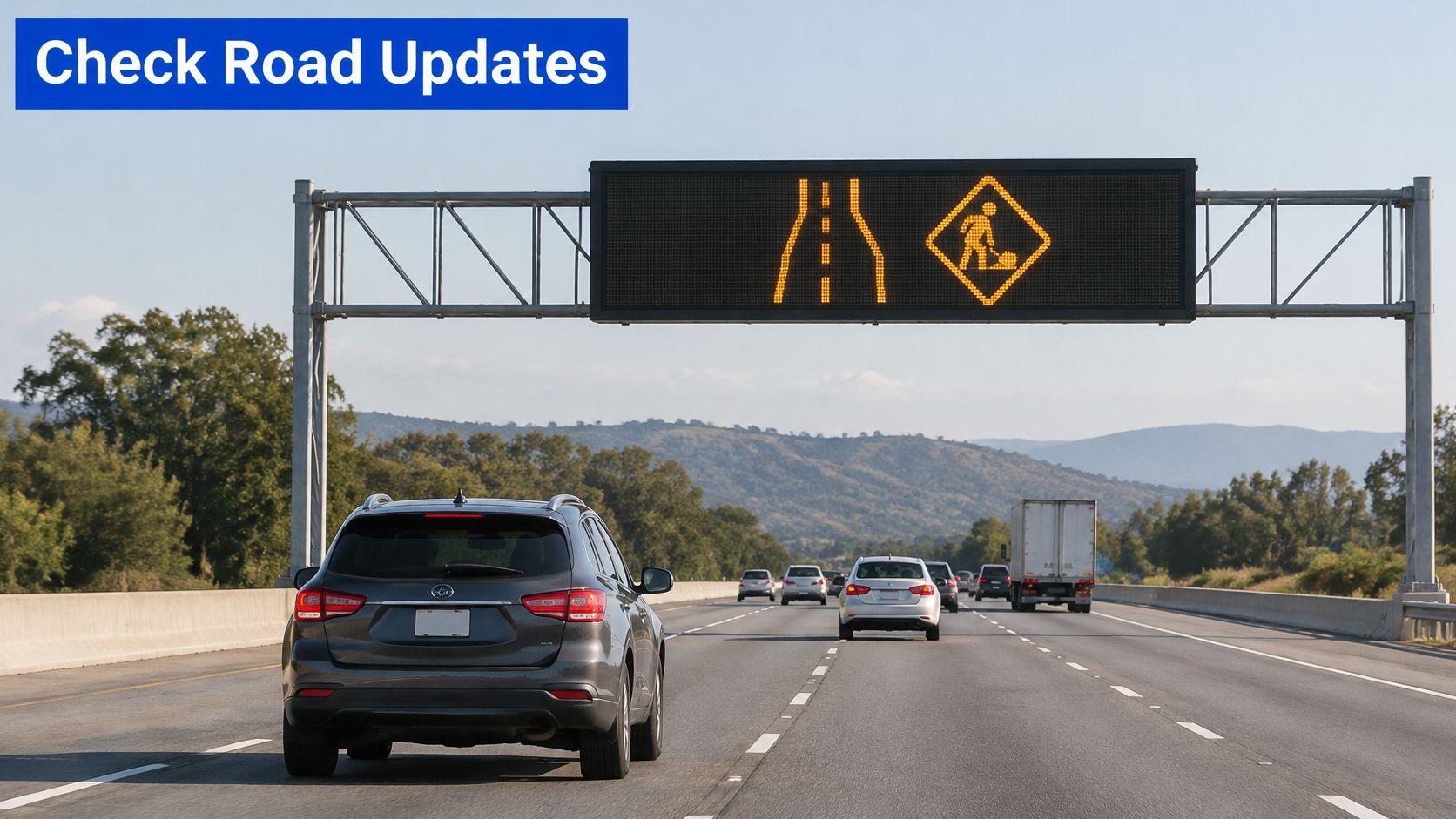
Highway signs that light up with changing text demand a different reading skill. A variable message sign isn't permanent, so you can't memorize today's message for tomorrow. It may warn of a lane closure, a collision ahead, poor weather, or a travel time delay on Highway 401 or Highway 407, and it expects you to act before you reach the problem.
Ontario's newer electronic highway signs are designed to be understood quickly, and an Ontario news release on bilingual electronic highway signs reported 21 such signs in southern Ontario and seven in northeastern Ontario, using bilingual text, full colour, and internationally recognized images or symbols. Read the picture and colour first, then the words. That habit helps when messages appear in English and French or when traffic is moving fast.
Read early, move once
Glance at the sign as soon as it's legible, decide what it means for your lane and speed, then make one smooth adjustment. Don't brake sharply or stop to finish reading. If a lane is closing, check your mirrors, signal, and merge while there's still space around you.
On a highway, your goal is simple: Understand the message early enough that your lane change looks boring.
Say the sign warns of a closed right lane two kilometres ahead in your own planning, but traffic beside you is still light. Moving left now is calm and legal. Waiting until the pylons appear turns the same move into a squeeze. For test questions, choose the answer that has you reading early and adjusting gradually, not the one that slows suddenly in live traffic.
8 Ontario Driving Signs at a Glance
Read this table the way you would read a sign on the road: picture what you see first, then name the action it requires. The middle column holds the decision. When a practice question describes one of these scenes, translate the description back into the sign, and the core rule usually points you to the right answer.
Sign Sign Type Core Rule for Drivers Commonly Seen Near Pedestrian Crossover (PXO) Sign Pedestrian crossing Stop and remain stopped until the pedestrian clears your half of the road. Mid-block crossings near schools, parks, and busy streets Roundabout Signs Warning and guide Yield to traffic already in the roundabout; follow lane guidance and signal when exiting. Roundabouts, including suburban intersections and regional roads Community Safety Zone Signs Regulatory area notice Drive carefully and observe posted limits; certain offence fines are higher in the zone. Schools, seniors' residences, and community centres Fluorescent Yellow-Green School and Pedestrian Warning Signs Warning Slow down and watch for children and pedestrians; be ready to stop. School crossings, school zones, parks, and community centres Photo Enforced Speed Zone Signs Enforcement notice Obey the posted speed limit; the larger warning sign marks an area where speed enforcement is in place and where you should already be at a safe speed. School zones, community safety zones, and construction zones Bicycle Lane and Share the Road Signs Bicycle and road-sharing Watch for cyclists, check blind spots, and leave adequate space when passing. Urban bike lanes and rural or suburban cycling routes Flashing Red Light and Stop Arm School Bus Signs School bus warning and stop Stop for a bus with flashing red lights and an extended stop arm, unless a physical median divides the road. School bus routes on rural and urban roads Electronic Variable Message Signs (VMS) Electronic information Read the message early and adjust driving to current road conditions. Highways and major roads before closures, hazards, or decision points
From Recognizing Signs to Passing the G1 Test
Do a quick recognition check without looking back at the headings. Amber beacons over a marked crossing mean stop for the PXO. Circular arrows mean yield and enter the roundabout when there's a gap. Fluorescent yellow-green means watch for children and pedestrians, a bus stop arm means stop unless a physical median separates you, and an electronic highway message means read early and adjust once. If you can name the action within a second of picturing each sign, you're building the right habit.
Then sort the eight examples by job. The MTO handbook guide to signs groups signs into regulatory signs, warning signs, temporary-condition signs, and information-and-direction signs, and notes that a green circle shows an activity is permitted or required while a red circle with a diagonal line shows it's prohibited. That framework helps with unfamiliar signs too. Shape and colour give you the category, the symbol gives you the subject, and any number or tab gives you the detail.
That order matters because new drivers don't get quiet roads for their first decisions. The Ontario road safety publication reports that in 2022, more than 30,000 Ontario collisions involved distracted or inattentive drivers, causing nearly 11,000 injuries and 100 deaths, and it identifies drivers aged 16 to 25 as more likely to drive distracted than any other age group. You can't control other drivers' attention. You can make your own sign reading fast enough that it doesn't steal your focus from traffic, pedestrians, and lane markings.
Turn that into a study routine this week. Re-scan this list once and say each required action out loud. Quiz yourself on the tricky pairs next, especially school zone signs with flashing lights versus community safety zone signs, and PXO beacons versus ordinary pedestrian signals. Then move to full practice under test conditions so you can spot whether your errors are coming from signs, rules, or simple rushing.
G1ready.ca keeps a dedicated Road Signs Test alongside its Road Rules Test, with separate scoring that matches the G1 exam format. Its practice content is built around the 2026 Ontario MTO Driver's Handbook, so you can drill exactly the new and commonly misunderstood signs covered here, free and without registration. Work through the signs test until the colour, shape, and action come together automatically, then take a mixed test to prove you can recognize them when they appear between rules questions. That's how a sign you studied at your kitchen table becomes a calm, correct decision at a suburban crossing.
Visit G1ready.ca to practise these eight signs with free, registration-free questions that include immediate feedback and clear explanations. Use the Road Signs Test to lock in recognition, then try a full practice exam to check your signs and rules scores separately before test day.