
You've finally decided to stop guessing and get your Ontario G1 in order, but the first question is still the same, where do you begin if English isn't the language you think in first? If you're searching for the ontario driving test in hindi, the good news is that Ontario's system already makes room for Hindi-speaking learners, and the process is more structured than it looks at first glance. Once you understand the language options, document rules, and test-day flow, the whole thing becomes much easier to handle calmly.
Starting Your G1 Journey in Hindi
A lot of newcomers arrive in Ontario with the same quiet worry. They know they need a licence, they've heard about the G1, and they are unsure whether the process will feel foreign, slow, or hard to follow in English. The good news is that Ontario's testing system is set up for high volume and language access, and Hindi is part of that system rather than an afterthought. That matters because the first hurdle is often not the rules themselves, but figuring out how the appointment, the test format, and the language option fit together. DriveTest knowledge test languages
What the G1 actually is
The G1 is the first stage in Ontario's graduated licensing system. After that come the G2 and then the G licence, so the G1 is the doorway, not the destination. If you understand the first stage clearly, the later steps feel less intimidating.
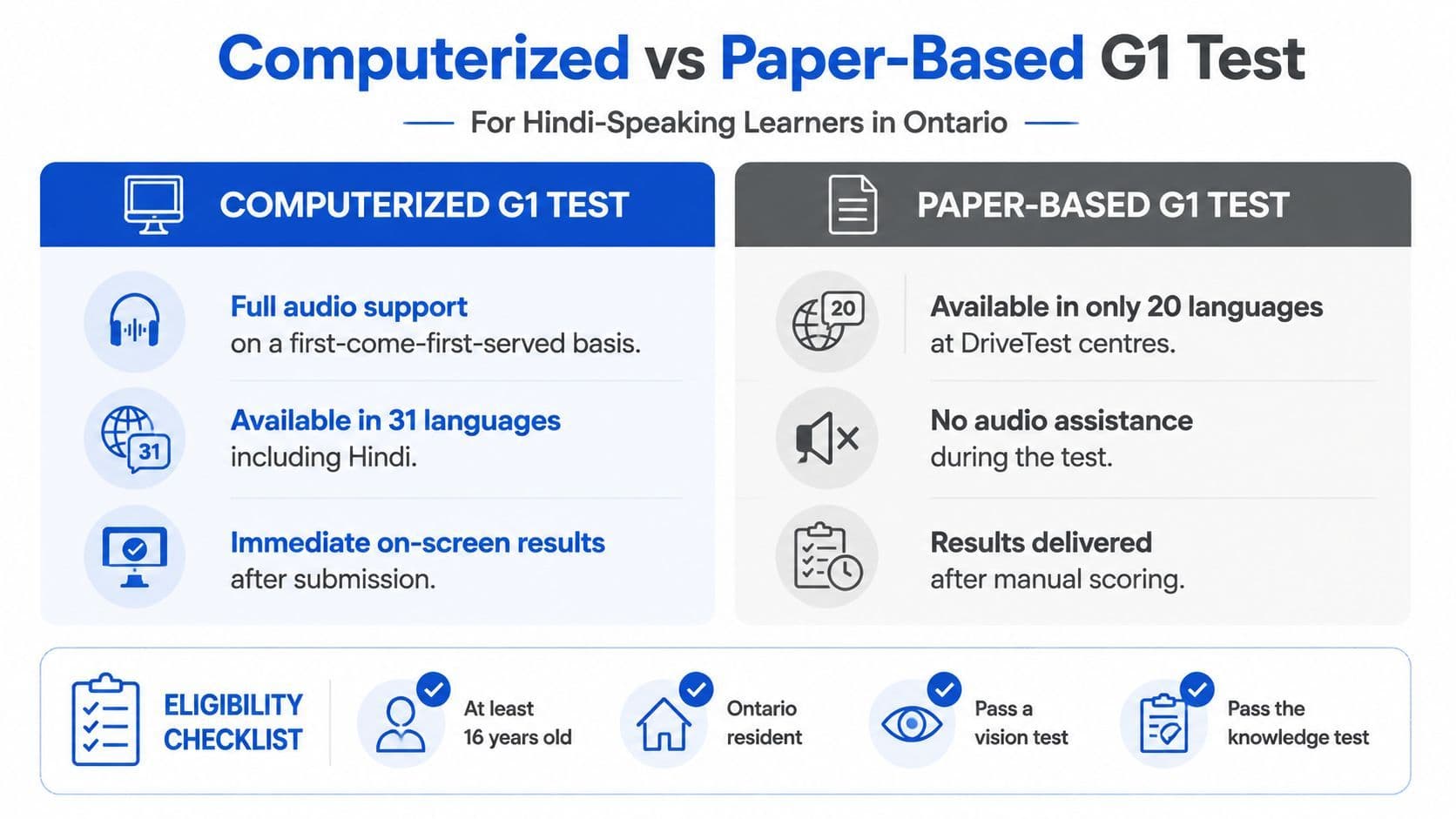
DriveTest centres are the official places where the knowledge test happens, and Ontario's rules require applicants to be at least 16 years old, be an Ontario resident, pass a vision test, and pass a knowledge test on road rules and traffic signs before receiving a G1 licence. Ontario's G driver licence rules
That is why I tell Hindi-speaking learners to separate the licence process into parts. The language option helps with reading the questions, but the licence itself still depends on Ontario's identity checks, residency rules, and vision screening.
Why Hindi support matters
Hindi support makes the entry point clearer for learners who think faster in Hindi than in English. That matters because the knowledge exam is not just about memorising answers, it is about understanding road signs, right-of-way, and Ontario-specific rules in a way that holds up under test pressure. DriveTest's official language list includes Hindi for the computerized class G1 knowledge test, so a Hindi-speaking candidate can work from a language format that feels familiar while still meeting the same provincial standard. DriveTest knowledge test languages
The format also matters. A computerized test feels different from a paper handout, because the questions appear on a screen and you work through them in order. For some learners, that is easier, since they can focus on one question at a time. For others, it helps to practice on a screen first so the test setting does not feel new on arrival.
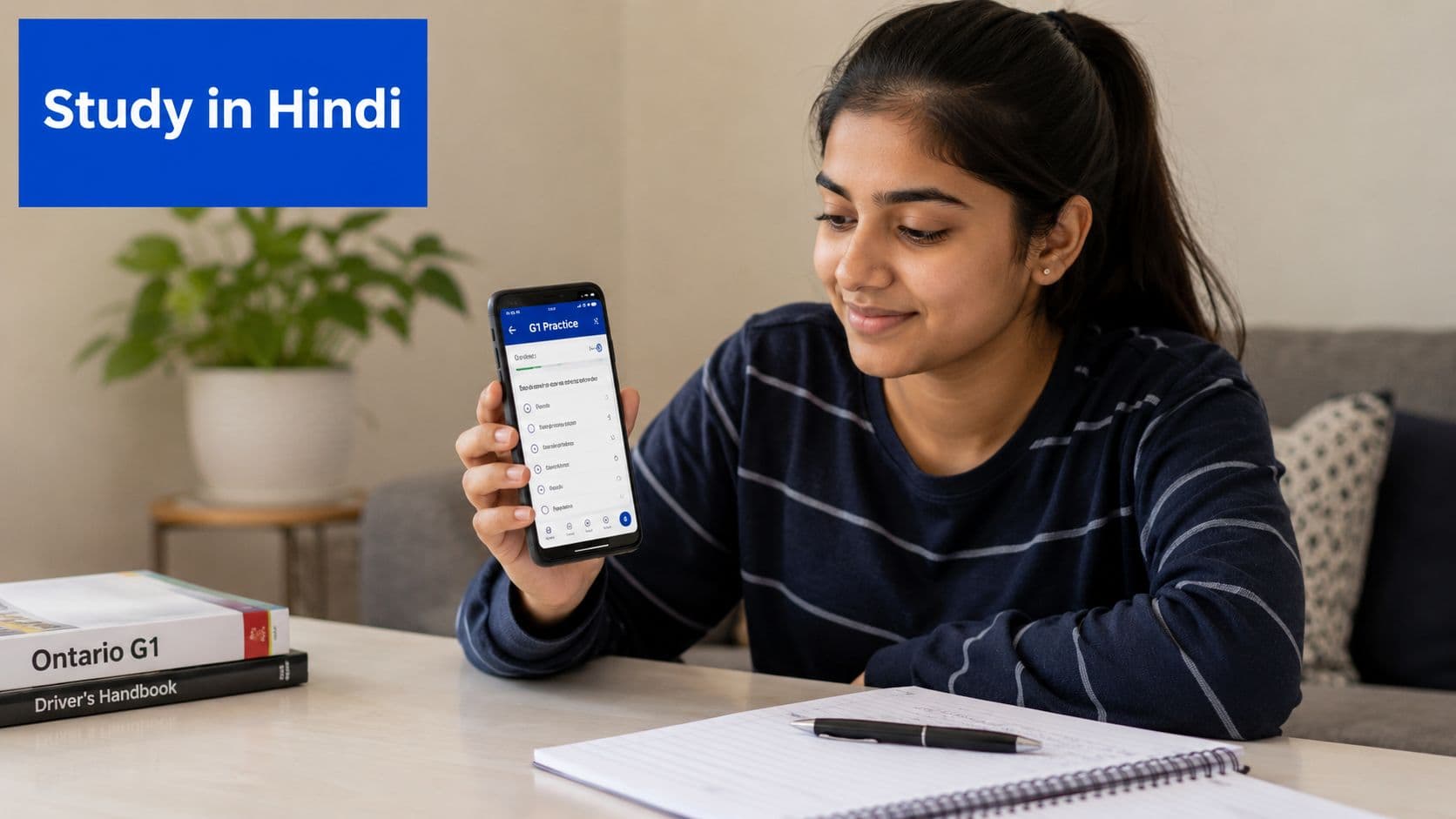
If you are using Hindi to study, the smart move is to treat it as a bridge, not a shortcut. Read the English road-sign terms alongside the Hindi explanation, repeat the ones that show up often, and make sure you can recognize the meaning even if the wording changes slightly. That approach helps because Ontario's test checks understanding, not just memory.
How to use Hindi support well
The goal is simple. By the end of this guide, you should know what the G1 is, what the system expects from you, and how to use Hindi support without getting tripped up by the logistics.
Start with the test centre, not the question bank. Confirm that the language option you want is available for the knowledge test, bring the right identity documents, and be ready for the vision check as part of the same visit. When newcomers miss a step, it is usually because they prepared for the questions but not for the process around the questions.
Eligibility and Documents You Need Before Booking
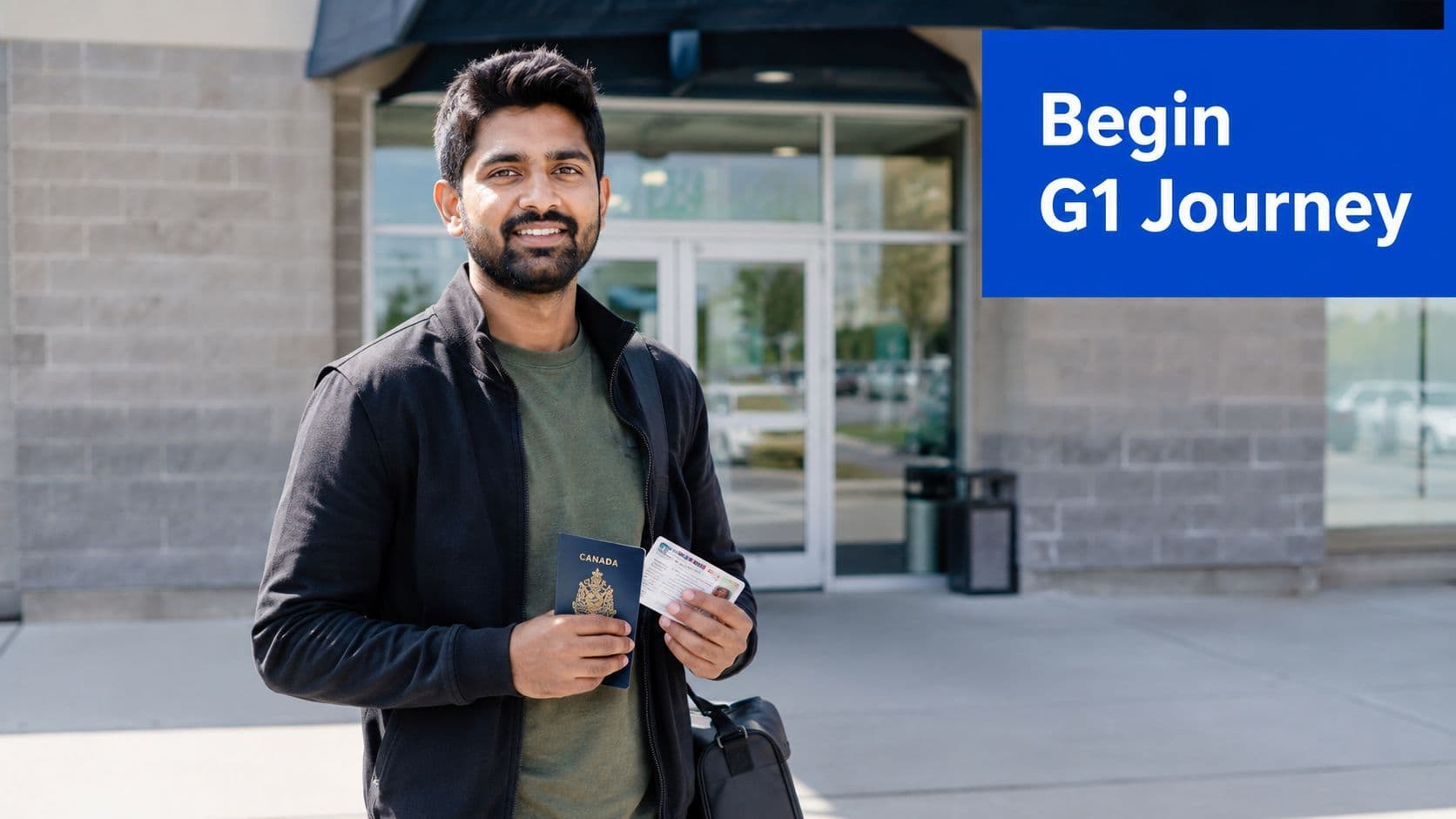
Ontario keeps the entry rules straightforward, but newcomers often mix them up with rules from other provinces or from their home country. The safest approach is to think in this order, age, residency, identity, vision, then knowledge test. Ontario says applicants must be at least 16 years old, be an Ontario resident, pass a vision test, and pass the knowledge test before getting a G1 licence. Ontario's G driver licence rules
Start with the basics
Before you make a booking, check whether you can already meet the core requirements. If you're a newcomer, the residency part matters just as much as the age requirement. If you wear glasses or contact lenses, bring them, because the vision test happens at the same visit as the knowledge test.
The other thing people overlook is document readiness. You need original identification, not photocopies, and the documents should be current. If you show up with the wrong format, you don't just lose time, you may lose the chance to complete everything in one visit.
Common document mistakes to avoid
A first visit to DriveTest is not the place to experiment with “close enough” paperwork. Bring the original versions of what you need, keep them easy to reach, and make sure names match across your documents as closely as possible. That matters especially for newcomers whose immigration documents, passports, and local address proofs may all look different at first glance.
Most-forgotten mistake: people bring photocopies because they think the counter only needs to see the information. It doesn't. Bring the originals.
You'll also want to plan for the on-site flow. The vision screening comes before the knowledge test, so don't bury your glasses at the bottom of a bag or leave your ID in a coat pocket in the car. When the staff ask for identification, you want to hand it over quickly and confidently.
A simple pre-visit check
Use this mental checklist before you leave home.
- Age and residency: confirm you're eligible for Ontario's G1 process.
- Original ID: bring the original documents, not copies.
- Vision support: pack glasses or contacts if you use them.
- Name matching: check that your main documents don't create avoidable confusion at the counter.
If you've handled those pieces, you're ready for the language and booking step without scrambling later.
Booking Your G1 Test With Hindi Language Support
Many Hindi-speaking learners get stuck here, not because the G1 questions are unusually hard, but because the booking details are easy to overlook. DriveTest offers the computerized knowledge test in up to 31 languages with full audio support on a first-come-first-served basis, and paper-based G1 tests are available in 20 languages at DriveTest centres. Hindi is included in the official language support for the G1, so the key question is which format fits your visit and your study habits best. DriveTest language support
Understanding the G1
The G1 is the knowledge test that starts the Ontario licensing process. For many newcomers, the challenge is not the driving rules themselves, but getting the test in a format that matches how they read and listen under pressure.
Computerized or paper-based
The computerized option is the one many learners hear about first. It gives you built-in language support and audio assistance, which can make the experience easier if reading English quickly is not your strength. Paper-based tests are still available, but the language selection is narrower, and they do not provide the same audio help.
That difference matters because someone searching for ontario driving test in hindi is usually trying to solve a practical access problem, not only find sample questions. If you study better with on-screen audio support, the computerized route is usually the better fit. If paper feels more familiar, you can still check availability at the centre, but the language list there is more limited.
How to approach booking
Treat the booking process like a logistics task, not a guess. Create your DriveTest account, choose your location, and look for the language and format that match how you prepare. If Hindi support is available for the session you want, book that setup instead of assuming you can change it on the day.
For learners who want to compare language options in one place, this G1 language guide is a useful reference while you prepare your booking.
Built-in language support and translator rules are not the same thing. DriveTest's own language system covers many candidates, but if you plan to bring a person to translate, confirm that arrangement directly before test day.
Translators and language support
Many Hindi-focused pages talk about practice questions, but they do not always explain when a translator is needed. That missing detail is where people get confused. The safer approach is to use DriveTest's official language options first, then confirm any special arrangement separately if your situation is unusual.
Once your booking is set, save the confirmation, note the location, and check the session format again. A clear booking reduces a lot of stress later, especially if you are balancing work, family, and the pressure of getting your first licence in Canada.
What Happens on Test Day
The test centre feels less intimidating once you know the sequence. You arrive, check in, show your documents, complete the vision screen if it hasn't already been done, and then move into the knowledge test stage. For a newcomer, the quiet panic usually comes from not knowing what happens first, so clarity helps more than last-minute cramming.
The visit from start to finish
At the front desk, staff verify who you are and whether your paperwork matches the booking. After that, the centre handles the vision screening and then the knowledge test process. On a computerized test, you'll sit at a workstation, and on a paper test, you'll be given the printed version to complete at the centre.
A lot of candidates worry about whether they'll be rushed through the room. That's usually not the problem. The bigger issue is arriving without your documents ready, or not understanding how the centre expects you to proceed once your name is called.
Staying calm in the room
If English isn't your first language, use the fact that the test is available in Hindi to your advantage. Read each question carefully, don't rush through sign wording, and use the review time sensibly if you're unsure about an item. You're not being judged for speed alone, you're being assessed on accuracy.
Walk in with your ID ready, your glasses if you use them, and a clear mind. The centre is there to process the test, not to surprise you.
For a more detailed test-day breakdown, this G1 test-day guide is a useful companion before your appointment.
Small practical habits that help
A neat outfit, a charged phone left in the car or turned off, and an early arrival can make the day feel more manageable. You don't need special clothes, just enough organisation to avoid unnecessary friction. If you've ever walked into a new office or government building and felt flustered, you already know why that matters.
Understanding the Test Structure and Pass Mark
A first-time G1 test can feel confusing if you expect one overall score. Ontario's knowledge test is split into 40 questions with 20 questions on road signs and 20 on rules of the road, and you need 16/20 in each section to pass. That means one strong area cannot cover for a weak one.
Why sectional scoring changes how you study
The marking works section by section, so the test is checking two separate skill sets at the same time. A learner may recognise signs quickly and still fall short if right-of-way, lane use, or intersection rules are not clear enough.
A classroom example helps here. If a student can name every sign but hesitates at four-way stops, the weaker part still decides the result. The test works the same way. Balance matters, so your practice should show you which half needs more attention instead of letting your stronger half hide the gaps.
For Hindi-speaking learners, this is also where good study materials matter. The official ideas are easier to retain when you review them in a familiar language and then check the Ontario wording beside them. A useful starting point is G1 license study material in Hindi and English, especially if you want to connect Hindi explanations to the format you will see on the computer screen.
What to remember when practising
Treat each practice session as a check on one section, not just a way to finish a quiz. If you miss a question, note whether the mistake came from signs or from road rules, because that tells you where your next review should go.
Key takeaway: a good result in one section does not balance out a weak result in the other. Signs and rules are separate hurdles, so prepare for both with equal care.
Keeping your review split into signs and rules makes the pattern easier to see. Once your mistakes are grouped that way, the test feels less random and more manageable.
Building a Hindi-Friendly Study Routine With G1ready.ca
A good Hindi-friendly routine starts with the official handbook in English, then adds practice that matches how you learn. Many Hindi-speaking learners retain the ideas faster when they see them again in a familiar language and then check the Ontario wording beside it. A practical way to do that is to use this G1 licence study guide alongside G1ready.ca, because it offers free, registration-free practice exams that mirror the official style and difficulty, along with targeted quizzes, a diagnostic test, mixed tests, and a full simulator.
A simple two-week rhythm
Begin with the handbook topics that matter most, road signs and rules of the road. After that, take a diagnostic test so you can see where marks are slipping instead of guessing. Then build short practice sessions around the weaker section, and only later move into mixed tests and a full-length run.
The goal is not to memorise answers in one language and hope they transfer. The goal is to read the official ideas, practise them in a comfortable format, and then recognise the same concepts under test pressure. That helps learners who can explain a rule in Hindi but still need to spot the Ontario wording quickly on the screen.
How to use practice feedback well
Immediate feedback is the part many drivers underuse. If you miss a question, stop and read the explanation before moving on. That habit works better than doing fifty questions in a row and forgetting why the same rule kept tripping you up.
Use this sequence:
- Diagnostic first: find weak areas early.
- Topic quizzes next: drill signs or rules separately.
- Mixed practice after that: make your brain switch between topics.
- Full simulator last: build endurance and confidence.
The platform also keeps progress tracking and detailed performance statistics, which helps you see whether your mistakes are shrinking or just shifting from one topic to another. If you like studying on your phone, tablet, or desktop, that flexibility makes it easier to practise in short windows during the day. You can also use the G1 licence study guide as a companion while you turn handbook reading into active recall.
Ontario's testing system is busy enough that structured study pays off, as noted earlier. That earlier overview also showed how heavily the knowledge and road-test system is used, which is one more reason to study in a way that lets you find weak spots early instead of waiting until booking day.
Keep the routine realistic
You do not need marathon sessions every day. A short, focused review with immediate correction is usually better than a long tired session where your attention drifts. If your study time is predictable, your confidence usually is too.
Your Path From First Study Session to Test Day
The process becomes manageable once you reduce it to a few clean actions. First, confirm that you're eligible. Then gather original documents, book the test in the format and language that suit you, study with a sectional strategy, and walk into DriveTest ready for the vision check and knowledge exam.
You do not need to know everything on day one. You need a clear routine, steady practice, and the patience to fix weak sections before test day.
A simple final checklist helps keep the nerves under control.
- Confirm eligibility: age, Ontario residency, vision, and knowledge-test readiness.
- Prepare documents: originals only, with glasses or contacts if needed.
- Book smart: choose Hindi support and the format that suits your comfort.
- Study by section: road signs and rules of the road should each get attention.
- Arrive prepared: be early, stay calm, and review one last practice set if it helps.
Passing the G1 is a milestone, not the end of the road. It opens the way to the next stages of driving in Ontario, and the habits you build now will help later when you move on to the G2 and G tests.
If you want a structured place to practise before booking or before test day, G1ready.ca gives you free Ontario G1 practice tests, topic quizzes, a diagnostic test, and full-length exam practice that matches the official format. Visit G1ready.ca and use it to turn handbook reading into confident, Hindi-friendly test preparation.


