
Most Ontario learners start with the wrong assumption about Ontario G1 practice test Reddit threads. They think the posts are just noisy opinions, when the better read is that they're a rough map of what trips people up, and what helps them pass the first time. The trick is not to follow every suggestion, it's to separate repeated community wisdom from one-off anecdotes, then build a study plan around the parts of the G1 test that are scored separately.
Why Reddit Is Worth Reading Before You Study for the G1
Reddit isn't random noise when you're preparing for the Ontario G1. It's messy, yes, but it's also one of the few places where hundreds of learners keep repeating the same pain points, the same shortcuts, and the same mistakes. When the same advice shows up across r/ontario, r/Ontariodrivetest, and newcomer threads, that repetition is a signal worth paying attention to.
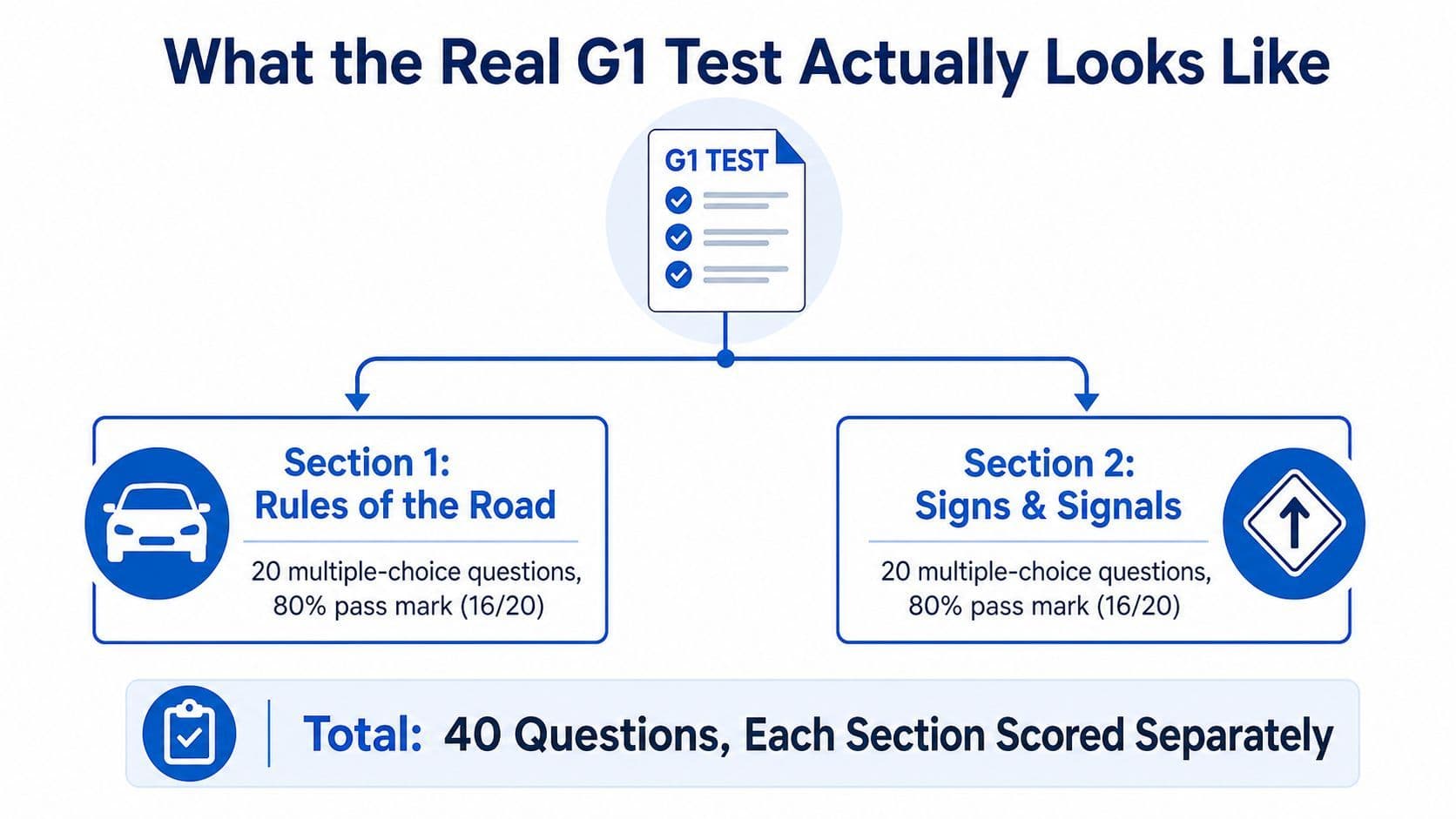
The clearest pattern is that people keep coming back to the same core truth. Ontario's G1 knowledge test is 40 multiple-choice questions split into two 20-question sections, with 16 correct in each section needed to pass and a 30-minute time limit Ontario G1 test structure discussion. That structure changes how you should study, because a strong score in one section does not rescue a weak score in the other.
What repeated advice usually means
When many Ontario learners say the same thing, they're usually describing the shape of the test rather than showing off a study hack. The advice to drill signs separately, for example, makes sense because signs and rules are scored as different sections. The advice to keep repeating quizzes until the answers feel automatic also makes sense, because the test relies on recurring patterns in sign colours, sign shapes, and handbook rules.
Practical rule: if a Reddit tip ignores the two-section structure, treat it as incomplete.
That doesn't mean every thread is accurate. It means Reddit is most useful as a filter, not an authority. If a tip keeps appearing and it matches the actual test format, that's usually worth keeping. If it sounds clever but doesn't map to the two-section pass rule, it's probably just decoration.
For first-time drivers, parents helping a teen, and newcomers to Ontario, that distinction matters. Reddit can help you see where people stumble, but the value comes from using those repeated warnings to build a study routine that respects how the exam is marked.
What the G1 Test Structure Actually Looks Like
The Ontario G1 knowledge test is built around a simple structure, and that structure changes how you should prepare. It has 40 multiple-choice questions, split evenly between traffic signs and rules of the road, with 20 questions in each section test format overview. You need at least 16 correct out of 20 in each section, not just a strong total score, and the time limit is 30 minutes Ontario G1 test structure discussion.
That scoring setup changes what a mistake means. If you miss too many signs questions, the rules section does not rescue the result. If your road rules knowledge is weak, a strong signs section does not cancel it out. The exam works like two separate mini-exams placed side by side.
The official MTO G1 knowledge test must be taken in person at a DriveTest centre, and online practice tests are only preparation tools official in-person requirement. That distinction matters. Online quizzes help you rehearse, but they are not the actual exam.
Why the format changes your study plan
Once you accept the separate section scoring, the study plan becomes clearer. You are not just trying to “get better at G1 questions.” You are trying to keep each section above 16/20. That means your study time should be split with intention, especially at the beginning. Spend enough time on signs to stop guessing patterns, then give the rules section enough attention to handle road logic, edge cases, and wording.
A lot of learners mix everything together too soon. That can feel efficient, but it also hides one weak area until test day. A better method is to isolate the trouble spots first, then bring them together later under time pressure.
The test rewards section-specific confidence, not general familiarity.
That is why Reddit advice about drilling signs separately keeps appearing. It matches the way Ontario marks the exam. Once you understand that structure, every practice test becomes easier to read, because you know exactly what it is training.
The Reddit Recommendations That Keep Showing Up
The most useful Reddit advice is not flashy. It's repetitive, and that's the point. Across Ontario threads, one recommendation shows up again and again, high-repetition retrieval practice. People report taking the same sample quiz over and over until they hit 100%, because the test's logic keeps circling back to familiar sign patterns and handbook rules high-repetition advice.
The advice that maps well to the exam
The strongest pattern is simple. Use the official MTO Driver's Handbook as your base, then reinforce it with question banks that mirror the exam's two-part structure. Reddit users repeatedly say the test tracks handbook phrasing and traffic-rule edge cases closely, so the handbook is not optional background reading, it's the source material that quizzes should echo handbook-aligned practice material.
Another recurring tip is to focus on demerit-point questions and rules-of-the-road scenarios. Those items show up often in community discussions because they're easy to underestimate, and weak recall in a narrow topic cluster can pull you below the per-section threshold. That's especially important when you remember that each section stands on its own.
The advice that helps, but only if you use it carefully
Some Reddit users also say to keep repeating the same quiz until the pattern becomes boring. That's good advice when the quiz reflects Ontario wording, but it becomes misleading if the quiz is too easy or too generic. A quiz that feels comforting isn't always teaching you the right thing.
Reddit habit Why it helps Repeating the same quiz Builds recall for recurring patterns Studying the handbook first Keeps you tied to the real source Separating signs and rules Matches the actual scoring setup Reviewing missed edge cases Protects weak sections from dragging down the result
The deeper value of these threads is that they push you toward retrieval practice, not passive reading. The learners who seem most prepared are usually the ones who don't just recognise an answer once, they can produce it again under pressure. That's a different skill.
How to Vet Any Practice Test Before You Trust It
A practice test is only useful if it trains the right habits. If the quiz does not match the Ontario structure, it can waste your time while still making you feel ready. A short check before you start can keep you from that trap.
Start with format and feedback
Start with the shape of the quiz. Does it reflect the actual test, or does it only look polished? Good practice material should separate signs from rules of the road, because that matches the two-part exam. It should also tell you not only that you were wrong, but why, because explanations turn a mistake into something you can remember the next time.
Green flags
- Matches the official format: separate signs and rules practice instead of one blended pile.
- Explains every answer: brief rationales help you remember the rule, not just the letter.
- Feels current: content should reflect the latest Ontario handbook language.
- Shows your weak areas: section-level feedback helps you see where you are slipping.
Watch for the red flags people complain about
Reddit complaints usually focus on quizzes that feel imported from somewhere else. Questions about US road rules, vague answer keys, or old wording are obvious problems. So are quizzes that hide explanations behind a paywall before you have even seen a real sample run, because you cannot learn from a test you cannot inspect.
The strongest baseline is still the official MTO Driver's Handbook paired with question banks that mirror the exam's two-part format, as discussed in handbook plus mirrored question banks. If a practice test does not match that structure, skip it.
For newcomers, the bar should be higher. Ontario road rules differ from what many people learned elsewhere, so generic apps can leave gaps exactly where you need clarity. One solid quiz is more useful than five shiny ones that teach the wrong habits.
A structured option like a handbook-aligned free G1 test guide fits this logic when it mirrors the exam format and gives explanations you can act on. The point is not brand loyalty. The point is keeping your study time tied to Ontario content that behaves like the actual exam.
A Realistic Week of G1 Prep in Practice
Maya treats G1 prep like a regular school week, not a last-minute rush. On Monday, she reads the handbook sections on rules of the road, then answers a short quiz made up only of those questions. On Tuesday, she switches to signs and leaves the two topics separate, because she wants each one to make sense on its own before she starts mixing them together.
By midweek, Maya can see where she slips. She keeps confusing demerit-point details and a few rules-of-the-road scenarios that sound almost the same when she reads them too quickly. That matches the common failure points people keep repeating in Ontario Reddit threads.
How the week changes once weak spots appear
On Thursday, Maya stops doing broad quizzes and starts drilling the questions she keeps missing. She rereads the handbook pages tied to those mistakes, then tests herself right away so the correction has something to stick to. That matters because one weak topic cluster can pull a section below 16/20 even when the rest of the quiz feels fine.
On Friday, she uses a structured simulator with timed questions so the pace feels familiar instead of surprising. She also follows a handbook-based study routine for the G1 test, because a week of prep works better when the order is clear. On Saturday, she moves to a mixed quiz only after the basics feel steady. That sequence matters, because mixed quizzes are better for checking readiness than for teaching the material from scratch.
Short, repeated review beats long, unfocused sessions.
Maya's week is ordinary on purpose. She is not trying to become an expert in one sitting, she is trying to remove the small errors that cost marks. That is the right frame for the G1, because the exam is short enough that a few careless mistakes carry real weight.
By Sunday, she is no longer guessing at sign shapes or rushing through road-rule wording. She has built enough familiarity to notice when a question is testing a detail rather than a general idea. That is the difference between passive reading and actual exam readiness.
Common Reddit-Backed Myths That Hurt Your Score
The most misleading G1 myths are the ones that sound efficient. They usually come from someone who passed once and then treated that result like a universal rule. That is a problem, because Ontario's test is scored by section, not by confidence or instinct.
The myths that fail basic logic
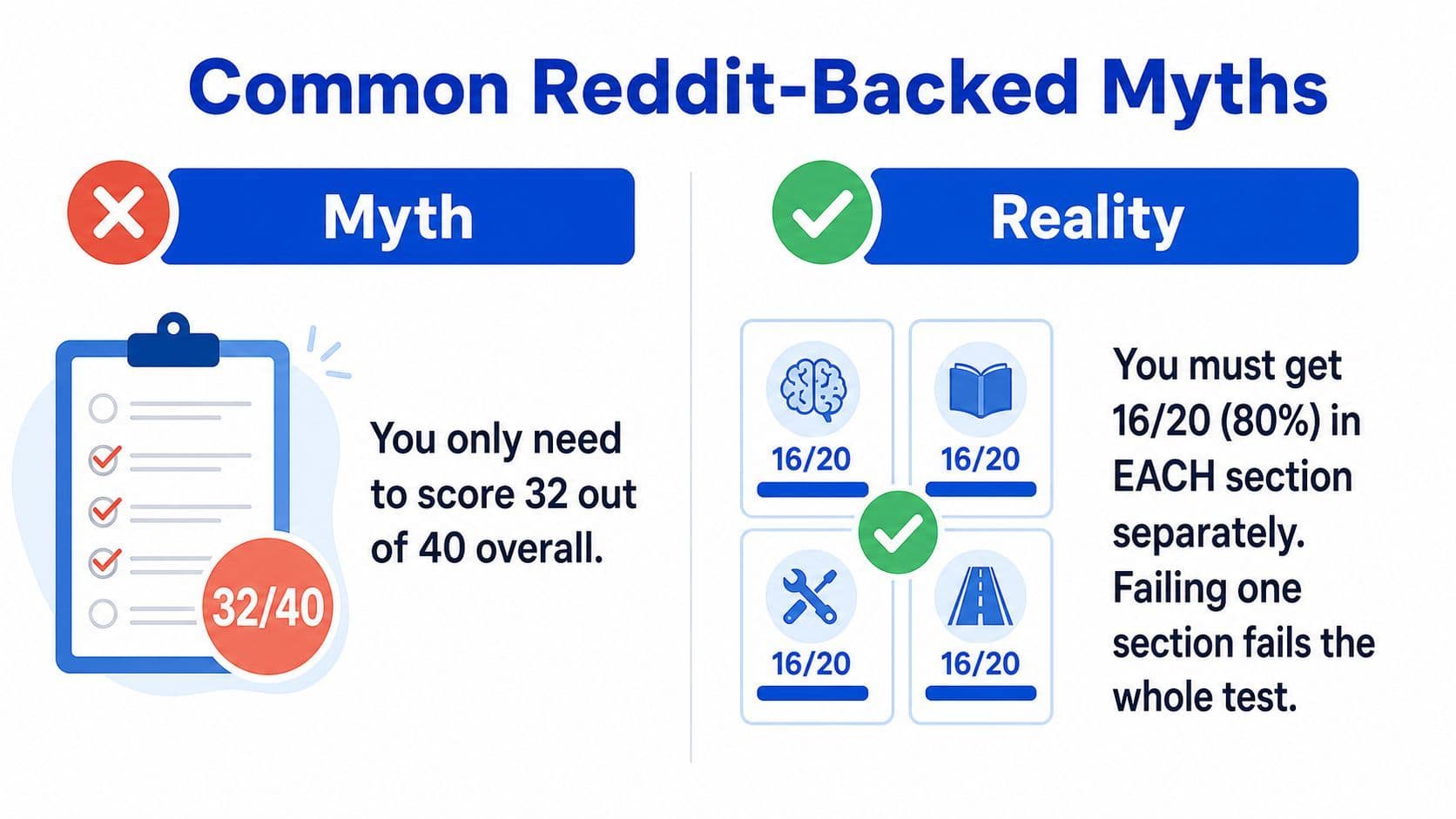
The first myth says you only need 32 out of 40 overall. It sounds neat, but it misses the actual rule, which requires 16/20 in each section. One weak section is enough to fail the whole test, even if the total number looks fine.
The second myth says cramming the night before is enough. Sometimes a lucky guess carries someone through, but luck is not a study plan. If signs or road rules are still shaky, a last-minute review does not give those gaps time to settle.
The third myth says the test is easier than practice, so one good quiz result means you are ready. That assumption causes trouble. Reddit users who rely on it often describe getting tripped up by different wording on the actual exam, where the same rule can be asked in a less familiar way.
Why newcomers should be cautious
The fourth myth says generic driving apps are enough for newcomers. They are not, at least not by themselves. Ontario-specific rule differences are exactly where new residents can get caught off guard, and the official handbook remains the most reliable source for those details newcomer gap in Reddit advice.
There is also no official provincial pass or fail rate published for the G1 knowledge test, so claims that 30% to 70% fail on the first attempt are unverified estimates, not government statistics unverified fail-rate discussion. That matters because scary numbers can push people into poor habits, like cramming or trusting a single app too much.
A better way to read Reddit is to separate pattern from anecdote. If a warning matches the two-section structure, it deserves attention. If it comes from one person's lucky pass, treat it as a story, not a rule.
Structured practice still has a place here, because it gives those Reddit lessons a place to be tested against the handbook. A resource like G1ready.ca's study materials fits that role when you want repetition, feedback, and a cleaner view of which topics still need work.
Where G1ready.ca Fits Into an Evidence-Backed Routine
Reddit is useful because it shows the same mistakes appearing again and again. It is less useful for building a study system that spots weak areas, explains why an answer was wrong, and keeps your attention on the material that still needs work. A structured simulator fills that gap.
A newcomer-facing question keeps coming up in Reddit threads, what to study beyond generic practice tests, especially because Ontario-specific details can be missed when people rely only on community advice. The issue is not that Reddit is useless. It is that Reddit gives you patterns, while you still need a way to test those patterns against the handbook and check whether they hold up in practice newcomer question on Reddit. A platform like structured G1 license study materials can sit inside that routine without replacing the handbook or the discussion threads.
How the pieces fit together
Targeted quizzes are useful for the signs section because they let you work on one cluster at a time before mixing topics together. That matters because a familiar topic can make your score look stronger than it is, the same way a clean driveway can hide an icy patch until you step on it. A diagnostic test helps reveal those hidden weak spots before they show up on the actual exam.
Immediate feedback matters for the same reason a driving instructor corrects a mistake right after it happens. If you wait too long, the answer and the reason behind it start to blur together. When each wrong choice comes with a clear explanation, the correction is easier to remember and easier to reuse.
Mixed tests and a realistic simulator belong later, once the separate topics feel more stable. At that stage, you are training for pacing and attention, not just recall. Repeating the same material is still useful, but repetition works best when it is organized instead of random.
The balance is simple. Reddit points you toward the topics people keep missing. The handbook gives you the correct rules. A simulator lets you practise under exam-like conditions so those two sources turn into a routine instead of a stack of open tabs.
Your 14-Day G1 Study Plan Built Around the 16 20 Rule
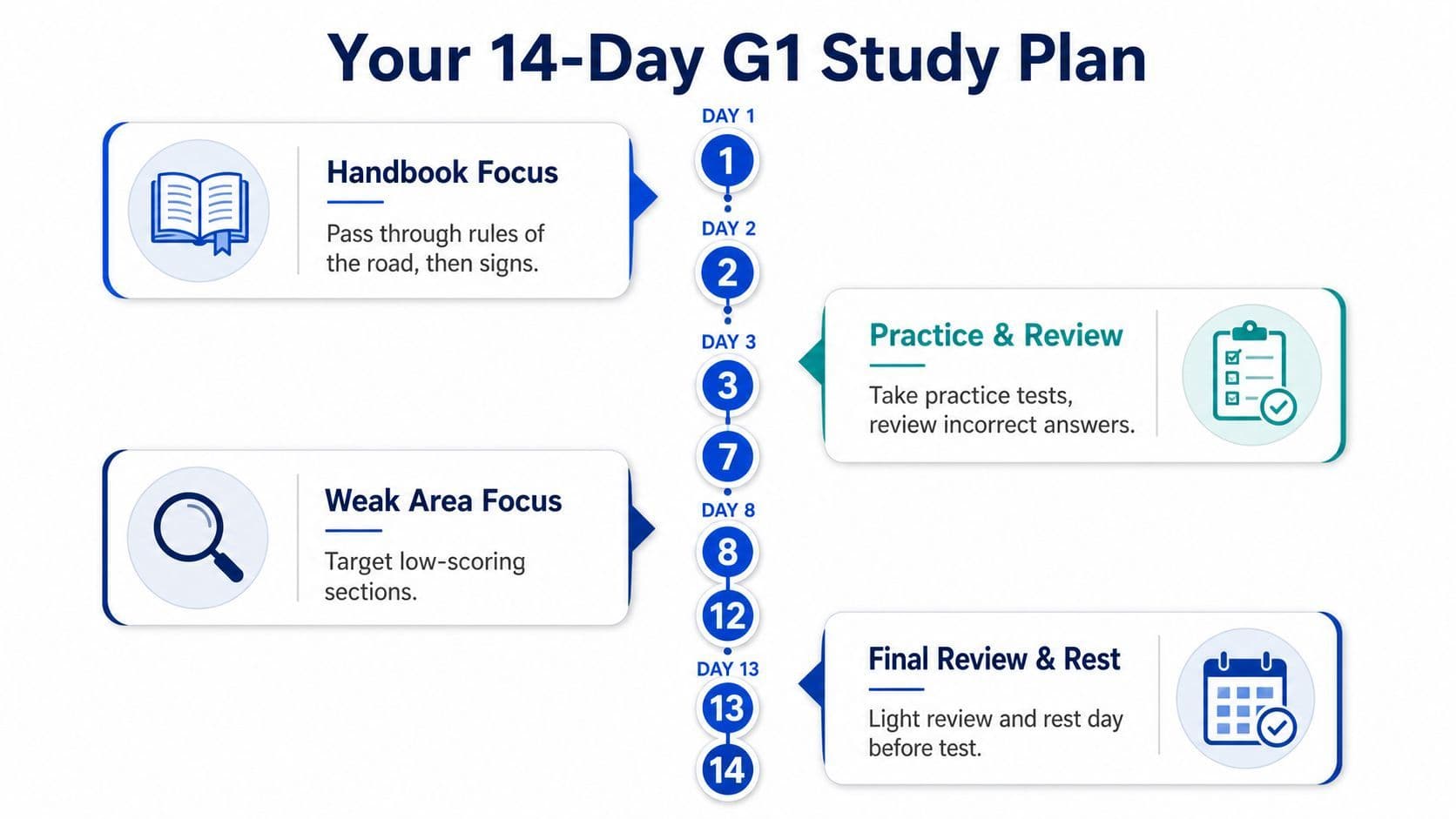
A short plan works better than a heroic one. Two weeks is enough time to build section-by-section confidence if you keep the focus on the 16/20 rule and don't let weak topics hide.
Days 1 to 5 build the base
Start with the handbook. Read the rules of the road first, then the signs section, so each one has its own pass through your head before you start testing yourself. After that, move to short quizzes on one topic at a time and don't advance until you're comfortably clearing the section threshold in practice.
Days 6 to 12 expose weak spots
Once the basics feel stable, add mixed quizzes and a diagnostic run. Look at every missed question and group the misses by topic, because that's where your next study block should go. If a cluster keeps dropping your score, go back to the handbook and work it again before you move on.
Use timed practice in the middle of this stretch so the clock stops feeling unfamiliar. The actual exam is only 30 minutes, and the time pressure matters as much as the content time limit and structure.
Days 13 and 14 are for rehearsal and rest
Do one full mock exam, then review every miss carefully. The next day should be light, not frantic. Skim your notes, avoid overload, and give yourself enough margin to walk into DriveTest calm and alert.
A simple test-day checklist helps:
- Bring the right ID: make sure your documents are ready before you leave.
- Expect an in-person test: the official G1 must be taken at a DriveTest centre.
- Sleep properly the night before: tired guessing is still guessing.
- Do one last light review only: don't try to relearn the whole handbook at once.
If you want a tighter way to practise the Ontario format, G1ready.ca offers handbook-aligned quizzes, feedback, and simulator-style practice that fit the routine above. Use it alongside the handbook and the most useful Reddit advice, then walk into DriveTest with a plan instead of guesswork.
If you want a structured way to turn Reddit advice into real progress, visit G1ready.ca and work through handbook-aligned practice, targeted quizzes, and timed simulation in one place. It's a practical fit for first-time drivers, newcomers, and parents helping a teen prepare, especially if you want your study time to match how the Ontario G1 is scored.


