What if the Ontario G1 test in Urdu is not an easier paper, but only a different language for the same rules? Plenty of families treat an Urdu booking as a way around the English handbook. That is the gap. Urdu helps you understand a rule. It does not replace the wording Ontario tests, or the signs you will read on the road. Think the idea through in Urdu, then check the handbook sentence before you trust an answer.
Ontario G1 Test Format and Passing Score
The knowledge test is two scored papers in one sitting. You face 40 multiple-choice questions: 20 on road signs and 20 on rules of the road. Each section stands alone. You need at least 16 correct in each section. A perfect signs score cannot cover a weak rules score.
Section Questions Pass mark What it covers Road signs 20 16 correct Regulatory, warning and guide signs Rules of the road 20 16 correct Right-of-way, lane changes, parking, speed limits Whole test 40 16 correct in each section Both sections scored separately
What each section is measuring
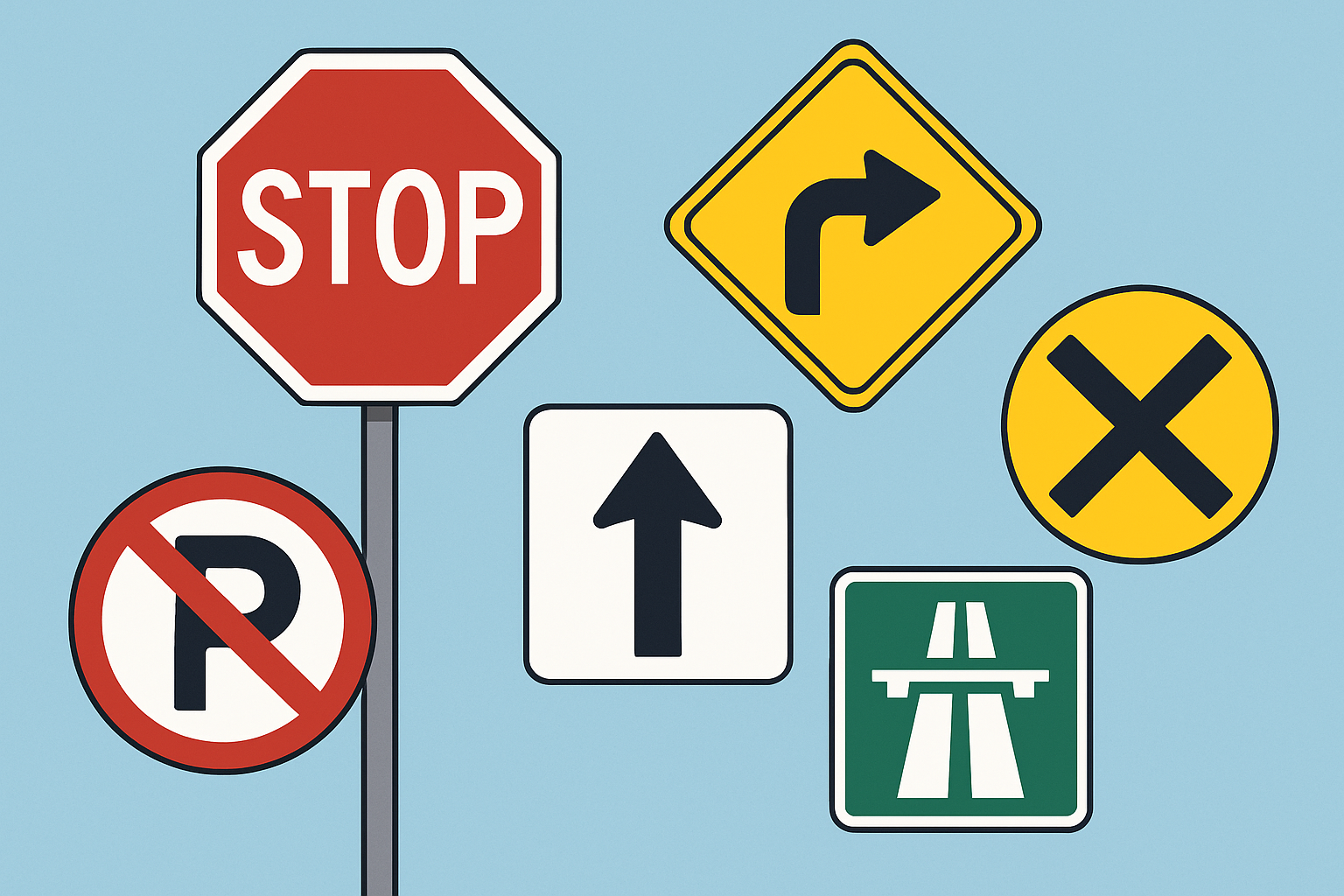
Road signs test whether you can read a shape, a colour, and a message together. Regulatory signs include stop signs and speed limit signs. Warning signs include curves, hills, and school zones. Guide signs include highway exits and distances. If you only remember the word on a familiar sign, a similar shape with a different message will look right and be wrong.
Rules of the road test what you do, not what you can name. Right-of-way, lane changes, parking, speed limits, and the other situations in the handbook all live here. A question may describe two cars at an intersection, or a driver moving into a faster lane, without naming the rule. You supply the rule.
Wrong options are written to sound close. On any sign or picture, slow down. Name the shape before you read the choices. On a rules question, decide who must yield before you look at the answers.
Practical rule: You can miss four questions in each section. You cannot miss eight in one section and pass on the other. Score every practice attempt that way.
Confirm the current question count and pass mark in the official Ontario Driver's Handbook before you treat those numbers as fixed. The test is built from that book. A practice set with a different split will train the wrong habit.
Taking the G1 Knowledge Test in Urdu
Language access changed the written test, not the law. The Ontario government announcement said the Urdu option would be available in spring 2018, alongside Farsi, so newcomers could learn provincial road rules. Before that expansion, DriveTest Centres already offered the G1 test in 20 languages, including English and French.
Most useful study still starts with the handbook on the table, not with a translated answer key.

Who the option actually helps
The Urdu choice covers the written knowledge examination only. The same announcement is clear that applicants still need identity documents, applicable fees, a vision test, and a knowledge test. Question structure and the pass mark do not change with the language.
Three learners use it well, and they are not the same person. A newcomer may read Urdu more comfortably than English traffic terms. A parent may need Urdu to explain a rule to a teenager who will sit the test in English. A driver who thinks in Urdu may still need the English handbook sentence because that is the wording exam questions echo.
Ontario's 2021 census tables report approximately 290,900 people in the province's urban census metropolitan areas with knowledge of Urdu, while about 168,445 report Urdu as a language spoken at home. Some already drive in Canada. Others hold a foreign licence and are new to graduated licensing. One Urdu-only sheet cannot serve both.
A split that keeps you accurate
Explain the rule in Urdu until the idea is clear. Then open the English handbook and match that idea to the exact sentence. If an Urdu note and the handbook disagree, keep the handbook. Check any Urdu material against the current official book before you study from it.
When you book, ask for Urdu and confirm that language is offered at that centre. Bring the identification the licence office asks for. The platform is made for Ontario learners preparing for the G1 test in Ontario, and the guide to G1 test languages is worth reading before you lock the language on the booking.
Write the test language at the top of your notes on day one. Practice in the language you will sit, or you will recognise a rule and still miss the wording.
If you want a short look at how language choice fits a study week, this walk-through is a useful start.
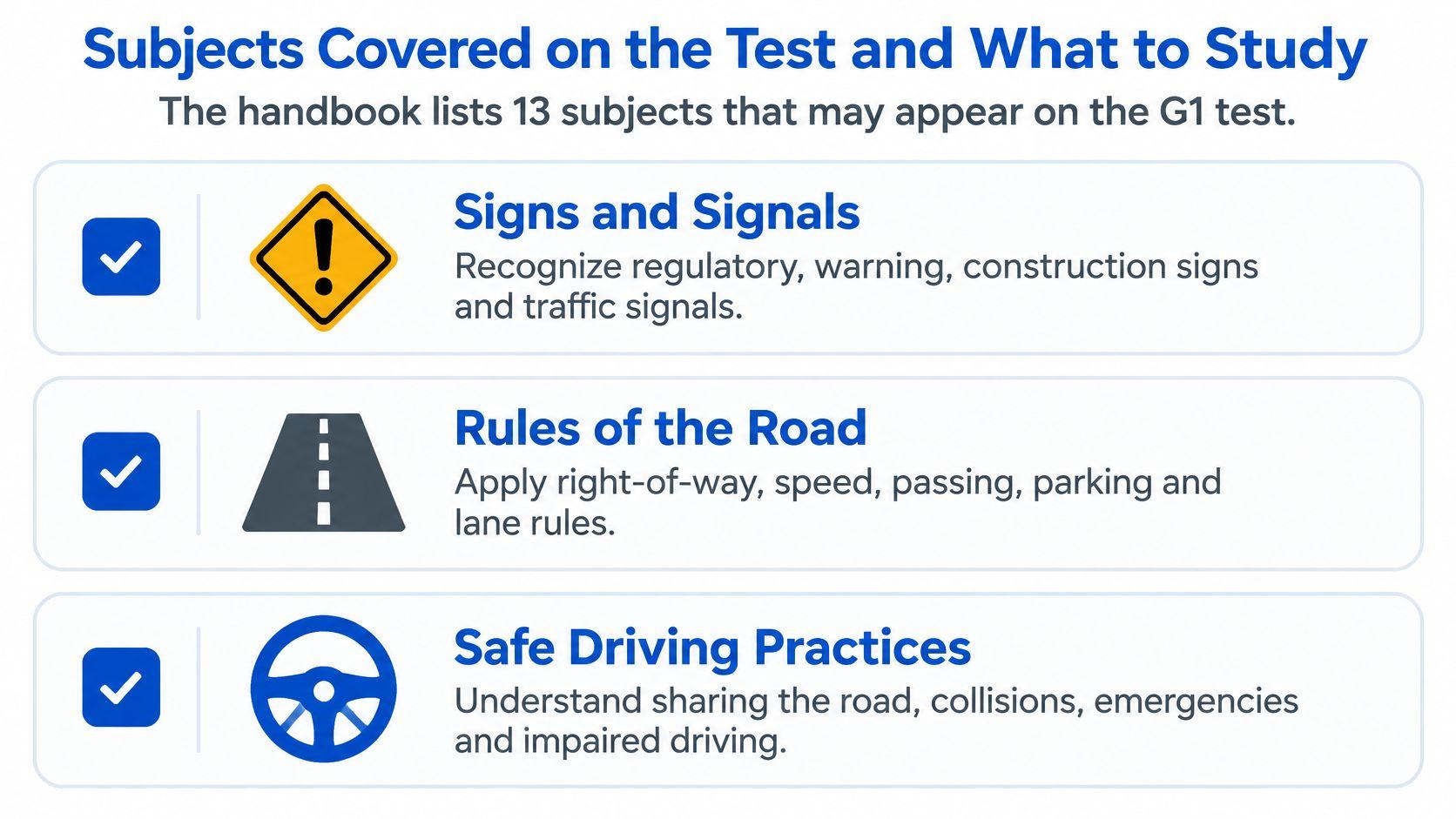
Subjects Covered on the Test and What to Study
A signs quiz is not the test. The Ontario Driver's Handbook lists the areas that may appear: seatbelt use, traffic signs and lights, emergency vehicles, headlights, speed limits, entering and leaving freeways, meeting streetcars and school buses, licence suspensions, the demerit-point system, passing other vehicles, collision reporting, sharing the road with other users, and general rules of the road. It also gives sample multiple-choice questions and tells you to study the official material first.
Group those topics into three blocks so a week has a shape.
Study block Subjects on the handbook list Signs and lights Traffic signs and lights; headlights; emergency vehicles Driving manoeuvres Speed limits; passing other vehicles; entering and leaving freeways; meeting streetcars and school buses Licensing and responsibility Seatbelt use; demerit-point system; licence suspensions; collision reporting; sharing the road with other users; general rules of the road
Study one block until you can teach it
Knowing a sentence and using it in a scene are different skills. A question can describe a freeway ramp or a stopped school bus and never name the topic. If you only recognise the heading in the book, you will stall.
Work the handbook's sample questions one block at a time.
- Signs and lights: Cover headlights and emergency vehicles in the same sitting as signs. A flashing light is often the whole clue.
- Driving manoeuvres: Give extra time to freeway merging, passing, and streetcars. New drivers rarely meet these before the test, so memory from the passenger seat is thin.
- Licensing and responsibility: Seatbelts, demerit points, suspensions, and collision reporting feel like paperwork. They are scored rules. Say each one aloud without the page in front of you.
Move to the next block only when you can explain every rule in that block in your own words, with the book closed. If you need the page, you are still reading, not ready.
Common Rule Mistakes That Cost Learners Marks
The expensive mistake is answering from driving habit instead of the handbook. The wrong choice often sounds sensible. That is why it costs marks. A parent who has driven for years, and a teen who has watched that parent, can share the same wrong picture of what the law requires.
Common mistake Rule to remember Passing a school bus that has flashing red lights Stop in both directions on an undivided road while the bus is loading or unloading Driving past a streetcar that is loading passengers Stop behind it, unless the handbook rule for that road type says otherwise Thinking demerit points only bring fines Enough demerit points can lead to a licence suspension Passing on the right to save time Pass on the left unless the handbook allows passing on the right in that situation
Why the sensible answer fails
Say a school bus ahead has flashing red lights, and the opposite lane looks empty. Habit says you can creep past if you are careful. The rule says you stop in both directions on an undivided road while passengers load or unload. The empty lane is not permission.
A streetcar with its doors open feels similar. Many learners think they may slide past slowly on the right. The handbook rule is to stop behind the streetcar unless that road type is one of the exceptions the book spells out. If you cannot name the exception, you do not have it.
Demerit points are the quiet one. Learners treat them as a fine you pay and forget. Enough points can bring a licence suspension. If your notes only say "points mean money," rewrite them.
Passing on the right is the habit that feels efficient in slow traffic. The rule is to pass on the left unless the handbook allows passing on the right in that exact situation. "I was saving time" is not one of those situations.
How to drill a miss
Read the rule. Say it in your own words. Then take two practice questions on that topic and, for each wrong option, say why it fails. One missed question usually means the whole topic needs another pass, not a single corrected tick.
On test day, if the scene involves a school bus, a streetcar, a freeway ramp, or an emergency vehicle, name the specific rule before you read the options. The handbook text decides the answer. A shortcut does not.
Using Practice Tests Without Memorizing Answers
Practice tests help when you understand the rule. They do not help when you memorise the letter beside last night's question. The paper asks the same rule in a different street, with different wording. A remembered option then becomes a wrong answer you feel sure about.
A four-step pass on every miss
- Answer the question without looking back at a previous attempt.
- Read the explanation for the right option and for each wrong one.
- Write the rule in one sentence, in your own words, in the language you think in, then check it against the handbook.
- Redo that question the next day. If you only remember your sentence, you have the rule. If you only remember the option letter, you don't.
Use practice in three different jobs, not one endless quiz. A signs-only set or a rules-only set is for a weak block. A full 40-question test is for timing and stamina, because fatigue shows up late, not on question three. A diagnostic test at the start shows which block to open first, so you don't spend the first week polishing signs you already know.
Keep a small log: date, topic, rule you missed. Three misses on school buses is a topic problem. Three misses on random signs is a recognition problem. Those need different reviews.
Scores show direction, not a guarantee. g1ready.ca is a privately owned website that is not affiliated with or operated by any government agency. When an explanation and the Ontario Driver's Handbook disagree, the handbook wins. The Ontario driving quiz guide is a sensible place to see how a quiz should be used beside the book, not instead of it.
Before test day, sit two full 40-question tests in a row, with at least 16 correct in each section on both. That is the target the four-week plan is built toward. One lucky paper is not.
How to Study for the G1 Test in Four Weeks
You can start tonight. Pick a test date about four weeks away, and don't book it until practice scores are steady. The weeks below are the order, not a suggestion you shuffle when signs feel easier.
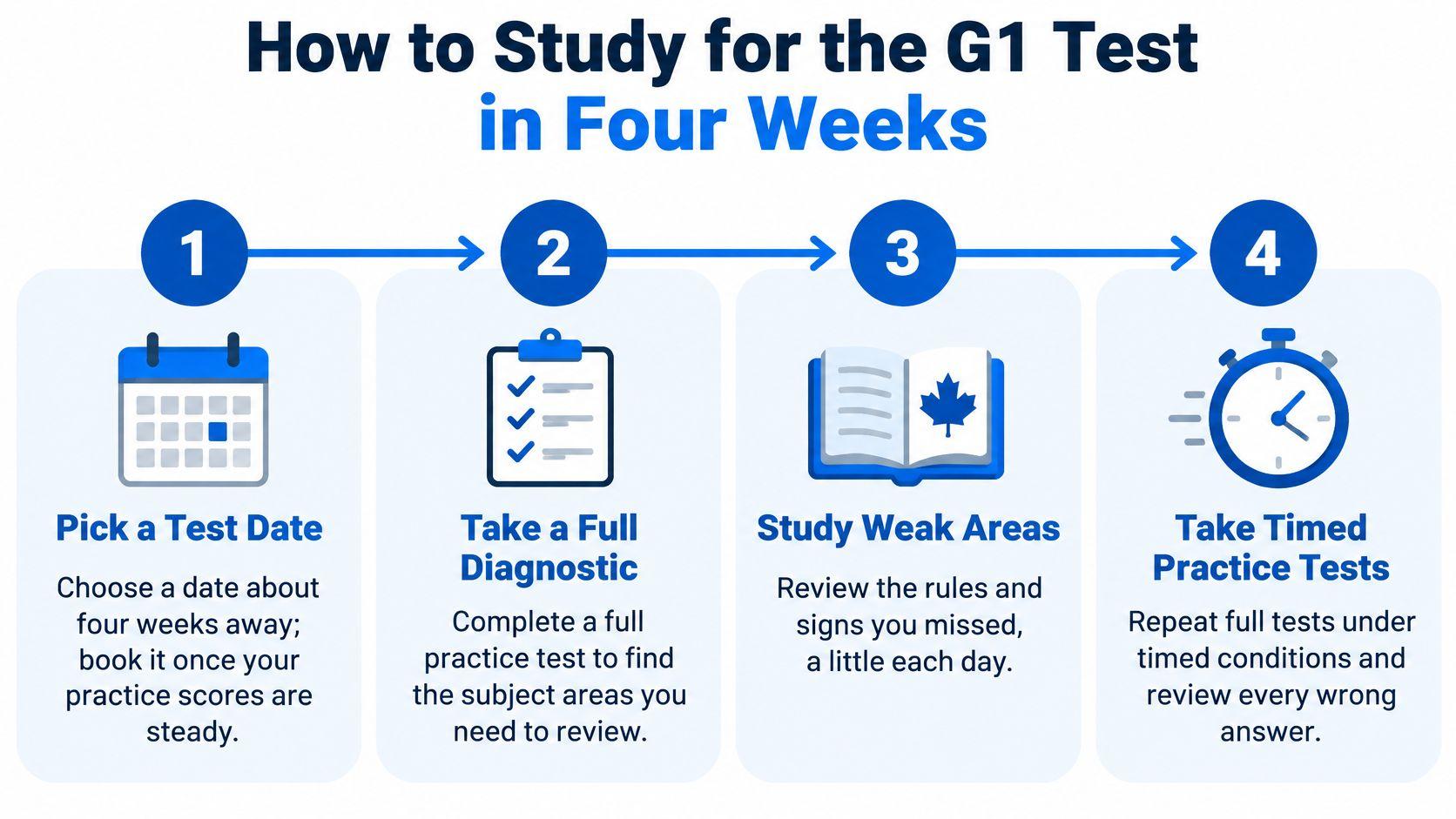
Week Focus Daily time Check before moving on Week 1 Road signs 20 minutes Name every sign type and its shape Week 2 Rules of the road 30 minutes Explain right-of-way and lane changes without notes Week 3 Mixed topics and mistakes 30 minutes Score 16 or more on two mixed practice tests Week 4 Full-length practice 40 minutes Two full 40-question tests with 16 or more in each section
What you do each week
Week 1, signs. Twenty minutes is enough if you sort signs by type and shape, not by page order. The slip is booking the test on night one, before you know which shapes you confuse.
Week 2, rules. Thirty minutes on right-of-way and lane changes, said without notes. The slip is studying only signs because they feel concrete, then discovering rules questions on the weekend paper.
Week 3, mixed work. Thirty minutes on the topics you still miss, including the school bus, streetcar, and passing mistakes. Two mixed tests at 16 or better tell you the blocks are holding together. One high score after a lucky run does not.
Week 4, full papers. Forty minutes for a timed 40-question test, with a separate score for each section. Do this on both weekend days if you can. In the last two days, review only the topics still in the log, then rest. Cramming a new chapter the night before swaps a rule you knew for a sentence you half remember.
A week-four score under 16 in either section means more time on that section. It does not mean you hope the paper is kinder. If the signs column is fine and the rules column is not, do not "balance" by rereading signs you already name on sight.
Stop a week early only when the check in the last column is true. A calendar date is not a check.
Book Your G1 Test and Start Studying Today
Book inside the four-week plan once those two full tests meet the target. Booking earlier feels organised. It mostly means you sit the test while a section is still under 16.
Confirm you can be licensed before you choose a morning. The Ontario page for new drivers says a first-time driver must be at least 16, be an Ontario resident rather than a visitor, pass a vision test, and pass a knowledge test on signs and rules of the road. After those tests you receive a G1 licence and start graduated licensing. New drivers complete G1 and then G2 before a full G licence. That path is the same if you test in English, French, Urdu, or another available language.
What you pay, and the order to follow
The Ontario driver and vehicle fee schedule lists the original driver's licence package, covering G1, G2, and G licensing, at $90. The same schedule lists the standard driver's knowledge-test fee at $15.75. Specialised Class A through F knowledge tests are listed higher, so don't mix those figures with a standard G1 attempt. Check the live schedule before test day. Amounts can change, and you may be paying for the broader original-licence package rather than a standalone attempt.
- Confirm age, Ontario residency, and that you can complete the vision and knowledge tests.
- Choose the test language and confirm the centre offers it. The G1 test booking guide walks through that choice without treating language as a shortcut.
- Book the date and time only after section scores are steady.
- Bring the identity documents the licence office requires. A missing card ends the visit before the test starts.
- In the final week, practise with free practice tests on G1ready.ca. Those tests include instructor-reviewed answers, and the 200-question G1 Practice Test gives instant feedback on each question along with a detailed explanation of the correct answer. Read the explanation, not only the tick.
Pick a tentative date tonight, take a diagnostic test, and open the first study block. If the signs check isn't met by the end of week one, move the date. Don't move the standard.
G1ready.ca gives Ontario learners free, handbook-aligned practice for the G1 knowledge test, with separate signs and rules scoring so an Urdu or English booking is judged the same way as the paper test. Use a diagnostic test to see which block is costing marks, then review the missed rules before you reserve a DriveTest date. Start tonight at G1ready.ca.