You're probably here because railway crossings feel simple until a practice question makes them confusing.
A lot of G1 learners know the general idea. Stop for trains. Don't drive around gates. Be careful. Then the test adds details like how far back to stop, what a crossbuck means, or whether a school bus must stop even when there's no gate. That's where people second-guess themselves.
This guide breaks down Ontario railway crossing rules the way a patient driving instructor would. You'll learn what the signs mean, what to do at every crossing, and how these rules often appear on the G1 test.
Why Railway Crossing Safety Is a G1 Test Priority
You're driving on a quiet road during your G1 practice. The crossing ahead looks simple. No train is in sight, and you feel the urge to keep rolling. That is exactly the kind of moment the G1 test cares about, because railway crossings punish late decisions.
Ontario puts this topic on the G1 test early for a reason. A crossing is a place where drivers must recognize a hazard, judge distance correctly, and follow a rule without hesitation. Those are the same habits you use at intersections, especially when deciding who must wait and who has the right to go. If you want a refresher on that larger pattern, review Ontario G1 right-of-way rules.
What the test is checking
The exam usually is not testing train trivia. It is checking whether you can do three simple things under pressure:
- Spot the crossing early: Do you notice the warning soon enough to prepare?
- Know the stopping rule: Do you know where a vehicle must stop when a train is approaching?
- Follow the signal fully: Will you wait, even if the road looks clear for a moment?
A railway crossing works like a locked gate at a parking lot exit. When the system says wait, your opinion does not change the rule.
Why this section gets tested so often
New drivers often treat railway questions as rare exceptions. On the G1, they are usually the opposite. They are basic safety questions dressed up in a rail setting.
A question might show a flashing signal and ask what you do next. Another might test stopping distance. Another may check whether you confuse the rules for a regular passenger vehicle with the special rule for a school bus. That last one trips up many learners because they remember one rule and apply it to every vehicle.
The pattern is simple. The G1 rewards calm, exact answers. It penalizes guessing, rushing, and mixing one vehicle's rule with another.
Practical rule: If a crossing asks you to stop, your job is to stop first and decide second.
That mindset helps with the test and with real driving. Once you treat railway crossings as a strict obedience question, not a judgment contest, the answers become much easier to choose.
Decoding Railway Crossing Signs and Signals
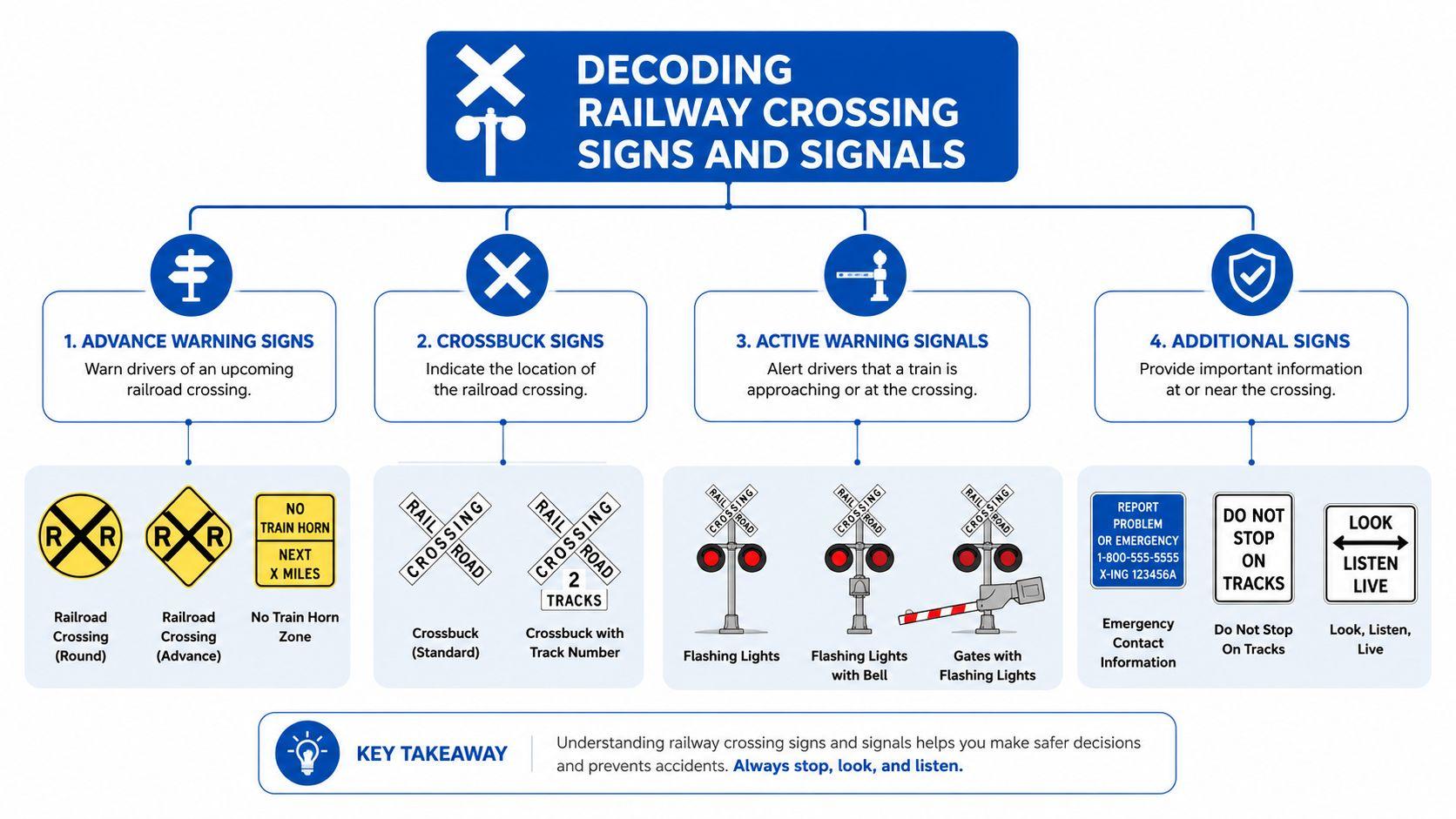
Before you can react properly, you need to recognise what kind of crossing you're approaching. Ontario uses a simple ladder of warnings. Some crossings only use signs. Others add flashing lights, bells, and gates.
If you're also reviewing sign recognition more broadly, Ontario road signs for the G1 test is a useful companion.
Passive and active crossings
A passive crossing gives you warning through signs only. There are no flashing lights, no bells, and no gate moving up or down. At these crossings, the driver has to do more of the work. You slow, look carefully, and decide only when it's safe to proceed.
An active crossing adds operating signals such as red lights, bells, or gates. These are stronger warnings, but they don't mean you can relax. They mean you must obey the system immediately and completely.
Ontario public railway crossings are marked by the familiar red and white crossbuck, the large X-shaped sign. Think of it as the railway version of a stop-and-check alert. It tells you that train tracks cross the road ahead and that you must scan the area with extra care.
The safest driver at a railway crossing isn't the fastest thinker. It's the one who slows down early enough to make a calm decision.
Ontario Railway Crossing Signals and Required Actions
Signal What It Means What You Must Do Advance warning sign A railway crossing is coming up ahead Slow down, scan early, and prepare to stop if needed Crossbuck sign You are at or very near a public railway crossing Treat it as a serious warning. Look both ways and proceed only when safe Red flashing lights A train is approaching or the crossing is active Stop and wait until the signal stops and it's safe Bell The crossing warning system is active Do not enter the crossing Lowered gate The crossing is closed to road traffic Stop and stay stopped. Never drive around it
What these signals mean on the G1 test
G1 questions often swap one signal for another to see if your decision changes. The key idea is simple. If the crossing is active, your action becomes more definite. You're no longer just checking. You're obeying a warning device.
A helpful memory trick is this: Signs tell you to prepare. Signals tell you to stop. Gates tell you to stay out.
That one sentence clears up a lot of multiple-choice questions.
The Driver's Action Plan at Every Crossing
A railway crossing is one place where a simple routine beats quick reactions. On the G1 test, that often shows up as a judgment question. You are asked what to do first, when to stop, or how far back to wait. The safest answer usually comes from following the same order every time.
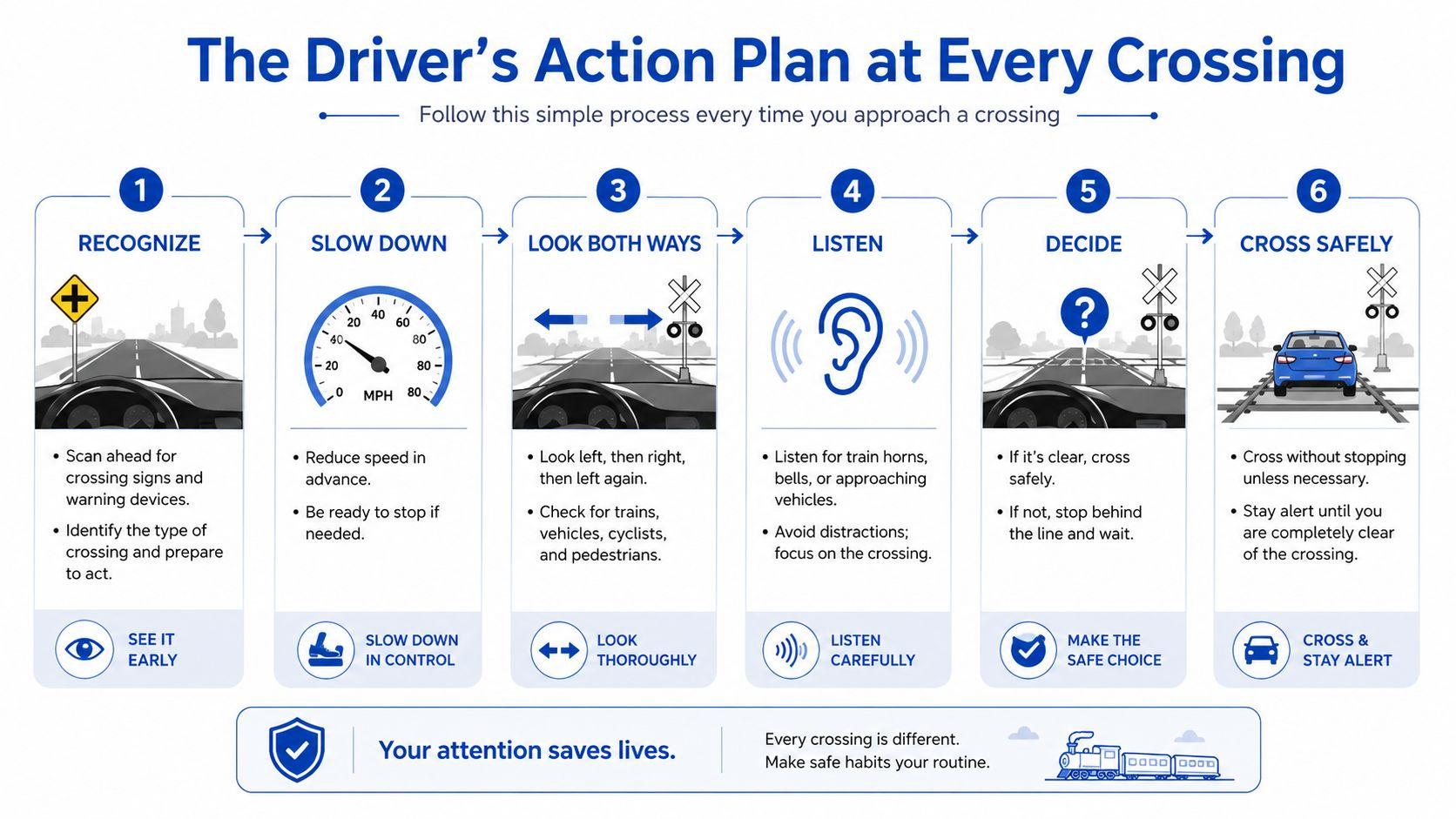
Your repeatable crossing routine
As you approach the tracks, treat the crossing like a zone where you need extra space and extra time. Do not wait until you are right beside the rail to decide what to do. Late decisions cause problems fast, because a train cannot swerve or stop for you like a car at an intersection sometimes can.
Use this checklist in order:
- Ease off the speed early. Give yourself time to observe without rushing.
- Check the full crossing area. Look for pavement markings, the crossbuck, lights, bells, and gates.
- Scan both directions. Use more than one quick glance.
- Listen if visibility is poor. If needed, lower distractions and pay attention to sound.
- Stop when required. Stay calm and wait until the crossing is clearly safe.
- Drive across in one steady movement. Once you commit, keep going until your whole vehicle is clear.
A good way to remember it is: slow, scan, stop if needed, then clear the tracks completely. That pattern also helps with multiple-choice G1 questions, because the wrong answers often involve rushing, hesitating on the rails, or reacting too late.
Why the 5-metre rule shows up on the G1 test
One of the easiest railway crossing marks to test is stopping distance. In Ontario, all public railway crossings are marked by large red and white X signs called crossbucks, and drivers must stop at least 5 metres from the nearest rail or gate when a train is approaching (Ontario MTO truck handbook on stopping at railway crossings).
That distance can feel farther back than a new driver expects. There is a reason. The train is wider than the rails themselves, so the danger area is not just the shiny steel line on the road. A simple memory trick helps here. Treat the rail like the centre of the hazard, not the edge of it.
Memory aid: Stop well back, not right at the track.
For the G1, remember the number exactly. 5 metres is the kind of detail that turns into a direct test question.
Cross only if you can clear the tracks
The final step is often where learners get trapped by trick questions. Seeing open space ahead is not enough. You should enter the crossing only if there is room on the other side for your entire vehicle to get clear.
Picture it like stepping through a doorway. If the space beyond the doorway is blocked, you wait. You do not stand in the doorway and hope traffic sorts itself out. Railway crossings work the same way.
Once you go, keep your movement smooth and steady. Pick your speed before entering. Avoid any action that could leave you stuck on the tracks. On the G1 test, if two answers both sound cautious, choose the one that keeps the vehicle completely off the rails unless the path ahead is open.
Rules for Pedestrians and Cyclists
Railway crossings aren't only about drivers. Pedestrians and cyclists are more exposed, less protected, and easier to miss, especially when everyone is focused on the train.
Ontario crossing design reflects that. Pedestrian safety protocols at Ontario at-grade crossings require stop lines to be installed exactly 5 metres from the rail or 2 metres ahead of the crossing sign, with tactile detectable tiles placed at the stop bar to warn visually impaired pedestrians of the hazard (CARSP paper on at-grade crossing pedestrian safety). The same source notes that G1 drivers must yield to pedestrians at these marked zones.
What drivers need to watch for
A learner driver often watches the flashing lights and forgets to scan the sidewalk. That's a mistake. People on foot may stop, hesitate, or misread the situation. Cyclists may also adjust their path as they prepare to cross the tracks.
Keep these habits in mind:
- Check the pedestrian area early. Don't focus only on the rails.
- Yield at marked zones. If pedestrians are where they're meant to cross or wait, your duty doesn't disappear because a railway crossing is nearby.
- Expect balance issues for cyclists. Track gaps can be awkward, especially if a rider approaches at a poor angle.
- Avoid pressure from behind. A tailgating driver doesn't change your responsibility to slow down and observe properly.
Cyclists also need special care because rail gaps and surfaces can affect balance. A cautious driver gives them room, stays predictable, and avoids sudden squeezing near the crossing.
Special Situations for School Buses and Heavy Vehicles
This is one of the most tested distinctions in railway crossing rules Ontario learners need to know. The rules for a regular passenger vehicle are not identical to the rules for a school bus.
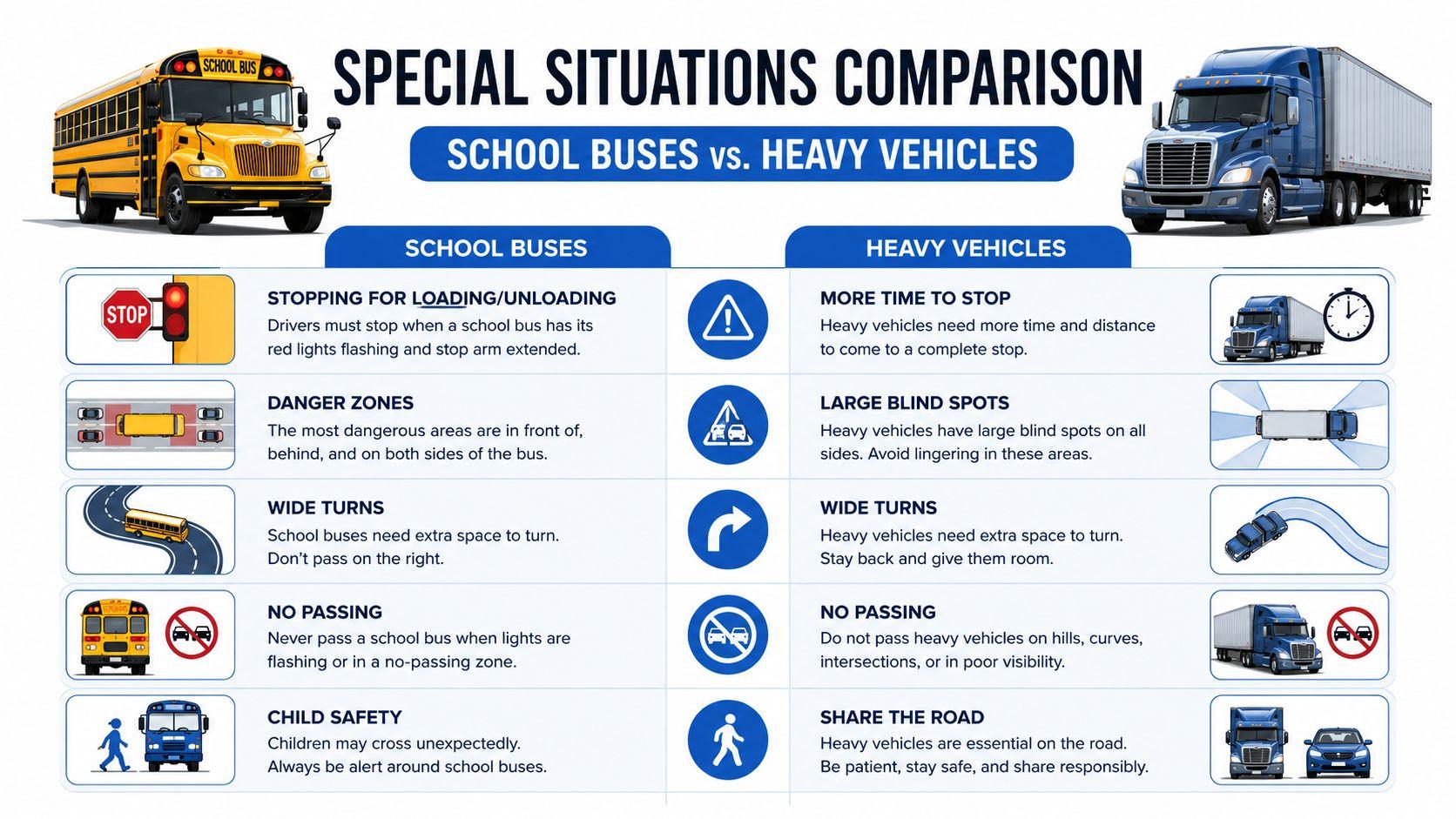
The school bus rule learners miss
The key G1 distinction is this: general drivers follow the 5-metre stop rule when required, but school buses must stop at all crossings, regardless of active signals (Ontario MTO truck handbook on railway crossings). That's the part many practice questions target.
Learners often answer based on what they'd do in a car. That leads to the wrong choice. If the question asks about a school bus at a crossing without gates or without flashing lights, the safe answer is still the stop requirement.
A good test habit is to ask yourself one quick question before answering: “Is this a passenger car or a school bus?”
Here's the contrast in plain language:
- Passenger car: Stop when the situation or signal requires it.
- School bus: Stop at every railway crossing.
- Test takeaway: Don't transfer the car rule onto the bus.
Why larger vehicles need extra care
Heavy vehicles have more mass, longer stopping distances, and less room for error. They also need more space to clear the crossing fully. That's why professional drivers are taught to approach railway crossings with extra planning rather than quick reactions.
For G1 purposes, you don't need to memorise every commercial rule. You do need to recognise that buses and larger vehicles operate under stricter expectations because the consequences of a mistake can affect many people at once.
If you use practice tools to study this topic, look for ones that separate bus scenarios from car scenarios. For example, G1ready.ca's G1 test questions and answer guides focus on scenario-based explanations that can help learners sort out exceptions clearly.
Emergencies Penalties and Reporting Issues
A common G1 test trap is simple: you know the normal crossing rule, but the question asks what to do when the normal situation breaks down. That is where calm, clear steps matter most.
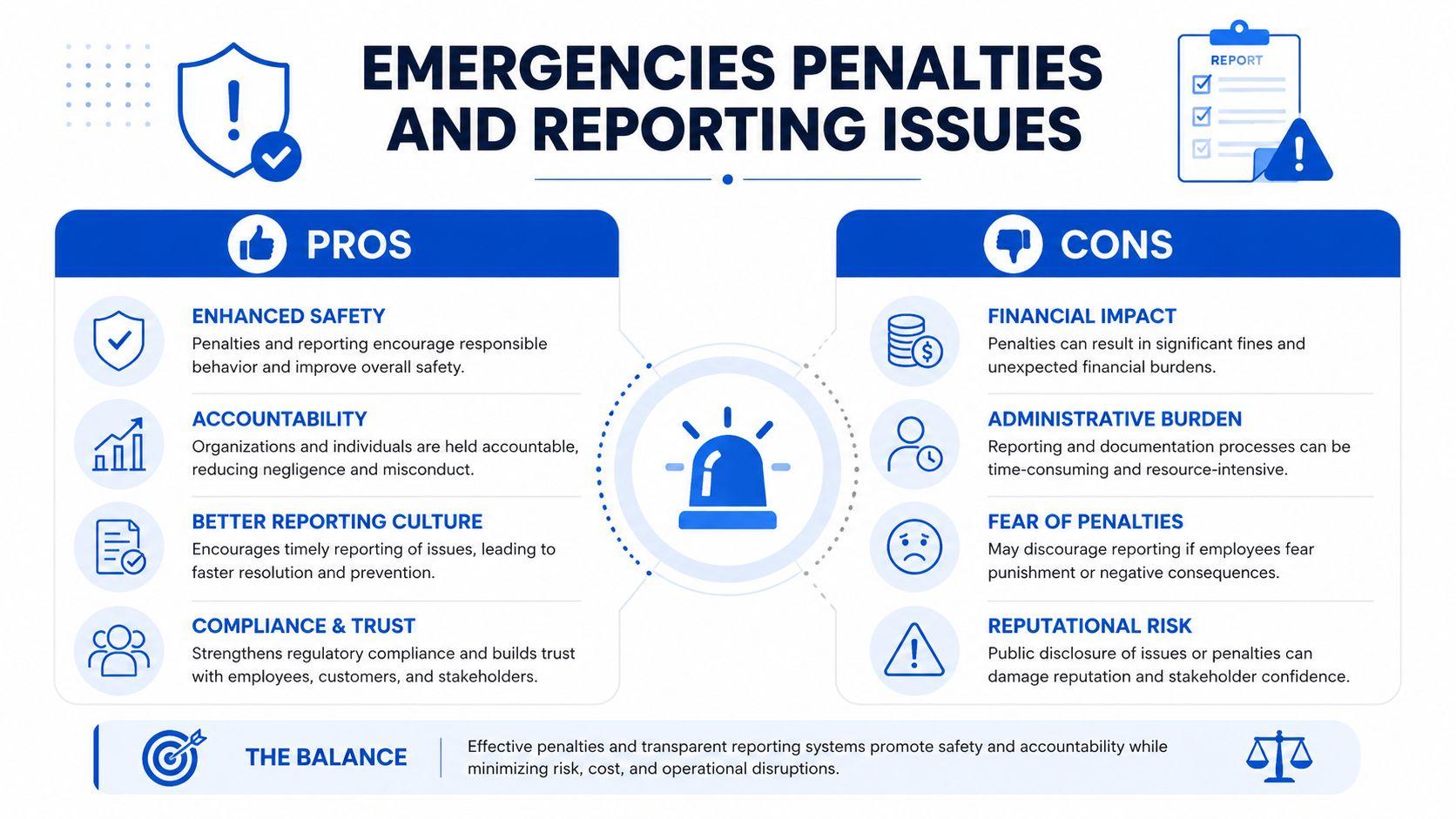
If your vehicle gets stuck
Treat the vehicle like a coat you can replace. Your safety comes first.
If your car stalls or gets trapped on the tracks, do not stay inside trying to restart it while time passes. Leave the vehicle right away, move far from the tracks, and get other people away too if you can do that safely. Then use the emergency number posted at the crossing, or call 911.
A good memory rule for the G1 test is: get out, get clear, get help.
Here are the steps in order:
- Exit the vehicle immediately.
- Move well away from the tracks.
- Help passengers get clear.
- Use the crossing emergency sign or call emergency services.
When faced with the option of one more restart, the safe answer is no. Cars can be replaced. Seconds cannot.
What to do if signals seem wrong
Flashing lights, bells, or a lowered gate are not something you judge for yourself. You obey them.
If a gate stays down, lights keep flashing, or something about the crossing seems wrong, never drive around the barrier. Treat it like a locked door. Your job is not to decide whether the equipment is mistaken. Your job is to stay out and report the problem using the posted railway number or by contacting police.
That point shows up on tests in a tricky way. A question may describe a driver who sees no train and assumes the signal is broken. The correct answer is still to wait and report it, not to cross.
Penalties and test mindset
Ontario treats unsafe behaviour at railway crossings seriously because the risk is high and the margin for error is small. For G1 study purposes, focus less on memorising exact penalty amounts and more on the action that avoids the penalty in the first place. Stop when required. Never go around a lowered gate. Leave a stalled vehicle and report the emergency properly.
If you want extra scenario practice on mistake-heavy topics like malfunctioning signals and emergency choices, these G1 test questions and answer guides can help you practise the decision, not just the wording.
G1 Practice Test Railway Crossing Questions
The fastest way to lock this in is to answer questions the way the actual test asks them. Read each one slowly. Then check the explanation, especially if you got it right. That's where the memory sticks.
Question 1
When a train is approaching at a public railway crossing in Ontario, how far back must a driver stop?
A. 2 metres from the nearest rail
B. 3 metres from the nearest rail
C. 5 metres from the nearest rail or gate
D. At the edge of the crossbuck sign
Correct answer: C
Why: Ontario's rule is specific. You must stop at least 5 metres from the nearest rail or gate when a train is approaching. G1 questions often include smaller distances to tempt learners who remember “stop back a bit” but not the exact number.
Question 2
What does a red and white crossbuck sign mean?
A. School zone ahead
B. Railway crossing ahead or at that location
C. No passing zone
D. Construction detour
Correct answer: B
Why: The crossbuck is the standard railway crossing sign at public crossings. It tells you that tracks cross the road and that you must approach with care. It is not the same as a stop sign, but it is a strong warning that railway rules apply.
Question 3
A school bus approaches a railway crossing with no gate and no flashing lights. What must it do?
A. Slow down and continue if the driver sees no train
B. Stop only if passengers are getting off
C. Stop only during school hours
D. Stop at the crossing
Correct answer: D
Why: This is the classic exception question. School buses must stop at all railway crossings. If you answer based on passenger-car logic, you'll miss it.
Question 4
Why must drivers avoid shifting gears while crossing railway tracks?
A. It damages the transmission
B. It can cause the vehicle to stall on the tracks
C. It confuses other drivers
D. It activates railway signals
Correct answer: B
Why: The safety concern is stalling or losing momentum while on the crossing. The correct habit is to choose your gear before entering and cross smoothly.
Question 5
If a crossing gate is lowered and you think the signal may be malfunctioning, what should you do?
A. Drive around the gate if no train is visible
B. Wait briefly, then cross carefully
C. Obey the gate and report the issue using posted contact information or local law enforcement
D. Follow the vehicle ahead if it crosses first
Correct answer: C
Why: A lowered gate is not optional. Your job is to stop, stay out, and report the concern properly. You're never expected to override the crossing system based on a guess.
If this style of practice helps, keep using railway scenarios until the answers feel automatic. On the actual G1, confidence usually comes from repetition, not from rereading the handbook one more time.
If you want more Ontario G1 practice in the same plain-language style, G1ready.ca offers registration-free quizzes, topic-based tests, and exam-style practice that can help you review road signs, right-of-way, and railway crossing rules without cramming.