
You're probably staring at a pile of notes, a half-finished practice quiz, and one nagging question, what matters on the WA road rules theory test? That's the right place to be. The test is straightforward in format, but the questions that catch people out are often the ones official pages barely unpack, especially give-way at uncontrolled intersections, pedestrian priority at slip lanes, and school-zone details.
What the Road Rules Theory Test WA Is
A learner sits down at the WA Department of Transport, sees a screen full of rule-based questions, and quickly learns this is not a casual quiz. The road rules theory test WA is a computerised theory test built around the rules in the Drive Safe handbook. For cars, it uses 30 multiple-choice questions with a pass mark of 24 correct answers, which is 80%.
That structure matters because it rewards real rule knowledge, not guesswork. Transport WA says the test checks your understanding of WA road rules, and the car version does not allow a mobile phone, device, or handbook during the exam, so you need to know the rule rather than look it up on the spot.
Who this test is for
This guide focuses on the C-class learner permit pathway, which is the standard car learner route in Western Australia. Transport WA also runs separate theory tests for motorcycles and mopeds, and that version has 35 questions with 28 correct answers needed to pass.
Practical rule: If you're studying for a car learner permit, learn the car handbook and practise car-style scenarios. Don't split your attention across motorcycle rules unless that's the licence you're actually chasing.
The part that catches many learners off guard is not the obvious sign meanings. It is the rule judgement at uncontrolled intersections, the way pedestrians are treated at slip lanes, and the school-zone details that are easy to miss when traffic looks quiet. Those are the moments where the test starts to feel like real driving, because the correct answer depends on who has priority, where the vehicle is positioned, and what the road layout is asking you to do.
Pass the theory test, and you move into supervised learning with a permit in hand. Fail it, and you still gain something useful before you ever get near a practical driving assessment.
Eligibility and the Licence Pathway Around the Test
Many drivers begin with the same fundamental goal: obtain the learner permit, then develop sufficient confidence to progress to the practical test. In Western Australia, the theory test is the first step in this sequence, preceding supervised driving, the practical driving assessment, and any probationary licence outcome.
The usual order of steps
The pathway is simple when you lay it out plainly. First, you pass the road rules theory test. Then you hold a learner permit, practise under supervision, and later sit the practical driving assessment when you're ready. The theory test is the first proof point, it tells the Department of Transport that you understand the rules well enough to start learning on-road.
For many applicants, there are also identity and residency checks, and under-18 learners generally need parental consent as part of the application process. People with interstate or overseas experience may still need to sit the WA test if they're moving into the WA licensing system rather than converting directly, so it's worth confirming your exact pathway before you book.
Why the order matters
Learners often try to rush past the theory test because it feels easier than driving practice. That's a mistake. The road rules you learn here shape every supervised drive after it, especially the moments where you have to judge who goes first, where to stop, and what signs mean in real traffic.
A clean way to think about it is this. The theory test checks knowledge. The learner permit lets you practise. The practical driving assessment checks whether you can apply those rules safely. If you understand that sequence, it becomes easier to plan study time and driving lessons around the right milestone instead of cramming everything at once.
Test Format, Passing Criteria, and What Happens at the Terminal
A learner can walk into the terminal feeling prepared and still lose marks on small rule details. That is usually what happens on the WA road rules test, because the questions are built around situations where you have to decide who must yield, where pedestrians have priority, and what the sign in front of you is really asking you to do.
The car learner theory test is a computerised 30-question multiple-choice exam, and you need 24 correct to pass, which is an 80% threshold. The test is marked automatically, so there is no hidden scoring method, and there is no chance to rescue a weak answer by explaining what you meant. The official WA car theory test page sets that out clearly.
WA test formats at a glance
Format Total questions Pass mark Pass percentage Reference handbook Car learner theory test 30 24 correct 80% Drive Safe Motorcycle and moped theory test 35 28 correct 80% Ride Safe
The no-handbook rule matters more than many applicants expect. You cannot rely on flipping pages or checking a note on your phone during the test, so the terminal rewards memory and rule recognition, not live referencing. That is why the questions often feel straightforward on paper but less forgiving in the room, especially when a question turns on a small difference between a stop sign, a give way sign, and a situation where no sign is present.
What the result feels like in practice
Learners usually want one clear outcome on the day, pass or not pass. The computer shows that result immediately after the test. If you pass, you continue through the permit process. If you do not, you book again and use the result to see which rule groups still need work.
That is why the test is better treated like a checkpoint than a wall. A weak score does not mean you cannot drive, it means your study method needs tightening. The strongest candidates do not only memorise isolated questions, they learn the logic behind signs, priorities, and limits so the computer cannot catch them with a slightly different scenario.
The questions that cause the most trouble are often the ones the handbook covers quickly. Uncontrolled intersections are a good example, because the answer depends on who reaches the intersection first and who is turning across whom. Pedestrian priority at slip lanes is another, since a car may have the easier line through the turn while the pedestrian still has the clearer right to cross. School-zone questions can also be awkward, because the limit is only part of the issue, and the sign timing and surrounding conditions matter as well.
If you can explain why a rule exists, you are usually much harder to trip up by a reworded question.
The High-Yield Road Rules You Will Be Tested On
The official pages explain the format well, but they're thinner on the everyday rules that trip learners up. That's where the study time should go, because the test rewards calm judgment in common road situations, not just definition-level recall.
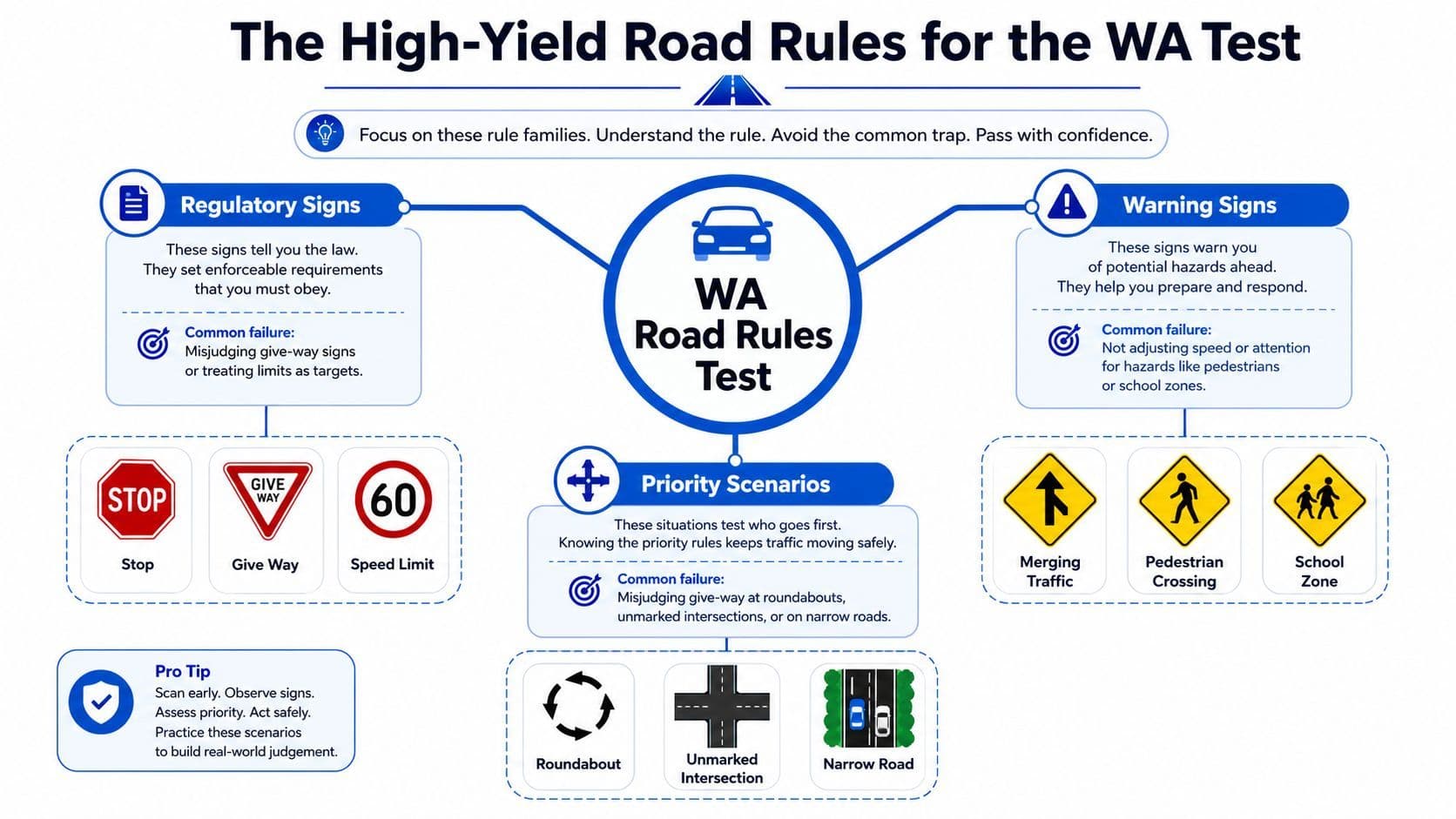
The pressure points tend to fall into a few families. The first is road signs, especially the difference between regulatory signs and warning signs. The second is priority, which includes roundabouts, uncontrolled intersections, and T-junctions. The third is pedestrian protection, especially around crossings and slip lanes. Transport WA points learners to the handbook, but a COTA WA guide exists because these are among the most asked about road rules, which tells you where the confusion sits in real life.
Signs, limits, and temporary changes
Start with the signs you see every day. Stop, give way, and speed limit signs are the backbone of the test because they tell you what action the law expects immediately. Warning signs matter too, especially where they prepare you for school children, merging traffic, or a pedestrian crossing ahead.
Temporary signs around roadworks deserve more attention than many learners give them. They can override the normal expectation you've built on familiar roads, and that's exactly why they're worth practising. If a question shows a changed speed or lane pattern, treat the temporary sign as the priority instruction unless the scenario clearly says otherwise.
Priority at intersections and when pedestrians enter the picture
Many learners lose confidence at an uncontrolled intersection, where you need to decide who gets through first based on road position, turning path, and the specific shape of the junction. At a roundabout, the error usually comes from looking only at your own entry and forgetting that another vehicle's approach angle changes the priority picture.
Pedestrians add a second layer. Slip lanes are especially tricky because drivers often focus on the car turning path and forget that pedestrians crossing the slip lane still matter. If you see a pedestrian crossing on the line of travel, the safe assumption is that the pedestrian's movement controls yours until the crossing is clear.
School-zone and behaviour rules that hide in plain sight
School-zone questions usually look simple and then become slippery fast. Learners misread the sign, miss the active hours, or forget that the question is asking about the zone rather than the road generally. The same goes for alcohol, drugs, and mobile phones. These questions often look obvious, but the test uses them to check whether you know the rule well enough to apply it without hesitation.
Memory hook: When a road question feels ambiguous, ask what the sign, the road user, or the crossing is asking you to protect. That usually points to the right answer.
Sample Questions With WA-Style Explanations
A good way to study is to stop reading rules as paragraphs and start reading them as decisions. The test does that to you anyway. It gives you a short scenario, four options, and expects you to decide fast.
1. Uncontrolled intersection, give way to the right
You approach an uncontrolled intersection at the same time as another vehicle on your right. What should you do?
A. Go first because you arrived slightly earlier
B. Give way to the vehicle on your right
C. Sound your horn and proceed
D. Reverse and re-enter the road
Correct answer: B
The right-of-way rule is about avoiding conflict, not winning position. If the vehicles arrive together, the vehicle on the right takes priority in the usual road-rule logic learners are expected to know. A is tempting because drivers often think in terms of speed rather than priority. C and D are obvious distractors.
2. Default urban speed limit
You're driving on a built-up street and there are no speed limit signs. What's the usual limit?
A. The same as the last signed road
B. 50 km/h
C. 60 km/h unless it's near shops
D. Whatever feels safe
Correct answer: B
This is one of the simplest question types, but people still overthink it. The correct answer is the default urban limit. A is a trap because the last sign doesn't carry forever. C adds a made-up condition, and D ignores the legal rule entirely.
3. School-zone awareness
A school-zone question shows flashing lights. What should you do?
A. Ignore the sign if no children are visible
B. Slow only if a patrol officer is present
C. Treat the zone as active while the flashing warning is in effect
D. Keep the same speed unless the road is narrow
Correct answer: C
The point of the question is the sign, not whether you can see students. A and B rely on guesswork, and D tries to replace the sign with road width. School-zone questions reward attention to the sign's active condition, not assumptions.
4. Pedestrian at a slip lane
You're turning left through a slip lane and a pedestrian is crossing the path ahead. What should you do?
A. Continue if you have already signalled
B. Give way and wait until the pedestrian is clear
C. Honk to warn the pedestrian
D. Move around the pedestrian if there is room
Correct answer: B
This is a classic priority question. The driver's turn doesn't cancel the pedestrian's right to cross safely. A is a common trap because signalling feels like permission. C and D make the situation less safe, not more.
5. Learner alcohol rule
You hold a learner permit and plan to drive after dinner. What alcohol limit applies?
A. A small amount is fine if you feel okay
B. The same as a full licence holder
C. Zero blood alcohol is required
D. It depends on whether a supervisor is in the car
Correct answer: C
Learners need to know this one cold. A and B sound casual, but they're wrong. D tries to blur the rule by introducing the supervisor, but the learner condition still stands.
For more practice in a multiple-choice format, some learners also use the G1 Right-of-Way Rules guide to see how intersection logic is broken down in a different licensing system. The rule logic there isn't WA-specific, but the habit of reading the road scene carefully is the same.
A Four-Week Study Plan Built Around the Drive Safe Handbook
A clean study plan beats random practice every time. Learners usually improve faster when they study in layers, because each week gives them one job instead of trying to absorb everything at once.
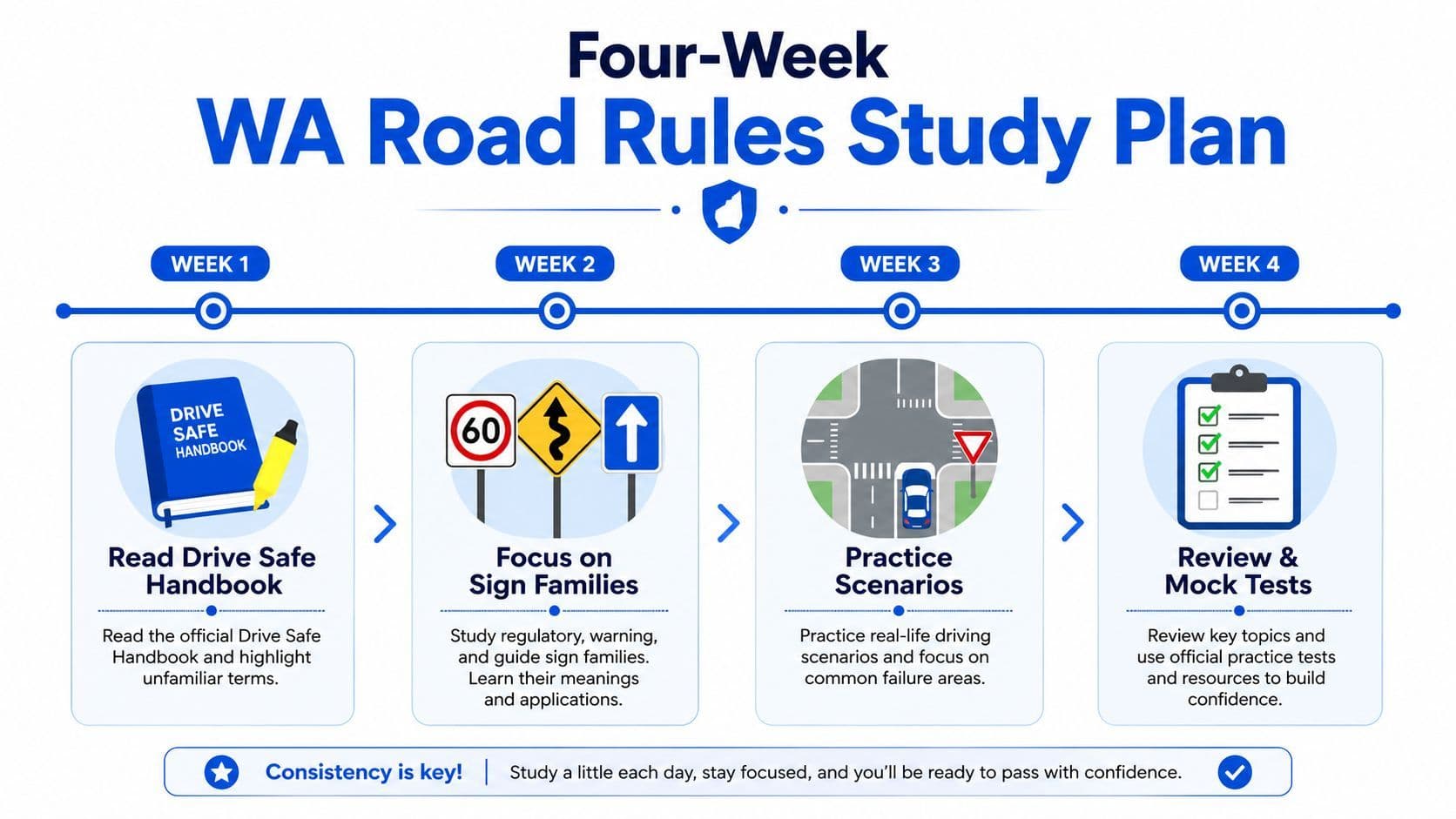
Week 1, read and mark
Read the Drive Safe handbook cover to cover and mark any rule that feels unfamiliar. Don't chase speed here. Your job is to identify the topics that need work, especially signs, give-way logic, and anything that sounds obvious until the question turns it sideways.
Week 2, drill the tricky rule families
Use topic quizzes and short practice sets focused on the areas that confuse people most. Give extra attention to intersections, pedestrian priority, and school-zone conditions. If a rule still feels fuzzy after the second read, copy the scenario into a notebook and write the rule in your own words.
Week 3, mix the topics
Switch to mixed-question practice under timed conditions. That forces your brain to recognise the rule without the safety net of a topic label. If you keep missing the same type of question, don't just redo the quiz, go back to the handbook and compare the wording.
Week 4, full mock runs
Do full-length mock tests, review every miss, and finish with a quiet reread of the rules that still slow you down. A sensible checkpoint is whether you can answer a mixed set cleanly more than once in a row before you book the actual test.
The point of the plan is simple. It turns study into repetition with purpose, not repetition for its own sake.
If you want a structured quiz environment, the G1 licence study material shows how a handbook can be turned into shorter practice sets and review routines. The method is useful even if the licence system is different.
Booking the Test, Fees, and What to Bring on the Day
Test day goes better when the boring parts are already handled. Booking, ID, and arrival details should feel automatic, because that leaves your attention for the questions that trip people up, especially the give-way calls at uncontrolled intersections, pedestrian priority near slip lanes, and the finer points of school-zone signs.
What to sort out before you go
Book through the Department of Transport and choose a time that leaves room for early arrival. Check your identity documents before you leave home, and if you are under 18, make sure the parental consent paperwork is ready as well. Keep your bag simple, because you will not need phones, notes, or anything else that pulls your attention away once you are at the terminal.
If you need to rebook, do it as soon as your plans change. Waiting until the last minute usually adds stress that does not help your study rhythm. A clear schedule makes the whole process feel steadier, which matters more than people expect on a test that already asks you to read road situations carefully.
What the day should look like
Sleep properly the night before and eat something light before you go. Arrive early enough to settle yourself before you sit down, because a calm start makes it easier to read the wording in front of you instead of rushing past it.
The computer will not change the road rules for you. What changes is your own pace. A question about an uncontrolled intersection can feel simple once you have seen the pattern, but it can also look unfamiliar if you arrive tense and start guessing from habit.
You can use the appointment and timing habits in the Ontario G1 test appointment guide as a reminder that test-day logistics matter as much as memory. The licence systems are different, but the habit is the same. Show up early, bring the right documents, and keep the morning free of avoidable friction.
If nerves hit halfway through, slow your breathing and return to the rule. Do not turn one awkward prompt into a bigger problem in your head. One question is only one question, and the safest move is usually to read it again with the road position in mind.
Common Mistakes, Final Tips, and Official Practice Resources
A lot of first-time failures come from familiar traps. The learner knows the topic, but the wording catches them off guard, or they trust instinct where the road rule needs exact reading. That happens often with uncontrolled intersections, pedestrian priority at slip lanes, and school-zone signs, because those questions reward careful checking more than quick memory.
The five mistakes that cause trouble
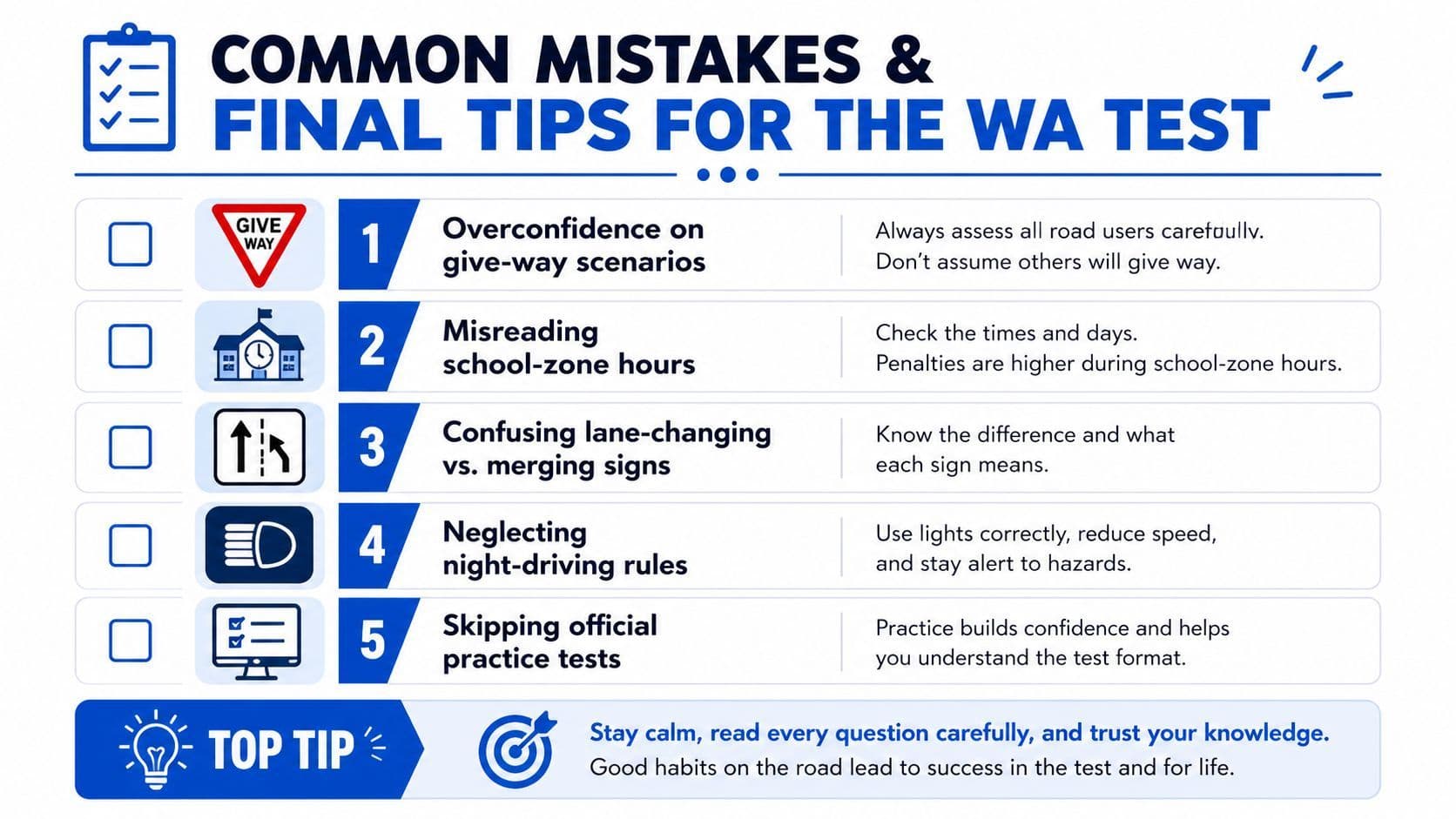
- Overconfidence on give-way scenarios. Read the road position carefully, especially at uncontrolled intersections and roundabouts. A tiny change in who arrives where first can change the answer.
- Misreading school-zone hours. Treat the sign and its active condition as part of the question, not background decoration. School-zone rules work like a gate that opens only under the conditions shown on the sign.
- Confusing regulatory and warning signs. One tells you what you must do, the other tells you what danger or condition is ahead. If you read them as the same thing, the answer can look right while still being wrong.
- Underestimating the zero-alcohol rule for learners. Learner status is not a suggestion, it is a condition. The test expects you to know that the rule is strict, not flexible.
- Running out of time on the last questions. Do not rush early questions so hard that you create panic at the end. A steady pace leaves room to reread the awkward ones instead of guessing under pressure.
The free resources that help most are still the official ones. Start with the Drive Safe handbook, use the WA road-rules theory test quiz, and check the WA theory test overview for the official explanation of how the test sits in the licensing pathway. For the questions that official summaries cover only lightly, especially the tricky priority situations, it helps to revisit them as practice, not as trivia.
If you want one final rule for test day, make it this. Study so you can explain why the answer is right. Recognition alone is fragile. Reasoning is what carries you through the WA test, and it is what helps the rule stick when you are finally out on the road.
G1ready.ca helps learners practise theory-test style questions with immediate feedback, hints, and clear explanations, which is useful when you are trying to lock in road rules logic before test day. If you want a structured way to build confidence with multiple-choice practice and review your weak spots, visit G1ready.ca and start from there.


