
You're sitting in the driver's seat with one hand near the indicator stalk. You've checked the mirror, spotted the turn, and then the hesitation arrives: Does this situation need a signal? That pause is common for new drivers, especially when the road looks quiet or the manoeuvre seems too small to matter.
In Ontario, the answer comes from two connected ideas. The Highway Traffic Act explains when you must communicate a change in direction or position. The MTO handbook explains how early and clearly you must do it. Together, they cover much more than a simple left or right turn.
This guide walks through the legal wording, the practical execution rule, the 30-metre visibility standard, and the four real-road moments learners often overlook: driveway exits, parking-lot movements, passing cyclists, and pulling toward the curb. If you're building your fundamentals, G1 practice for driving can complement this review with targeted preparation.
The G1 Moment Every New Driver Reaches
A new driver usually understands the obvious example. At a marked intersection, you're turning right, so you move the stalk and check for pedestrians. The uncertainty appears in less familiar situations: leaving a driveway, moving around a parked vehicle, changing lanes in a nearly empty street, or slowing beside the curb.
That hesitation matters because signalling isn't a courtesy you add only when traffic is heavy. Ontario's rules apply to G1 drivers during the entire two-stage licensing period, just as they apply to fully licensed drivers. A quiet road doesn't remove the need to communicate your intention.
Practical rule: Signal because your path or position will change, not because another driver has already appeared.
The safest way to think about turn signals lights is as a message sent before your vehicle acts. Other road users need time to interpret the message, decide whether it affects them, and respond. If you steer first and signal afterward, you've reversed the order that makes the signal useful.
The rest of the topic becomes easier when you separate it into three questions:
- What does Ontario law require? The Highway Traffic Act identifies the movements that require a plainly visible signal.
- How should you perform the action? The MTO handbook focuses on signalling before the movement and leaving it on long enough to be understood.
- Where do learners forget? Driveways, parking lots, lane changes near cyclists, and pulling toward the curb create the most uncertainty because they don't always look like conventional turns.
You'll also see how to apply the 30-metre visibility requirement, when brake lights should join your signal, and why a signal that comes on too late can still lose marks even when your intention seems obvious. The aim is to replace the question “Do I need it?” with a dependable habit: if your vehicle will change direction, lane, roadway position, or speed in a way that can affect others, communicate first.
What Ontario Law and the Handbook Actually Require
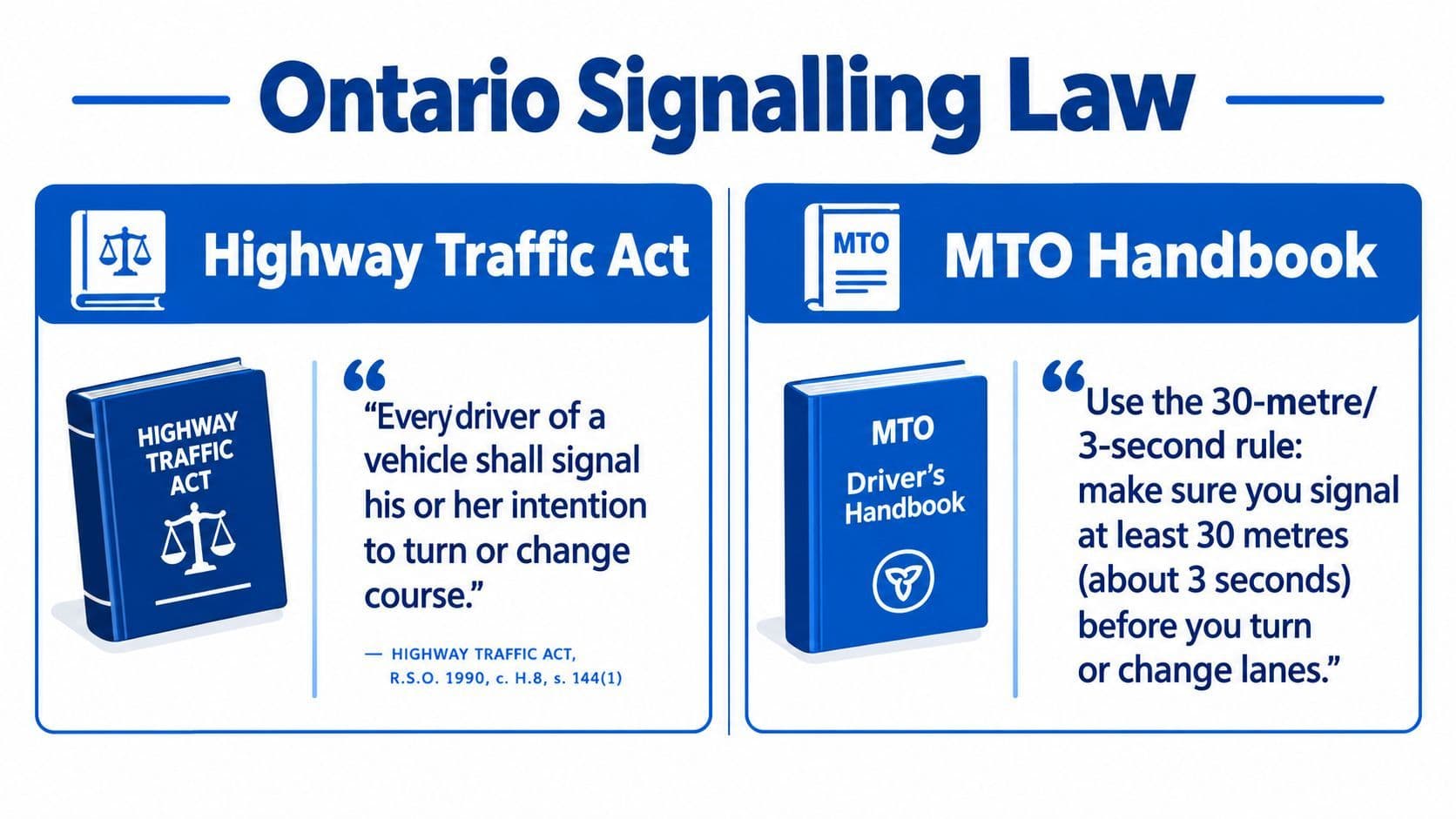
Ontario's Highway Traffic Act uses a clear standard. A driver must give a signal that's plainly visible to other traffic before turning left or right, entering a private road or driveway, changing lanes, or leaving the roadway when another vehicle's operation may be affected. The Ontario Highway Traffic Act wording also sets a technical visibility requirement for mechanical or electrical signal devices.
The signal must clearly show your intention and be visible and understandable from the front and rear in daytime and nighttime from 30 metres. At night, the device must be self-illuminated. That's the legal side of the rule. It tells you that the signal must communicate a planned movement to surrounding traffic.
The MTO handbook adds the execution detail. It tells drivers to use turn signals and brake lights before stopping, slowing down, turning, changing lanes, leaving the road, or moving out from a parked position, and to signal well before the action so other road users can see it. The official MTO guidance on driving along also connects signalling with blind-spot checks and safe movement.
Legal intention and mechanical execution
Think of the paired rule this way:
Requirement What you must do Legal duty Communicate before a turn, lane change, driveway entry or exit, or departure from the roadway when another vehicle may be affected. Execution duty Activate the signal early enough and keep it visible long enough for other road users to understand it. Equipment duty Keep the signal device working and visible from both the front and rear under the applicable lighting conditions.
The 30-metre measure is something you can use during practice. At a residential approach, it may feel like roughly one and a half car lengths before the intersection or lane change, though the exact visual distance depends on the vehicle and road. At higher speeds, begin earlier because traffic covers distance faster and needs more time to react.
The Ontario set-fines schedule lists an $85 set fine for using turn signals improperly, as shown in the Ontario Courts set-fines schedule. That consequence reinforces the practical point: signalling is a regulated driving behaviour, not an optional gesture.
A G1 examiner can see your intention and still mark the action poorly if the indicator appears after the steering input, flashes for too little time, or isn't followed by the required observation checks. For broader review of Ontario traffic rules, use this guide to new driving rules in Ontario.
When You Must Signal Beyond a Simple Turn
Use a trigger list rather than trying to memorise isolated road pictures. Whenever your vehicle changes its direction, lane, roadway position, or movement toward a stop, ask what other road users need to know before you act.
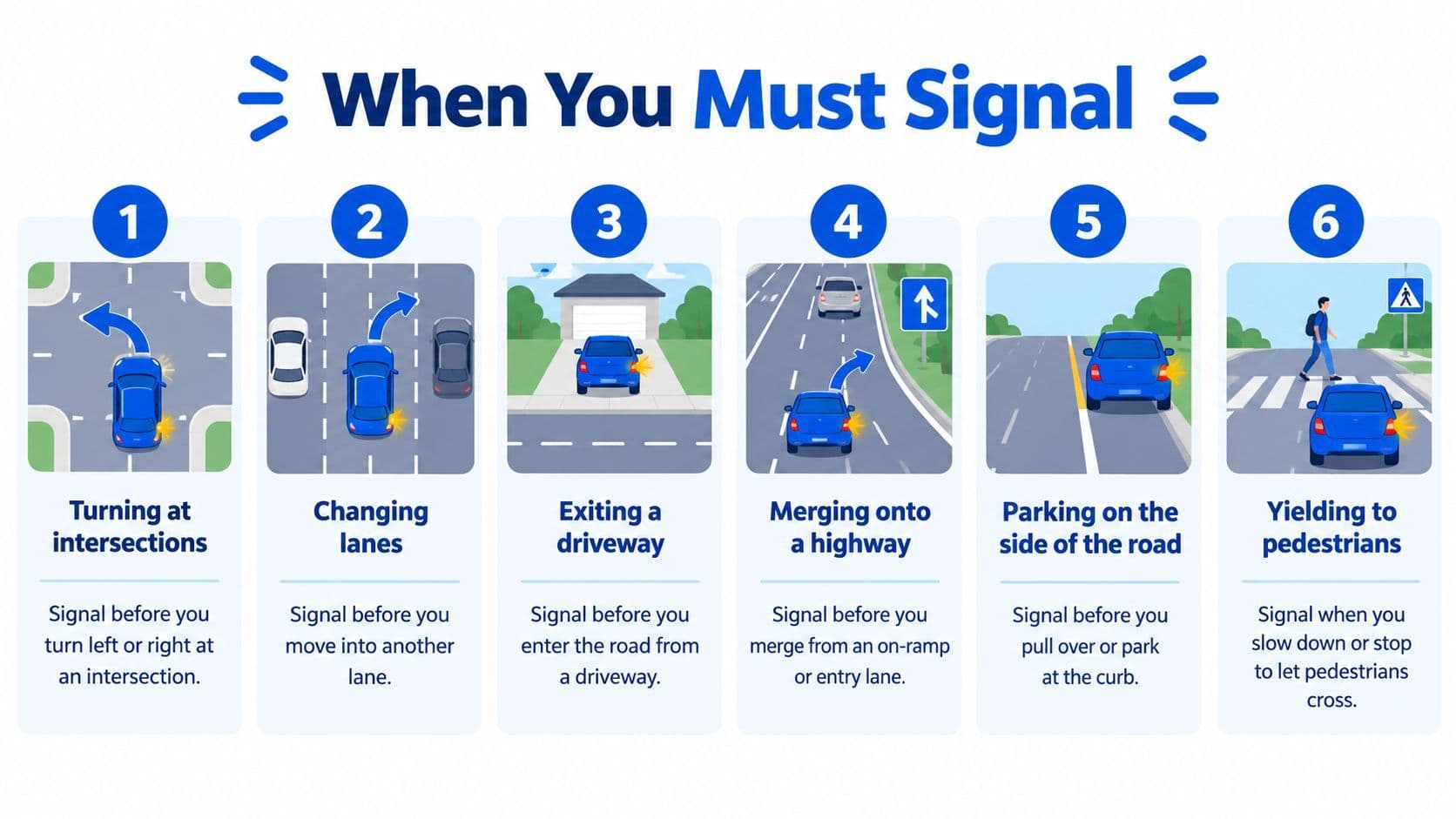
Turning at an intersection or driveway is the familiar trigger. Activate the appropriate signal before braking for the turn and before you begin steering. The same applies when entering a private road or driveway. If you're turning right into a residential driveway, the right indicator should appear before the vehicle begins to slow and angle toward the entrance.
Changing lanes requires a signal before the lateral movement. Turn it on, check the mirror, check the blind spot, and move only when the space is safe. Don't wait until the front wheels cross the lane line. The signal needs to give the driver beside or behind you a readable warning.
Pulling away from a parked curb is another required situation. Signal before you move away from the curb, then complete your mirror and shoulder checks. A parked car may look isolated, but a cyclist, motorcycle, or approaching vehicle can occupy the space you're about to enter.
Slowing or stopping also deserves attention. The MTO handbook tells drivers to use turn signals and brake lights before stopping or slowing down. If you're approaching a hazard, preparing for a turn, or moving toward the curb, communicate before the brake application becomes the only warning.
Other repeat triggers include:
- Leaving a roundabout: Signal before exiting so waiting drivers and pedestrians can understand where you're going.
- Merging from an on-ramp: Use the signal during the merge, then complete mirror and shoulder checks before entering the traffic lane.
- Leaving a parking lot or private lane: Signal before joining the public road, even when you can't see another vehicle.
- Moving around a roadside hazard: If your path shifts into another lane, communicate that change before steering around the obstruction.
The most common G1 trap is treating a driveway or parking-lot exit as “not real traffic.” It still changes your position relative to the roadway, so you should signal before moving. Examiners want to see the indicator come on before the brake or steering input, not as an afterthought once the vehicle is already committed.
How to Signal Correctly in the Car
Start with the stalk, not the steering wheel. In most passenger vehicles, the stalk sits on the left side of the steering column. Push it up for a right signal and pull it down for a left signal, although you should confirm the symbols in the vehicle you're using because controls can vary.
Activate it before the manoeuvre, not while you're performing it. Use the 30-metre visibility standard as your practical target, and give yourself about three seconds where road speed and conditions make that timing appropriate. The goal is enough warning for another driver to see, understand, and respond.
For a full turn, move the stalk firmly and let the indicator remain active through the approach and manoeuvre. For a brief lane change, a light tap may activate the vehicle's temporary three-flash function, but don't rely on that feature if it ends before you've completed the movement. The signal must last long enough to cover the actual lane change.
Look for the green arrow on the dashboard and listen for the regular clicking sound. Those two checks confirm that the signal is active, but they don't replace your observation routine. Check the mirror, perform a shoulder check immediately before moving, and cancel the indicator after the turn or lane change if the vehicle doesn't cancel it automatically.
Brake lights add a second message. If you're slowing for a turn, pulling toward the curb, or stopping near a hazard, press the brake smoothly after the signal has given following traffic advance notice. The mirror, shoulder-check, and signal guide can help you rehearse the order without turning your head too early or moving before the check is complete.
Relax your wrist, keep your thumb near the stalk, and make the signal part of the movement rather than a separate decision.
Small habits are visible during a road test. A relaxed grip helps you control the stalk without disturbing the steering wheel. A consistent sequence, signal, mirror, shoulder check, movement, cancellation, shows that you're communicating deliberately rather than reacting at the last moment.
Real Ontario Scenarios That Trip Up Learners
The indicator question becomes clearer when you follow the vehicle through a complete situation. The road may change, but the communication principle stays consistent.
Leaving a residential driveway
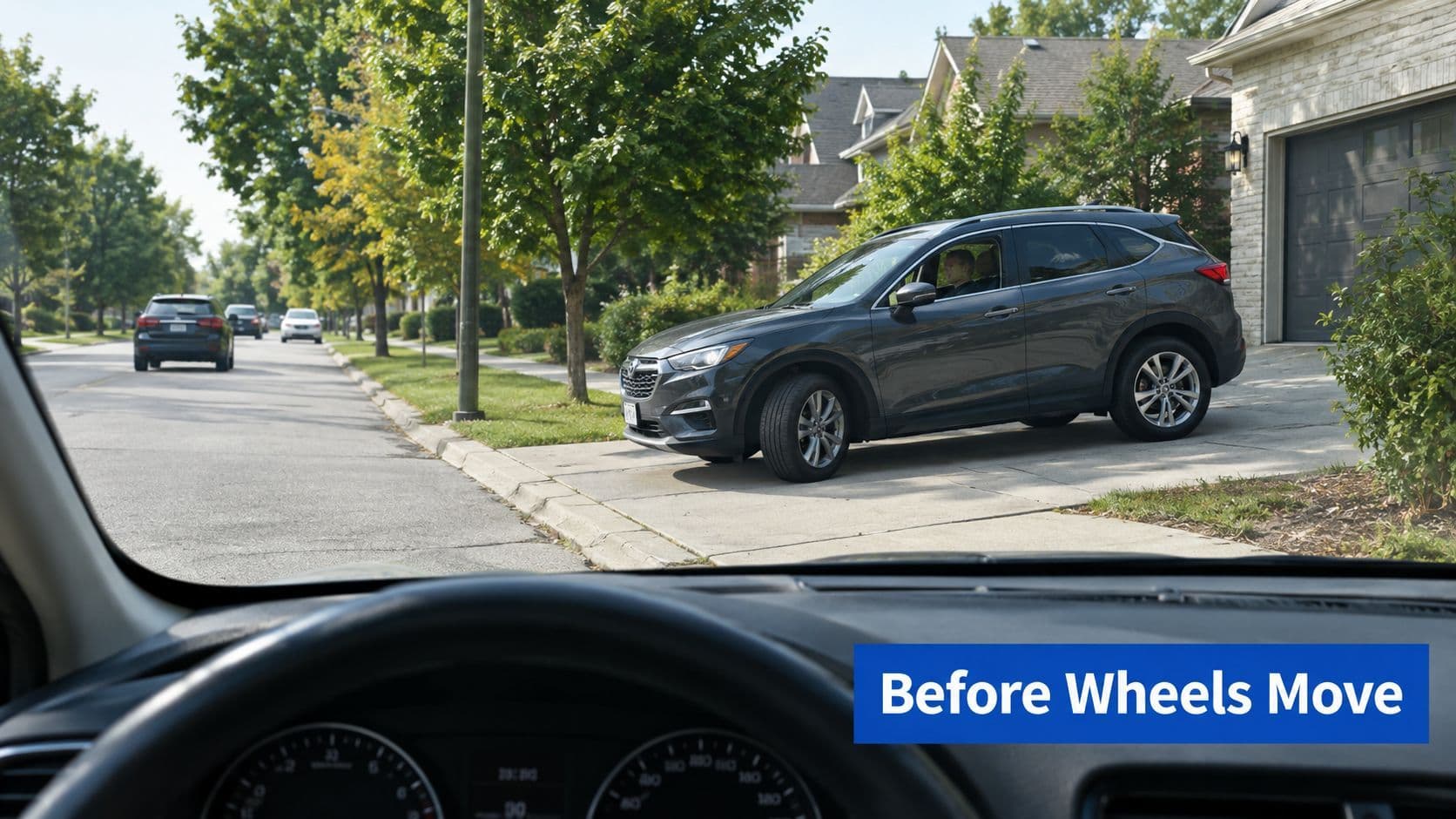
You're reversing or moving forward from a driveway onto a busy street. If you're turning left into the traffic lane, activate the left signal before the wheels move, then check the roadway, mirror, and blind spot. Once the vehicle's nose has cleared the sidewalk and you're preparing to turn right into the lane, the right signal communicates that next direction.
The full-mark habit is signal before the first movement, then update the signal when the vehicle's intended direction changes. Don't treat the sidewalk crossing as a reason to skip the indicator.
Merging toward a QEW-style highway
On an on-ramp, use the left signal while you're preparing to join the traffic lane. Check your mirror, judge the closing speed of vehicles, and complete a shoulder check before merging. If the roadway requires you to cross another lane after joining, cancel the first signal when appropriate, then signal again before the second lane change.
The full-mark habit is one signal for each distinct lateral movement. A long ramp doesn't give permission to drift across lanes without a fresh message.
Turning across a parking-lot aisle
Low speed doesn't make a turn invisible. While crossing a parking-lot aisle, pedestrians may be walking between vehicles and drivers may be searching for an open space. Use the directional signal before steering so people nearby can read your path.
The full-mark habit is communicate even when the setting feels informal. A parking lot still contains conflicting paths.
Pulling toward the curb
Suppose you're moving right to allow a transit bus to pass or to let a cyclist continue safely. Signal right, check the mirror, brake gently, and complete a shoulder check before moving toward the curb. Before re-entering traffic, signal left, check again, and wait for a safe gap.
The full-mark habit is signal both parts of the movement, pulling over and returning to traffic. A cyclist passing beside you needs to know whether you'll remain stopped or move back into the lane.
Common Turn Signal Mistakes to Avoid on the G1 Exam
Some learners know the rule but perform it too briefly or in the wrong order. The correction is usually simple once you identify the assumption behind the mistake.
The lazy lane-change flick
A quick tap can end before the vehicle has started moving into the next lane. If the indicator stops while your car is still crossing the lane line, following drivers receive an incomplete message. Hold the stalk or use the temporary function only when it lasts through the manoeuvre.
Hazards used as permission
Four-way flashers don't ask other drivers to let you move. They make all indicators flash together, so they don't identify whether you intend to go left or right. In a parking lot, use the actual directional indicator for the path you're about to take.
Cancellation forgotten
After a turn, the green arrow may continue flashing down the next block. That can make other road users expect another movement that isn't coming. Cancel the signal as soon as the manoeuvre ends, then confirm that the dashboard indicator has stopped.
Exits treated as automatic
A curved highway exit or roundabout lane can make the steering direction seem obvious. The vehicle still leaves its current roadway path, and drivers waiting nearby need to understand that you're exiting. Signal before the exit rather than assuming the lane shape communicates everything.
Brake and signal reversed
Signalling only while braking on a highway gives following traffic a late warning. Put the directional message first, then brake smoothly when the movement requires it. The correct pattern is signal, observe, act, with brake lights supporting the warning rather than replacing it.
Every error comes back to the same timing principle: the signal must be visible before the movement begins and remain active long enough to be understood.
Turn Signals Versus Hazard Lights and Final Checklist
Turn signals and hazard lights both flash, but they communicate different information. A directional signal tells others that your vehicle is about to move left or right, change lanes, enter a driveway, leave the roadway, or move from a parked position. Hazard lights warn that the vehicle is stopped, unusually slow, or dealing with a roadside problem that affects normal traffic flow.
Ontario law treats these devices differently. The Highway Traffic Act restricts flashing red vehicle lamps, while making an exception for turning signal lamps and four-way hazard lamps, as set out in the Highway Traffic Act provisions on flashing lamps. Hazards aren't a substitute for a directional signal because they don't tell anyone which way you intend to move.
That creates a familiar G1 trap. You're waiting in a left-turn lane at a green light and switch on the hazards because you want to make your vehicle more noticeable. The examiner still needs to see a left signal, because the required message concerns your direction of travel, not merely your presence.
Night-before checklist
Use this short rehearsal before the test:
- Signal distance: Activate the indicator early enough to be plainly visible and use the 30-metre standard as your practical reference.
- Turn timing: Signal before braking or steering into the turn.
- Lane changes: Signal, check mirrors, shoulder check, then move.
- Separate movements: Give a fresh signal for each distinct lane change.
- Driveways: Signal before entering or leaving a private driveway.
- Curb movements: Signal before pulling away from or toward the curb, then signal again before re-entering traffic.
- Cancellation: Turn the indicator off after the manoeuvre and confirm the dashboard arrow has stopped.
- Hazards: Reserve four-way flashers for warning situations, not for ordinary turns, lane changes, or asking for space.
Practise the sequence until your hand reaches the stalk without taking attention away from the road. On test day, you're not trying to make the car look busy. You're showing that every signal has a clear purpose, arrives before the movement, and is followed by a safe observation check.
Use G1ready.ca to practise Ontario-focused questions on signalling, traffic rules, and related G1 topics with immediate explanations and targeted quizzes. Rehearse the timing and mechanics here, then use the practice tests to identify which signalling situations still make you hesitate before test day.


