

Your renewal notice usually shows up at the worst time. You're busy, the expiry date suddenly feels close, and a simple question turns into six smaller ones. What do I need to renew my license? Can I do it online? Do I need a new photo? What if my name or address changed? What if I'm new to Ontario and my documents don't match perfectly?
That confusion is normal. In Ontario, many renewals are straightforward, but the frustrating cases are the ones people remember. A missing document, an old address, a medical requirement, or a change to your name can turn a quick errand into a second trip.
The easiest way to handle it is to treat licence renewal like a document check first and a service transaction second. If your paperwork lines up, the renewal itself is usually the simple part.
Your Licence Renewal Notice Has Arrived
For most Ontario drivers, the renewal notice is the moment the task becomes real. Until then, renewing your licence sits in the same mental pile as updating an address or replacing an old health card. It matters, but it's easy to put off.
Then the letter arrives.
Some people open it and see a quick online renewal. Others realise right away that their situation is different. Maybe they moved. Maybe the licence photo is old. Maybe their legal name changed after marriage, divorce, or another formal update. Newcomers often hit a different problem. Their Ontario file is current, but the supporting documents they plan to use still show an older address or a different version of their name.
That's where most wasted trips start.
Read the notice before you gather anything
The renewal notice often tells you more than people expect. It can point you toward an online option, flag that you need to appear in person, or signal that additional review applies to your case. Don't start with a generic checklist from memory. Start with the notice in your hand and look for anything that changes the path.
A practical approach is to check these points first:
- Renewal method. Does the notice push you toward online, in-person, or another specific process?
- Personal details. Does your name and address still match your current documents?
- Expiry timing. Are you renewing on time, or are you already dealing with an expired licence?
- Extra conditions. Is there any indication that a test, medical review, or updated photo may be required?
Practical rule: If your notice and your current documents don't tell the same story, assume you may need in-person service.
Simple renewals and complicated renewals are not handled the same way
People often search “what do I need to renew my license” expecting one universal answer. In practice, there are two answers. One is for straightforward renewals where your identity, address, and driver record are all current. The other is for files with a change, a gap, or a special condition.
That distinction matters more than most drivers realise. California's renewal system shows how strongly some jurisdictions tie renewal rules to identity and safety checks. The Insurance Institute for Highway Safety notes that California licences are generally valid for 5 years, and drivers 70 and older must renew in person at every renewal. The same table notes that in-person renewal is not permitted for drivers 80 and older without a vision test. That makes renewal a recurring checkpoint, not just a paperwork task (IIHS licence renewal laws table).
Ontario's process is its own system, but the practical lesson is the same. Renewal isn't just about paying a fee and waiting for a card. It's also about making sure the licence record still matches the driver.
The right mindset saves time
Treat your renewal like a file review. Pull together the notice, your current licence, your identity documents, and anything that proves a recent change before you decide where to go or how to submit.
That habit is what keeps a renewal routine instead of irritating.
The Definitive Ontario Licence Renewal Checklist
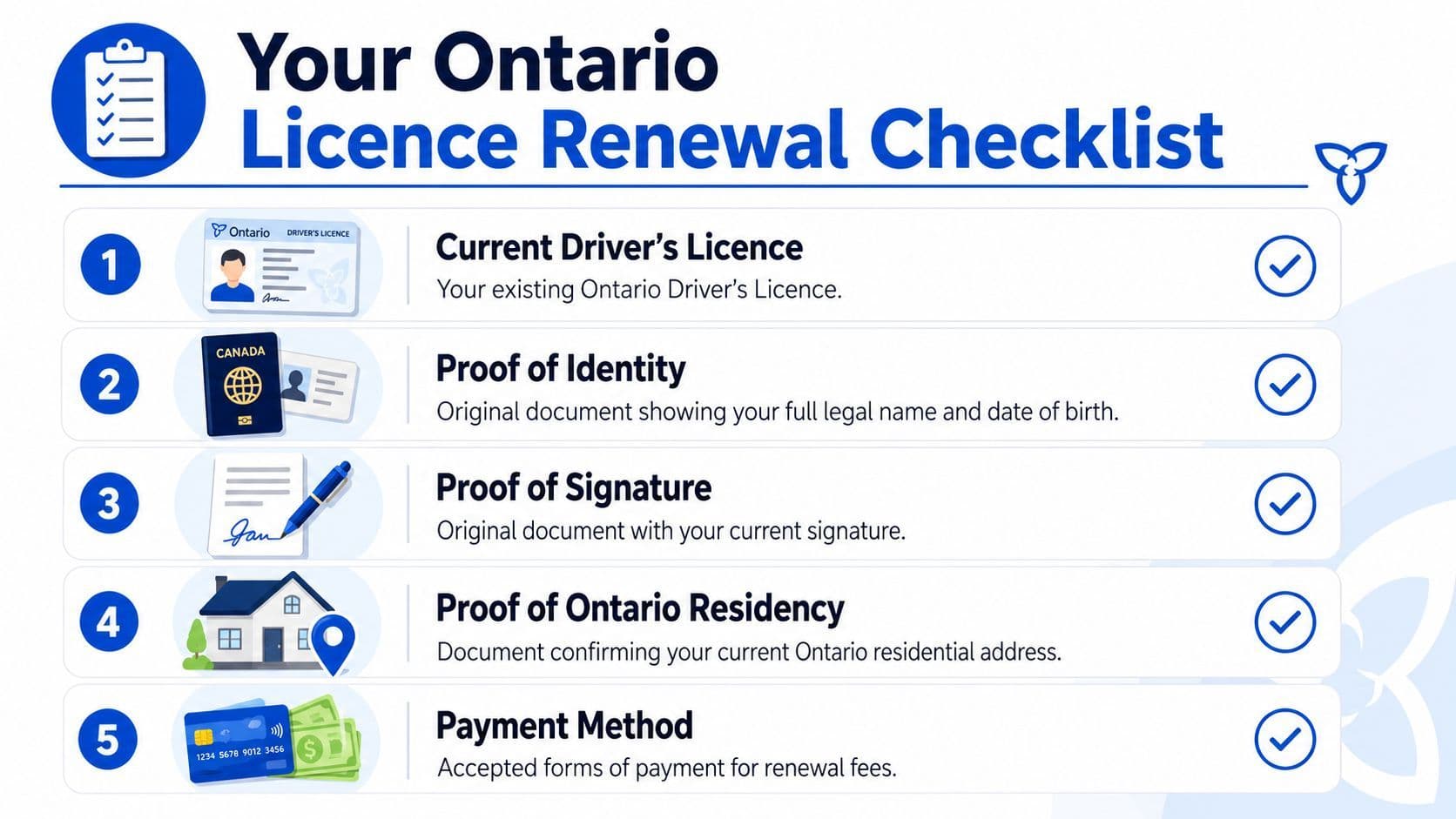
The fastest way to avoid a failed trip to ServiceOntario is to gather more than the bare minimum. People usually bring the current licence and assume that will be enough. It often is for a clean renewal, but it won't help much if the clerk needs to confirm your name, signature, or Ontario address.
Here's the checklist worth using.
Start with the documents most people forget
Your current licence should be the first thing in your wallet or folder. Your renewal notice should be the second. Even when a renewal can be found in the system, having the notice with you reduces guesswork and gives staff the exact starting point they expect.
After that, focus on proof.
What to gather before you leave home
Bring originals, not screenshots or photocopies, unless the process you're using specifically says otherwise.
- Current Ontario driver's licence. This is the anchor document for the renewal. Bring it even if it's close to expiry.
- Renewal notice. If you received one, take it with you. It can contain instructions that change your route.
- Proof of identity. Bring an original government-issued document that shows your full legal name and date of birth. A passport is the document many people reach for first because it's easy for staff to verify.
- Proof of signature. If your situation requires extra verification, bring an original document showing your current signature.
- Proof of Ontario residential address. This is the document people skip most often. Bring something current that clearly ties you to your Ontario address.
- Payment method. Don't assume every location handles payment the same way in the exact same way, especially if you're rushing in near closing time.
A lot of confusion comes from thinking one document will do every job. Sometimes it will. Sometimes it won't. If your passport proves your identity but doesn't help with your current Ontario address, bring a separate address document. If your name changed recently, bring the document that connects the old name to the new one.
Bring the document that explains the change, not just the document that shows the result.
Why originals matter
Service staff need to verify that the document is genuine, current, and readable. Photocopies create problems because they remove security features and make it harder to resolve discrepancies on the spot.
This matters even more in non-standard cases. California's DMV is a useful example of how renewal can turn into a decision tree rather than a single checklist. The DMV says requirements can differ depending on whether you renew online, by mail, or in person, and whether your notice says you need a knowledge test. It also notes that some drivers may need residency proof at every renewal, a record check if they were previously licensed in another state or jurisdiction within the last decade, or identity matching if a name has changed. The same page notes three attempts for a required knowledge test, and a failed third attempt means a new application (California DMV renewal guidance).
The Ontario lesson is simple. If your file is anything other than routine, documents need to tell a clear story.
Before you go, it helps to watch the process once so the steps feel familiar.
Choosing Your Renewal Method Online In-Person or Mail
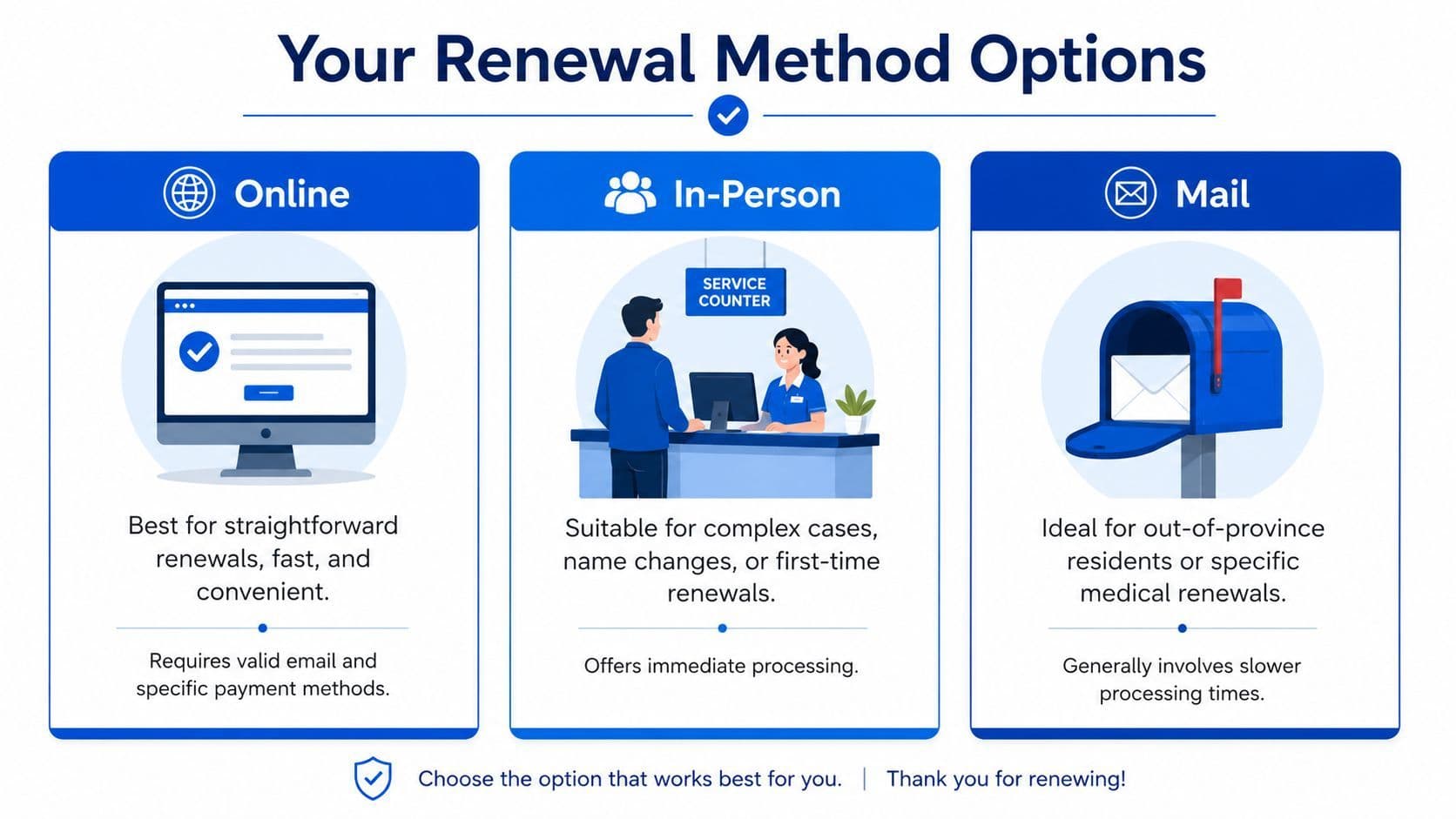
The best renewal method depends less on convenience and more on whether your file is clean. If nothing has changed and your notice points you toward digital service, online renewal is often the least disruptive option. If anything about your identity, address, photo, or driving status needs attention, in-person service is usually the safer path.
Online renewal works best for simple files
Online renewal is the easiest option when your information is already current and the system doesn't need anything new from you. That usually means no unresolved identity issue, no document mismatch, and no instruction requiring an office visit.
Use online renewal when these conditions are true:
- Your personal details are unchanged. Same legal name, same address, no new discrepancy.
- Your notice supports it. If the notice directs you online, that's a strong signal.
- You can pay digitally. Have your payment method ready before you start.
- You don't need same-day clarification. Online is efficient, but it doesn't answer edge-case questions well.
The advantage is obvious. You can finish the transaction without travel or lineups. The drawback is equally obvious. If the system flags something unusual, you still need to go in person.
For drivers who are also updating other information, it helps to review a practical guide to updating your driver's licence details before starting.
In-person renewal is slower but safer for anything unusual
In-person service is the right choice for renewals that have one moving part too many. A name change, an address problem, expired status, document mismatch, or uncertainty about medical or testing requirements all fit here.
Here's the trade-off in plain language:
Method Works well when Main risk Online Your file is straightforward You may get stopped by an unresolved issue In-person Your renewal has complications You spend more time, but usually leave with clarity Mail Your circumstances make remote handling necessary Slower back-and-forth if anything is missing
If you're asking whether your case is “simple enough” for online renewal, it probably isn't.
Mail renewal has a place but it is rarely the easiest option
Mail renewal can make sense when a driver is away, dealing with a specific instruction, or following a process that can't easily be completed online. But mail is the least forgiving method if a document is missing or unclear.
That pattern shows up in other jurisdictions too. Maryland's process is tightly document-gated. Eligible drivers can renew online, by kiosk, or by mail only if they have a renewal invitation and no disqualifying changes. Online renewals require the driver's date of birth, licence number, and the last four digits of the Social Security number. In-person renewal can become mandatory after legal-name changes or if the licence has been expired for more than one year, and the agency may then require a knowledge exam, road test, and vision screening (Maryland renewal workflow summary).
That isn't an Ontario rule, but it shows a practical truth that applies anywhere. Remote renewal works best when nothing needs interpretation.
Navigating Special Renewal Scenarios
Standard renewals are mostly administrative. Special renewals are about proof. When people get stuck, it's usually because the licence record, the supporting documents, and the current real-life situation no longer line up perfectly.
Name changes and mismatched identity documents
A legal name change changes the entire renewal conversation. If your current licence still shows one name and your supporting documents show another, the issue isn't whether you can renew. The issue is whether you can clearly connect the two identities.
Bring the document that creates that link. Depending on your situation, that may be a marriage certificate, change-of-name certificate, divorce document, or another formal record. The mistake people make is bringing only the newest ID and leaving behind the document that explains why the name changed.
If you're helping a newer driver who still has a learner-stage concern rather than a full renewal, this Ontario learner's licence renewal guide covers a different set of expiry and retest issues.
Address changes and out-of-date records
Address problems look minor until they stop a transaction. If you moved and never updated your address, your renewal notice may still have reached you, but your supporting paperwork may not line up cleanly.
A strong address document should be current, readable, and tied to your residential address in Ontario. Old documents create friction. So do documents with abbreviations, nicknames, or unit numbers that don't match how the address appears elsewhere.
Use a quick self-check before you go:
- Street address. Does it match across your documents?
- Spelling of your name. Is it exactly the same?
- Recency. Is the address proof current enough to look credible at a glance?
- Document quality. Is it an original or otherwise acceptable form, not a blurry phone image?
Medical reviews senior drivers and commercial classes
These cases need more patience. If your licence class carries extra obligations, or if a medical issue affects your file, don't treat the renewal as a quick counter visit. Build time for follow-up.
That doesn't mean there's a problem. It means the renewal can involve a review rather than a simple extension. Commercial licences often come with added standards. Medical reporting can trigger extra documentation. Senior renewals may also involve additional screening depending on the exact circumstances.
A useful policy reminder comes from the research on older-driver renewal rules. A 2024 peer-reviewed study in Injury Prevention found that when states relaxed older-driver renewal rules, outcomes worsened. Loosening in-person renewal requirements was associated with a higher crash rate among drivers aged 65 to 74 with RR 1.08, 95% CI 1.01 to 1.16, and less restrictive timing for drivers 75 and older was associated with an increased injury rate of RR 1.10, 95% CI 0.99 to 1.22 (2024 Injury Prevention study).
The practical takeaway isn't alarm. It's context. When renewal rules ask for another review, that step usually exists for a reason.
Renewal Costs Timelines and Common Pitfalls
The hardest part of renewal usually isn't the payment. It's uncertainty. People want to know how much time to set aside, whether they'll leave with everything done, and what mistake is most likely to force a second trip.
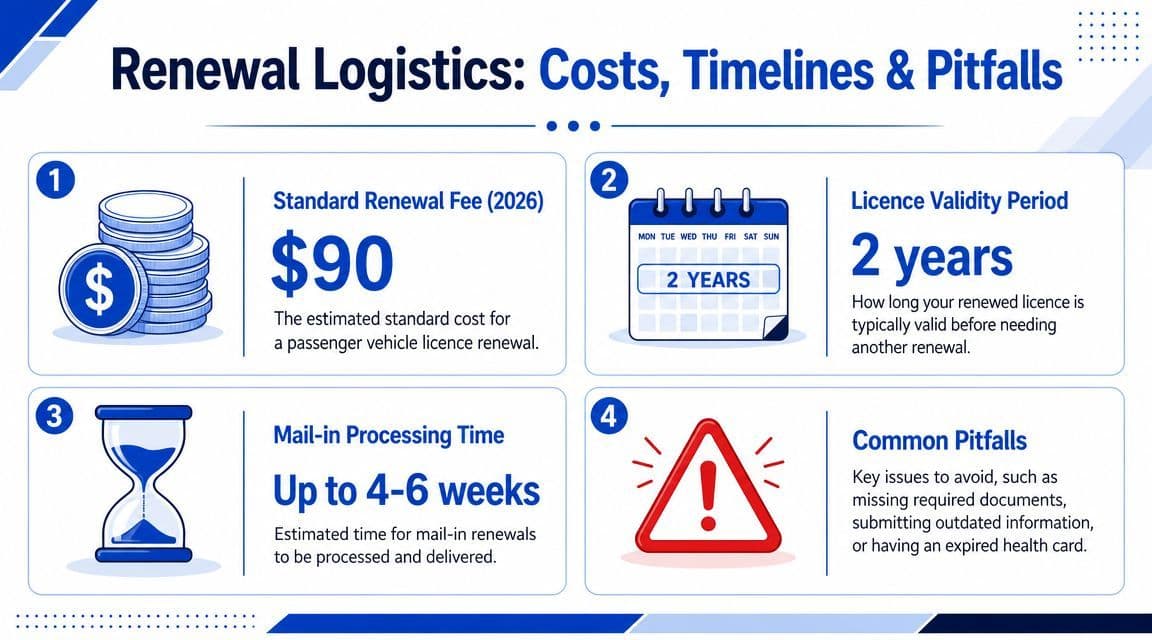
The safest answer on costs is this. Expect a base renewal fee, and be prepared for added charges if your situation triggers extra steps such as testing, medical review, or other file updates. Because fees can change and may differ by licence class or circumstance, check the current Ontario licence renewal fees guide before you go.
What affects cost and timing
Timing depends more on method and complexity than on the renewal itself.
Online renewals are usually the least disruptive because you avoid travel and in-person waiting. In-person renewals take more of your day, but they can resolve questions immediately. Mail is the slowest-feeling route because every missing item turns into another round of waiting.
A realistic way to think about timing is:
- Online. Best when your file is clean and accepted without extra review.
- In-person. Best when you want an answer immediately if something doesn't match.
- Mail. Best only when your situation makes the other options impractical.
The more unusual your file is, the more valuable immediate clarification becomes.
The mistakes that cause the most delays
Most renewal problems are boring. That's good news, because boring problems are avoidable.
Here are the ones I'd watch for first:
- Bringing too few documents. One ID document may not cover name, signature, and address.
- Relying on outdated paperwork. An old address document can derail an otherwise simple renewal.
- Ignoring a name mismatch. If one document has your old name and another has your current one, bring the linking legal document.
- Waiting until the last minute. Tight deadlines make every missing paper feel bigger than it is.
- Assuming online is always faster. It's faster only when your file doesn't need human review.
- Not reading the renewal notice carefully. A single line of instruction can change the entire process.
One more pitfall deserves extra attention. Generic advice often assumes every driver is renewing the same kind of licence in the same way. That's rarely true. Newcomers, commercial drivers, senior drivers, and anyone with a recent legal or medical change need a more careful document check than a basic “bring your licence and pay” answer.
Final Tips for a Hassle-Free Renewal
If you want the smoothest possible renewal, do the prep in the same order a ServiceOntario clerk would check it. First identity. Then address. Then any change that needs explanation. Then payment. When drivers reverse that order, they spend time thinking about the transaction before they've confirmed the file.
A few habits make the process much easier:
Use a pre-visit check instead of a mental note
Put your documents in one place the night before. Don't trust yourself to remember them on the way out the door. Include your current licence, the renewal notice, your main identity document, address proof, and any paper that explains a name or status change.
Choose the method that matches the complexity
People often chase convenience when they should be chasing certainty. If your renewal is routine, online may be the right call. If anything about your file feels even slightly off, in-person service often saves time overall because you can solve the issue while you're there.
Don't treat a mismatch as a small detail
A different spelling, an old address, or a missing legal change document can matter more than people expect. Most renewal headaches don't come from dramatic problems. They come from small inconsistencies that no one fixed early.
A successful renewal usually comes down to one thing. Your documents tell one clear story.
If you searched “what do I need to renew my license”, the short answer is this. Bring more proof than you think you'll need, use the renewal notice as your starting point, and choose in-person service whenever your case isn't fully straightforward.
That approach isn't flashy, but it works.
If you're still sorting out Ontario licensing questions, G1ready.ca has Ontario-focused study tools and guides for drivers preparing for written tests, learner-stage steps, and related licence questions.


