Stop repeating the shortcut you've probably heard from friends, siblings, and even well-meaning parents. A broken yellow line doesn't mean passing is allowed. Not automatically. Not every time you see those dashes. That shortcut leaves out the half that matters on a G1 test and on a real Ontario road, the conditions you must check for yourself.
Why a Broken Yellow Line Road Marking Matters
You're behind a slow farm vehicle on a quiet two-lane road outside town. The centre line is broken. Your hands tighten a little. You think, can I go?
That pause is normal. It's also useful. A broken yellow line road marking isn't a green light, it's conditional permission. The paint opens a door, but you still have to look through it before you move.
An open gate on a shared path doesn't mean the other side is clear. You still check for people coming toward you. You still judge whether there's room to get back to your side.
Who runs into this question
Teen learners meet it first on practice questions. Parents meet it later, in the passenger seat, trying not to grab the dashboard. Newcomers to Ontario meet it when the lines look familiar but the wording on the test doesn't match what they learned elsewhere.
Instructors hear the same worry in different words. The learner can name the line. The learner can't yet explain what to check before crossing it. That gap is where marks, and confidence, get lost.
If you can only name the line, you know half the answer. The other half is what you must verify before you move left.
You'll get both halves here. You'll learn what the colour tells you and what the broken pattern tells you. You'll see how a broken line differs from a solid one, work through five road situations where the right answer is often to wait, and clear out the myths that make learners overconfident.
You don't need to memorise a slogan. You need a habit. See the line, read the road, then decide. That's the habit a careful Ontario driver builds, and it's the habit G1 questions are testing.
Reading the Colour and Pattern Together
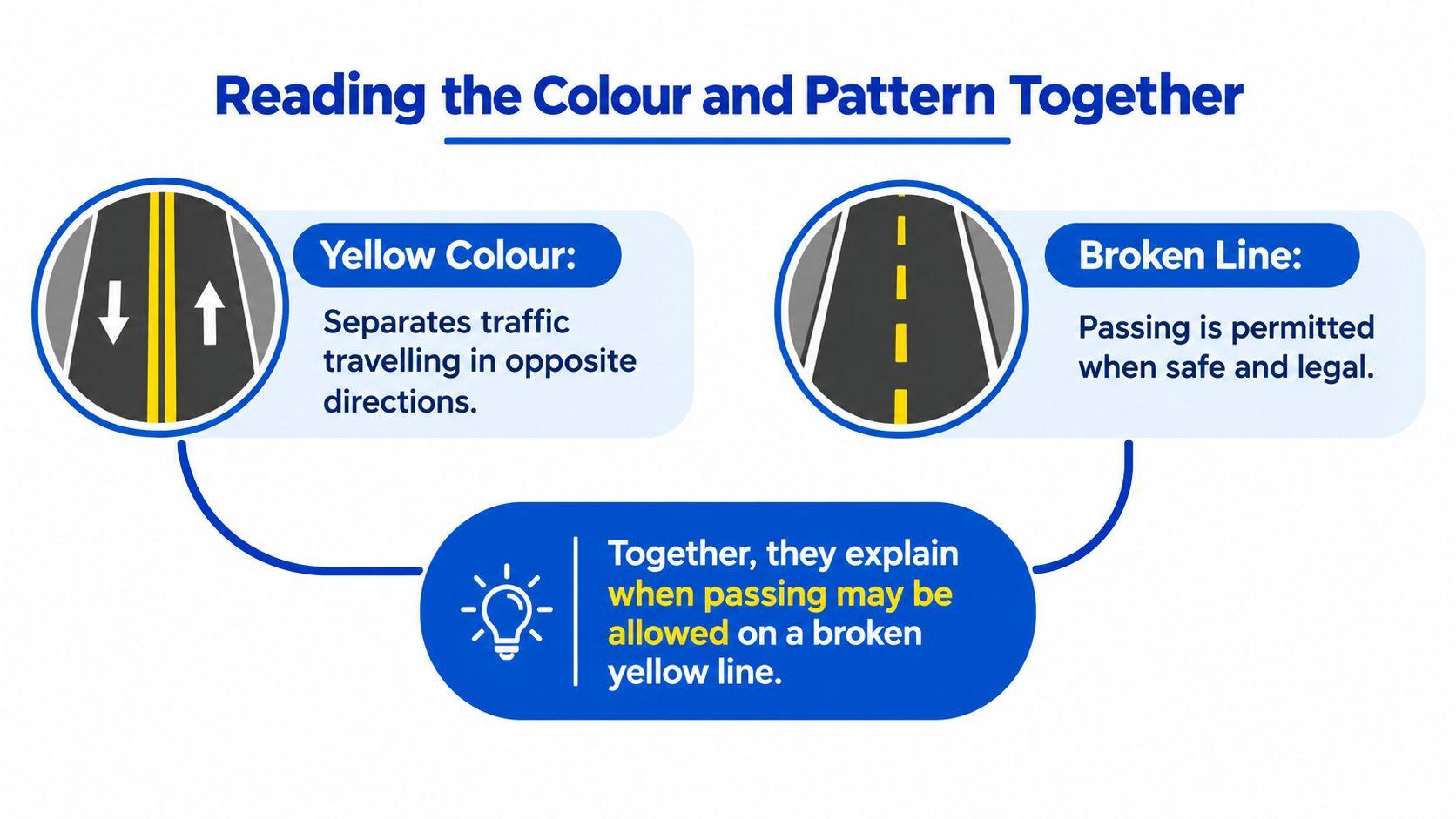
A centre line packs two messages into one marking. Learners get confused when they try to read both at once. Slow it down. Read them one at a time.
The colour tells you who is on the other side
Yellow separates traffic travelling in opposite directions. That's the first message. If yellow is on your left, vehicles on the other side are coming toward you.
Use a school hallway in your head. Two streams of students walk toward each other. Someone paints a yellow boundary down the middle so each stream keeps to its own side. Yellow doesn't say you can cross. It says, careful, the other side moves against you.
The pattern tells you whether crossing may be considered
The broken pattern adds the second message. In Ontario, a broken yellow centre line separates opposing traffic, and Ontario's MTO Driver's Handbook guidance on a broken line on the left says a driver may pass only when the way ahead is clear and there's enough broken line remaining to complete the manoeuvre safely.
Stay with the hallway. The gaps in the line are like openings in that boundary. An opening lets you step into the other stream for a moment, but only if nobody's coming and you can step back before the opening ends.
Two checks hidden inside one rule
Read that handbook wording closely, because G1 questions love to test it word by word.
- The way ahead is clear: You can see far enough, and no oncoming vehicle, hazard, or obstruction blocks the lane you'd borrow.
- Enough broken line remains: The opening doesn't run out mid-pass, forcing you to squeeze back in a panic.
Miss either check and the answer changes. The line hasn't changed. Your situation has.
That's why conditional permission is the phrase to keep. Yellow warns you about opposing traffic. Broken says passing may be permitted under suitable conditions. Neither part guarantees that passing is legal or safe right now, in this spot, at this speed, with this view.
On test questions, train your eye in that order. Colour first, what's on the other side? Pattern second, may I consider crossing? Conditions third, should I? Learners who skip straight to the pattern often pick the cheerful answer. Learners who read all three pick the correct one.
Broken Versus Solid Yellow Lines Compared
Same colour, different pattern, different instruction. That contrast trips up learners who remember yellow but forget to look at whether the line is broken or solid.
A solid yellow line signals that passing is unsafe. The road is telling you the view, the curve, or the layout ahead doesn't give you a safe opening. Annoying when you're stuck behind a slow truck, yes. But the line was painted after someone studied that stretch so you don't have to guess.
Don't mix up yellow and white
Here's the other mix-up to clear early. In Ontario, the MTO handbook distinction between yellow and white pavement lines explains that yellow lines separate traffic travelling in opposite directions, while white lines separate traffic travelling in the same direction.
So a broken white line is about changing lanes beside traffic moving with you. A broken yellow line is about borrowing a lane from traffic moving toward you. Same dashes, very different risk. If you swap the colours in your head, you'll misread the whole road.
Reading Yellow, White, Broken, and Solid Pavement Lines
Marking Traffic it separates Passing meaning Decision for the driver Broken yellow Opposite directions Passing may be permitted when clear Check ahead, check the remaining broken line, then decide Solid yellow Opposite directions Passing is unsafe Stay in your lane and wait for conditions and markings to change Double yellow Opposite directions Passing is unsafe for traffic on the solid side as set out in the handbook markings Treat the centre as closed for passing and hold your position Broken white Same direction Lane changing beside same-direction traffic Check mirrors and blind spot, then change lanes when safe Solid white Same direction Lane changing is restricted by the marking's purpose Stay in lane unless directed or required to move safely
Notice what the table doesn't say. It doesn't say a broken line guarantees a lawful pass in every situation. The handbook is careful on this point, and so should you be. Markings also divide lanes, identify turning lanes, and mark pedestrian crossings and obstacles. One marking never tells the whole story of a road.
Roadside rule of thumb: Colour tells you the direction of the traffic beside you. Pattern tells you whether the door is open. Your eyes tell you whether to walk through it.
When a practice question shows you a picture, cover the answer choices for a second. Name the colour out loud. Name the pattern. Then look at the choices. You'll feel the wrong answers fall away, because most of them mix up one of those two signals.
Working Through Real Passing Scenarios
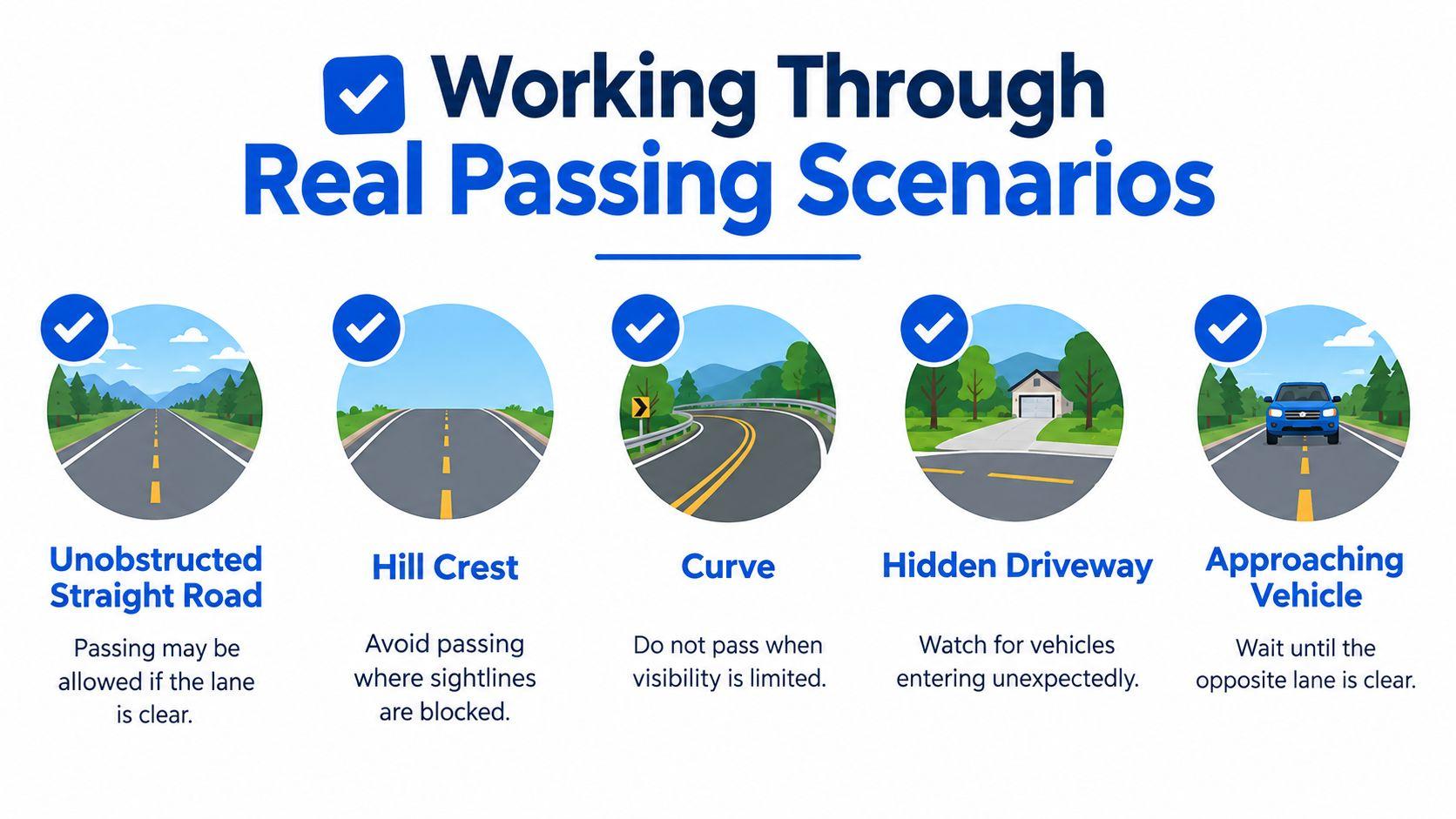
A broken yellow line gives you a chance to pass, not a green light to go. The difference becomes clear when the road changes. Here are five situations to practise judging before you act.
Five roads, five decisions
1. The open, straight road. You can see well ahead, and no traffic or road users are in your path. There is enough broken line to complete the pass and return to your lane with room to spare. After checking ahead and behind and signalling, you may decide the pass is safe.
2. The hill crest. The road rises and hides what lies beyond. Even with a broken line, you cannot confirm the oncoming lane is clear. Wait until you have a clear view.
3. The curve. Trees or the bend block your sightline. An oncoming vehicle could appear before you have room to return. Stay in your lane.
4. The hidden driveway. A hedge or roadside gap may conceal a vehicle about to pull out. Scan the road edges and keep enough space to respond. If you cannot see what is ahead, wait.
5. The pedestrian crossover. A person approaching or using the crossing needs your attention. Do not pass near the crossing. Wait until the area is behind you and you can assess the road clearly.
A routine for judging the pass
Use the same checks each time, like checking both ways before crossing a street:
- Look ahead: Check for oncoming traffic, hills, curves, intersections, and enough broken line to finish the pass.
- Check behind: Look in your mirrors. Is another driver already passing?
- Scan the roadside: Watch for pedestrians, cyclists, driveways, and vehicles waiting to turn.
- Decide early: If anything is unclear, stay in your lane. You can reassess when the road opens up.
Passing is one part of driving on a two-lane road. For more practice with speed, spacing, and scanning, read this guide to driving on a highway in Ontario. A broken line may allow the move, but only a clear view and enough room make it a sensible choice.
Common Misconceptions About Passing Rules
Misconceptions spread because they're short. Short is easy to repeat in a hallway before a test. Short is also where the conditions get trimmed off.
Three shortcuts to retire
Broken means go. This is the big one. It turns conditional permission into a promise. The handbook attaches clear conditions to that broken line, and dropping them is like reading only the first half of a sentence. On the test, answer choices that say passing is always allowed on a broken line should make you suspicious.
Empty-looking means safe. A road can look empty because the hazard is hidden. A crest hides a car. A curve hides a cyclist. A hedge hides a driveway. Learners trust empty. Experienced drivers trust visible. If you can't see it, you can't claim it's clear.
The centre line is only about my pass. It isn't. There's another driver in this story, coming toward you, with a right to their half of the road.
The other driver's half of the road
Here's the rule that corrects that third myth. Ontario's Highway Traffic Act provision on vehicles meeting one another requires vehicles meeting on a highway to move to the right of the centre of the roadway, leaving the other vehicle one-half of the roadway free.
Read that as a learner, not a lawyer. When you borrow the oncoming lane, you're borrowing someone else's half. You must be able to give it back, fully and in time, while still meeting the handbook's conditions for passing. Both rules apply at once. One doesn't cancel the other.
That's also why studying markings beside the wider rules helps, and a clear overview of Ontario traffic control regulations can connect centre lines to the signs and signals you'll meet in the same questions. The test rarely asks about one rule in total isolation. It layers them, the way a real intersection does.
If your plan only works when the oncoming driver brakes, slows, or swerves for you, it isn't a plan. It's a hope. Don't pass on hope.
Replace each shortcut with a question. Not, is it broken, but, is it clear? Not, does it look empty, but, can I see? Not, can I fit, but, can I return and leave their half free? Questions keep you honest in a way slogans can't.
Comparing Ways to Study Centre Line Questions
You can study this topic three common ways. Each one teaches something. Each one leaves a gap. Knowing the gaps helps you combine them instead of relying on one and hoping.
Three approaches, honestly compared
Rereading the official handbook. The exact wording lives there, and the wording matters. It's the right place to confirm what broken and solid lines mean. Its limit is simple. Reading a rule ten times doesn't test whether you can apply it to a picture of a hill crest under time pressure.
Full mixed practice exams. These show you how a centre line question feels when it arrives between a sign question and a right-of-way question, which is how test day works. They're great for stamina and pacing. Their limit is focus. If markings are your weak spot, a full exam might only give you a couple of them before moving on.
Targeted quizzes on one regulation. These repeat the same idea in different scenarios until the reasoning sticks. Broken line on a straight road. Broken line at a crest. Broken line near a driveway. That repetition is exactly what conditional rules need, because you're practising the judgement, not just the definition.
Where a practice platform fits
One option in that mix is G1ready.ca, which offers free, registration-free practice exams, targeted quizzes on specific traffic regulations, mixed tests, a diagnostic test, and a G1 exam simulator. Questions include immediate feedback, hints, and explanations, and the platform tracks progress and performance statistics so you can spot weak areas. It's mobile-friendly, allows unlimited retakes, and provides individual customer support.
For a parent or instructor, that kind of tool works as homework between drives. You handle the road. The quiz handles the repetition. If you're comparing study formats more broadly, this guide to free driving licence practice tests lays out what to look for before you commit your study time.
- Use the handbook to confirm: Check the rule when an explanation surprises you.
- Use targeted quizzes to build judgement: Stay on markings until the scenarios feel familiar.
- Use full exams to rehearse test day: Mix everything once the single topic feels solid.
That order matters. Learners who start with full exams often practise their mistakes at speed. Learners who build one topic first walk into the full exam with something to rely on.
Your Next Step Before Test Day
You don't need more slogans before test day. You need one habit, practised until it feels boring. Boring is good. Boring means automatic.
Say it out loud, every time
On every practice drive and every practice question, talk yourself through the same three steps. Name the marking. State the conditions. Explain the decision.
It sounds like this. Broken yellow line, opposing traffic on my left. I may pass only if the way is clear and enough broken line remains. I can see a crest ahead, so I can't confirm it's clear. I'm waiting.
That little speech feels silly the first time. By the tenth time, it's just how you think. Parents and instructors, ask for it by name. Don't ask, can you pass here? Ask, walk me through it. You'll hear exactly where the reasoning breaks, and so will the learner.
A simple routine for this week
- Start narrow: Take a targeted quiz on pavement markings only. Don't mix topics yet.
- Study your wrong answers: Read each explanation slowly. Which condition did you miss, the clear way ahead or the remaining broken line?
- Retake until the reasoning is automatic: You're not chasing a score. You're chasing the moment the checks happen without effort.
- Then widen out: Move to mixed questions and notice whether the habit survives when markings sit beside signs and signals.
Test-day habit: Treat every broken yellow line as a question, not an answer. The line asks, is it clear? You supply the answer with your eyes.
One last reassurance for nervous learners. Waiting is a complete, respectable answer. On the road, nobody awards points for the boldest pass. On the G1 test, the careful choice is very often the correct one, because the questions were written by people who want you checking conditions, not collecting dashes.
You came in with a shortcut. You're leaving with a method. Colour, pattern, conditions, decision. Practise that order until it's reflex, review the questions you got wrong while they're still fresh, and you'll meet centre line questions on test day the way a calm driver meets that quiet two-lane road. Unhurried. Eyes up. Ready to wait, and ready to go only when it's clear.
Ready to turn that habit into test-day reflexes? G1ready.ca offers free, registration-free G1 practice exams and targeted quizzes on pavement markings and other Ontario traffic regulations, with immediate feedback and clear explanations for every answer. Start with a markings quiz today, review the questions you miss, and retake it until reading a broken yellow line road feels automatic.