
You've just passed the G1 knowledge test, collected your Ontario photo card, and started planning your first drive. Then a parent asks whether you can take friends to school, or whether you can practise on a 400-series highway. That's often the moment a new driver realises that holding a licence doesn't automatically mean having unrestricted driving privileges.
Ontario's driving license restrictions are designed to control risk while a driver builds experience. Some apply because you're at the G1 or G2 stage. Others remain attached to an experienced driver because of vision, medical, or vehicle-class requirements. The practical challenge is knowing which rules apply to you, how they're recorded, and what paperwork may be needed before a restriction changes.
What Driving License Restrictions Actually Mean in Ontario
A teenager leaves a DriveTest centre with a new Class G1 card and feels ready to drive. The card is real, but it comes with conditions that affect who can sit beside the driver, when the car can be used, and which roads are available. Ontario's graduated licensing system is built around increasing exposure gradually, rather than giving a new driver every privilege immediately.
A restriction is a legally enforceable limit connected to your licence or driver record. Breaking one can lead to a traffic charge, demerit consequences, or a licence problem. The exact consequence depends on the offence and the driver's record, so a new driver shouldn't treat a restriction as informal advice.
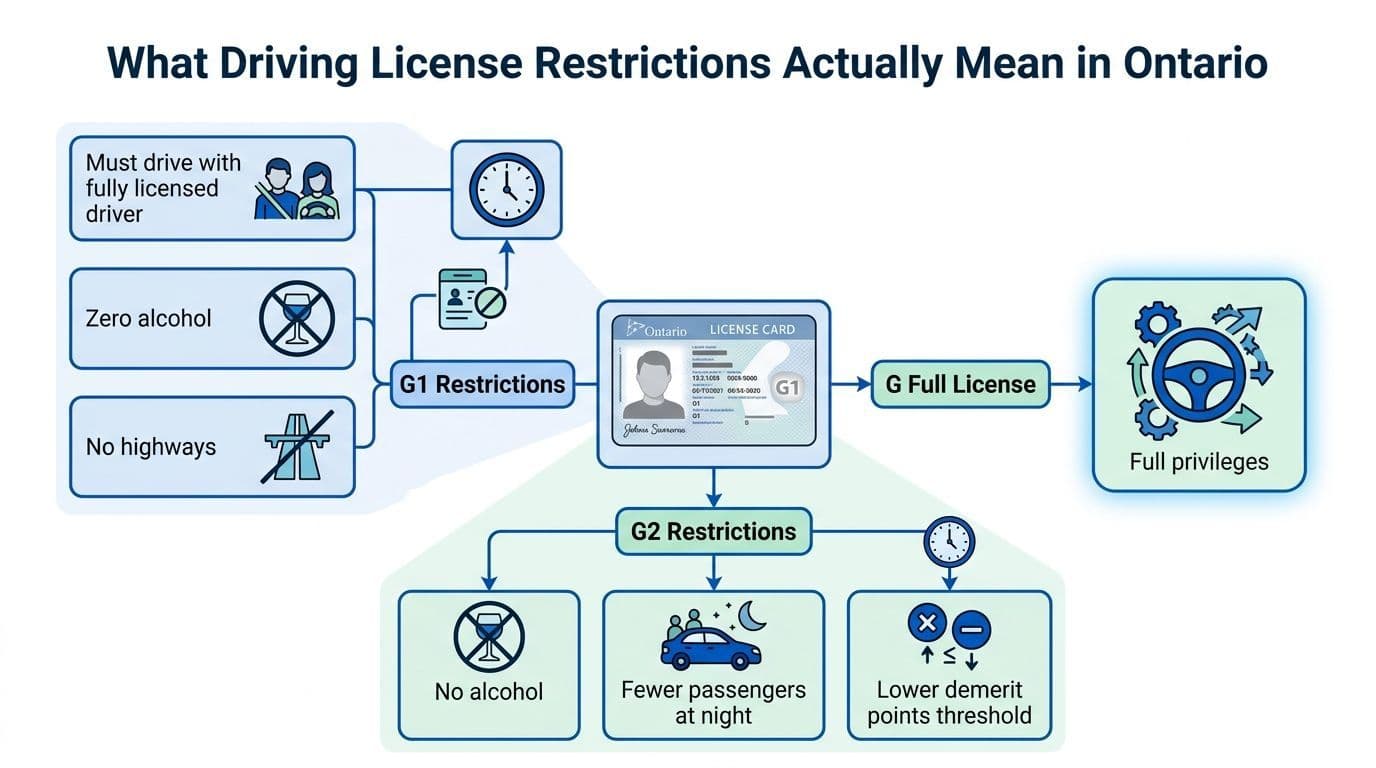
Two restriction tracks
The first track is the novice-driver system. G1 and G2 conditions regulate supervision, alcohol, passengers, time of day, and road access. Ontario's government reports that, 14 years after graduated licensing began, fatalities and injuries among teen drivers had declined by almost 25 per cent (Ontario's road-safety backgrounder).
The second track is condition-based licensing. A driver may need corrective lenses, medical monitoring, or a particular vehicle class. Those restrictions can apply even after the driver reaches a full G licence.
A licence restriction isn't a punishment by itself. It's a condition that defines when, where, or how you're legally allowed to drive.
For a new driver, the immediate question is usually simple: “Can I drive this trip?” The answer depends first on whether the card says G1, G2, or G, and then on any additional conditions recorded on the licence.
G1 Licence Conditions and the Rules You Must Follow
A Class G1 licence gives you permission to practise, but only inside a tightly controlled framework. The Ontario Highway Traffic Act regulation for novice drivers sets out the core conditions, while the official MTO driver's handbook explains them for learners.
The supervisor and the vehicle
You can't drive alone with a G1. The accompanying driver must sit beside you, hold a valid Class G or higher licence, and have at least four years of driving experience. That supervisor's blood-alcohol concentration must be below 0.05, and if the supervisor is 21 or under, the required BAC is zero. The G1 driver must have zero blood alcohol.
Only the supervising driver may occupy the front passenger seat. Other passengers can sit in the rear, but everyone must have a working seatbelt and the vehicle can't carry more people than its seatbelts allow. The rule also prevents a G1 driver from using a passenger arrangement that creates additional distraction beside the steering wheel.
A supervisor's eligibility needs to be checked, not assumed. The MTO handbook explains that G2 time can count toward the experience requirement only when the G2 licence was valid and wasn't suspended. A person who appears experienced may still fail the legal test if their licensing history doesn't meet the condition.
Time, roads, alcohol, and towing
A G1 driver may drive only between 5 a.m. and midnight. Driving from midnight to 5 a.m. isn't permitted, even for a short trip. G1 drivers also can't drive on 400-series highways or certain high-speed expressways unless they're accompanied by an Ontario-certified driving instructor.
The alcohol rule is absolute for the novice driver. The G1 holder must maintain a zero blood-alcohol level, and that requirement applies even when the driver feels capable of driving. Seatbelts are mandatory for every occupant.
A G1 driver may tow only a trailer that doesn't require a separate braking system. Street racing and stunt-driving conduct are treated as serious offences, not as ordinary learning mistakes. If a G1 licence expires, the driver must follow the applicable renewal or retesting process instead of continuing to drive on an expired credential.
Condition What It Means Penalty Qualified supervisor A fully licensed driver with the required experience and BAC status must sit beside you A violation can result in a charge and licensing consequences Zero alcohol The G1 driver must have zero blood alcohol Alcohol-related conduct can trigger serious sanctions Front-seat rule Only the supervisor may sit in the front passenger seat Carrying another front passenger breaches the condition Time restriction No driving between midnight and 5 a.m. A prohibited trip can lead to enforcement action Highway restriction No 400-series highways or specified expressways without an Ontario-certified instructor Road access is limited during the learning stage Seatbelts and capacity Every occupant needs a seatbelt, and the vehicle can't exceed its belt-equipped seating Unsafe passenger arrangements can create separate offences Towing Towing is limited to a trailer that doesn't require a separate braking system Improper towing can breach the G1 condition
The system's logic is consistent. It removes solo driving, alcohol exposure, late-night driving, high-speed-road exposure, and unnecessary front-seat distraction while the driver is still developing judgement.
G2 Licence Conditions and How the Rules Eased
The G2 stage changes the daily experience substantially. You no longer need a qualified accompanying driver for every trip, you can drive on highways, and the midnight-to-5-a.m. curfew is removed. These changes recognise that passing the first road test demonstrates a higher level of control than a G1 permit, but they don't turn a novice driver into an unrestricted driver.
What changes from G1
A G2 driver may drive alone and may use 400-series highways. The G1 front-seat supervision rule no longer applies to the G2 driver, and passenger numbers return to the vehicle's ordinary seatbelt capacity rather than the G1 arrangement.
Alcohol rules also change, but a G2 driver remains subject to Ontario's novice-driver alcohol restrictions. The zero-alcohol expectation continues to matter, and a driver shouldn't interpret the move from G1 to G2 as permission to drink and drive.
The MTO's G2 licensing information remains the right place to confirm the conditions attached to a current licence.
What stays strict
Seatbelts still apply to everyone in the vehicle. Distracted driving rules still apply, including the use of handheld electronic devices. A G2 driver also remains inside Ontario's novice demerit-point system. Escalation can lead to an interview, a suspension, or other licensing consequences, and a novice driver can face a 30-day suspension at nine demerit points under the applicable graduated system.
A G2 driver who is carrying a G1 learner must also respect the G1 rules. The G1 passenger still needs a qualified supervisor beside them, so a G2 driver can't sit in that seat and make the practice drive legal.
Topic G1 Rule G2 Rule Driving alone Not permitted Permitted Supervisor Required beside the G1 driver Not required for the G2 driver's own driving 400-series highways Not permitted unless with an Ontario-certified instructor Permitted Midnight to 5 a.m. Driving prohibited Curfew removed Alcohol Zero blood alcohol Novice alcohol restrictions still apply Passengers Front seat limited to the supervisor, with seatbelt limits Ordinary seatbelt capacity applies G1 learner in the vehicle Qualified supervisor required A G2 driver can't supervise unless legally eligible
Ontario's handbook says the graduated process includes G1 and G2 before the full G licence, and drivers have up to five years to complete it (Ontario handbook export). G2 therefore represents broader access, not the end of the licensing journey. Approved beginner driver education can also affect the timing before the G exit test, provided the driver meets the ministry's requirements.
For a practical explanation of the next stage, review this G2 licence guide alongside the current MTO rules.
Medical, Vision, and Vehicle-Class Restrictions Explained
Novice restrictions and condition-based restrictions solve different problems. G1 and G2 rules apply because the driver is progressing through Ontario's graduated system. A vision, medical, or vehicle-class condition applies because of the driver's ability, health information, or the type of vehicle they're authorised to operate.
Vision conditions
A driver who passes the vision screening while wearing glasses may receive a corrective-lens condition, commonly shown through an “X” condition code. That driver must wear the required corrective lenses while driving. Contact lenses may satisfy the correction requirement when they provide the necessary vision correction, but the printed condition shouldn't be ignored.
If an optometrist later confirms that correction is no longer needed, the driver may need an updated report and a licensing-office review before the condition is removed. The driver shouldn't assume that a new prescription, surgery, or improved eyesight automatically changes the plastic card.
Medical review
A physician's report can prompt an MTO medical review. Conditions such as diabetes, seizures, sleep apnea, or recovery from a stroke may lead the ministry to request further information or impose a driving condition. The outcome depends on the medical evidence and the licensing category, not on the diagnosis's name.
A driver recovering from a stroke may be asked for specialist information about function, recovery, and safe driving ability. A commercial driver whose health no longer supports commercial operation may be downgraded to Class G, which changes the vehicles they can legally drive. Medical restrictions therefore require careful coordination between the treating professional, the MTO Medical Review Unit, and the driver.
Vehicle classes
Class G authorises ordinary passenger vehicles within its scope. A motorcycle endorsement and a full Class M are separate licensing matters, while bus and heavy-vehicle privileges require their own class and testing requirements. A driver moving from a commercial class to Class G may see the downgrade reflected on the card, even though their ordinary passenger-vehicle privileges remain.
Restriction Type Trigger Appears on Licence As Removal Process Corrective lenses Vision requires glasses or contacts Condition code such as X Updated professional report and ministry review Medical Reported health or functional concern Medical condition or class change Medical reassessment and MTO decision Vehicle class Driver no longer meets a class requirement Licence class or downgrade Required testing and qualification evidence Novice stage G1 or G2 status Class printed on the card Progression through the graduated system
Drivers who need to understand commercial-class pathways can consult this Class A and Class B licence guide, then confirm eligibility directly with the MTO.
Suspension, Reinstatement, and Probation Rules
A suspension temporarily removes the legal right to drive. It isn't the same as a disqualification, which can prevent a person from holding or obtaining a licence under more serious circumstances. A probationary licence is different again, because it allows driving under specified conditions after a licensing consequence or during a monitored period.
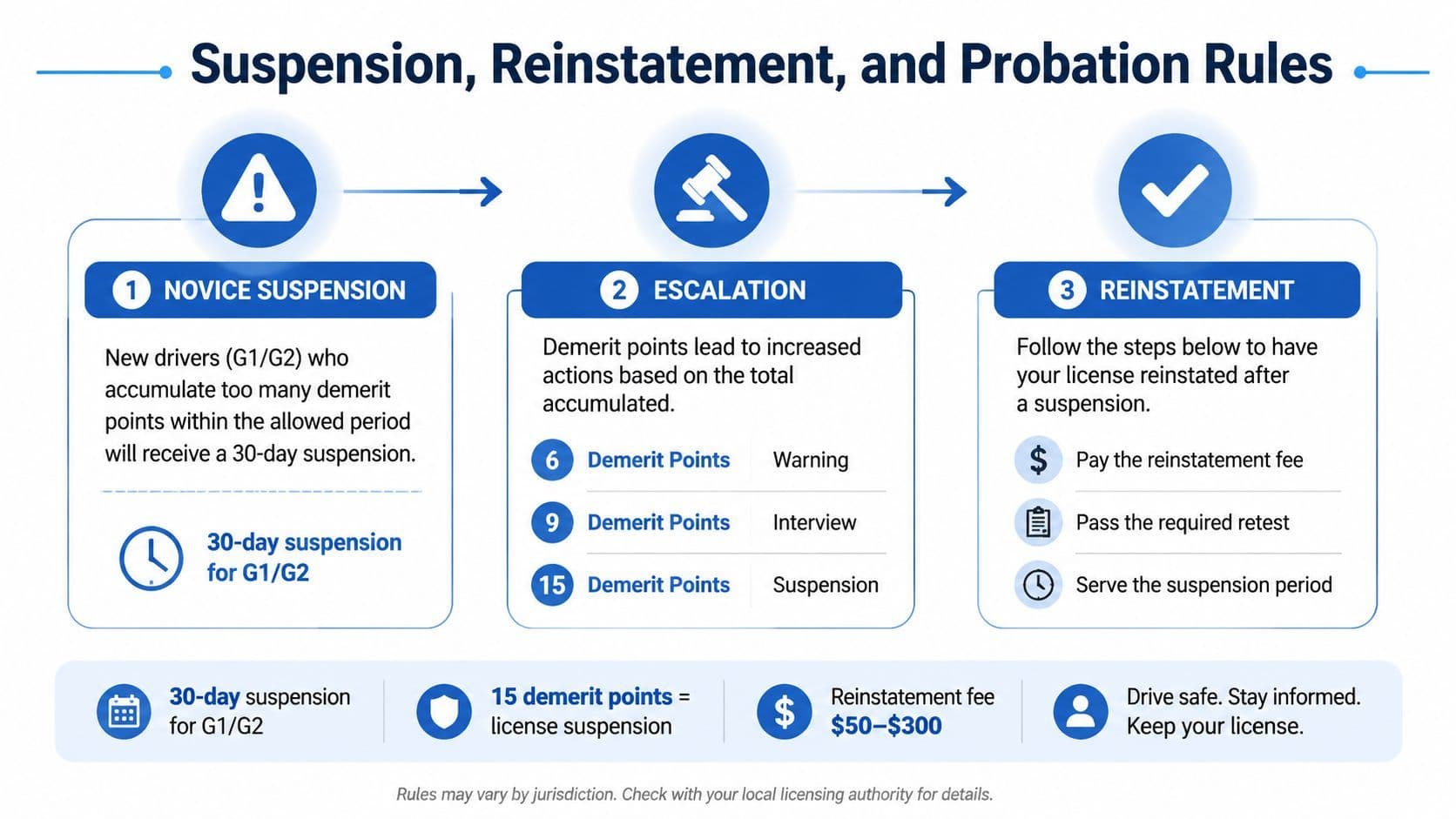
For G1 and G2 drivers, demerit accumulation can produce a 30-day novice suspension. Experienced drivers can also face escalating consequences for demerit points, and convictions under the Highway Traffic Act, including careless driving, can create separate licensing problems. The applicable result depends on the offence, the driver's stage, and the record.
Why one incident can create several problems
Suppose a G2 driver is stopped for speeding while carrying passengers. The speed allegation may create an immediate roadside consequence in circumstances where the law permits one, while a conviction can later affect demerit points, insurance, probation, or eligibility for the full G test. The charge and the final licensing outcome aren't the same thing, so the driver needs to track both.
A suspension must be served for its full period. Paying a fee doesn't erase the time requirement, and driving during the suspension can create a new offence. Reinstatement may require payment of the applicable administrative fee, completion of a retest, and proof that all conditions have been met. The fee structure can include a $281 administrative fee, depending on the situation.
The 2025 amendments also introduced a one-year ignition-interlock requirement for certain impaired-driving convictions. That requirement is conviction-specific, so drivers should obtain the exact reinstatement conditions rather than rely on general advice.
Reinstatement checklist
- Confirm the status: Check whether the record shows a suspension, disqualification, or probationary condition.
- Serve the period: Don't drive until the complete suspension has ended.
- Pay required amounts: Administrative and reinstatement fees must be handled before privileges return.
- Complete testing: Retesting may be required before the licence is restored.
- File insurance documents when required: An SR-1 filing may form part of the reinstatement process.
- Respect new conditions: An ignition interlock or probationary requirement can continue after driving privileges return.
Reinstatement is a compliance process, not a single payment. Treat every condition on the notice as a separate task.
This Ontario demerit-points guide can help explain the point system, but a suspension notice and the MTO remain the authority for an individual case.
How to Shorten or Remove Licence Restrictions
Ontario doesn't offer a shortcut based on convenience. A restriction changes only through a recognised pathway, and the correct route depends on whether the issue is training time, foreign experience, medical evidence, or licence class.
Training and foreign experience
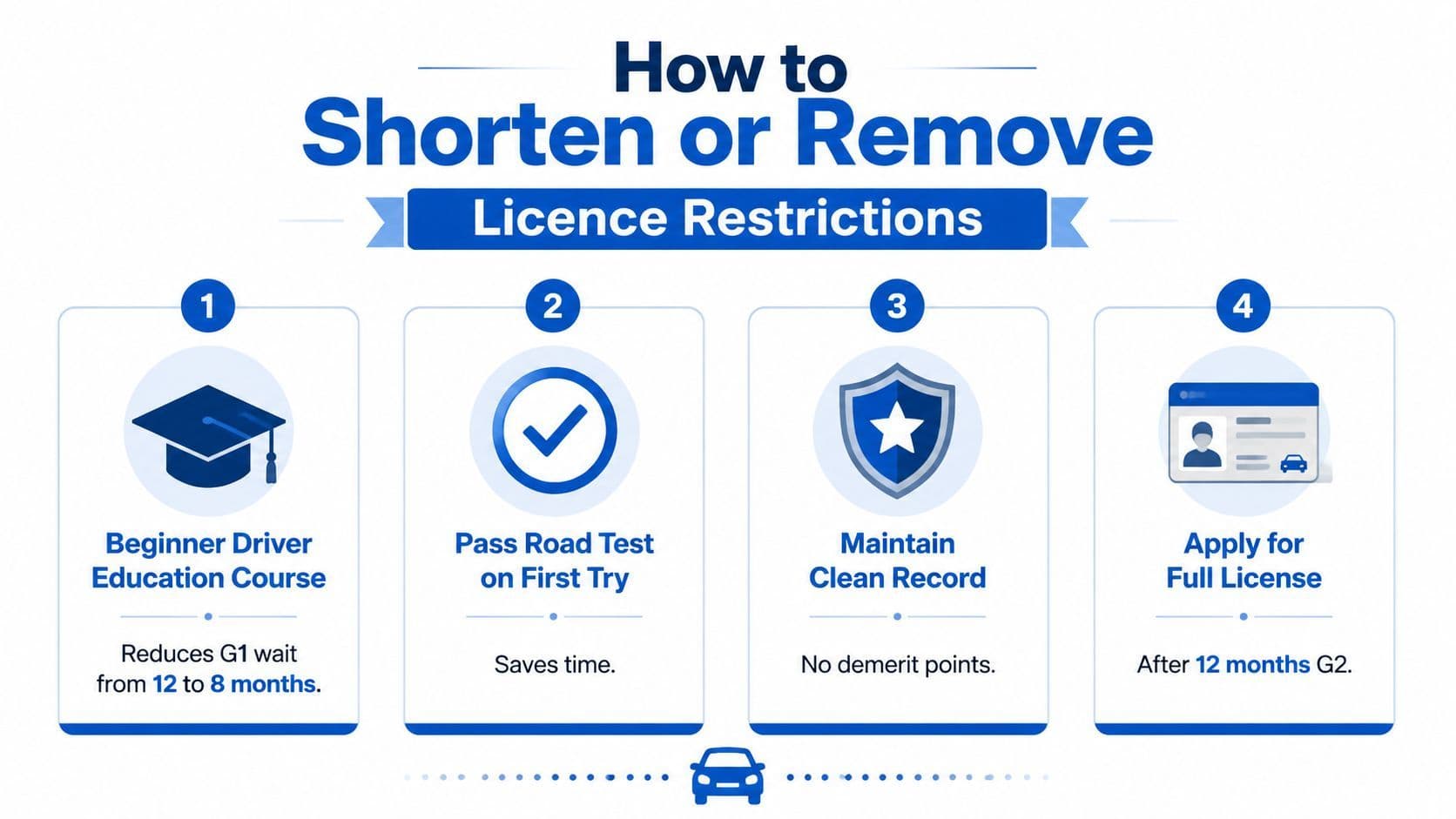
An approved Beginner Driver Education course can shorten the standard G1 waiting period from 12 months to 8 months, after the certificate is submitted to the Ministry of Transportation (Ontario's handbook information). The course doesn't remove G1 conditions. It changes when the driver may become eligible for the next road-test step.
Newcomers may also qualify for credit for documented driving experience from another country or jurisdiction. Ontario requires acceptable proof, and the ministry must recognise the experience before reducing a waiting period. A foreign licence alone isn't enough if the experience document can't be verified or doesn't meet Ontario's requirements.
Keep the paperwork consistent:
- Obtain experience evidence: Request an official letter or record that identifies your driving history.
- Use acceptable documentation: Translations and authentication may be needed when documents aren't in an accepted format.
- Submit before planning around the credit: Don't assume the reduced wait has been granted until the ministry confirms it.
- Keep course records: Submit the BDE certificate so the shorter G1 period can be applied.
Medical review and class upgrades
If a medical condition triggered a restriction, ask the treating physician or specialist for focused information about functional ability and safe driving. General statements may not answer the MTO's questions. The Medical Review Unit may require reassessment, and DriveTest may be involved where a practical evaluation is necessary.
A driver can also pursue a class upgrade. Moving from G toward M, D, or A requires meeting the relevant eligibility and testing requirements. The upgrade process doesn't erase a medical limitation, but it can formally establish a broader class when the driver qualifies.
If the restriction appears incorrect, use the formal review route. Written submissions, a Licence Appeal Tribunal hearing, or judicial review under the Licence Appeal Tribunal Act may be available depending on the decision and circumstances. Legal advice is sensible when a medical downgrade or suspension affects employment.
Common Myths About Driving Licence Restrictions
Ontario drivers often repeat rules from another province, an old handbook, or a friend's experience. The safer approach is to compare the assumption with the actual condition attached to the licence.
Common Myth Actual Ontario Rule “One beer is safe on a G1.” A G1 driver must have zero blood alcohol. Feeling normal doesn't change the legal condition. “Passengers under 21 are banned outright.” The G1 rule isn't a blanket ban on every passenger under that age. The key limits concern the supervisor's eligibility, the front seat, and seatbelt-equipped capacity. “A G1 driver can use a 400-series highway if the trip is short.” G1 drivers can't use 400-series highways or specified expressways unless accompanied by an Ontario-certified driving instructor. “G2 means the highway restriction continues.” G2 drivers may drive on highways, subject to the other rules that still apply to novice drivers. “An out-of-province licence automatically resets the graduated clock.” Ontario assesses documented driving experience. A driver should submit acceptable proof rather than assume the clock has restarted or transferred automatically. “Corrective-lens codes don't matter if I use contacts.” The condition still governs driving. Use appropriate correction and arrange a formal review if the condition should change. “A suspension ends automatically, so I can drive once the date passes.” The driver may need to complete reinstatement steps, pay required fees, pass a retest, or satisfy additional conditions.
The most dangerous myth is the alcohol one because it turns a strict condition into a personal judgement. The most expensive administrative myth is assuming that foreign experience, medical changes, or a completed course will update the record without ministry documentation.
Putting It All Together on Your Licence Journey
Think of Ontario licensing as a timeline with two layers. The first layer is your novice class, moving from G1 to G2 and then to full G. The second layer consists of any condition codes, medical decisions, or vehicle-class limits that may continue across those transitions.
At G1, plan every drive around supervision, zero blood alcohol, the permitted driving hours, and road access. Ontario's system gives drivers up to five years to complete the graduated process, while the standard G1 term is one year and can be shortened to 8 months with an approved driver education course and the required certificate (Ontario's licence-process guidance).
At G2, solo driving and highway use become available, but novice obligations remain. The next road test is the route toward full G privileges. A vision code, medical restriction, or class limitation may still appear on the card after that transition, because reaching full G doesn't automatically remove a separate condition.
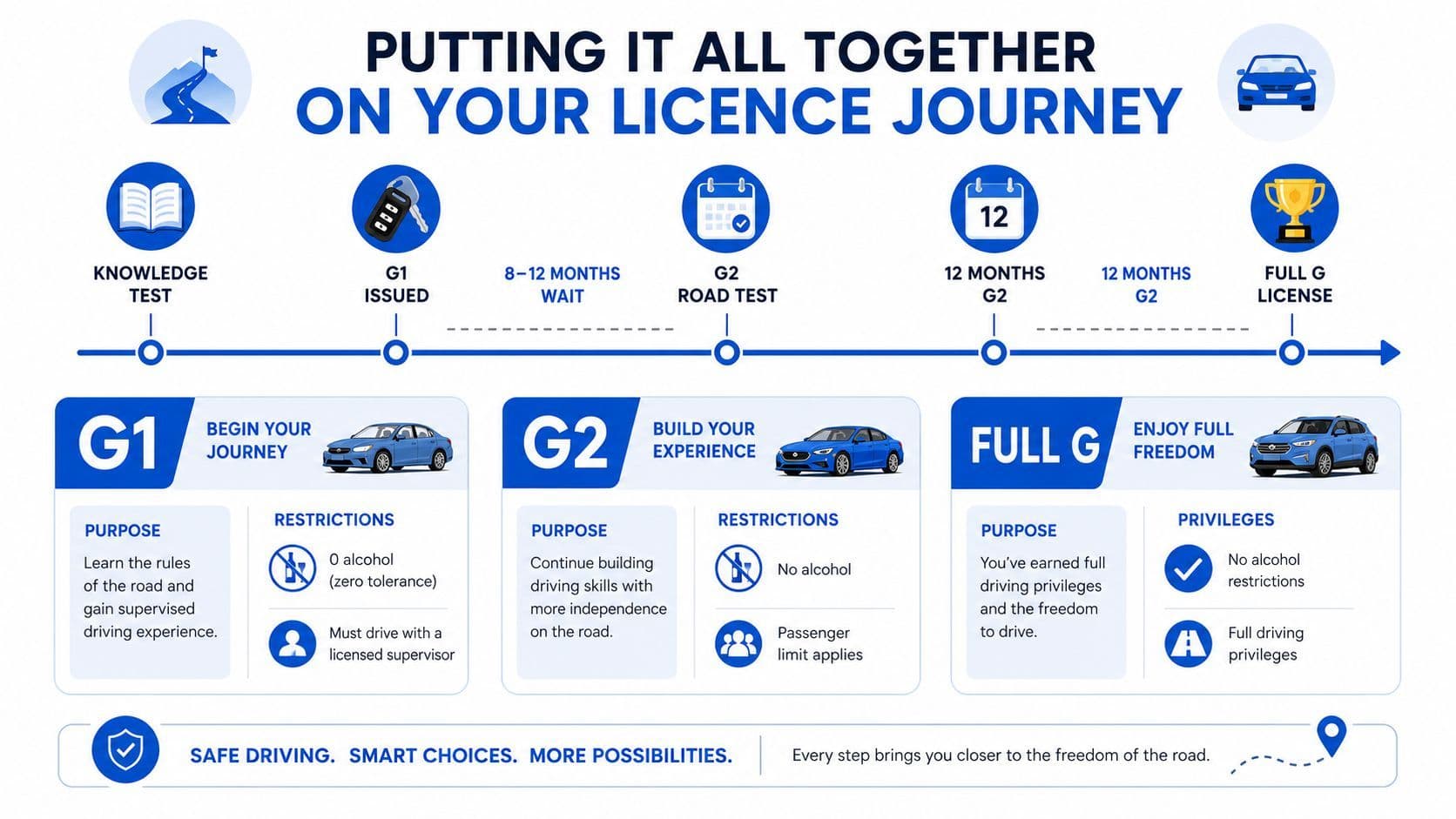
Use this decision tree before your next drive:
- Identify the class: Is the card G1, G2, or G?
- Read the conditions: Check for corrective-lens or other endorsement codes.
- Check your status: Confirm whether a suspension, disqualification, or probation is active.
- Match the remedy: Use training for waiting-time issues, documentation for foreign experience, medical review for health-based restrictions, and testing for class upgrades.
- Verify before driving: If the card, notice, or MTO record is unclear, contact the ministry or obtain qualified advice before taking the vehicle onto the road.
G1ready.ca offers free, registration-free practice exams, targeted quizzes, diagnostic practice, mixed tests, and an exam simulator aligned with the Ontario G1 handbook. Visit G1ready.ca to strengthen your knowledge of the rules before you test and start your licence journey with a clearer understanding of the restrictions that apply.


