
You're probably not looking for another fluffy “be calm and follow the route” article. You're looking at a calendar, a booking email, maybe a half-used practice log, and a test date at the Newmarket DriveTest centre that suddenly feels very real. That's the right place to be, because Newmarket rewards drivers who arrive organised, drive cleanly, and understand the local pressure points, not drivers who've memorised a few turns and hoped for the best.
Newmarket is a skills centre first and a route centre second. The lot, the check-in desk, the traffic around Harry Walker Parkway, and the restricted-area rules nearby all punish sloppy preparation. If you want a calm test day, treat this place like a logistics problem and a driving problem at the same time.
Pulling Into the Newmarket DriveTest Lot
The test starts before the examiner even looks up. A nervous teen tightens both hands on the wheel, a parent tries not to overtalk the last turn, and a newcomer from another province rolls into Harry Walker Parkway wondering whether the building is even the right one. That first minute in the lot decides the mood for the whole morning.
Newmarket is one of those centres where people show up carrying too much in their head, route videos, parking fears, and a dozen little what-ifs. Drop all of that and focus on the basics, because the centre doesn't reward overthinking. It rewards drivers who arrive with the vehicle sorted, the papers ready, and the mindset that this is a skills test, not a memory test.
If you've been reading only route-heavy pages, you're missing the point. Newmarket coverage often obsesses over turns and streets, but the better preparation is simpler, controlled braking, lane discipline, clean observation, and steady judgment in traffic.
Practical rule: if the morning feels chaotic in the lot, your drive will feel chaotic on the road.
The best candidates treat the arrival as a rehearsal. They park once, gather their documents once, shut the phone off once, and stop making the examiner wait for basic admin. That calm routine matters more than knowing one more bend in the route.
Location, Hours, and Services at a Glance
The Newmarket DriveTest centre sits at 320 Harry Walker Parkway S, Newmarket, L3Y 7B4. DriveTest lists it as offering public tests for G2, G, M2, M, LM2, and LM, plus commercial tests, with inside services running Monday to Friday 7:00am–7:00pm and Saturday 8:30am–5:00pm, and road test appointments Monday to Saturday 8:00am–5:00pm. That's the core logistics picture you need before you book or travel. Official DriveTest centre listing
Detail Information Centre name Newmarket DriveTest centre Address 320 Harry Walker Parkway S, Newmarket, L3Y 7B4 Public tests G2, G, M2, M, LM2, LM Commercial tests Yes Inside services Monday to Friday 7:00am–7:00pm, Saturday 8:30am–5:00pm Road test appointments Monday to Saturday 8:00am–5:00pm
For people coming from Newmarket, Aurora, or the rest of York Region, the main thing is separating inside services from road-test appointments. The hours are not the same, and the service model isn't the same either. A candidate who wants to exchange a licence by appointment is dealing with a different process than someone showing up for a road test.
The centre list also shows the Newmarket location's inside transactions estimate as “Closed”, while still supporting booking an appointment to exchange your licence. That distinction matters because walk-in expectations can waste your morning if you assume every service behaves the same. DriveTest centre alphabetical list
If you want a broader location overview before booking, use the local test-location directory at G1ready's G1 test locations page. It's the kind of page that helps you compare centres instead of guessing.
A few non-official Newmarket guides also note the centre's phone numbers as 1-888-570-6110 and 647-776-0331, and describe the service area as Newmarket, Aurora, and surrounding York Region. I'd still keep your planning anchored to DriveTest first, because that's the source that controls your actual appointment and service timing. Newmarket DriveTest location guide
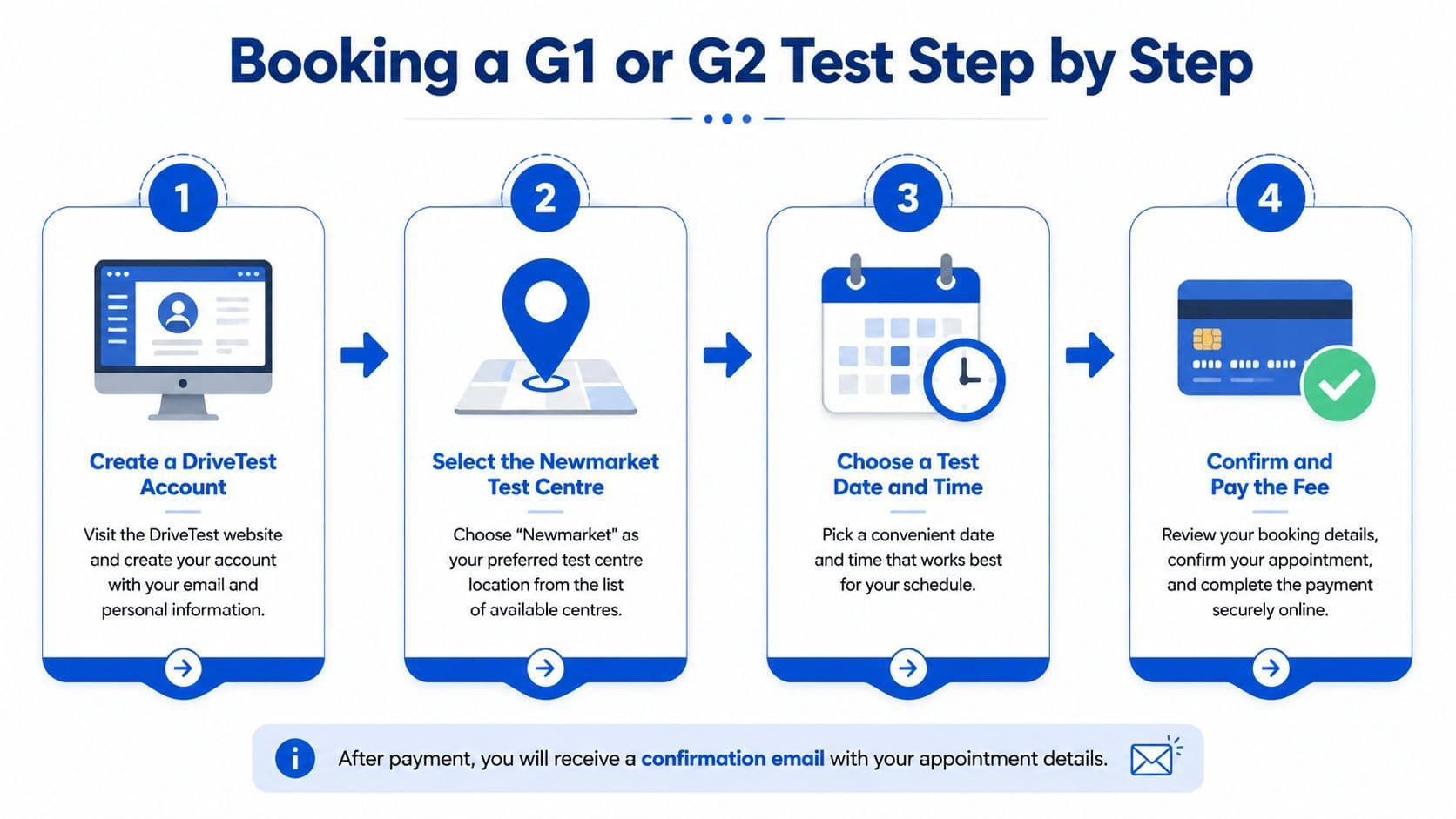
Booking a G1 or G2 Test Step by Step
Booking sounds easy until the calendar fills and you're staring at a thin list of options. The fix is simple, move fast, choose the correct test class, and don't guess. If you're booking a knowledge or road test, your booking email is the proof that matters on test day.
Book the right test, not just the first open slot
Start with the right licence class. A G1 knowledge test is not the same booking as a G2 road test or a G full road test, and people still make the mistake of clicking the first available option because they're in a hurry. If you're unsure about the appointment flow, the Ontario booking overview at G1ready's driving test appointment guide lays out the process in plain terms.
At Newmarket, the early morning road-test slots tend to disappear first, and that's not a surprise. A 2026 Newmarket route guide notes that the lot is calmer at 8 AM than at 4 PM, which is exactly why those earlier appointments go quickly. Newmarket route guide
Use cancellations, but don't build your plan around luck
If you see a better slot open after you've already booked, treat that as a bonus, not a strategy. People cancel, and openings appear, but a serious candidate doesn't sit around hoping for a perfect last-minute slot.
Don't let the booking portal make you reckless. Pick a workable date, then keep checking for a cleaner time if your schedule allows.
If you're the kind of learner who wants an extra round of structured practice before test day, a platform like G1ready.ca can help with Ontario G1 preparation and confidence-building practice, which is useful for the earlier stage of the licensing path. That's about study discipline, not magic, and it belongs before the test, not beside it.
What to Bring on Test Day
The fastest way to lose your morning is to arrive with a car and no usable paperwork. Newmarket examiners want the basics handled cleanly, and they're not there to sort out a scrambled glove box. Bring the right items and the test stays simple.
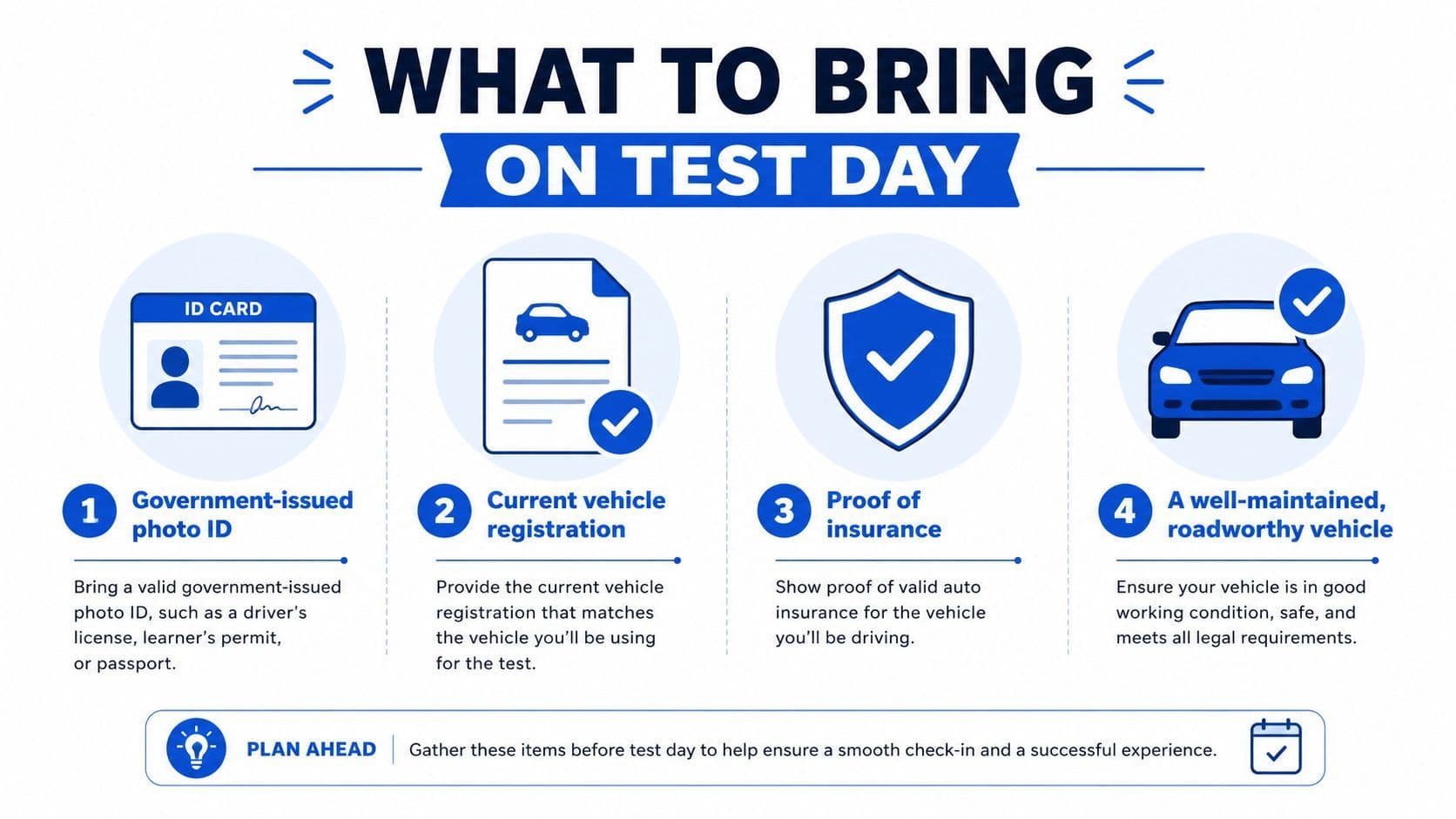
Four things to have ready
- Government-issued ID: Bring the ID that matches your booking details. If the name or date doesn't line up, you've created a problem for yourself before the engine even starts.
- Vehicle registration: The car you use should have current registration ready to show.
- Proof of insurance: Don't assume a photocopy buried in a folder is enough. Have it easy to reach.
- A roadworthy vehicle: Working lights, signals, horn, brakes, decent tyres, and enough fuel are not optional extras. They're the entry fee.
If you wear corrective lenses under your licence conditions, bring them. Leave them in the car and you've just invited an avoidable failure point. If you're showing up in a G2 vehicle, the supervising driver needs to be licensed and ready too.
The official Ontario documents list for this kind of preparation is worth reviewing before the day arrives, and the practical checklist on G1ready's G1 document guide is a straightforward place to compare your own pile of papers against a clean standard.
What examiners notice immediately
A dead signal, a dim brake light, or a car that looks half-maintained sends the wrong message. The examiner may still continue, but you've already started on the back foot. I'd rather see a learner over-prepare the car than hope the examiner won't notice a weak tyre or a low tank.
If you're unsure about one detail at the front desk, ask directly and politely. Don't improvise, because improvisation with paperwork is how good candidates waste good appointments.
Arrival, Check-In, and the First Minutes
Arrive early, but not absurdly early. Fifteen to twenty minutes gives you enough time to park, breathe, and check in without turning the wait into a panic spiral. If you show up late, the whole mood changes before you've driven a metre.
The smoothest arrivals look boring. The documents are sorted before the door opens, the booking confirmation is ready on the phone or printed out, and the candidate walks straight to the front desk without rummaging through a backpack. That's the behaviour examiners and staff notice, because it shows the driver can manage basic tasks under pressure.
Check-in should be quiet and efficient
Keep the phone fully off, not just on silent. A phone buzzing in the middle of check-in tells everyone you didn't take the morning seriously enough. Use the washroom before you're called, because once the examiner is ready, you don't want to ask for another delay.
The first minute after your name is called should feel controlled. Keep your documents in one place, answer questions directly, and don't start overexplaining your nerves. A short, steady response is stronger than a long apology.
Calm check-in is not personality, it's preparation.
Then do the basic vehicle checks without rushing them. Adjust the seat, mirrors, and steering position before you move, because the examiner is watching whether you can settle yourself into a safe driving position without drama. That first impression is part of the test, even if nobody says it out loud.
Local Skills That Actually Matter Around Newmarket
The biggest mistake I see at Newmarket is candidates worshipping route videos and ignoring the actual driving they're being judged on. Route familiarity helps, but only as a confidence aid. It doesn't rescue sloppy lane position, late mirror checks, or a driver who hesitates every time traffic gets busy.
Train the habits the examiner can actually score
Newmarket's traffic environment pushes drivers to show real judgment. That means holding lane discipline on wider roads, adjusting speed cleanly in busier stretches, and making intersection decisions without freezing. A candidate who can do that consistently looks ready, even if they don't know every street in advance.
The broader Ontario guidance also supports practising in varied locations, times of day, and conditions rather than drilling one memorised loop. That's the right mindset for this centre too, because a test day can't be reduced to a script. CBC's Ontario DriveTest analysis
Memorising turns won't save a driver who forgets to scan early or change lanes cleanly.
Focus on how you drive, not just where you drive
There's a reason local instructional content keeps pointing back to skill. The Town of Newmarket says questions about road test routes, test frequency, and related exam details should go to DriveTest, not the town, which is a polite way of saying the route obsession misses the issue. The better approach is to prepare for the behaviours the road exposes, including speed control, mirror use, and clear decision-making. Town of Newmarket restricted-area notice
The centre's test profile reinforces that point. Ontario-focused reporting places Newmarket's G2 pass rate around 64% and the full G pass rate near 61%, both below the 69% provincial average reported across centres, so this is not a place where casual driving habits tend to slide by. Ontario DriveTest pass-rate reporting
The local practice question matters too. Newmarket maintains a restricted area for driving instructors and schools, so if you're practising near the centre, know where you can train legally and where you can't. That's not a minor detail, it's part of the practical setup around the test site. Restricted-area rules for instructors and schools
Final Checklist and Confidence Before You Drive Off
The night before, lay out the documents, check the car, and set the route to the centre once so you're not doing it half-asleep in the morning. The morning of, eat something light, get there early, and turn your phone off before you step inside. Don't turn the drive to the centre into a final lesson, because that just burns focus you'll want for the test itself.
Use this short checklist and stop there:
- ID and booking confirmation are ready
- Insurance, registration, and glasses are in the car
- Lights, signals, horn, tyres, and fuel are checked
- You've arrived early enough to settle in
- The phone is off and out of the way
If you've prepared properly, the examiner is seeing your normal driving, not your panic. That's the whole point. A calm driver notices more, corrects faster, and makes fewer small mistakes.
Preparation beats performance. Safe driving is what gets marked.
If you want more Ontario test prep that's practical instead of noisy, G1ready.ca gives you structured G1 practice tools that help learners build confidence before they ever reach the road-test stage. Visit G1ready.ca and use it to tighten your study routine, then walk into Newmarket ready to drive, not just hope.


