A flashing yellow light does not always mean the same thing. First identify the device, then respond to what it controls: at an intersection, the signal allows cautious movement; amber lights on a school bus or at a pedestrian crossover call for a different response.
Under section 144(17) of Ontario's Highway Traffic Act, a driver facing a flashing yellow light at an intersection may proceed with caution. Check what the light is mounted on and who might enter your path before moving. This simple habit helps you respond to the device, not just its colour.
What a Flashing Yellow Light Means in Ontario
A flashing yellow light at an intersection permits cautious movement. It isn't a command to stop, and it isn't permission to carry on without checking the intersection.
The wording matters. Under section 144(17) of Ontario's Highway Traffic Act, a driver facing a flashing circular amber indication “may proceed with caution”; section 144(15) instead requires a driver facing steady amber to stop when that can be done safely, or otherwise proceed with caution. Ontario law uses amber for the colour drivers commonly call yellow.
Ontario signal meanings compared
Signal What the driver must do Legal basis or source Flashing yellow at an intersection Proceed with caution; slow, scan and yield if needed Highway Traffic Act s. 144(17) Steady yellow Stop if it can be done safely; otherwise proceed with caution Highway Traffic Act s. 144(15) Flashing red at an intersection Stop, then proceed only when it is safe MTO Driver's Handbook Flashing yellow beacon over an intersection, sign or obstruction Caution: adjust speed and scan the roadway before proceeding MTO Driver's Handbook Flashing amber on a stopped school bus Slow down and prepare to stop MTO Driver's Handbook
The important contrast is permission versus obligation. A flashing amber signal allows you to enter cautiously when conditions permit. A steady amber signal requires a decision about whether you can stop safely, not whether you'd prefer to get through before red.
For a closer comparison of the steady signal, use the Ontario yellow-light rules guide. Don't transfer the steady-yellow stopping rule to a flashing signal just because both lights have the same colour.
Memory rule: Flashing yellow means move carefully. Steady yellow means stop when safe. Flashing red means stop first.
None of these short phrases replaces observation. A driver can correctly identify a flashing yellow signal and still make an unsafe decision by ignoring someone crossing ahead.
How to Proceed Safely Through a Flashing Yellow Light
The Ontario Ministry of Transportation's traffic-light guidance tells drivers to use caution both when approaching a flashing yellow light and when moving through the intersection. Your response therefore starts before the entry point and continues until you've cleared the conflict area.
Use a repeatable approach
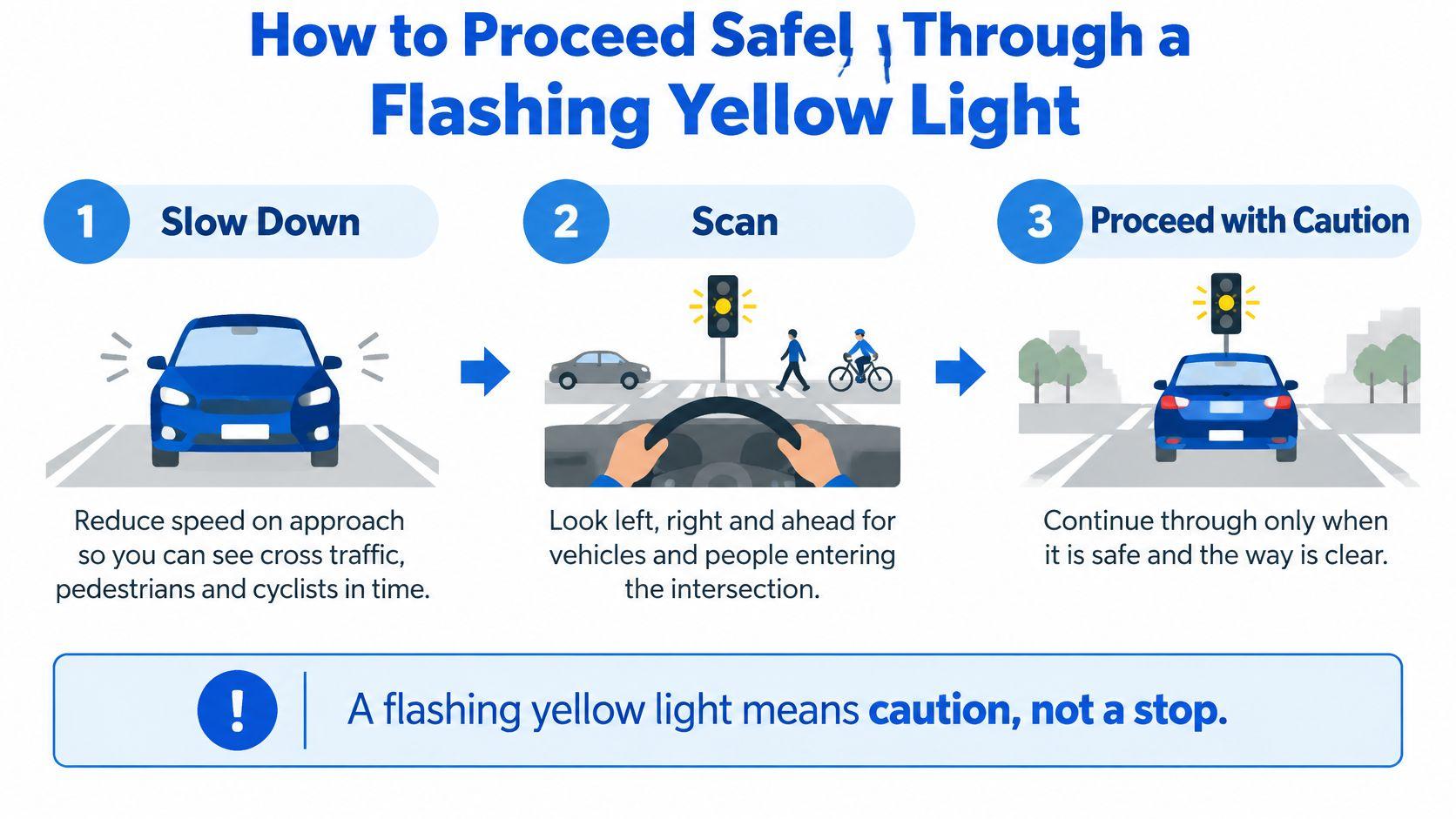
- Slow down early. Reduce speed enough to recognise cross traffic, pedestrians and cyclists before you reach them. Don't wait until you're beside the crosswalk to begin assessing whether you can continue.
- Scan left, right and ahead. Check the crosswalks, approaching traffic and the lane you intend to enter. Looking only at the signal leaves you without the information needed to act on it.
- Yield where necessary. Allow road users with priority to proceed, including pedestrians lawfully crossing and oncoming traffic that would conflict with your left turn. Permission to move doesn't remove a turning driver's responsibilities.
- Check what you can't yet see. A van beside the intersection might hide an approaching vehicle, while a cyclist could be coming along your right side. If your view is restricted, adjust your approach rather than treating the visible space as proof that everything is clear.
- Enter only with a clear path. Confirm that you can complete the movement without stopping across a crosswalk or blocking the intersection. Keep watching for changes as you travel through.
Use this visual reminder to connect observation with action.
Avoid the common approach errors
Rolling through at full speed leaves little room to respond if another road user enters your path. Slowing down should be a deliberate preparation to assess the intersection, not a token lift of the accelerator.
Another mistake is delaying the decision until you're already inside the crosswalk. If you need to wait for someone, leave their crossing space clear rather than stopping where they must walk around your vehicle.
Say the procedure aloud during supervised practice: slow, scan, yield if necessary, then proceed only when the path is clear. A sound approach means travelling at a speed you could stop from, keeping your eyes moving, and checking your exit before entering.
Right of Way Still Applies at a Flashing Yellow
A flashing yellow doesn't mean the road is yours. It permits a cautious movement, but you still have to determine whether someone else has priority.
The MTO Driver's Handbook applies caution to both the approach and the movement through the intersection. Watching carefully before entering isn't enough if you then stop checking for pedestrians, cyclists or turning traffic.
Resolve conflicts before claiming space
Use these checks to work out who needs room to move. They're conflict checks, not a licence to force your way ahead of someone who makes a mistake.
- Vehicles already inside: Let a vehicle occupying your intended path clear the intersection. Don't enter because you expect its driver to hurry.
- Pedestrians lawfully crossing: Yield to a person in the crosswalk, including someone who begins crossing as you approach your entry point. Watch the whole crossing, not just the pavement immediately ahead of your bonnet.
- Oncoming traffic during a left turn: Wait when an approaching vehicle is close enough to create a hazard. A flashing yellow doesn't make the gap larger.
- A clear remaining path: Continue only when your movement won't conflict with another road user who has priority.
The Ontario yield-sign guide can help learners distinguish yielding from automatically stopping. The essential skill is recognising when another person's movement requires you to wait.
Apply the rule to a changing scene
Suppose you approach a flashing yellow, a cyclist is crossing ahead, and a car is approaching from the left. Slow down, allow the cyclist to finish crossing, and assess the car's movement before committing to yours.
Don't assume that the other driver sees you or will respond correctly. Equally, don't invent a blanket rule that every vehicle coming from the left automatically goes first. Read the controls, positions and movements that apply.
A flashing yellow gives you a reason to slow down, never a reason to assume the way is clear.
You may need to stop because a person or vehicle occupies your path. That stop responds to the conflict, not to a general stopping command from the flashing yellow signal.
Telling Flashing Yellow Signals Apart From School Buses
Colour alone doesn't tell you what a device controls. A light on a traffic-signal head, a beacon beside a warning sign and an overhead lamp on a school bus can all look amber while requiring different decisions.
Use the mounting and surroundings as identification clues.
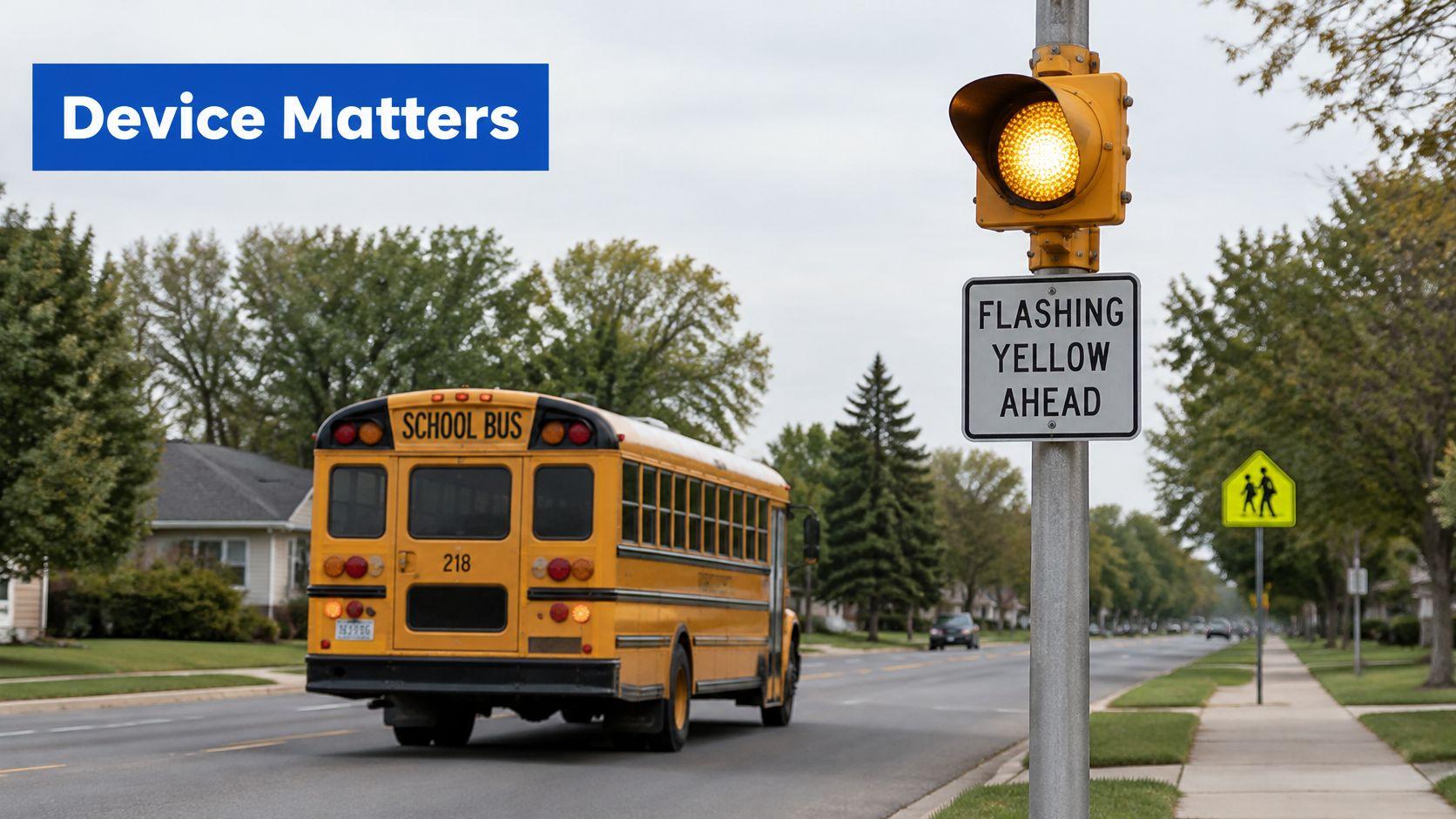
Flashing yellow devices and the action each requires
Device Mounted on or controls Driver action Flashing yellow signal head Intersection traffic signal Proceed with caution Flashing yellow beacon Above an intersection, a warning sign or a road obstruction Adjust speed and scan the roadway Overhead yellow at pedestrian crossover Pedestrian crossover, activated by pedestrians Yield to people in the crossover Flashing red signal head Intersection traffic signal Stop, then proceed only when safe Flashing overhead amber on school bus School bus stopping to load or unload Slow and prepare to stop; stop if red lights and stop arm are on
The MTO's driving guidance identifies flashing yellow beacons above intersections, above warning signs and on road obstructions as caution warnings. For example, a beacon above a curve warning sign on a country road directs your attention to the road feature ahead. It isn't a traffic signal changing towards red.
A pedestrian crossover requires another reading of the surroundings. Ontario's cycling-skills guidance explains that pedestrians may activate overhead yellow lights at crossovers and that drivers, including cyclists, must yield to pedestrians in the crossover. The lights don't give approaching traffic permission to continue uninterrupted.
Read the school bus lights separately
Overhead amber lights on a school bus indicate that the bus is coming to a stop to pick up or drop off passengers. Drivers approaching from either direction must slow and prepare to stop; the opposite-direction exception applies on a divided roadway with a median.
When the red lights flash and the stop arm is activated, stopping is required, and a vehicle approaching from behind must stop at least 20 metres before the bus, according to the MTO's school-bus guidance. A driver travelling in the opposite direction across a median isn't required to stop.
Consider a bus showing overhead amber lights on a rural road with opposing lanes and no median. A driver following at full speed hasn't made the required preparation, even if the red lights haven't started flashing. The correct response begins while the bus is preparing to stop.
Use the following video as another prompt to practise identifying the device before naming your response.
Try a simple verbal drill with an instructor or parent: name the mounting, name what it controls, then name the action. Signal head, beacon, crossover or bus is a more useful starting point than colour alone.
Flashing Yellow Questions on the G1 Test
The G1 knowledge test is based on the Ontario driver's handbook, so prepare by learning the rule behind an answer rather than memorising its position on a screen. For flashing-light questions, pay particular attention to the device, the flashing pattern and the road users mentioned.
The examples below are G1-style practice questions, not reproduced official test questions. Use them to check whether you can explain your choice without relying on a remembered answer letter.
Sample flashing yellow questions with answers
Sample question Correct answer Rule behind it Flashing yellow at an intersection means: stop, proceed with caution, or proceed at normal speed? Proceed with caution Highway Traffic Act s. 144(17) How does a steady yellow differ from a flashing yellow? Steady yellow means stop if it can be done safely Highway Traffic Act s. 144(15) School bus ahead shows flashing overhead amber; what do you do? Slow and prepare to stop MTO Driver's Handbook Flashing yellow beacon over a road obstruction calls for what? Adjust speed and scan the roadway MTO Driver's Handbook
For the intersection question, the important words are with caution. “Proceed” by itself leaves out the responsibility to assess conditions, while “stop” confuses the flashing-yellow rule with a different signal.
For the steady-yellow question, keep the safety condition attached to the answer. “Always stop immediately” isn't an accurate substitute for stopping when you can do so safely, and accelerating to avoid the next signal isn't the rule.
Explain why the other choices fail
The school-bus example tests whether you noticed the device. If you selected an answer meant for an intersection signal, your next study task is device recognition, not repeating the same question.
The beacon example tests whether you connect a warning with the hazard ahead. “Proceed at normal speed” is a poor choice when it means ignoring the warning or failing to reassess your speed. Don't use that phrase as an automatic answer shortcut, though: read the complete situation.
Study check: Before moving on, explain why your chosen answer fits and why the closest alternative doesn't.
After every missed question, find the matching handbook passage and write the distinction in plain language. For example, note whether you confused flashing with steady, a bus with a signal head, or permission to proceed with priority.
That explanation is more useful than recording only that you got the question wrong. It tells you exactly what to reread and what kind of scenario to practise next.
Practise Flashing Yellow Situations Before Test Day
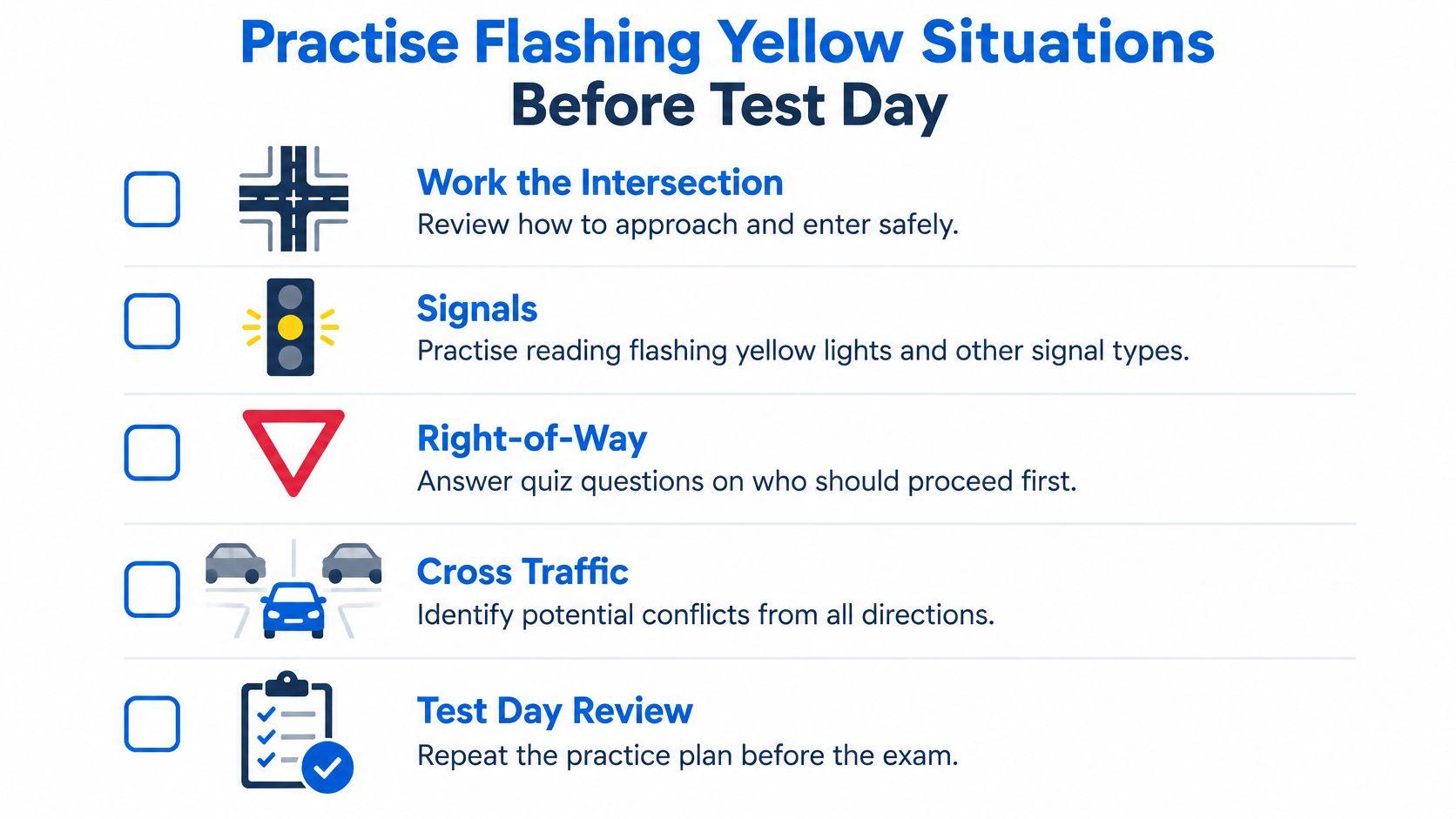
Use the next week to practise decisions, not just definitions. Start with intersection questions, move to signal recognition, then work on right-of-way situations that add pedestrians, turning vehicles or restricted visibility.
Read the explanation after every miss, even when you think you merely clicked too quickly. A rushed answer can reveal that you recognised a colour but overlooked the device or the person crossing.
Build a focused practice routine
- Begin with intersections: Work through questions about approaching, entering and clearing an intersection. Explain where you'd look before choosing an answer.
- Separate similar signals: Compare flashing yellow, steady yellow and flashing red without treating them as interchangeable warnings.
- Add right-of-way conflicts: Identify whose path would cross yours and why you may need to wait.
- Retake the same material: Check whether you can explain the answer without recalling where it appeared on screen.
- Finish with mixed situations: Include buses, beacons and pedestrian crossovers so you must identify the device before responding.
This checklist can help keep your review focused.
Make the retake count
A correct answer on a later attempt is useful only if you understand why it's correct. Recalling a familiar screen isn't the same as recognising the rule in an unfamiliar road scene, so change a detail and test your reasoning again.
For example, replace the intersection signal in a practice scenario with overhead lights on a bus. If your answer changes for the right reason, you're developing the distinction you'll need behind the wheel.
Our free practice tests at G1ready.ca include instructor-reviewed answers and a streak system, with material built around the 2026 Ontario MTO Driver's Handbook for Ontario learners. We list quizzes for Chapter 1 through Chapter 22, plus topic tests covering intersections/signals/right-of-way, alcohol and impaired driving, demerit points, distracted driving, and fines/suspensions/penalties; use the Road Rules Test alongside focused intersection practice.
Today, complete an intersection quiz, review every missed answer, and talk yourself through an approach using the procedure steps. Flashing yellow means proceed with caution, never proceed without looking.
G1ready.ca offers free practice tests with instructor-reviewed answers to help you distinguish intersection signals, warning beacons and school-bus lights. Visit G1ready.ca, practise the intersections/signals/right-of-way questions, and review the explanation for every answer you miss.