
Stop if you can do so safely before the stop line. If a safe stop isn't possible, continue through the yellow with caution. In Ontario, the yellow light is a decision signal, not a green light or a red light.
You're approaching a busy suburban Toronto intersection at 50 km/h, watching the green ahead, when it changes to amber. The driver behind you is close enough to make you nervous, the crosswalk is active, and your instinct says to either brake hard or accelerate. Take a breath. Ontario's traffic rules yellow light decision comes down to one question: Can you stop safely before the stop line?
The Moment a Yellow Light Changes Your Plan
You are approaching a busy Toronto intersection when the green signal turns yellow. Your eyes move from the light to the stop line, then to the wet pavement and the vehicle following behind. This is the moment your plan changes. The right response depends on whether stopping remains safe, not on a reflex to brake hard or accelerate.
Under section 144(15) of Ontario's Highway Traffic Act, a driver facing a circular amber signal must stop if stopping can be done safely. If a safe stop is not possible, the driver may proceed through the intersection with caution.
That wording is the key to the Ontario rule and to the way a G1 question tests it. A yellow light creates a risk-based decision. Your speed, distance from the stop line, road surface, traffic behind you, and required braking force all matter.
The rule to remember: Stop when you can stop safely. Continue cautiously only when stopping would itself create a hazard.
Use the stop line as your reference point. If it is still far enough ahead for smooth, controlled braking, begin slowing. If your vehicle is already too close for anything except a sharp or unstable stop, continuing carefully may be safer. A close-following vehicle matters because sudden braking could create a collision, but it does not give you permission to speed up.
A yellow signal is also a warning about the next phase. Treating it as extra green time can carry you into the intersection after the light turns red, create conflict with crossing traffic, and lead to the Ontario offence listed as “Amber light, fail to stop.” The related offence schedule sets the fine at $150.00, with a higher $300 amount in a community safety zone.
Your G1 takeaway is simple: yellow means assess, then act smoothly. The official rule and the test wording point to the same habit. Check whether a safe stop is available, choose early, and avoid turning a manageable signal change into an emergency manoeuvre.
How to Read a Yellow Light Before It Becomes a Decision
A yellow light should not be the first signal you notice. As you approach an intersection, scan ahead instead of watching only the vehicle in front. From several car lengths away, check whether the green has remained steady or has just appeared. Also look for pedestrians, cyclists, turning vehicles, and a pedestrian countdown, if one is present.
At 50 km/h, your vehicle covers ground quickly. Amber phases are engineered to match approach speed, so the safe-stop window becomes shorter on faster roads. Use that timing as background, not as permission to accelerate. Ontario traffic-signal timing guidance explains the engineering behind these phases. (Ontario traffic-signal timing guidance)
Use the safe-stop test
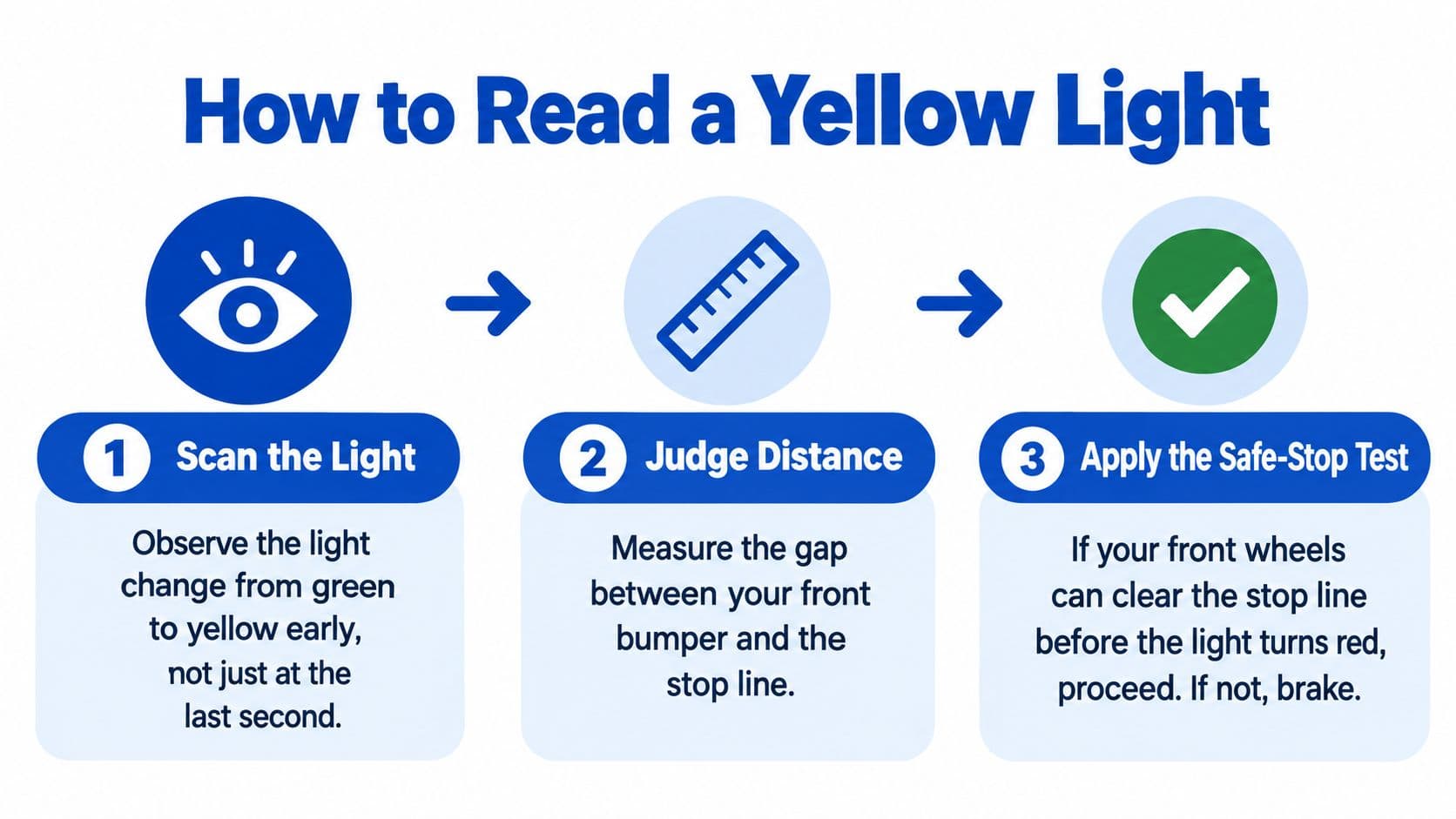
When the signal changes, ask three questions:
- Can I apply the brake gradually and stop before the stop line?
- Would stopping require a sharp or unstable manoeuvre?
- Would continuing be safer than forcing the stop?
If controlled braking brings your front wheels to the stop line, stop. If avoiding the line requires harsh braking, continue through cautiously while keeping your path steady. A vehicle following closely may affect the risk of a sudden stop, but it does not justify accelerating. Do not lock the wheels, skid, or swerve.
A pedestrian countdown helps you anticipate a changing signal, but it does not replace the traffic light or your safe-stop judgment. When the countdown ends, do not rush. A green light that has been on for some time deserves closer attention than one you have just reached.
The point of no return is not a painted mark on the road. It is the position where braking would become dangerous. While you are still well back, cover the brake and prepare for a smooth stop. If you are already too close for controlled braking, maintain a steady course, check the intersection, and clear it carefully.
Smooth inputs matter during a G1 lesson and in everyday traffic. The examiner needs to see that you recognised the change early. The driver behind you also needs predictable braking, not a sudden launch or panic stop.
Stop or Go The Ontario Decision Test
Yellow-light decisions become easier when you compare the main possibilities instead of searching for a single response that applies everywhere. The table below uses the same legal foundation, but shows how position and speed change the practical choice.
Ontario Yellow Light Decision Matrix
Position & Speed Signal Timing Correct Action Well back from the stop line, travelling at a controlled speed Yellow has just appeared Begin a smooth stop if you can do so safely Moderately close, with enough distance for either a controlled stop or a steady continuation Midway through the amber interval Choose the safer option, without accelerating or braking abruptly Very close to the stop line, or already unable to stop smoothly Yellow is late in the interval Continue through cautiously, maintaining control and watching the intersection
The middle row causes the most anxiety. You might have enough room to stop, but the vehicle behind you might be close, or the road may be slippery. That's why the law doesn't say “always stop” or “always proceed.” It asks whether stopping can be done safely. Ontario's legal wording is about the vehicle approaching the signal, and the exception applies only when a safe stop can't be made. Ontario legal commentary on approaching a yellow light explains that the rule isn't an automatic right to continue through because the indication remains yellow.
What the G1 question is testing
A knowledge-test question may present a tempting answer such as “speed up to clear the intersection.” That isn't the safe or lawful response when you could have stopped under control. The test is checking whether you understand that yellow ends the green phase and requires a decision.
Use these habits:
- Cover the brake early: Prepare for a controlled stop without resting your foot heavily on the pedal.
- Keep your path predictable: Don't accelerate at the last moment or change lanes to escape the signal.
- Commit to the safe choice: Once you've judged that stopping or continuing is safer, follow through smoothly.
A late amber isn't a challenge to beat the red. It's a situation where forcing a stop may be less safe than clearing the intersection cautiously.
Why Yellow Timing Changes by Speed
You approach a busy intersection at the posted limit when the signal turns amber. Your decision point is already farther away than it would be at a slower speed. Ontario timing guidance lists a recommended driver reaction time of 1.0 second and longer amber intervals as approach speed increases: 3.0 seconds at 45 km/h or less, 3.3 seconds at 50 km/h, 3.7 seconds at 60 km/h, 4.2 seconds at 70 km/h, and 4.6 seconds at 80 km/h. (Ontario signal timing and decision-distance reference)
That extra time reflects two separate tasks. First, you travel during the moment it takes to recognise the change and react. Then the vehicle needs room to slow under control. At a higher speed, both parts require more distance, so the yellow phase gives you time to assess the stop rather than treat the light like a countdown to beat.
Posted Speed Approximate Yellow Duration Typical Safe-Stop Distance 50 km/h 3.3 seconds 45 metres 60 km/h 3.7 seconds 60 metres 70 km/h 4.2 seconds 80 metres 80 km/h 4.6 seconds 100 metres
The safe-stop distances in this table are approximate reference figures paired with the signal-timing guidance above, not a separate legal rule. They show why the decision area moves farther back as speed rises. At a faster intersection, waiting until you reach the stop line can turn a calm assessment into hard braking.
Scan the signal early, keep a suitable following distance, and leave room to respond smoothly. The G1 speed-limit rules guide reinforces the related idea that speed affects both how far you travel and how early you need to make the yellow-light decision.
How the G1 Test Phrases Yellow Light Questions
The G1 test may not repeat the Highway Traffic Act sentence word for word, but its answer choices usually revolve around the same distinction. Look for wording such as:
- “A yellow light means you should…”
- “If the light turns yellow as you approach an intersection, you should…”
- “You may proceed through a yellow light when…”
The correct answer will usually preserve the legal sequence: stop if you can do so safely, otherwise proceed with caution. A distractor may suggest speeding up, continuing automatically, or stopping abruptly regardless of the situation.
Practice question one
A yellow light appears as you approach an intersection. What should you do?
A. Accelerate to get through before the red light
B. Stop if you can do so safely
C. Stop immediately, even if the vehicle behind you is close
D. Continue without checking for traffic
Correct answer: B.
The test isn't asking whether yellow means “stop every time.” It's asking whether you know the safe-stop condition. If stopping can be done smoothly before the stop line, stop. If stopping would require dangerous braking, continue carefully.
Practice question two
You're too close to the stop line to stop safely when the signal turns yellow. What should you do?
A. Reverse from the intersection
B. Accelerate sharply
C. Proceed through the intersection with caution
D. Stop in the middle of the crossing
Correct answer: C.
The key phrase is too close to stop safely. That phrase activates the exception in Ontario's rule. You still need to check the intersection, maintain control, and avoid creating a new hazard. The answer isn't “the yellow gives you priority,” because yellow doesn't grant an unconditional right to proceed.
The Ontario traffic-rules practice guide can help you recognise how questions turn legal principles into short scenarios. While studying, underline the condition in each question. Words such as “safely,” “approaching,” “stop line,” and “too close” often tell you which answer reflects the rule.
Edge Cases Wet Roads Left Turns and School Zones
A wet road changes the stopping judgment before it changes the law. You may see the yellow from the same distance, but the vehicle may need more room to slow smoothly. If the pavement is wet, start assessing earlier and avoid a sharp brake application that could reduce control. The safe-stop window has effectively moved farther back from the intersection.
A left turn creates a different concern. If you've entered the intersection legally and are already committed to the turn, don't stop abruptly in the middle of the box because the light changes. Check for oncoming traffic, yield where required, and complete the turn when it's safe. If you're still behind the stop line when the yellow appears, use the same safe-stop test rather than treating the turn lane as permission to proceed.
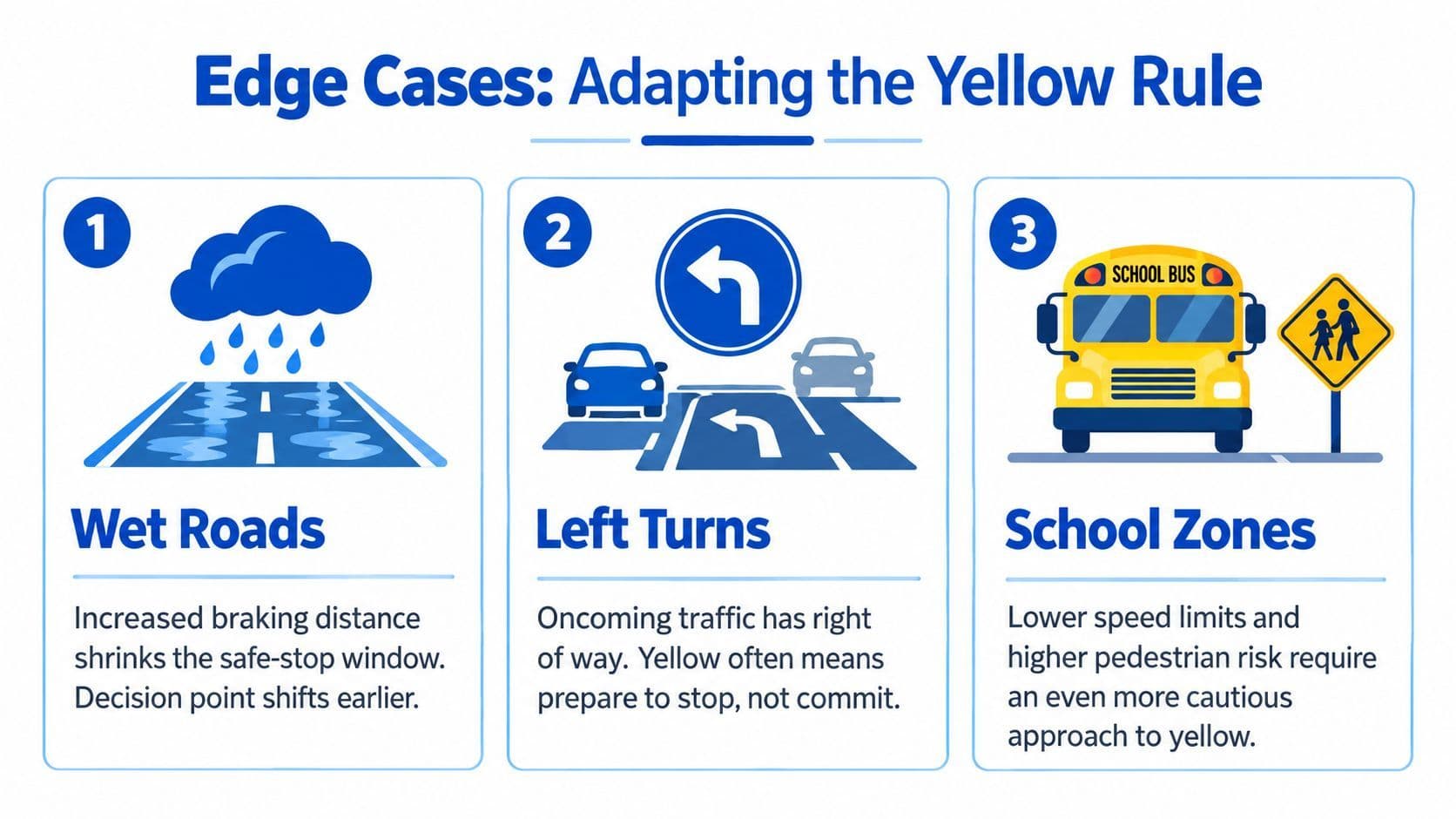
Three situations that demand earlier judgment
- Wet roads: Increase your visual lead time and brake progressively. The road surface can make a stop less predictable.
- Left turns: Don't enter just to “hold” the intersection for a later turn. If you're already committed, clear it safely.
- School zones: A lower posted speed gives you more control, but pedestrians and children require extra caution. A yellow light still calls for the same legal assessment.
Emergency vehicles add another layer. If a siren is approaching from behind as the signal turns yellow, don't stop on a wet crossing or block the emergency vehicle's path. Keep moving through when necessary to clear the conflict area, then pull over safely when you can do so without creating another hazard.
The Ontario left-turn rules guide is useful when you're practising how signal changes interact with turning position. The common thread remains steady: judge early, brake smoothly, and never panic-stop.
Watch the scenario in motion before practising it on the road:
Your Yellow Light Checklist for Confident Driving
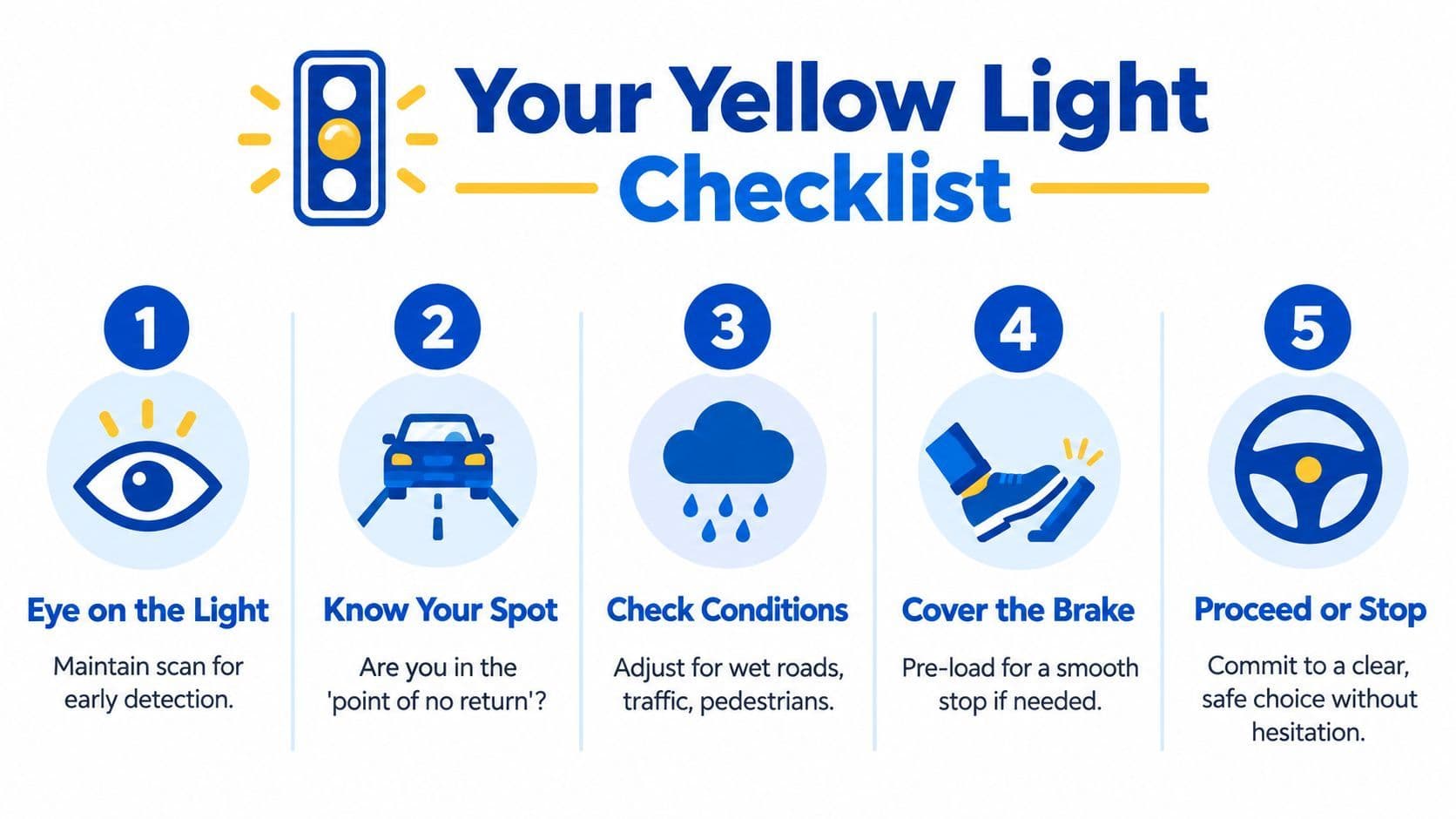
The experienced driver's routine happens quickly, but it isn't rushed. When amber appears, run through the same sequence every time:
- Scan the light: Look ahead early and check the intersection, pedestrians, turning traffic, and road surface.
- Know your position: Decide whether you're far enough back to make a controlled stop.
- Check conditions: Account for wet pavement, your speed, traffic behind you, and anyone crossing.
- Cover the brake: Prepare to slow smoothly without locking the wheels or startling the driver behind.
- Proceed or stop: Stop if you can do so safely. Otherwise, continue with caution and clear the intersection under control.
The Highway Traffic Act supplies the legal wording. The timing guidance explains why speed and distance matter. The G1 question pattern tests whether you can apply both ideas instead of memorising “yellow means stop” as an absolute rule.
You now have a repeatable process for the next intersection: read early, judge the stop line, adjust for conditions, and choose the safe action without accelerating to beat the red. Practise that process until it feels ordinary, and a nervous G1 question becomes much easier to recognise.
Use G1ready.ca to practise Ontario traffic-signal questions, including yellow-light decision scenarios, with immediate explanations and targeted quizzes. Work through the traffic-rules questions before your G1 test, then apply the same safe-stop process during your next supervised drive.


