
You've arrived at ServiceOntario for a licence renewal, only to discover that the photo rules are stricter than expected. Your hair covers part of an eye, your expression is too cheerful, or you're wearing a head covering without being ready to explain the reason. The visit may end with a request to return for a retake.
The confusion usually starts with timing. Ontario drivers renew their licence every 5 years, but the licence photo is generally updated every 10 years. A renewal and a photo update aren't always the same appointment, and the difference matters for first-time drivers, newcomers, learners, and anyone moving between an Ontario driver's licence and an Ontario Photo Card.
Why Your Driver's Licence Photo Matters More Than You Think
You arrive at ServiceOntario with the right documents, expecting the photo to take only a moment. Then a fringe covers one eye, your expression is too cheerful, or a head covering raises a question. A staff member may ask you to retake the image, turning a simple visit into another trip.
The photo is part of a regulated identity credential, not a casual snapshot. Ontario keeps it as a consistent visual reference, so the image needs to remain useful for identity checks as your appearance changes.
Practical rule: Treat your licence photo like a security checkpoint, not a casual portrait.
The timing causes a common misunderstanding. Ontario's driver's licence renewal guidance says drivers renew their licence every 5 years, while the photo itself is generally updated every 10 years. These are separate cycles, like two clocks running on the same card. A renewal may not automatically mean a new photo, while a photo update may occur at a different point.
Ontario also allows a person to retake a photo at any time for a $35.75 fee, as noted on the province's driver's licence renewal page. That option can help if your appearance has changed or you want a replacement image outside the ordinary photo cycle.
The same timing can confuse newcomers and first-time drivers choosing between an Ontario driver's licence and an Ontario Photo Card. The card category, licence record, renewal appointment, and photograph connect, but they do not all follow identical schedules.
A clear, front-facing image with the face fully visible gives the province a stable baseline for comparison. It is designed for reliable identification, rather than for a flattering social-media portrait. For a learner or newcomer receiving a first Ontario credential, understanding that purpose makes the photo rules easier to follow the first time.
Technical Requirements for Ontario Driver's Licence Photos
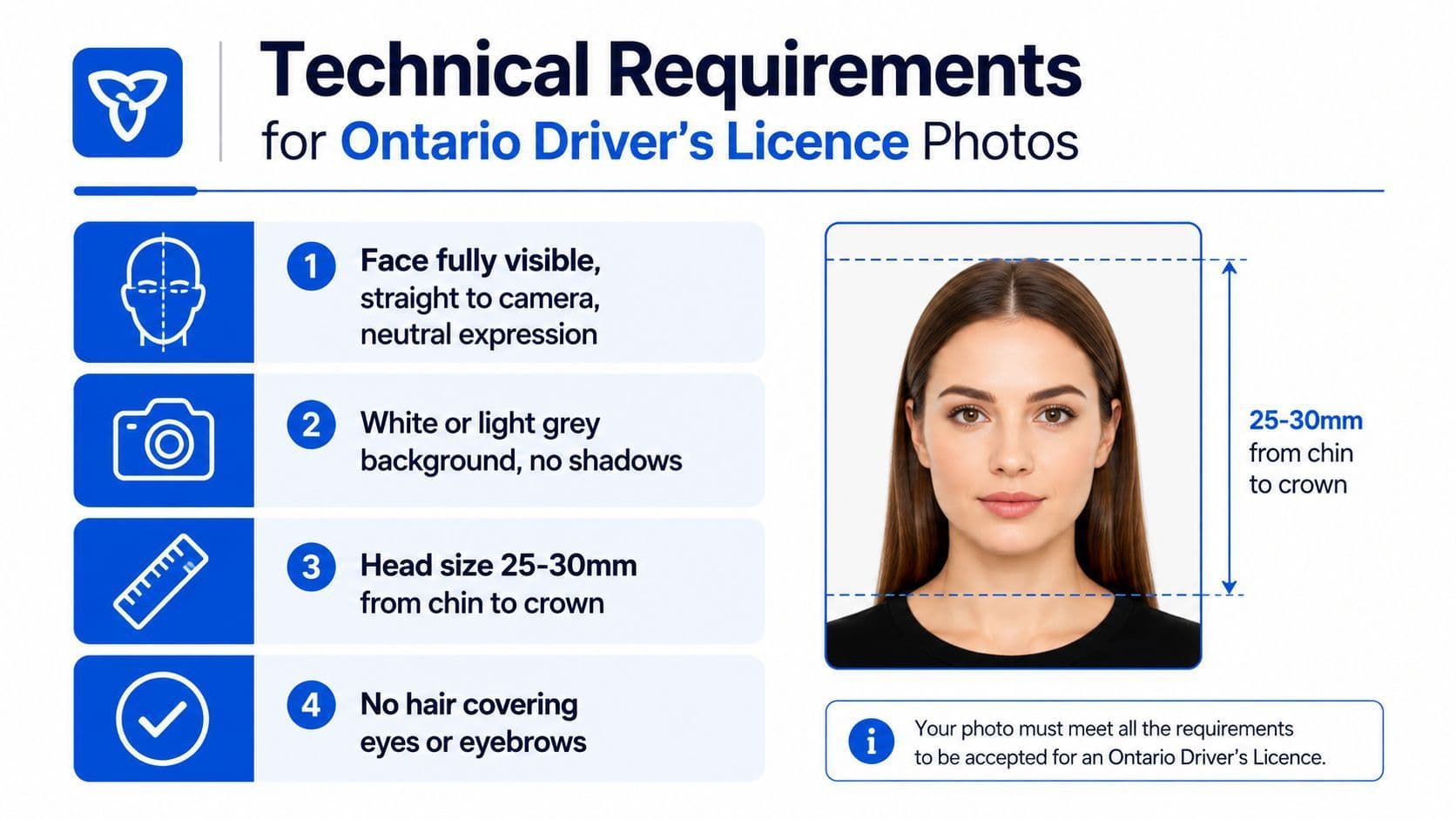
You have only a moment at the camera, but a few small details determine whether the image meets Ontario's standard. Your face must be fully visible, unobstructed, and facing straight at the camera, with a neutral, relaxed expression. Smiling is not accepted under the province's stated photo rules, and hair cannot cover your eyes.
Position your face correctly
Face the camera squarely. Keep both sides of your face visible, without turning your chin or tilting your head up or down. A relaxed, closed-mouth expression is the safest choice because it matches Ontario's neutral-expression requirement.
A straight-on image works like a consistent reference point for identity checks. Turning your head or making an exaggerated expression changes the features used for comparison.
Keep your eyes and facial features clear
Move bangs, loose strands, or a side sweep away from your eyes before the photograph is taken. The face must remain unobstructed, so accessories or coverings that hide facial features may cause a problem.
Ontario permits headwear for religious or medical reasons, provided it does not hide any part of the face. The exception concerns the purpose of the headwear, not ordinary fashion choices.
Follow the controlled photo process
The same provincial legislation cited earlier authorizes the Minister to require applicants to be photographed with ministry-provided equipment. A preferred studio portrait generally cannot replace the official image.
Use this quick check before the camera:
- Face: Fully visible and pointed directly at the camera.
- Expression: Neutral and relaxed, with no smile.
- Hair: Away from the eyes.
- Headwear: Only for a religious or medical reason, with the entire face visible.
- Process: Be ready for the photograph to be taken using ministry equipment.
What You Can and Cannot Wear in Your Photo
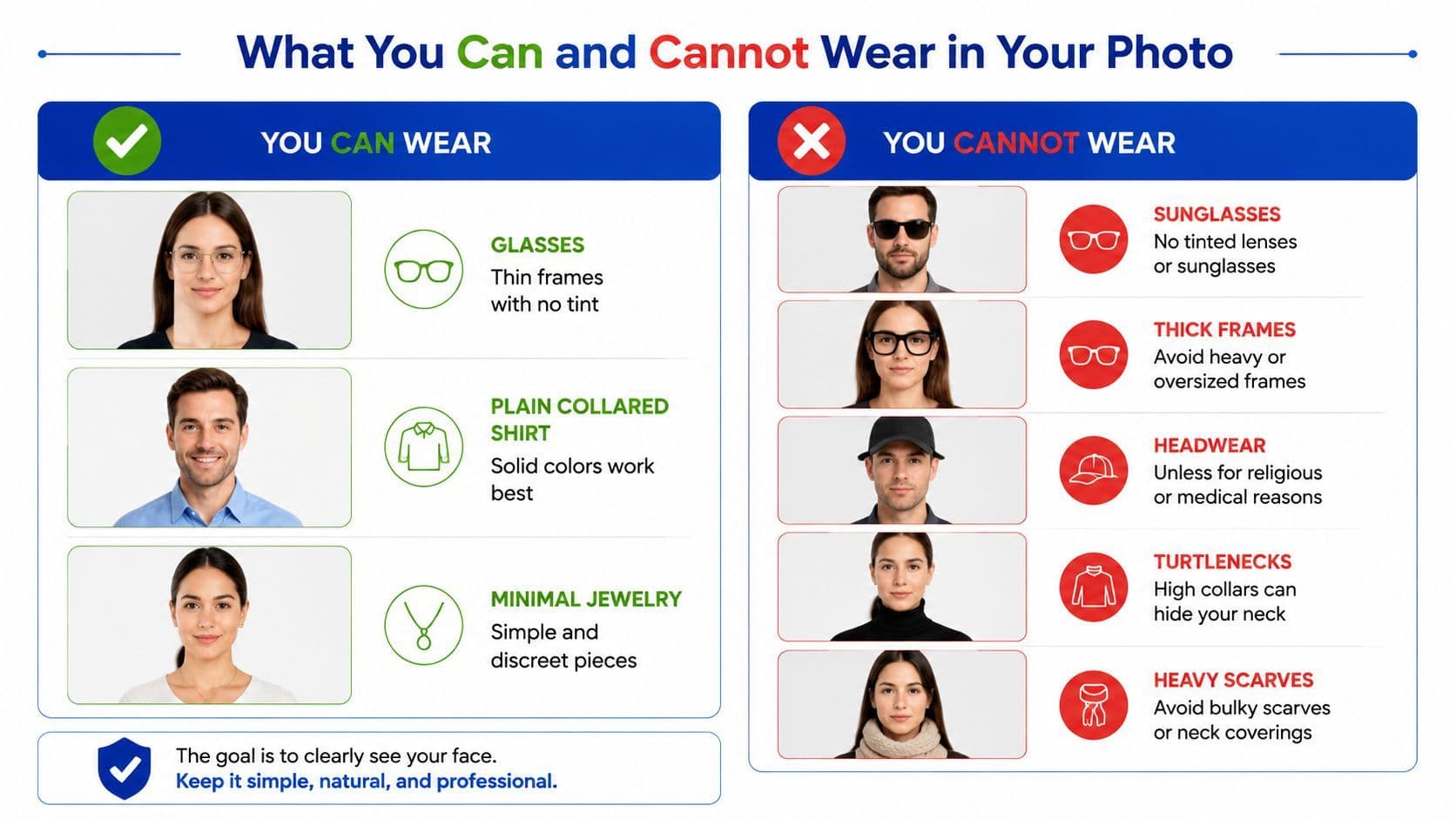
Clothing usually causes fewer problems than facial visibility, but small choices can still affect the result. Choose something comfortable and uncomplicated, with a neckline that doesn't crowd your face. A plain shirt in a colour that contrasts with the light studio background is a sensible choice.
The key distinction is between an item that merely changes your appearance and one that obstructs the required facial view.
Usually sensible More likely to cause trouble Plain collared shirt High collar or bulky scarf close to the chin Clear prescription glasses without glare Sunglasses or tinted lenses Small, simple jewellery Jewellery that crosses or hides facial features Religious or medical headwear that leaves the face visible Fashion hats, caps, or other coverings Hair arranged away from the eyes Fringe or loose hair over the eyes
Glasses can be a borderline case. If you need prescription glasses for everyday driving, bring them, but check that the lenses don't reflect the light and that the frames don't cover your eyes. Sunglasses and tinted lenses are poor choices because they interfere with clear facial visibility.
Jewellery isn't automatically a problem. Small earrings or a simple chain may be fine if they don't obscure your face. Oversized frames, large hoops, facial accessories, or anything casting a visible shadow deserves a second look before you sit down.
Headwear follows the strictest rule. Ontario allows it for religious or medical reasons, but it must not cover any part of your face. A baseball cap, fashion headband, or winter hat doesn't qualify merely because you prefer wearing it.
ServiceOntario's official requirements should take priority over general photo advice. The safest outfit is the one that leaves your face easy to see and gives the camera a clear, uncluttered view.
The Legal Framework Behind Photo Requirements
You arrive at ServiceOntario expecting a routine renewal, then learn that your licence photo and credential status involve separate rules. The timing can feel confusing because a driver's licence is generally renewed on a five-year cycle, while the photo may be updated on a different, ten-year cycle. A renewal date does not automatically mean a new photograph is required.
Ontario treats a driver's licence as a controlled government credential. As noted earlier, the Highway Traffic Act gives the Minister authority to require an applicant's photograph using ministry equipment. The Photo Card Act provides similar authority for Ontario Photo Card applicants.
That framework answers a common question from newcomers and first-time applicants: “Can I submit my own photo?” The provincial process is not a personal portrait submission. Ontario can require the photograph as part of issuing the credential, and the image must meet the administrative standard set for the card.
The rules also connect driver's licences and Photo Cards. A person cannot hold an Ontario driver's licence and an Ontario Photo Card at the same time. Someone with an Ontario Photo Card who applies for a driver's licence must surrender the Photo Card. A driver's licence holder applying for an Ontario Photo Card must surrender the licence.
The Photo Card overlap
The Photo Card Act describes several photo-card categories, including basic, enhanced, and combined photo cards. A combined card can function as both an enhanced photo card and a driver's licence, which makes the categories harder to follow during a change in status.
A non-driver may seek government photo identification, while a learner may be progressing toward a driver's licence. A newcomer may not know that applying for one provincial photo credential can require giving up another. The practical question is which credential you're applying for and what active credential you already hold.
A Photo Card is provided for the holder's convenience. The law does not require it to be obtained, carried, presented, or accepted under any Act. That makes it an optional identity document, not an informal application. Once someone applies, its issuance still follows a controlled process.
If the photograph fails to meet the required standards, Ontario may ask the applicant to return for a retake. Photo compliance therefore works as both a legal condition and an operational checkpoint.
How to Prepare for Your Photo Appointment
A photo appointment can go wrong before you reach the camera. Your renewal timing may involve a licence renewal, a separate photo update, or a change between credential types. These steps help you identify the right task and arrive ready.
Days before
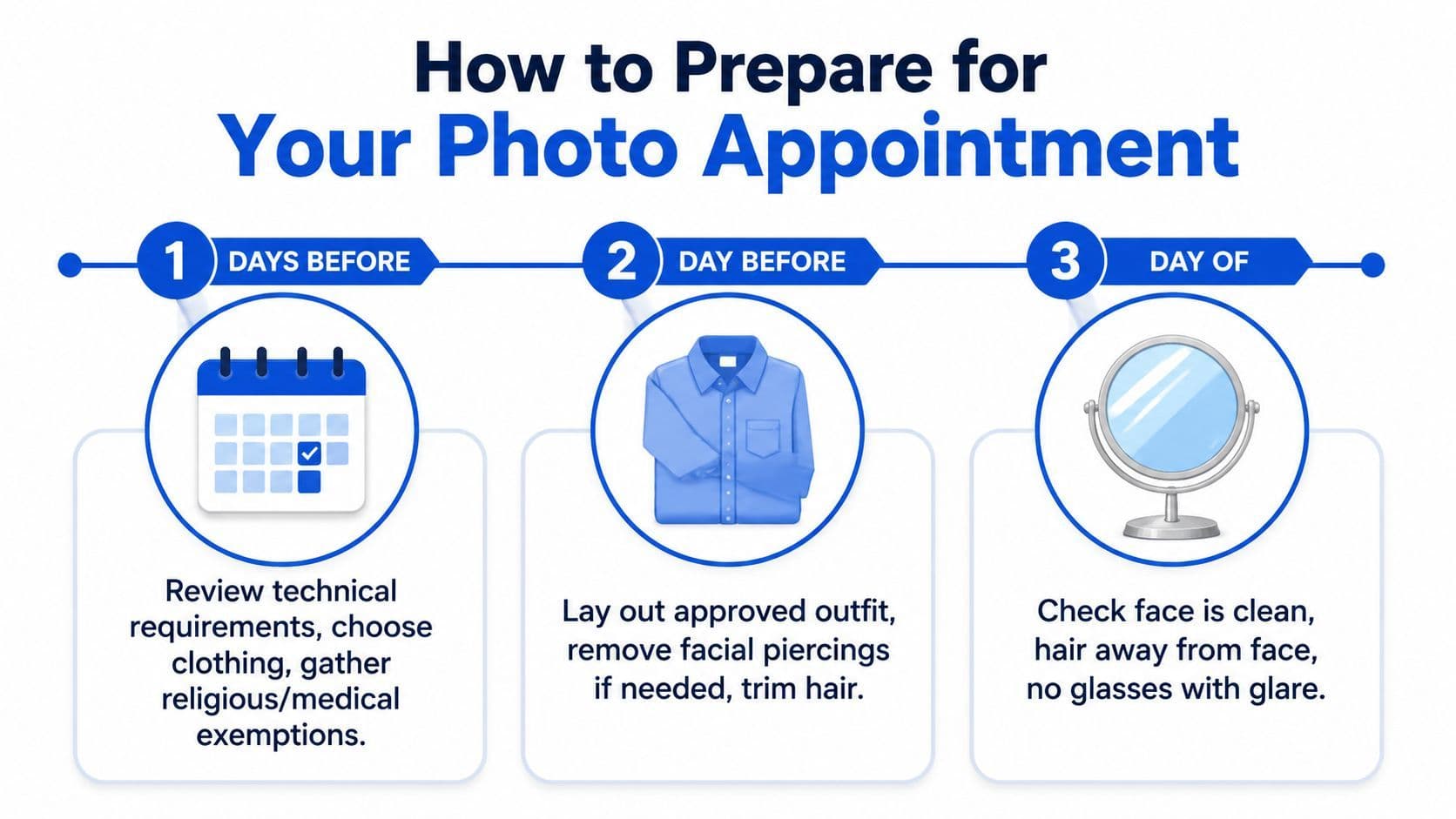
Check the applicable renewal instructions and confirm what your appointment covers. Ontario licences generally renew on one schedule, while the photograph may follow a longer update cycle. Treat these as two clocks, not one. A newcomer or first-time driver who also has an Ontario Photo Card should confirm which credential is active before booking, because the application may affect the document they already hold.
Choose plain clothing that leaves your face and neck clear. If you wear headwear for religious or medical reasons, gather any supporting information you may need before travelling to ServiceOntario.
The day before
Lay out your clothing and inspect your glasses under indoor light. Move hair away from your eyes, then remove or adjust accessories that could cross your face. Keep your appearance familiar. The goal is a clear, recognisable version of yourself, not a dramatic change for the camera.
If you are checking whether the transaction can be completed digitally, review this guide to renewing your driving licence online. An online option does not remove photo requirements, so the instructions may still point you to an in-person visit.
At the appointment
Arrive early enough to settle your expression and check your appearance. Face the camera directly, relax your mouth, keep your eyes visible, and follow the staff member's positioning instructions.
If the first image is not accepted, staff may ask for a retake or another visit. Make the adjustment rather than arguing over a borderline photo. A short correction is easier than leaving with the issue unresolved.
Common Reasons Photos Get Rejected and How to Avoid Them
A friendly smile feels harmless, which is why it catches people off guard. Ontario requires a neutral, relaxed expression, so smiling can make an otherwise acceptable photo fail the standard. Practise relaxing your mouth instead of trying to produce a natural portrait expression.
Hair creates another frequent misunderstanding. People often check that their face is generally visible, then overlook one strand crossing an eye. Ontario's rule is specific, so pin back bangs or sweep loose hair away before the camera is ready.
Glasses can look fine in a mirror and still produce glare in the photograph. Tilted lenses, bright reflections, tinted lenses, or heavy frames can interfere with the clear view of your eyes. If you don't need glasses for the appointment, you can ask staff about the appropriate approach, but don't remove prescription eyewear without considering your normal driving needs.
Headwear requires careful attention to the reason for wearing it. Ontario allows religious or medical headwear only when it leaves every part of the face visible. A fashion hat, cap, or headband doesn't become an exception because it feels familiar or practical.
Before leaving home: Check your expression, eyes, glasses, and headwear in the same order every time.
The safest response to a borderline item is to simplify. Choose plain clothing, minimal accessories, hair away from the eyes, and no covering that isn't connected to a religious or medical need. Staff can then evaluate a clear image rather than an avoidable complication.
What Happens If Your Photo Is Refused
A refused photograph does not end your licensing process, but it can create another visit. Ontario may require a retake when the image does not meet its standards. Before you leave, ask staff which requirement caused the refusal and what you should change. That answer is more useful than guessing and repeating the same mistake.
Ontario also allows a new photo outside the ordinary cycle for a $35.75 fee. This may help if you want to replace an existing image earlier, but the replacement still has to meet the facial-visibility requirements.
Identify the transaction you are completing
First, determine which transaction you are handling:
- A licence renewal: Ontario driver's licences are renewed every 5 years.
- A photo update: The licence photo is generally updated every 10 years.
- A retake: A new photo can be taken outside the normal cycle for the stated fee.
- A category change: Moving between a driver's licence and an Ontario Photo Card involves surrendering the other credential.
The five-year licence cycle and ten-year photo cycle work like two separate clocks. They can reach their checkpoints at different times. You may renew your licence while your current photo remains valid, or encounter a photo update during a renewal visit. A renewal does not automatically mean a new photograph.
For more detail, review the Ontario driver's licence renewal process before travelling to ServiceOntario. If staff refuse the image, correct the specific issue, confirm whether another visit is required, and ask how the refusal affects card processing.
Do not assume you can drive normally while waiting for a compliant card or replacement. Ask ServiceOntario about your status and whether your transaction includes a temporary document. This is especially important when a Photo Card is involved, because it is a separate credential and cannot be held together with a driver's licence.
Connecting Photo Requirements to Your G1 Journey
For a G1 learner, the photograph is part of a larger first-licence process. Test-day preparation includes more than studying road signs and rules. You also need to arrive with the identification and other documents required for your application, understand the photo standard, and be ready to follow the official capture process.
Newcomers can find the document side particularly unfamiliar. Before attending, use this guide to check what documents you need for the G1 test. Then review the photo basics: face forward, eyes visible, neutral expression, and no hair covering the eyes.
Your photo doesn't determine whether you pass the knowledge test, but poor preparation can make test day more stressful. A learner who has organised documents, selected suitable clothing, and practised a relaxed expression has fewer administrative distractions before answering questions.
The same mindset helps as you move through G1, G2, and full G licensing. Keep your personal information current, pay attention to whether an appointment is a renewal or a photo update, and don't confuse an Ontario Photo Card with a driver's licence. The two credentials cannot be held together, so a change in status may require surrendering the existing card.
G1ready.ca offers free, registration-free practice exams, targeted quizzes, mixed tests, a diagnostic test, marathon practice, and an exam simulator aligned with the Ontario G1 handbook. Visit G1ready.ca to prepare for the knowledge test while you organise the documents and photo details needed for your appointment.


