
You're sitting at a quiet suburban intersection on a Tuesday afternoon, both hands steady on the wheel, when another car reaches the stop sign across from you. You've stopped, but you aren't sure whether the other driver got there first. Should you proceed, wave them through, or wait for a signal?
That hesitation is common for new drivers. Ontario's four-way stop rules become much easier once you separate the decision into a few questions: Where did each vehicle make a complete stop? Who stopped first? Did two vehicles stop at the same time? Are pedestrians crossing? The legal foundation, turning situations, G1 exam traps, and malfunctioning traffic lights all fit into that sequence.
A Familiar Intersection and What This Guide Covers
At a four-way stop, the signs may look simple, but several decisions happen in a short moment. You must stop at the correct location, observe the other approaches, establish the order of arrival, and continue only when the intersection is clear and safe.
The most important habit is to stop completely before you decide who goes next. Ontario's official guidance identifies the stopping location as the stop line, crosswalk, sidewalk edge, or intersection edge, depending on which markings and features are present. That physical position matters because arrival order begins with a legal stop, not with the moment a driver first reaches the intersection.
Practical rule: Don't decide priority while your vehicle is still rolling. Stop first, then assess the order.
This guide covers the source of Ontario's four-way stop rules in the Highway Traffic Act, the exact stopping benchmarks that establish arrival order, the rule for simultaneous arrivals, and the way turning vehicles interact with vehicles travelling straight. It also addresses pedestrians, common G1 knowledge-test mistakes, and the difference between a signed four-way stop and an intersection where traffic signals have failed.
One point will keep returning: right-of-way never removes the duty to proceed safely. A driver who has priority still needs to check for pedestrians, cyclists, vehicles that haven't stopped, and any hazard in the intersection.
The Legal Foundation Behind Ontario Four-Way Stops
Suppose you approach an intersection and see a STOP sign on every corner. The order between drivers begins with Ontario law, not with an informal wave or an assumption that the wider road has priority.
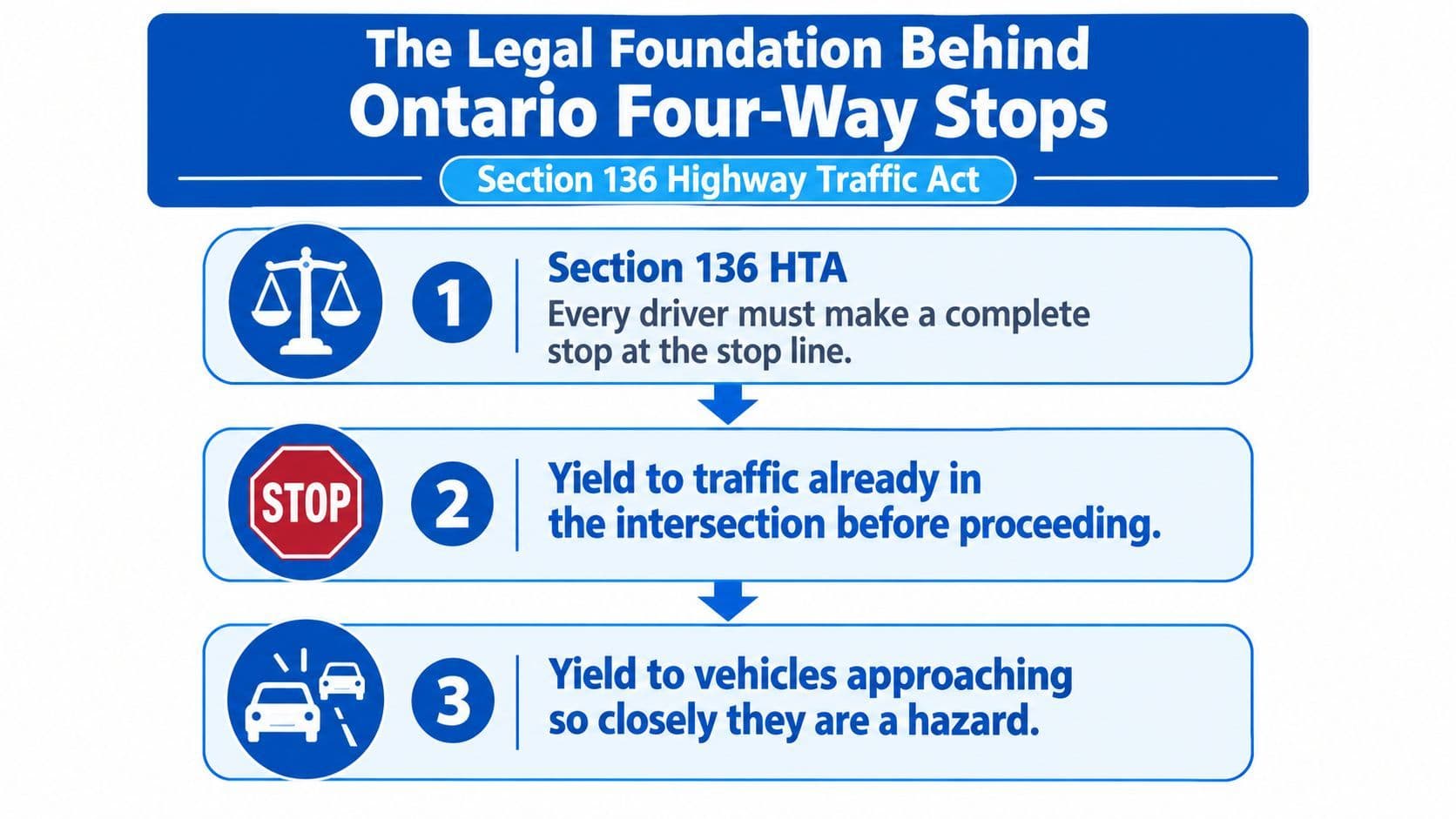
Ontario's core stop-sign rule appears in section 136 of the Highway Traffic Act. A driver must stop at the marked stop line. If there is no line, stop before the nearest crosswalk. If neither is present, stop immediately before entering the intersection. After stopping, the driver must yield to traffic already in the intersection and to traffic approaching closely enough to create an immediate hazard. The full rule appears in the Ontario Highway Traffic Act.
A four-way stop is a planned intersection-control arrangement. Each approach has stop control, so every driver faces the same basic duty to stop and then yield as required. Ontario Traffic Manual guidance explains that STOP signs assign right-of-way between vehicles approaching from different directions when a yield sign is not adequate. Stop control can also serve as an alternative to traffic signals where signals are not warranted or have not been installed. The Ontario Traffic Manual guidance on stop control describes the purpose and use of STOP signs.
What counts as a complete stop
Your wheels must stop moving. Slowing, creeping, or rolling past the correct point does not create a clear arrival moment and may not meet the legal requirement. Treat the stopping point like a bookmark. It shows other drivers when you have completed your part.
Use this sequence:
- Stop line: Stop before the marked line.
- Crosswalk: Without a stop line, stop before the nearest crosswalk.
- Sidewalk edge: Without a marked crosswalk, stop at the sidewalk edge.
- Intersection edge: Without a sidewalk, stop at the intersection edge.
The Act also sets requirements for STOP sign placement. A sign must face approaching traffic on the right side of the highway and sit between 1.5 metres and 15 metres from the intersecting roadway, as specified in the statute. Municipalities choose among four-way stops, two-way stops, traffic signals, and other controls for particular locations. Drivers must follow the signs installed at the intersection.
Who Goes First When Drivers Arrive at Different Times
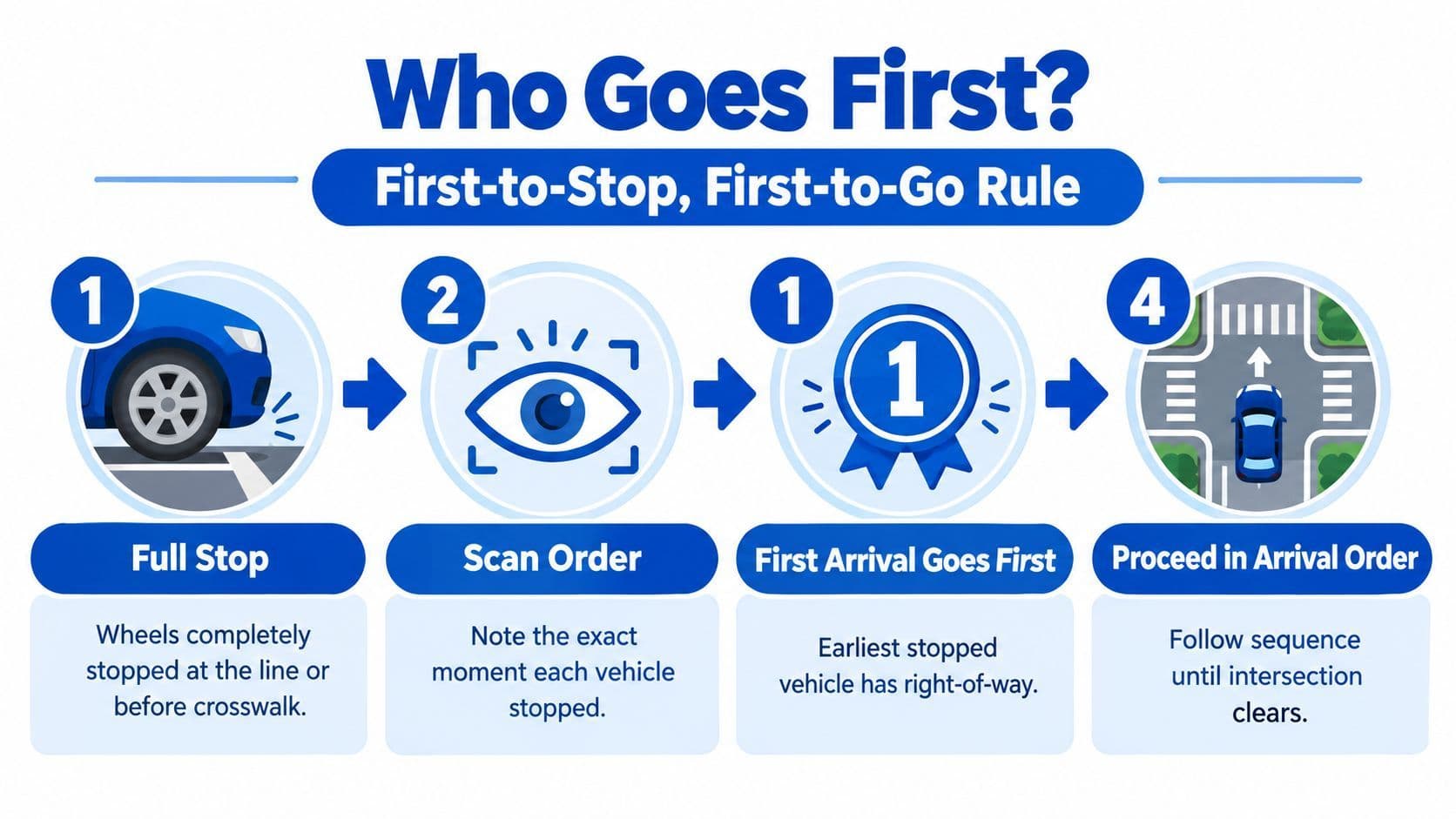
The basic sequence is straightforward: the first vehicle to come to a complete stop goes first. The key word is “stop.” A vehicle that reaches the intersection first but continues rolling hasn't established priority in the same way as a vehicle that stops properly.
Suppose three cars approach a four-way stop. The first car reaches its stop line and comes to a full stop. A second car stops shortly afterward at the crosswalk on the cross street. A third car arrives after both vehicles have stopped. The first car proceeds when the path is clear, the second car follows, and the third car waits until its turn.
The stopping benchmark comes from the vehicle's position and movement. Ontario guidance requires a driver to stop at the stop line, or at the crosswalk, sidewalk edge, or intersection edge when the earlier reference point isn't present. The official Ontario driver guidance on stopping at intersections explains these stopping locations.
Why rolling stops create confusion
A rolling stop removes the moment other drivers need to judge your arrival. If you slow almost to a stop and continue, another driver may believe you haven't stopped yet. That driver might move forward while you assume you have priority, creating conflicting movements.
Vehicle size, engine power, road width, and approach speed don't change the order. A large vehicle doesn't automatically go first, and a driver travelling on the wider road doesn't gain priority at an all-way stop. The signs control all approaches equally.
A vehicle already moving through the intersection has a different position from a vehicle that has just arrived. Wait for it to clear rather than treating its presence as a new arrival. Similarly, a vehicle turning right from a side street doesn't automatically outrank a vehicle that stopped earlier. The first complete stop establishes the initial order, subject to safe yielding and pedestrian duties.
If you stopped first, hesitation doesn't automatically cancel your turn. Proceed only after checking that the other driver understands the sequence and that the intersection is clear.
The Ontario right-of-way guide for G1 learners reinforces the practical distinction between arriving first and stopping first. Treat the rule as a sequence, not as a race to the sign.
This video provides another visual explanation of the order drivers use at a four-way stop:
Simultaneous Arrivals, Turning Rules, and Pedestrians
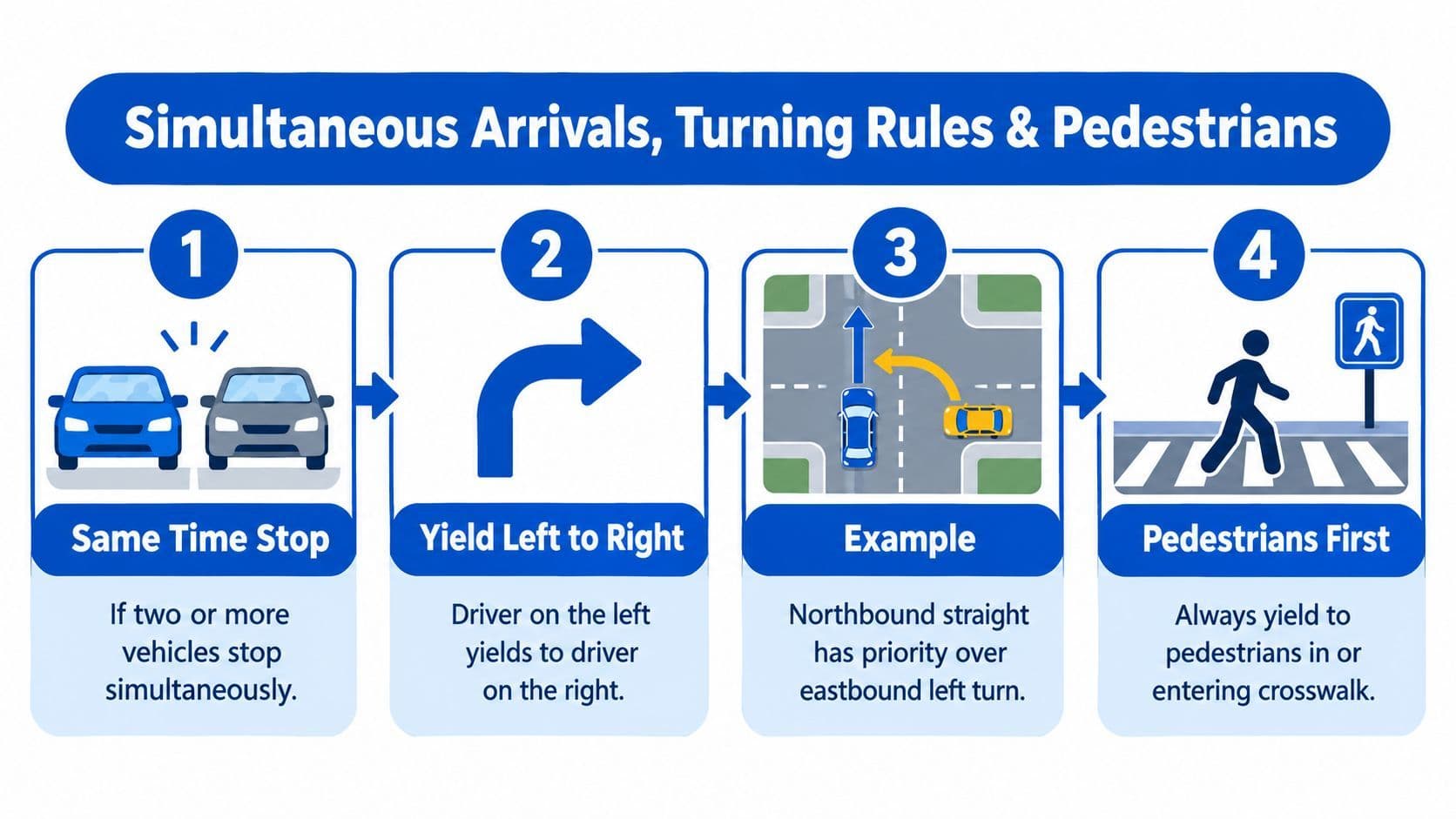
Two vehicles may stop at the same time, especially when visibility is limited or traffic is light. Ontario's tie-breaker is clear: the vehicle on the left yields to the vehicle on the right. Look across the intersection, identify the other vehicle's position, and allow the vehicle to your right to proceed first.
For example, you stop on the west side of the intersection while another vehicle stops on the south side at the same moment. The other vehicle is to your right, so you yield. If the other vehicle is to your left, that driver yields to you. Don't use the rule mechanically if a pedestrian or immediate hazard changes the situation.
Turning direction adds another layer. Consider a northbound vehicle travelling straight and an eastbound vehicle turning left. If both have stopped at the same time and their paths conflict, the eastbound left-turning vehicle must yield to the northbound vehicle travelling straight. A left turn crosses the path of oncoming traffic, so the turning driver waits until the movement is safe.
When two vehicles face each other and both continue straight, they can generally proceed together if their paths don't cross. A vehicle turning right can also proceed when its path is clear, but it must still check the crosswalk and yield to pedestrians. The fact that a right turn feels simple doesn't remove the requirement to make a complete stop first.
Pedestrians change the decision
Vehicle order never gives permission to drive through a crosswalk occupied by a pedestrian. Yield to pedestrians already in the crosswalk, entering it, or stepping off the curb where the driver must allow them to cross. Be especially careful when a pedestrian is hidden by a stopped vehicle in the next lane.
The driver's own communication can also create responsibility. If you wave a pedestrian or another road user across, you may encourage that person to move into a path they believed was safe. Wait until the crossing is complete instead of using a hand gesture to hurry the person.
Safe intersection habit: Establish vehicle priority only after checking the people who may be crossing your intended path.
For a focused review of crossing duties, use this Ontario pedestrian crossing rules guide.
If three or four vehicles stop together, avoid forcing a decision through speed or a horn. Make eye contact where possible, let one driver proceed clearly, and reassess the remaining vehicles after the intersection begins to clear. If you can't tell who has priority, waiting briefly is safer than moving on an uncertain assumption.
Common Mistakes the G1 Exam Tests at Four-Way Stops
G1 questions often test whether you can apply the rule to the exact position shown, rather than whether you memorized a slogan. The most common wrong answers come from treating a four-way stop like an ordinary intersection where one road automatically carries priority.
Watch for these traps:
- Rolling stop as arrival: A vehicle that slows but keeps moving hasn't made the complete stop required before proceeding.
- Wider-road assumption: A wider, busier, or more direct road doesn't automatically have priority at a four-way stop.
- Four-way versus two-way control: Check every visible stop sign. If only some approaches have stop signs, the intersection isn't governed by the same all-way sequence.
- Unnecessary waving: A hand gesture can confuse another driver and doesn't replace careful observation of the intersection.
- Left-turn shortcut: A driver turning left must yield when an oncoming vehicle travelling straight has priority.
- Crosswalk obstruction: Stopping beyond the correct benchmark can block pedestrians and put the vehicle in the wrong position for judging arrival order.
- Horn-based priority: Honking doesn't create right-of-way and can make a nervous situation less predictable.
The exam can test two separate layers at once. First, identify who has priority under the right-of-way rule. Second, choose the answer that still reflects safe conduct, including yielding to pedestrians and stopping at the correct location. The Ontario left-turn rules guide is useful when a question combines stop control with a turning movement.
School-zone and pedestrian questions may appear beside intersection questions because a driver must combine several observations. A technically correct arrival order still doesn't justify proceeding into a crosswalk, cutting across an oncoming vehicle, or entering when a hazard is too close.
Four-Way Stops vs Signal Failures and Flashing Red Lights
A signed four-way stop is permanent stop control. A signal-failure intersection is different in its design, but drivers may need to use the same practical sequence when the lights no longer control traffic normally.
Ontario police and municipal safety guidance instruct drivers to treat a non-functioning or flashing-red intersection as a four-way stop for yielding behaviour. Every approach must stop, drivers establish the order of complete stops, and the earlier tie-breaker rules apply. The intersection may normally operate with signals, but a power outage or malfunction removes that normal direction of movement.
Scenario Driver Action Right-of-Way Rule Signed four-way stop Stop at the required benchmark and scan all approaches First complete stop proceeds first Signal failure or dark signals Stop and treat each approach as stop-controlled Use arrival order, then the right-side tie-breaker Flashing red signal Stop, yield, and proceed only when safe Apply stop-sign priority Flashing yellow signal Slow, scan, and proceed with caution Do not treat it as a stop sign unless another control requires stopping
The important contrast is between flashing red and flashing yellow. A flashing red signal functions like a stop sign. A flashing yellow signal warns drivers to slow down and use caution, but it doesn't create the same automatic stop requirement.
For a G1 question, look at the signal display rather than relying on the intersection's usual layout. If the signal is dark or a flashing red controls the approach, use the full-stop and yielding process. If a police officer is directing traffic, follow the officer's directions instead of applying the usual signs or signals.
Quick Reference Checklist and Practice Next Steps
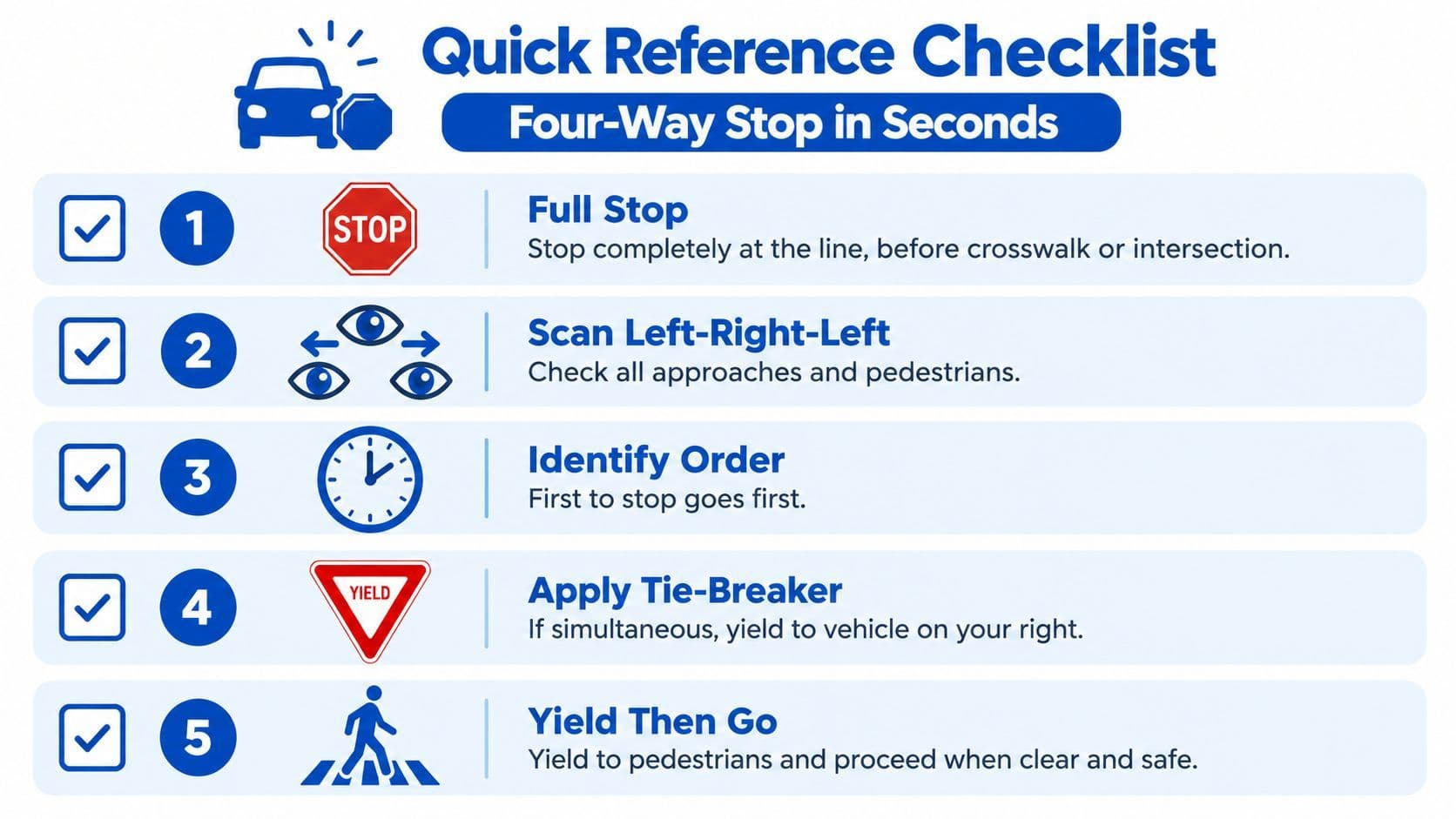
A nervous driver can reduce the whole process to five actions:
- Stop completely. Stop at the line, then the crosswalk, sidewalk edge, or intersection edge as applicable.
- Scan left, right, and left again. Look for vehicles, pedestrians, cyclists, and hazards.
- Identify the order. The first vehicle to stop proceeds first.
- Break a tie. If vehicles stopped simultaneously, the driver on the left yields to the driver on the right.
- Yield, then proceed. Let pedestrians cross and move only when your path is clear.
Quick questions
Can two vehicles facing each other turn left at the same time? They may be able to if their paths are arranged so they don't conflict and the intersection is clear, but don't assume the movement is safe. Follow the stop order, yield to oncoming traffic where paths cross, and check pedestrians.
Do cyclists and e-bike riders follow the same priority? Treat them as road users who must be considered in the intersection. Watch their position, signal, and movement, and don't proceed because you believe your vehicle has priority.
What should I do if nobody seems sure? Keep your vehicle stopped, make your intention clear only when necessary, and proceed after the order is understandable and safe. Courtesy should reduce confusion, not replace the rules.
For targeted practice, use timed questions and stop-sign scenarios on G1ready.ca, then review each explanation until the sequence feels automatic.
G1ready.ca offers practice questions on right-of-way, four-way stops, and stop-sign situations, with explanations that help you correct mistakes as you study. Visit G1ready.ca to practise these scenarios before your Ontario G1 knowledge test and build a calmer decision process at the wheel.


