
You're sitting with a Tamil handbook open, a phone full of practice questions, and one nagging worry. The official Ontario G1 test is available in Tamil, but the wording still feels unfamiliar, especially when the questions switch from everyday driving talk to translated traffic terms that don't always land naturally in your head. That's normal, and it's exactly why a good G1 practice test Tamil language routine has to be more than just memorising answers.
The test in Ontario is computerized, available in 31 languages, including Tamil, and it still follows the same structure for every learner, 40 multiple-choice questions split into two 20-question sections for road signs and rules of the road. You need 80% in each section, which means 16 out of 20 correct in both parts, not one combined total DriveTest's knowledge test page. That detail matters because many Tamil-speaking learners study as if one strong section can carry the other. It can't.
Understanding the G1 Test Format in Tamil
If you're preparing in Tamil, start by getting the structure clear in your mind before you start chasing scores. Ontario's official knowledge test doesn't change because you choose Tamil. It's still a computerized exam, and the language option is part of a standard provincial system, not a casual translation layer DriveTest's knowledge test page.
What the test actually asks you to do
The exam has 40 multiple-choice questions. Half are on road signs, half are on rules of the road, and you must pass each section separately with 80%, which is 16 correct out of 20 in both sections Ontario G1 test format. That means a learner who knows signs very well but misses too many rules questions still fails, even if the overall experience feels decent.
Practical rule: don't ask, “Did I do well overall?” Ask, “Did I pass road signs and rules separately?”
At the DriveTest centre, Tamil is the language you read the questions in. The driving standard does not become easier, and the content does not change into a different test just because the screen shows Tamil text DriveTest's knowledge test page. That's why Tamil-friendly preparation has to cover the official Ontario content, not just the words on the page.
A helpful place to get a quick overview of the layout before you start drilling questions is this guide to the G1 test format: G1 test format guide.
What confuses Tamil speakers most
The biggest confusion usually comes from translated driving terms. A word may be technically correct in Tamil, but it still feels unfamiliar if you've never connected it to a real road situation in Ontario. That's why test day confidence comes from recognising patterns, signs, and rules together, not from reading the Tamil version once and hoping it sticks.
The official infographic below is worth studying closely because it reinforces the key habit, separate mastery of signs and rules, not one blended score.
Finding Reliable Tamil Language G1 Practice Resources
Not every G1 practice test Tamil language resource deserves your time. Some tools look polished but score everything as one total, which teaches the wrong habit for Ontario. Others use outdated wording or ignore the two-section structure, which creates false confidence long before test day.
What good practice material should match
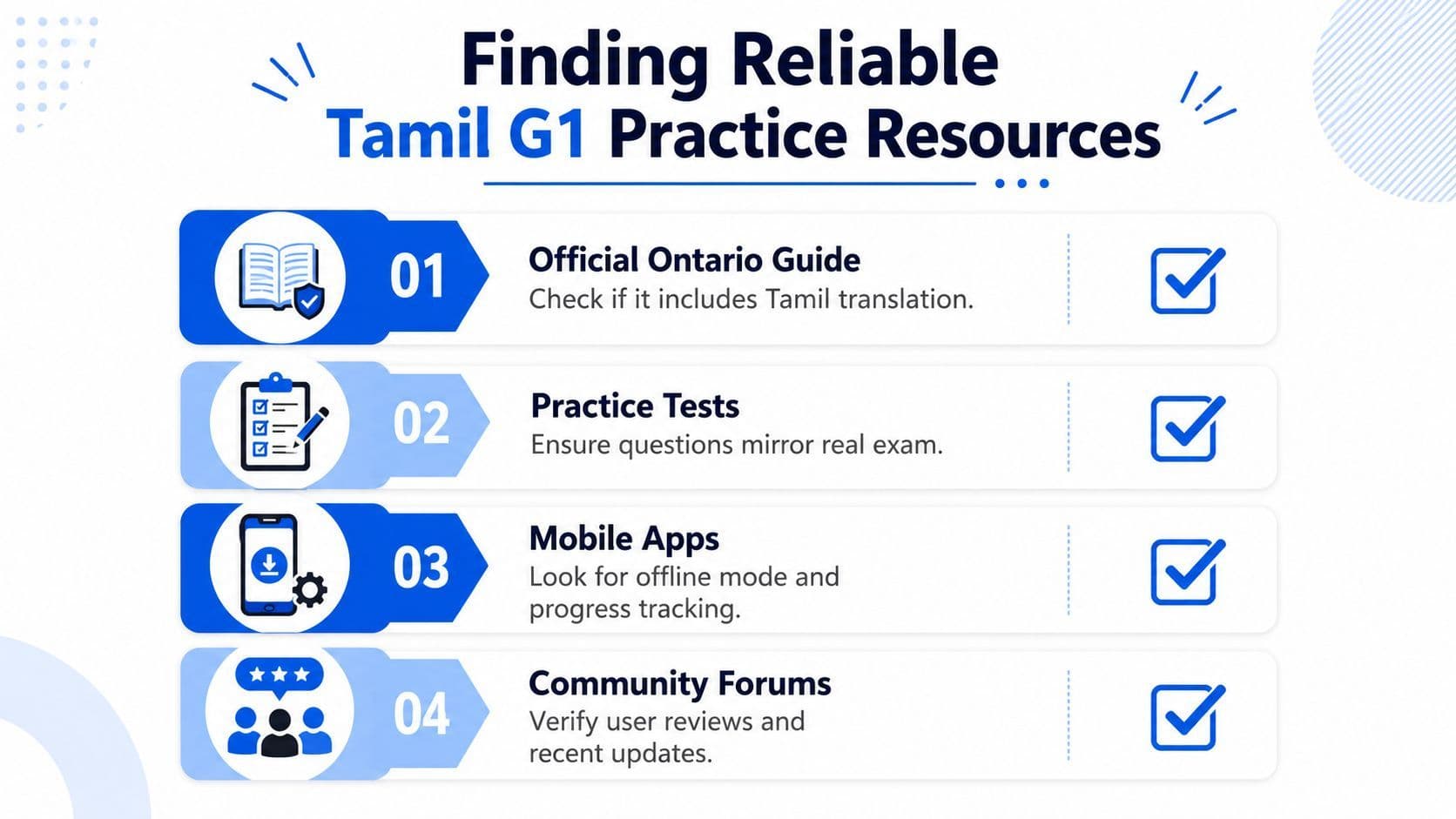
A trustworthy resource should line up with the current Ontario test in three ways. First, it should mirror the same 20 road-sign questions and 20 rules-of-the-road questions. Second, it should treat 80% per section as the standard, because that is what the actual exam requires Ontario G1 practice overview. Third, it should feel current enough that the questions and explanations still reflect how Ontario drivers are expected to think now, not years ago.
The reason this matters is simple. If a practice set teaches you to chase one overall percentage, you may ignore a weak section until the actual exam exposes it. That's a bad study bargain for Tamil-speaking learners, especially when translated wording already adds a layer of friction.
How multilingual access usually shows up
Ontario's driver-licensing system serves a multilingual population, and Tamil is part of that access picture. One Ontario-focused practice provider says its Tamil quiz is aimed at Tamil-speaking residents of Ontario, while another Ontario app listing shows support for 17 languages, including தமிழ் (Tamil), which shows how Tamil sits within a broader multilingual strategy for learner-drivers Ontario-focused Tamil G1 practice provider. Those resources have also been updated across multiple years, including 2025 and 2026, which is a useful sign that the materials are being kept in step with Ontario expectations same Ontario-focused Tamil G1 practice provider.
A quick check helps you avoid weak materials:
- Official structure: confirm the resource uses two sections, not one blended score.
- Question style: see whether the questions feel like Ontario road signs and Ontario road rules.
- Language support: verify Tamil is a real option, not a decorative label.
- Update history: look for recent versions rather than stale screenshots or old wording.
You can also compare the test-language options and study categories through this language guide: Ontario G1 test languages guide.
Building an Effective Tamil G1 Study Plan
Tamil-speaking learners usually don't fail because they're careless. They fail because they study in the wrong order. If you start with random questions, you may memorise the wording before you understand the rule, and that breaks down the moment the exam rephrases the idea.
Learn first, then test under pressure
Use a two-part method. First, learn the meaning behind the traffic idea in Tamil, then test yourself with timed practice. The point isn't to move quickly, it's to build recognition that survives pressure.
Start with road signs. These are visual, and once you connect the symbol to the meaning, the wording becomes easier. Then move to rules of the road, where the terms can feel less intuitive because translated expressions like yield or right-of-way may not map neatly onto the way you'd naturally say it in Tamil. When a term feels awkward, anchor it to a situation instead of a direct word match.
Read the rule, then ask yourself what the driver must do in that moment.
A simple routine that actually works
Use this sequence over and over:
- Study the handbook in Tamil, but slow down on terms that describe driver behaviour.
- Review road signs separately, because the visual memory helps.
- Take a timed drill, not an untimed guessing session.
- Check every mistake immediately, while the question is still fresh.
- Repeat the weak topics, especially if they keep showing up.
- Retest the same section until the score feels stable, not lucky.
Ontario's pass rule is sectional. A weak road-sign score cannot be rescued by a stronger rules score Ontario G1 test format. Section-specific drills followed by immediate mistake review are the safest way to build confidence without fooling yourself.
For practical prep materials that support this kind of routine, one option is the Ontario practice library from G1ready.ca, which offers handbook-aligned practice exams, instant feedback, and targeted quizzes.
Using Practice Tools to Track Your Progress
A practice tool should do more than mark a question correct or wrong. It should show where your reasoning slips, and that matters a lot when you are learning Ontario driving rules in Tamil. A learner who can spot a pattern in errors usually improves faster than someone who keeps restarting the same quiz and hoping the result changes.
Compare the tools by what they reveal
A diagnostic test is useful at the start because it shows whether your weak point is road signs, rules, or both. A progress tracker helps later, when you want proof that your scores are becoming steadier rather than just occasionally good. A realistic exam simulator gives the final check, because it shows how your mind works when the format feels close to test day.
Immediate feedback matters here. If a platform explains why an answer is wrong, you can correct the idea right away instead of carrying the same mistake into the next round of questions. Hints can help too, especially when they point you toward understanding rather than revealing the answer outright.
For learners who want a study reference that matches this kind of tracking, the Ontario G1 practice material guide can help you choose what to review next. Used well, practice tools and study material work together, one shows the gap, the other helps you close it.
What to look for on a mobile device
Tamil-speaking learners often study in short windows, during commutes or between family responsibilities. A mobile-friendly platform makes that easier because you can practise without setting aside a full evening. That flexibility matters when your study plan depends on repetition and steady review.
Some learners prefer short targeted quizzes. Others want longer practice to build stamina. Both can help, but they do different jobs. Targeted quizzes expose weak areas quickly, while longer sessions help you stay focused until the end.
How to know a tool is helping
A good sign is when your weak topics start appearing less often. Another sign is when you stop guessing from the Tamil wording and start recognising the road behaviour behind the question. If your scores only rise when you see familiar wording, the tool is teaching recall, not understanding.
A useful platform leaves a trail you can review. You should be able to see which topics need another pass, which answers you missed for the same reason, and whether your performance is improving across different question styles. That kind of record gives you a clearer picture than a single score on one day.
Common Mistakes Tamil Speakers Make During G1 Prep
A lot of Tamil-speaking learners think they're close to ready when they're not. The practice score looks decent, the questions feel familiar, and the language barrier seems smaller than it did at the start. Then test day arrives, and the format exposes the gaps.
The mistakes that keep showing up
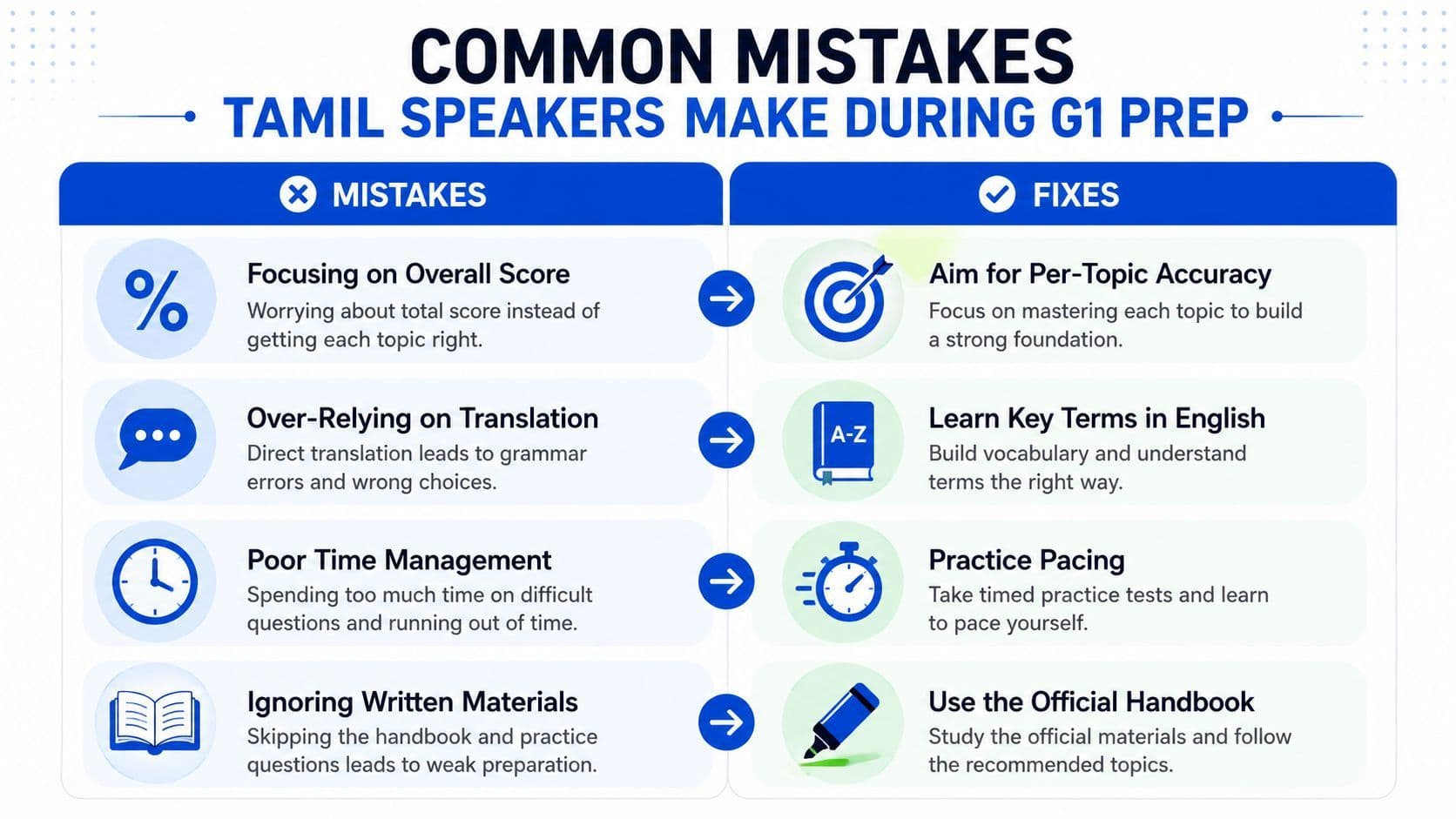
One common mistake is chasing an overall score instead of checking each section. Ontario doesn't care whether you averaged well across the whole test, it cares whether you passed road signs and rules of the road separately Ontario G1 test format. Another trap is memorising question patterns, which works until a real question uses different wording for the same rule.
Skipping the handbook is another problem. Practice questions help, but they can't replace the foundation in the official material, especially when rules are not absorbed cleanly through translation alone. And if you only practise in a quiet room with no timing pressure, the first stressful environment you face may be the DriveTest centre.
The fix for each one
- Overall score focus: track each section on its own and stop studying only when both are stable.
- Translation confusion: learn key terms as driving actions, not just dictionary words.
- Pattern memorisation: answer why the rule exists, then test with different wording.
- No handbook review: read the official material before repeating questions.
- No time pressure: use timed sessions so the test feels familiar.
The goal isn't to feel comfortable with the app. The goal is to feel calm when the question wording changes.
If a practice tool gives you instant explanations, use them as a correction system, not as a shortcut. That's where weak Tamil-to-driving terminology bridges get built, one mistake at a time.
Your Final Preparation Checklist for Test Day
A few days before the test, the work should feel settled. Your focus shifts from learning new material to checking whether your Tamil practice has become steady enough to hold up under test-day pressure.
What readiness should look like
Readiness shows up as repeatable results in both sections, not one lucky round. If you can keep passing road signs and rules of the road on different practice sets, your knowledge is holding, not just your memory of one question set. That matters because stress can make familiar wording feel unfamiliar, especially when the Tamil translation uses terms you had to learn carefully rather than guess.
You should also know what the centre will ask of you on the day. The DriveTest process includes a vision test and the written knowledge test, and the official Ontario test requirements are listed in the Ontario G1 test requirements summary. If the Tamil text on the screen looks a little different from the practice questions you have been using, slow down and read for the driving rule behind the sentence. That is the same habit you have been building all along, especially for translated traffic terms that do not always match everyday Tamil speech.
A short checklist for the centre
- Bring the right identification: check what you need before you leave home.
- Arrive early: give yourself time to settle before the vision test.
- Keep your section habits in place: answer each part on its own instead of relying on one strong area to carry the other.
- Read every question fully: translated wording can hide the actual action.
- If the Tamil interface feels off: slow down, rely on the driving rule, and ask staff for help if needed.
The best sign of readiness is calm recognition. You should feel like you have already done this work in practice, only now you are doing it in a quieter, more formal setting.
If you want a Tamil-friendly way to practise the Ontario format without wasting time on mismatched questions, G1ready.ca gives you handbook-aligned G1 practice tests, instant explanations, and targeted drills that fit the way Ontario's exam is scored. Visit G1ready.ca and start practising with the same section-by-section approach you'll need on test day.


