You're in the driveway with a new G1 card, and someone has already asked if you can take the car to the mall tonight. The honest answer depends on the trip, not on how ready you feel. G licence restrictions change when you pass a test. They don't disappear.
A parent in the passenger seat isn't a free pass if the clock is past midnight, the route uses a banned expressway, or anyone has been drinking. Judge the drive you plan. One failed condition means you stay parked.
The G1 Rules You Must Follow on Every Drive
Ontario places a G1 licence at Level One. Passing the knowledge test changes the conditions you drive under. It does not remove them. You may operate Class G vehicles only while every row below is true on that specific trip.
Restriction What the G1 holder must do Exception or detail Supervision Drive only with a fully licensed accompanying driver Driver needs four years of driving experience and sits in the front passenger seat Accompanying driver's alcohol Stay below 0.05% blood-alcohol concentration Zero if the driver is 21 or younger G1 driver's alcohol Maintain a zero blood-alcohol level No exception listed Seatbelts Ensure every passenger wears a working seatbelt Applies to all passengers Night driving No driving from midnight to 5 a.m. No exception listed Restricted roads No 400-series highways or high-speed expressways such as Highway 401, the QEW, the Gardiner Expressway, the Don Valley Parkway, E.C. Row Expressway and Conestoga Parkway An Ontario-certified driving instructor may allow driving on any road
Why one failed row ends the trip
Read the table like the safety switches on a car. One switch left open stops the whole machine, and one failed restriction stops the whole drive. Having supervision is only the first switch. The accompanying driver must be fully licensed, must have at least four years of driving experience, and must sit in the front passenger seat. That person's blood-alcohol concentration must stay below 0.05%, and it drops to zero when the accompanying driver is 21 or younger. Your own level stays at zero, and every occupant needs a working seatbelt.
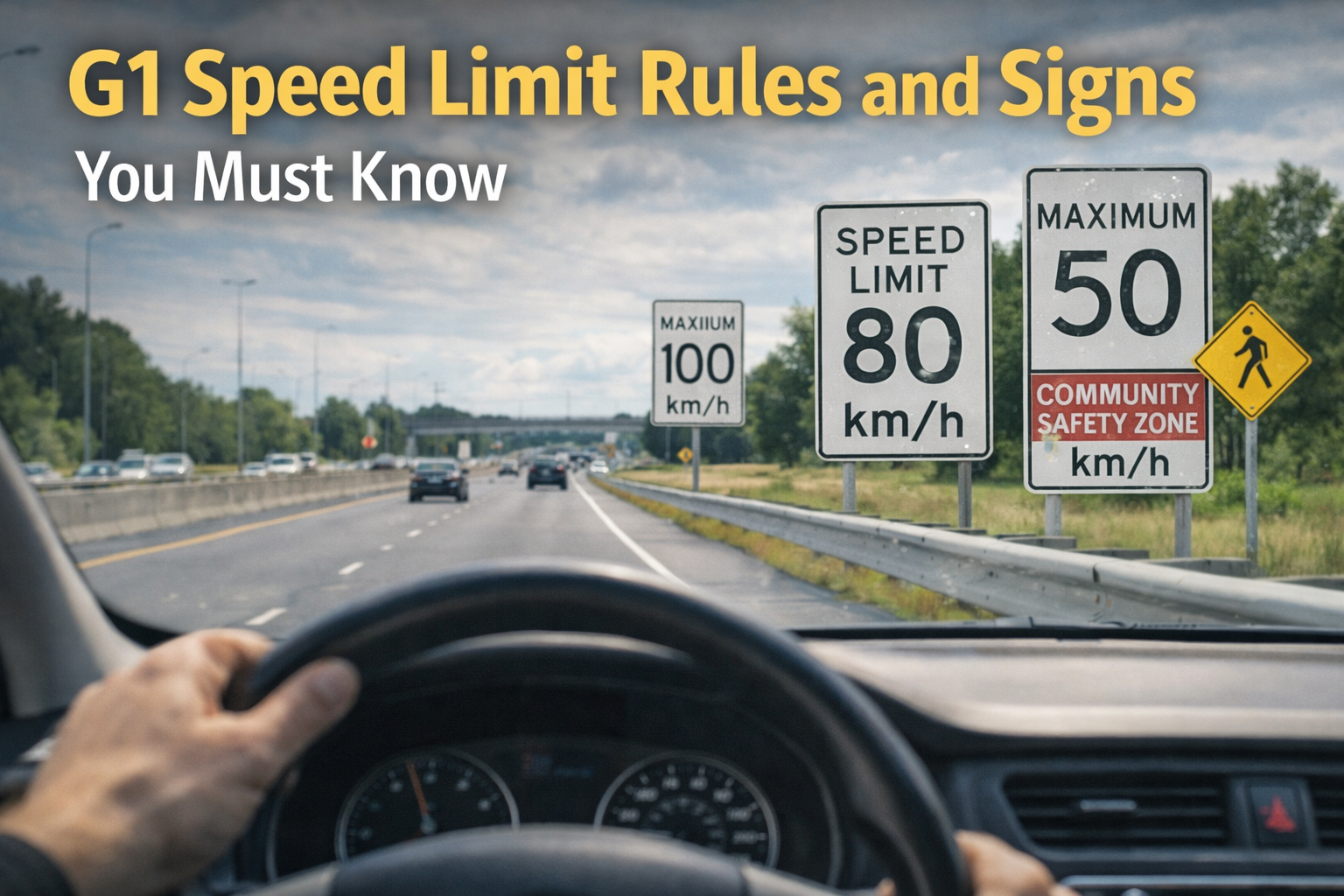
Time and road class are separate switches. You can't drive from midnight to 5 a.m. You also can't drive on 400-series highways or other high-speed expressways such as Highway 401, the QEW and the Gardiner Expressway. The handbook allows one road exception: an Ontario-certified driving instructor may accompany you on any road.
Practical rule: Treat the six rows as a checklist, not a menu. Supervisor qualification, clock time, road class and alcohol status all have to pass together.
The slips learners make most often
A sober parent still fails the supervision row after only two years with a full licence. The same parent fails it from the back seat while a friend rides up front. A movie that ends at 11:40 p.m. is legal at the curb and illegal at 12:10 a.m. in your driveway. A calm route through local streets stops being calm the moment a shortcut enters a banned expressway.
Before you start the engine, read down the table and confirm every row. If one row fails, change the time, the road, or the person beside you.
How Ontario's Three Licence Stages Work
Ontario introduced its graduated licensing system in 1994 for people applying for their first car or motorcycle licence, and the official graduated licensing rules set out three stages: G1, G2 and full G. Think of a staircase. Each step grants more freedom only after you've shown the skills of the step below. The G1 is a supervised learning licence, not an independent one. The limits exist so you practise while staying out of the riskiest hours and roads before you move up.
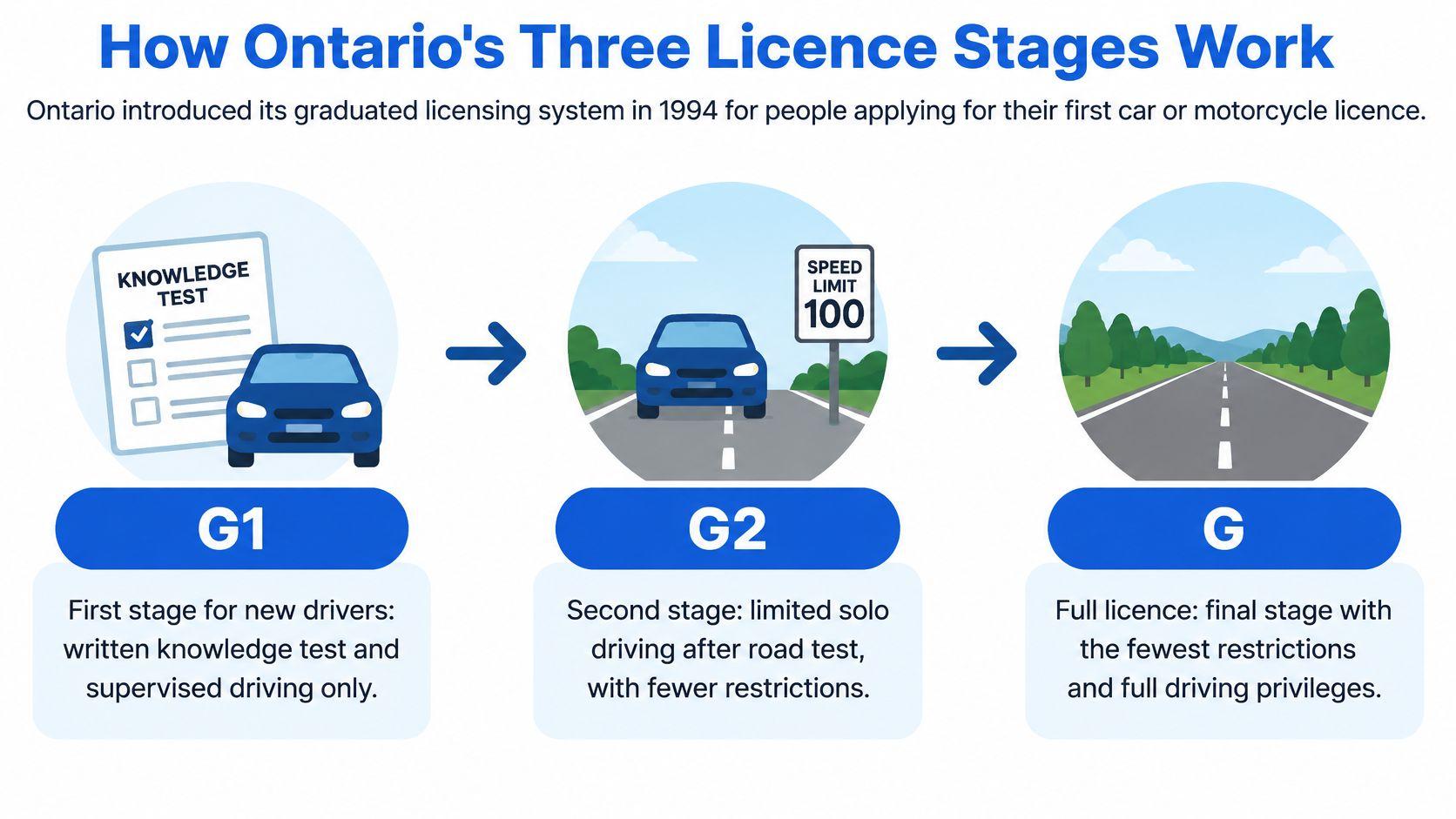
Say you're a first-time driver in Mississauga. You pass the vision screening and the knowledge test, and you receive a G1. Practice happens only with a qualified accompanying driver. You later book the first road test. A pass moves you to G2, where supervision is no longer the default, but novice conditions remain. After the G2 waiting period you take the second road test. Only a pass on that test, and the issue of a full G, ends graduated limits.
A driver who has passed the first road test is still a novice. The card in the wallet tells you which rule set is live.
- Read the stage on the licence. G1, G2 and full G are different permissions.
- Match that stage to its own conditions. Don't borrow rules from the stage you hope to reach next.
- Use the G2 comparison only if the card says G2. A G1 holder who applies G2 passenger rules is guessing.
The graduated driver's licence guide walks through how the stages fit together if you want the sequence beside your study notes. On the driveway, the card decides which conditions you open.
Common Misreadings About G1 Driving Permission
Passing the vision and knowledge tests issues the G1. It doesn't issue permission to drive alone. Ontario's new-driver licensing page states that this begins Level One of a process with two road tests, and that the path normally takes at least 20 months. The first road test moves you to G2. The second road test, after the G2 waiting period, leads to full G.
Four beliefs that get trips cancelled
"A licence in my hand means I can drive myself." The G1 only allows driving with a qualified accompanying driver. Action: don't leave unless that person is in the front seat, fully licensed, and carrying the required experience.
"Any adult in the car counts as supervision." Experience, front-seat position, and alcohol level are all part of the job. A neighbour who got a full licence last year doesn't qualify, and neither does a parent who has had two drinks. Action: ask how long the person has held a full licence, seat that person in front, and keep both of you at the alcohol level the rule requires.
"I'll be careful, so the 401 is fine." Care doesn't lift the expressway ban. The ban stands unless an Ontario-certified driving instructor sits beside you. Action: plan practice on ordinary roads, or book a lesson if you need highway time.
"Restrictions ended when I passed the first road test." A pass swaps one rule set for another. G2 conditions stay live until the full G is issued. Action: learn the G2 conditions as their own set, with their own limits on late-night passengers and high-speed roads.
A Friday pass doesn't rewrite Saturday night.
A teen passes the first road test on Friday and offers to drive three friends, all under 20, to a late movie on Saturday. The trip runs past midnight and takes a 400-series highway. Two G2 breaches stack on one drive: the passenger cap for drivers 19 and under is blown by three young passengers in the late-night window, and the route ignores the guidance to avoid highways posted over 80 km/h. Passing a test changes which rules apply. It never removes them.
Real Driving Situations Tested Against the Rules
Lists don't settle arguments in the car. Trips do. Test every plan against every condition, and treat a single failure as a stop sign.
Trip situation Allowed? Rule that decides it Parent in front seat, 3 p.m., local road Yes Supervised daytime driving on a road that is not restricted Parent in front seat, 12:30 a.m., local road No Midnight-to-5 a.m. ban Parent in front seat, Highway 401 No 400-series highway and high-speed expressway ban Certified Ontario driving instructor beside learner, Highway 401 Yes Instructor exception for any road Supervisor aged 21 with 0.03% BAC No Zero BAC limit for supervisors aged 21 or younger Supervisor aged 40 with 0.03% BAC, learner sober Yes Below the 0.05% accompanying-driver limit Learner has one drink No G1 holder must maintain zero BAC Four passengers, three working seatbelts No Every passenger needs a working seatbelt
Daytime errands versus late nights
A parent in the front seat at 3 p.m. on a local road is the textbook practice drive, assuming that parent has the experience and a legal alcohol level. The same parent at 12:30 a.m. on the same street is not allowed. The midnight-to-5 a.m. ban decides it, even when the road is quiet and the supervisor is perfect.
Highways and who sits beside you
A parent beside you on Highway 401 is a no, because that road is a 400-series highway. Swap the parent for a certified Ontario driving instructor and the same highway can be legal, because the instructor exception covers any road. The car and the pavement didn't change. The supervisor's status did.
Alcohol and seatbelts
A supervisor aged 21 with a 0.03% reading fails, because supervisors aged 21 or younger must be at zero. A supervisor aged 40 at the same reading can be within the accompanying-driver limit if you, the learner, are completely sober. One drink for you ends the trip on its own.
Four people and three working seatbelts also fails. Someone would ride without a working belt, and that row has no workaround.
Pick a trip you hope to make this week. Name the supervisor, the clock time, the roads and every person in the car. If any row in the situation table would read "No," choose a different plan.
How G2 Restrictions Differ From G1 Rules
Passing the G1 test does not wipe the rulebook clean. It swaps one set of limits for another, and a trip that was flatly illegal last month can now be legal only if several conditions line up at once.
The official MTO driver's handbook sets the G2 baseline: you may generally drive without an accompanying experienced driver, you must keep zero blood alcohol, and you may not carry more passengers than the vehicle has working seatbelts. On top of that sit the conditional rules. Drivers aged 19 and under face a strict limit on passengers under age 20 between midnight and 5 a.m., excluding immediate family members, and the handbook sets the exact count. Having a fully licensed driver in the front passenger seat changes how that late-night cap applies.
Restriction G1 holder G2 holder Supervision Must drive with a qualified accompanying driver May drive without an accompanying driver Blood-alcohol Zero Zero Passenger seatbelts Every passenger wears a working seatbelt Passengers may not exceed the number of working seatbelts Midnight to 5 a.m. No driving No ban; drivers 19 and under face a strict limit on passengers under 20, excluding immediate family Highways No 400-series or listed high-speed expressways Avoid 400-series highways posted over 80 km/h Fully licensed driver in front seat Required as accompanying driver Exempts the late-night under-20 passenger cap
Where G2 is looser, and where it isn't
Supervision is the big loosening. You can drive alone, at noon, with a car full of friends, and every row of the table is satisfied. Run a real trip through it anyway. A 19-year-old G2 driver leaving a shift at 1 a.m. may legally be on the road, yet the coworkers under 20 riding along trigger the under-20 passenger limit. The same drive at noon raises no such issue, and a sibling in the car is excluded from the count as immediate family.
Alcohol and seatbelts never loosen. Both stages require zero for the driver, and a G2 still cannot carry more people than working belts. Those rules survived the test unchanged. Our guide on how many passengers are allowed with a G2 walks through the late-night scenarios worth checking before you offer rides after a late shift.
Roads that still need a second look
Ontario's graduated licensing materials state that novice drivers must not drive on 400-series highways with a posted speed limit over 80 km/h, and they name the Queen Elizabeth Way, Don Valley Parkway, Gardiner Expressway, E.C. Row Expressway and Conestoga Parkway. Treat zero alcohol, seatbelt capacity and the late-night under-20 limit as separate checks to run on every trip, each able to fail the drive on its own.
G1 questions ask whether the drive is permitted at all. G2 questions ask you to combine age, time, passenger age, family relationship and who is in the front seat.
Graduated limits end only when the full G licence is issued. Until then, the rules have changed rather than disappeared, so judge each planned trip against the table the same way you did as a G1 learner.
Newcomers With Foreign Driving Experience
Ten years of daily commuting back home feels like it should count on Ontario roads. It can count. The card you're issued, though, decides which rules govern every trip, and your driving history only changes how fast the next card arrives.
Two pathways exist. Licence exchange applies when Ontario has an agreement that lets a licence from another jurisdiction carry over. Experience credit is narrower: verified past driving can count toward waiting time. It doesn't hand you a full G.
Applicants from places without an exchange agreement may still receive credit for verified foreign experience, and Ontario's regulations in force as of July 1, 2026 set out how prior licensing experience is treated. How much a wait shrinks depends on your pathway and your documents. What never changes is the testing: you still complete the vision test, the knowledge test, the G2 road test and the G road test.

Credit may shorten a wait or affect when you can book a test. It doesn't erase Ontario testing, and it doesn't grant full G privileges on its own. So judge each drive by the stage on the card, not by the odometer behind you. A newcomer holding a G1 who plans a solo 1 a.m. airport run, or a quick spin on the Gardiner, fails the same check as any other G1 holder.
A path you can follow in order
- Confirm the agreement status. Find out whether your home jurisdiction has a licence-exchange agreement with Ontario, or whether you're in the credit path instead.
- Gather verified evidence. A story about ten years of commuting isn't enough. Bring documents that show the licensing history you want credited.
- Pass the vision and knowledge tests. These come before any road test, even if you drove every day overseas.
- Pass the G2 road test. That's the move out of the most supervised stage.
- Check what your credit changes. Confirm whether your credited experience shortens the wait before the G road test instead of assuming the standard novice timeline applies.
- Pass the G road test. Full privileges follow that result, not the credit letter.
While your card says G1 or G2, the conditions for that stage still bind you, and foreign experience never removes them by itself. If you're sorting exchange rules from credit rules, the international licence in Ontario guide lays out the fork before you book a test you don't need, or skip one you do.
Confirm Your Restrictions Before Your Next Practice Drive
Make the check a habit, the same way you check mirrors before you pull out. Three questions, asked out loud, catch most illegal practice drives before they start.
Which stage does the licence show? A G1 card and a G2 card answer the midnight question differently. If you don't look, you'll apply the rule you wish you had.
Does the supervisor meet every condition? Experience, front seat and alcohol level are three answers, not one. "My dad is here" doesn't cover them.
Do the route and the clock avoid restricted roads and hours? Trace the drive on a map. A "quick" hop that joins the Gardiner, or a return that slips past midnight, fails even when the people in the car are perfect.
Run the trip you planned the way the situation table does. Name the deciding rule for supervision, alcohol, belts, time and road. One failure is a stop sign, not a detail to fix while you're already moving.
The same judgement shows up on the knowledge test. Our 200-question practice test includes a G1 Restrictions and Laws section of 10 to 20 questions, and the tests are built around the 2026 Ontario MTO Driver's Handbook. You pick a test from the list, either one section of the traffic regulations or a mixed test covering all chapters, and you drill the scenarios until the answer is boringly consistent.
Practise those restriction questions until every scenario comes out right. Plan a practice drive only when every condition for your stage is satisfied and the trip avoids restricted hours and roads.
G1ready.ca gives Ontario learners free practice built around the driver's handbook, including restriction and road-rule questions that match the trips you'll be asked about. Use it to sort G1 supervision, G2 passenger limits and the tests newcomers still have to pass before you book DriveTest. Start with the restriction questions on G1ready.ca and don't book a practice drive until every condition checks out.