You've landed in Ontario, your bags are half unpacked, and your wallet still holds the driver's licence you've used for years. Then the questions start. Can you drive today? Do you need an International Driving Permit? Is there really a 60-day rule, or is it 3 months? And if your licence can't be exchanged, what exactly happens next?
That confusion is normal. Ontario's rules make sense once you separate temporary driving, licence exchange, and the Graduated Licensing System. The problem is that many newcomers hear pieces of all three at once and end up with a blurry picture.
This guide is for that exact moment. It walks through the actual choices in front of you, in plain language, so you can decide what applies to your situation and avoid common mistakes. If you're searching for help with International License Ontario rules, start with one question: are you here as a visitor, or are you now considered a resident? From there, the path gets much clearer.
Welcome to Ontario Your International Licence Explained
A newcomer named Sara arrives in Mississauga for school. She has a valid licence from home, a place to stay, and a part-time job lined up. She also has a practical problem. The grocery store isn't nearby, winter is coming, and public transit won't always fit her schedule.
Her first instinct is simple. She already knows how to drive, so she should be able to keep driving. That part is understandable. The difficult part is that Ontario doesn't treat every foreign licence the same way.
Some drivers can exchange their licence. Others can use their previous driving experience as partial credit. Many have to start inside Ontario's own system and pass the G1 knowledge test before they can move forward.
Practical rule: Your past driving experience matters, but Ontario still decides how that experience fits into its own licensing rules.
Many people often become confused. They search “international licence Ontario,” read one page about visitors, another about residents, and a third about licence exchange, then try to combine all three. That's how people end up thinking an International Driving Permit is a licence by itself, or that every newcomer automatically gets 3 months to drive.
A better way is to sort your situation into three separate questions:
- Are you a visitor or a new resident: That changes the timeline for how long you can legally use your foreign licence.
- Is your country or jurisdiction eligible for exchange: That decides whether you can skip major parts of Ontario's testing process.
- If not, do you need the G1 route: That determines whether you'll enter the staged system used by new Ontario drivers.
Once those three points are clear, the process feels much less intimidating. You stop guessing and start making decisions in the right order.
Driving Temporarily with Your Foreign Licence
The most urgent question is usually the simplest one. Can you drive right now?
The first question to answer
Ontario draws an important distinction between visitors and new residents. Official guidance says new residents have 60 days to switch to an Ontario licence, while visitors can drive for up to 3 months, which is exactly why so many newcomers get mixed messages when their status changes from visitor to resident during the same stay, as explained on the Ontario licence exchange page for out of province and foreign drivers.
That's the heart of the 60-day versus 90-day confusion. A person may arrive thinking, “I can drive for 3 months,” but if Ontario considers that person a new resident earlier, the 60-day timeline matters. Students and workers often run into this because their real-life move feels gradual, but the legal category matters more than the feeling of being “just arrived.”
Use this simple decision tree:
- If you're visiting temporarily, the visitor rule may apply.
- If you've become a resident, start counting based on the resident timeline.
- If your status changed after arrival, don't assume the visitor timeline still protects you.
If you're unsure which status applies to you, treat the situation conservatively and verify it before driving. That's much safer than relying on a casual answer from a friend or online forum.
What an IDP does and does not do
Many newcomers hear about the International Driving Permit, usually called an IDP, and assume it solves everything. It doesn't.
An IDP is generally used as a supporting document that translates your licence details. It is not your actual driver's licence. If your original licence isn't valid for your situation, an IDP doesn't fix that. It travels with your licence. It doesn't replace it.
That matters because people often combine three separate ideas into one:
- A valid foreign licence
- An IDP
- Ontario residency rules
Those aren't interchangeable. You can have an IDP and still need to switch to an Ontario licence. You can also have a valid foreign licence and still need to stop driving once the applicable timeline ends.
A careful approach helps:
- Check your legal status first: Visitor and resident timelines aren't the same.
- Keep your original licence valid: An expired licence creates a different problem entirely.
- Treat the IDP as supporting paperwork: It may help explain your licence, but it doesn't create driving rights by itself.
If your stay in Ontario is becoming long-term, it's smart to move quickly into the correct licensing path rather than trying to stretch the temporary rules.
The Two Paths to an Ontario Driver's Licence
You arrive in Ontario planning to stay longer than a short visit. Your foreign licence may still matter, but the key question changes. Ontario needs to place you on the right licensing path.
For most newcomers, there are two possible routes. One route is an exchange. The other is entry into Ontario's graduated system. The difference depends on where your licence was issued, how Ontario treats that jurisdiction, and whether you can prove your driving history.
Path one. Exchange your licence
Some newcomers can trade an eligible foreign licence for an Ontario licence instead of starting from the beginning.
That route is usually the simpler one. Ontario is not creating a special “international licence.” It is recognizing an existing licence from a jurisdiction it accepts for exchange and converting it into the local system.
A useful way to picture it is as a transfer, not a reset. If your licence comes from an approved jurisdiction and your documents are in order, Ontario may let you move into its system with fewer steps than a brand-new driver.
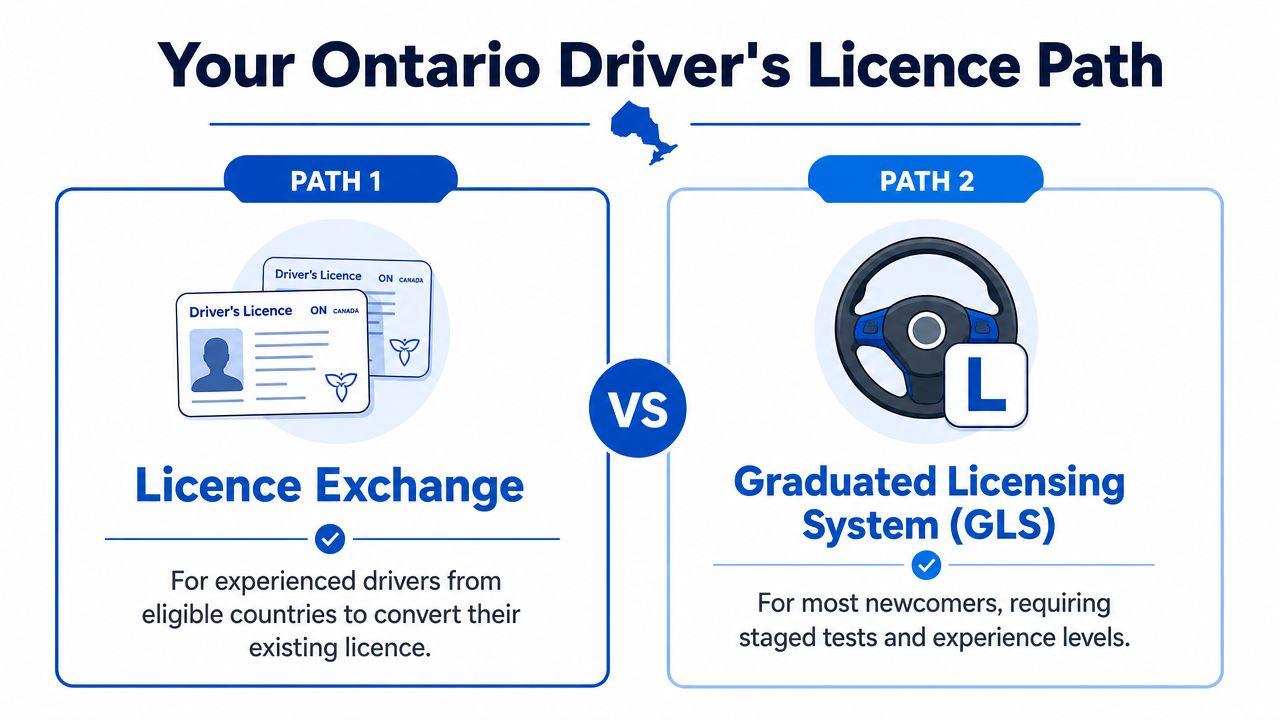
Path two. Enter Ontario's licensing system
If your licence is not eligible for direct exchange, you usually enter Ontario's Graduated Licensing System. That means starting at G1, then progressing to G2, and then to the full G licence.
This surprises many experienced drivers. You may have years of real driving experience, but Ontario still sorts drivers by its own rules. In some cases, past experience can still help you get credit or shorten part of the process. In other cases, you must follow the full sequence.
If you want a plain-language overview of where G1, G2, and G fit, this Class G licence guide explains how the system is structured.
A simple decision tree for newcomers
If the rules feel blurry, use this order of questions.
1. Are you staying in Ontario temporarily, or are you becoming a resident?
That question affects which timeline applies to you. The earlier section explained why some people hear about a 60-day limit while others hear 90 days. Those timelines are tied to status, not guesswork.
2. Was your licence issued by a jurisdiction Ontario recognizes for exchange?
If yes, you may be on the direct exchange path.
3. If no direct exchange applies, can you prove past driving experience?
If yes, Ontario may still give you credit for that experience, even if you must enter the graduated system.
4. If neither applies, are you ready to start with G1?
That is the full Ontario path.
This step-by-step approach helps because many newcomers mix up three separate ideas: temporary driving rights, exchange eligibility, and experience credit. They are connected, but they are not the same decision.
Ontario licence exchange eligibility by country
The practical question is still the same. Where does your current licence fit?
Country/Jurisdiction Likely Path A reciprocal jurisdiction approved by Ontario Full Exchange A non-reciprocal country where Ontario may accept documented prior driving experience Experience Credit A country or jurisdiction that does not qualify for exchange or recognized credit in your case Full GLS
This table stays broad on purpose. Eligibility can change, and paperwork often decides the outcome.
Use the table as a map:
- Full Exchange: Your licence may convert directly into an Ontario licence.
- Experience Credit: Your previous driving may count, even if you still need to enter Ontario's system.
- Full GLS: You begin with Ontario's staged licensing process and progress step by step.
Do not rely on nationality alone. Ontario looks at the issuing jurisdiction, whether your licence is valid, and whether your documents clearly support your claim.
How to Exchange Your International Licence Step by Step
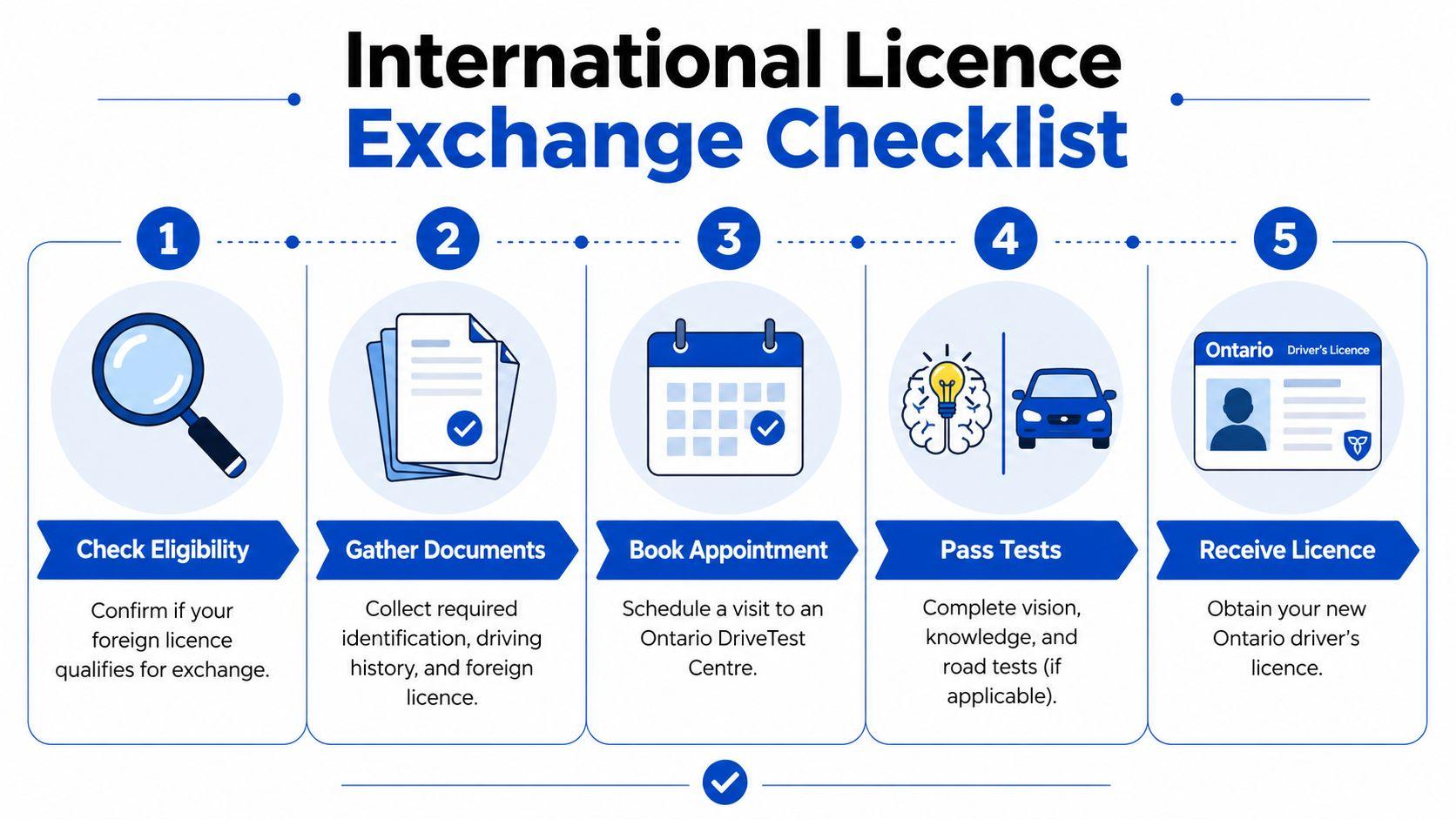
If your licence is eligible for exchange, the process feels much easier when you treat it like a document exercise instead of a mystery.
Bring the right documents first
Most delays happen before anyone reaches the counter. The issue usually isn't driving skill. It's paperwork.
Start by gathering:
- Your original foreign licence: Bring the actual licence, not just a photo or scan.
- Your passport or other accepted identity document: Staff need to confirm who you are.
- Proof of driving experience if relevant: This can matter if Ontario needs evidence of your prior history.
- A translation if your documents aren't in English or French: Don't wait until the appointment day to discover this.
A practical walkthrough for this process appears in the Ontario driver's licence exchange guide.
Many newcomers underestimate the translation issue. A licence may look clear to you because you've used it for years, but if the key details aren't readable in English or French, staff may not be able to process it the way you expect. That's why it helps to organise every document before leaving home.
This video gives a useful visual overview of how exchange steps can play out in practice.
What happens at the DriveTest visit
At the DriveTest centre, think in terms of verification. Staff will review your documents, check whether your jurisdiction qualifies for exchange, and tell you what tests or additional proof apply in your case.
You may also complete a vision test as part of the process. That catches some people off guard because they assume exchange is purely administrative. It often isn't.
If you qualify for direct exchange, the appointment may feel straightforward. If your situation is more complex, staff may ask for more documentation or place you on a route that still involves knowledge or road testing. That doesn't always mean something is wrong. It often means Ontario needs to place you into the correct licence level based on what you can prove.
Small issues that slow people down
A smooth exchange often depends on small details:
- Name consistency: If your passport and licence show names differently, bring supporting documents.
- Document condition: Worn, damaged, or unreadable licences can trigger questions.
- Driving history proof: If experience credit matters in your case, weak or missing proof can change your route.
- Language preparation: If a translation is needed, complete it before your visit.
Bring more supporting documents than you think you'll need. Staff can ignore extra documents. They can't approve missing ones.
The emotional side matters too. Many newcomers feel frustrated if Ontario doesn't treat their licence exactly as they expected. Try not to frame it as a judgment on your driving ability. In most cases, it's an administrative classification issue, not a statement about whether you know how to drive.
Navigating the Graduated Licensing System
A common newcomer scenario goes like this: you arrive expecting to switch your licence quickly, then learn Ontario may place you into the graduated system instead. That can feel frustrating, especially if you have years of driving experience. It helps to view the system as Ontario's way of sorting drivers into the right lane based on what they can prove, how long they plan to stay, and whether they qualify for exchange.
This is also where the timeline confusion matters. The 60-day and 90-day rules affect whether you can keep using your foreign licence temporarily. They do not automatically decide whether you can skip the G1, G2, or road tests. If your documents or country of origin do not put you on the exchange path, the graduated system becomes your route to a full Ontario licence.
What the G1 test actually checks
The G1 is a knowledge test. It measures whether you understand Ontario road signs and Ontario traffic rules, not just whether you already know how to drive in general.
Ontario divides the test into two separate parts: road signs and rules of the road. You need to pass both parts. A strong result in one section does not make up for a weak result in the other. Many applicants make a mistake on that scoring rule because they study broadly instead of preparing section by section.
The test is taken electronically at a DriveTest centre, and it uses multiple-choice questions shown on screen.
What passing G1 means for an international driver
Passing the G1 does not mean full driving freedom. It gives you a beginner-level Ontario licence with restrictions. For many adult newcomers, that is the part that feels most surprising.
A G1 works a bit like a learner permit with guardrails. You can drive, but only under specific conditions set by Ontario. Those rules affect real daily decisions, such as whether you can drive to an early shift, return home late at night, or use a car on your own.
As noted earlier, the temporary use period for a foreign licence and the graduated licensing stages are separate questions. If you are staying long enough to settle in Ontario and you do not qualify for direct exchange, your practical decision tree usually looks like this:
- From an exchange country with accepted proof: you may avoid some or all graduated steps, depending on what Ontario recognizes.
- From a non-exchange country, or without enough proof: you usually start with G1 and then move through Ontario's stages.
- Here temporarily and still within the allowed foreign-licence window: you may be able to drive for now, but you should still confirm what happens if your stay extends.
That distinction saves a lot of confusion.
How to prepare without wasting effort
Experienced drivers often run into trouble for a simple reason. They study from memory instead of studying Ontario's wording, signs, and test structure.
A better approach is more targeted:
- Study the Ontario Driver's Handbook: focus on local signs, right-of-way rules, and wording that may differ from your home country.
- Practice signs and rules separately: the test scores them separately, so your study plan should match that structure.
- Use screen-based practice: the actual test is electronic, so on-screen practice helps you read and answer in the same format.
- Review every wrong answer: do not just track your score. Find the rule behind the mistake and learn that pattern.
If you want a clear overview of how the stages fit together, this Ontario graduated licensing guide gives a useful explanation of the G1, G2, and full G path.
Treat the G1 as a local rules test. That mindset usually leads to better results than relying on past driving experience alone.
Insurance Registration and Final Practical Tips
Getting a licence is a major step, but driving in Ontario also means dealing with insurance, vehicle paperwork, and local road habits.
Insurance is often the next surprise
Newcomers often discover that being licensed and being ready to own or insure a car are different things. Insurance companies may ask about your driving history, previous coverage, and experience. If you're new to Canada, that conversation can feel uneven because you may have years of real driving history but limited local records.
A practical approach helps:
- Ask what proof of past driving experience is accepted: Some insurers may consider documentation from abroad.
- Compare quotes carefully: Different insurers evaluate newcomer profiles differently.
- Be ready with supporting records: Previous insurance letters and driving history documents may help.
- Don't rush into buying a vehicle first: Insurance cost can affect what type of car makes sense.
Registration and adapting to Ontario roads
If you buy a vehicle, registration is its own process, separate from your licence. Read every step carefully and keep copies of all ownership and insurance documents. Small paperwork mistakes can slow everything down.
Road culture matters too. Ontario driving may differ from what you're used to in several ways:
- Winter conditions: Snow, ice, and reduced visibility change braking distance and lane discipline.
- Highway behaviour: Traffic can move quickly, especially on major multi-lane routes.
- Local enforcement: Signs, school zones, and right-of-way rules are enforced according to Ontario standards, not the habits of your home country.
- Demerit awareness: Learn how penalties work early so one avoidable mistake doesn't follow you.
A newcomer who succeeds in Ontario usually does two things well. They learn the formal rules, and they also watch how experienced local drivers handle weather, spacing, lane changes, and busy interchanges.
Frequently Asked Questions About the G1 Test
A common newcomer scenario goes like this. You already know how to drive, but Ontario still asks you to prove that you understand Ontario signs and road rules. The G1 test is the checkpoint for that.
The confusing part is not always the test itself. It is knowing whether the G1 route even applies to you. Your first question should be practical: Do I need to take the G1 test at all?
Do all newcomers need to write the G1 test
No. It depends on which of the two licensing paths applies to you.
If Ontario recognizes your previous driving experience for a licence exchange, you may be able to skip part of the graduated licensing process. If you do not qualify for an exchange, the G1 test is your starting point. A good way to sort this out is to treat it like a fork in the road:
- Short stay in Ontario: You may be able to drive temporarily with your foreign licence, depending on your status and documents.
- Staying longer and eligible to exchange: Follow the exchange process.
- Staying longer and not eligible to exchange: Start with the G1 knowledge test.
That distinction matters because many people start studying for the G1 before confirming that they need it.
Does an international driving permit replace the G1
No. An international driving permit is a translation aid, not an Ontario licence.
It can help Ontario officials read the details of your home licence, but it does not move you into the Ontario system by itself. If you are settling in Ontario and your case falls under the G1 path, you still need to pass the required knowledge and road tests in the proper order.
How should I study if I already know how to drive
Focus on local rules, not general driving confidence.
Experienced drivers often struggle with the G1 for one simple reason. They answer based on the habits of their home country instead of Ontario law. The safer approach is to study as if you are learning a new rulebook for a familiar activity. You already know how to control a car. Now you need to learn Ontario's wording, signs, right-of-way rules, and penalties.
Pay special attention to areas that often differ from one country to another:
- school zones and community safety zones
- turns on red lights
- lane markings and sign shapes
- demerit points and licence suspensions
- what police expect during a traffic stop
What if English is not my first language
That is a common concern, and it is manageable.
The challenge is usually vocabulary, not driving ability. Study Ontario road terms slowly and repeatedly until the wording feels familiar. If a question seems harder than it should, the issue may be the phrasing rather than the rule itself. Practice tests can help you get used to how Ontario asks questions, which lowers stress on test day.
What is the biggest mistake newcomers make with the G1 process
Mixing together three separate timelines: how long you can drive on a foreign licence, when you need to enter the Ontario licensing system, and how long each G-level stage lasts.
Those are different questions. Treat them separately. The temporary driving timeline does not tell you whether you qualify for an exchange. The exchange rules do not tell you whether you must begin with G1. Keeping those timelines separate makes the whole process easier to understand.
If you are preparing for the G1 route, G1ready.ca offers free practice tests, targeted quizzes, and an exam simulator built around Ontario's knowledge test format.