
Ontario's graduated licensing program takes at least 20 months to complete, with the first waiting period reducible from 12 months to 8 months through approved driver education. The system is designed to spread risk and experience across stages rather than delay full licensure.
You may be looking at the process because you need to drive to work, reach school, take children to appointments, or settle into life in a new Ontario community. The frustrating part is that a licence can feel urgent while the legal path moves deliberately. A newcomer may have driving experience from another country but no Ontario licence, while a rural learner may know how to handle local roads yet lack a fully licensed supervisor nearby.
Ontario's graduated licensing program is built around that tension. It gives new drivers more freedom as they demonstrate skill, but it also places the greatest limits on the situations that demand the most judgement. Once you understand the purpose behind each stage, the timeline feels less like a pile of hurdles and more like a practical training route.
Navigating Ontario's Driver Journey
Consider a newcomer who has driven for years but now needs an Ontario licence for a new job. They may be comfortable behind the wheel, yet still face provincial testing, supervision requirements, and a staged route before they can drive independently. A teenager in a rural community can face a different problem. The roads may be familiar, but finding a fully licensed adult with enough experience to supervise regular practice can be difficult.
Ontario introduced graduated licensing in 1994 for people applying for their first car or motorcycle licence. The current system uses a two-step progression after the initial learner stage and takes at least 20 months to complete. The first level lasts 12 months, although an approved driver education course can reduce that wait to 8 months when the certificate is presented to the Ministry. Ontario also allows up to five years to finish the overall licensing process, so the system can accommodate learners whose work, finances, family responsibilities, or access to a vehicle make regular practice difficult. These timeline details appear in the Ontario Ministry of Transportation driver's handbook.
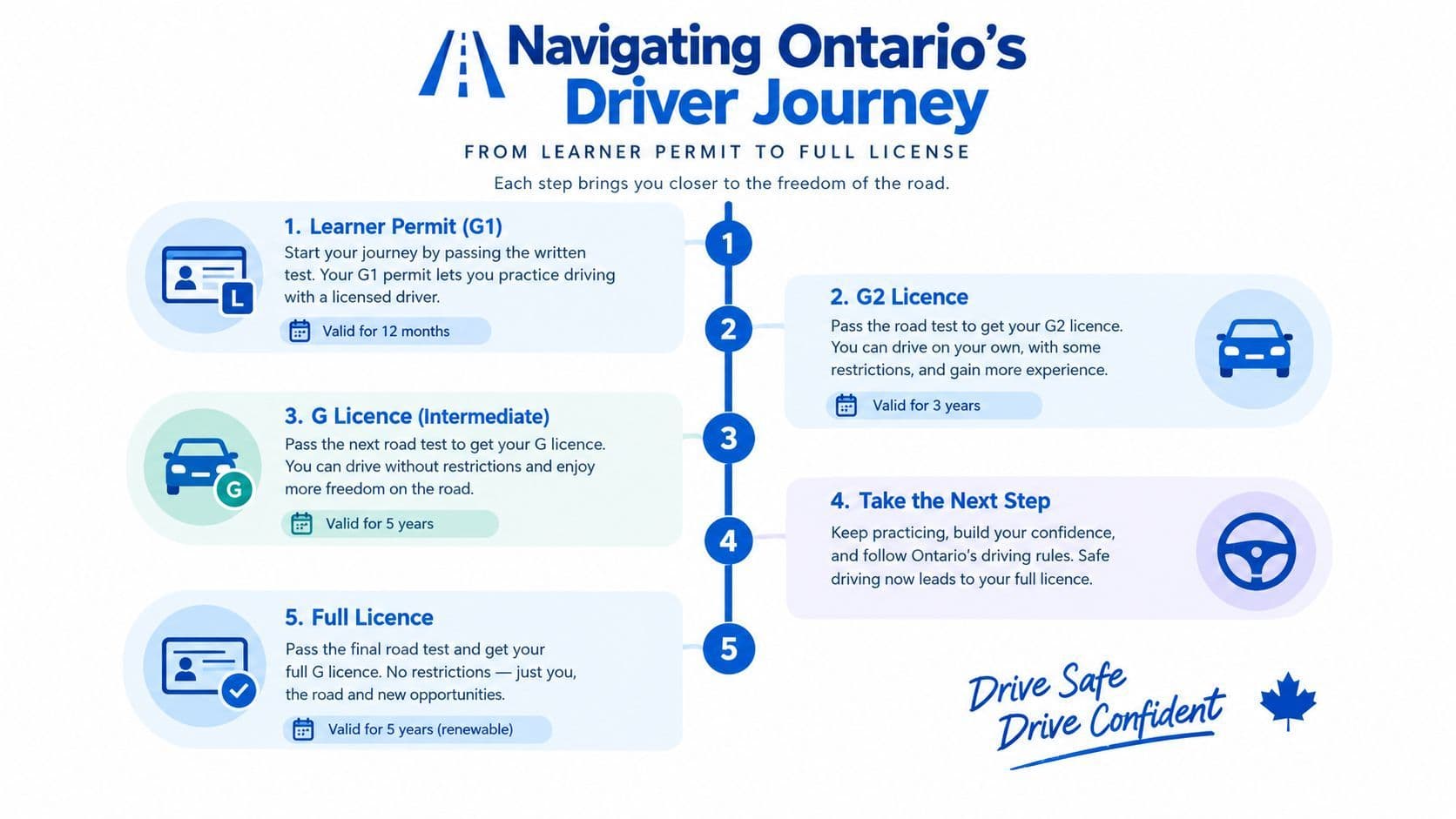
The system spreads learning across controlled milestones. Early practice happens with supervision and important restrictions. Later stages permit more independent driving, while the learner continues to build experience before receiving the full G licence.
Practical rule: Treat the waiting period as practice time, not empty time. A learner who uses it deliberately can arrive at the next test with experience in traffic, weather, intersections, and unfamiliar routes.
This staged approach has produced documented population-level safety outcomes. A 2023 Ontario Auditor General report recorded more than 11.1 million licensed drivers in the province as of December 2022, with more than 95% holding a G-class passenger vehicle licence. The report also cited a fatality rate of 0.5 per 10,000 licensed drivers, among the five lowest fatality rates in North America, and noted that about 40% of novice drivers historically complete Beginner Driver Education. Earlier Ontario government reporting associated the program with nearly a 25% decline in fatalities and injuries among teen drivers within 14 years of its introduction. These figures are reported in the Auditor General's review of Ontario driver training.
The important lesson isn't that every new driver follows the same schedule. It's that the programme gives each learner a sequence for building confidence without asking them to manage every driving situation immediately.
Understanding the Three Stages
Ontario's journey has three practical stages: G1, G2, and the full G licence. Think of them as progressively wider boundaries. At G1, another experienced driver creates a safety net. At G2, you can drive independently but remain a novice. With the full G licence, you have completed the graduated process and can drive without those graduated-stage limits.
G1 is supervised learning
The G1 begins after you pass the knowledge test. It isn't a licence for ordinary solo driving. You must practise with a fully licensed driver who has at least four years of driving experience, and that supervising driver must meet the applicable alcohol requirement. The G1 driver must maintain a zero blood alcohol level.
The supervision rule matters more than many learners expect. A family may own a vehicle but still lack an eligible supervisor. A newcomer may have relatives who drive, but not someone who meets Ontario's licensing and experience requirements. In a rural area, the only suitable supervisor may live far away, turning every practice session into a coordination problem.
G1 restrictions also keep early learning away from some of the most demanding conditions. The DriveTest overview of Ontario licences explains the supervision, alcohol, passenger, seat-belt, and highway restrictions that apply to G1 drivers.
G2 is controlled independence
After holding G1 for the required period, you can take the G2 road test. Passing it changes the nature of your driving. You can drive without a supervisor, which may make employment, school, and family responsibilities more manageable. You still have to drive responsibly and comply with the conditions attached to the novice stage.
G2 isn't a declaration that you have finished learning. It is a chance to practise independent decisions with more freedom than G1, while recognising that experience develops over time. Use this stage to build consistency, not just to collect kilometres. Practise entering busy roads, choosing safe following distances, scanning intersections, and adjusting your speed before conditions become difficult.
For a plain-language explanation of how the full Class G path fits together, see this guide to the Class G licence.
Full G is the final milestone
The full G road test marks the end of the graduated process. It assesses whether you can manage a broader range of driving situations with sound judgement, rather than merely perform isolated vehicle controls.
The exact pace differs from one learner to another. The legal route still includes the required time at each stage, but a patient learner may progress more safely than someone who rushes into a test with little practice. A learner who lives outside a major centre may also need to plan around travel to a testing location, vehicle access, work shifts, or weather.
The milestone is independence, but independence works best when it rests on habits you can repeat. Mirror checks, safe lane changes, speed control, observation, and calm decision-making matter long after the licence card arrives.
Decoding the Restrictions
A restriction can feel personal when you're eager to drive. In reality, the rules target situations that combine speed, complexity, limited visibility, or reduced supervision. The early stage is meant to keep a learner from facing all of those demands at once.
A G1 driver must have an eligible supervising driver, maintain zero alcohol, avoid driving between midnight and 5 a.m., and generally stay off 400-series highways and expressways unless accompanied by an Ontario-licensed driving instructor. All occupants must wear seatbelts, and passenger limits are tied to the vehicle's working seatbelts. These rules are set out in the G1 licence restrictions guide.
Why restrict highway driving? Highway merging requires a learner to judge speed differences, identify safe gaps, manage blind spots, and respond quickly when traffic changes. Night driving adds darkness, glare, fatigue, and reduced visual information. A learner can develop those skills, but the graduated structure gives them time to build the basics first.
What the safety evidence shows
Ontario evaluations found a 31% lower overall collision rate per 10,000 novice drivers in 1995 than in 1993, before the programme, and a 16% reduction in the per-driver crash rate after the 12-month learner period was introduced. The same evidence is summarised in the Ontario Ministry driver's handbook.
Independent summaries of Ontario's programme reported a 27% decline in alcohol-related collisions, a 62% decline in collisions between midnight and 5 a.m., and a 61% decline in freeway collisions after the programme was introduced. They also reported novice-driver crash reductions across age groups, including 31% among drivers aged 16 to 19 and 42% among drivers aged 20 to 24. The Canadian evaluation published through ScienceDirect discusses these outcomes and the way staged restrictions affect high-risk contexts.
The figures help explain why the rules focus on particular conditions. They don't mean every collision disappears, and they don't replace careful instruction. They show why a learner's first independent drive shouldn't begin on the fastest road, at the most difficult hour, with alcohol or a crowded passenger group.
Before highway practice becomes part of your routine, make sure the licence stage allows it and that you can manage merging calmly. A qualified instructor can help you introduce complexity in a sensible order.
The goal isn't to make driving feel small forever. The goal is to remove one source of risk at a time, so you can concentrate on building reliable judgement.
Accelerating Your Path
For someone who needs a licence quickly, the difference between the standard and accelerated route is practical. Without approved driver education, the G1 waiting period is 12 months. With an approved course and the required certificate, that first wait can fall to 8 months, while the overall minimum remains at least 20 months because the later stage still requires its own time.
Route G1 waiting period Overall minimum Standard route 12 months At least 20 months Approved driver education 8 months At least 20 months
The shorter G1 wait doesn't erase the need for practice. It gives you an earlier opportunity to take the G2 road test. You still need enough supervised experience to handle ordinary streets, intersections, lane changes, parking, and changing conditions without relying on memorised test routines.
When the faster route helps
Approved driver education can be useful for a newcomer with a job opportunity that depends on independent travel, a student whose placement is difficult to reach by transit, or a household trying to coordinate work and childcare. It can also add structure when no experienced family member knows how to organise practice.
The tradeoff is access. A course may require a schedule that conflicts with shifts, and its price may be difficult for a household already paying for transportation, rent, or settlement costs. Rural learners may also need to travel to reach a suitable provider. Compare the course's approval status, lesson format, instructor qualifications, driving locations, and certificate process before enrolling.
The shortest legal path isn't automatically the safest practical path. Choose the route that leaves enough time for repeated, supervised practice.
Newcomers should also confirm whether Ontario can recognise previous licensing experience. Don't assume that foreign driving experience automatically removes every requirement, and don't assume it counts for nothing. Ask the Ministry or an authorised licensing office what documents are acceptable before making a timeline or course decision.
For a rural driver, the central question may be less about shaving time from the calendar and more about securing regular access to an eligible supervisor and a suitable vehicle. For a newcomer, it may be both. The right plan balances the legal timeline with the practice opportunities you can realistically maintain.
Passing the G1 Knowledge Test
The G1 knowledge test is the first gateway, but memorising isolated answers won't prepare you well. You need to understand two connected areas: road signs and rules of the road. A sign tells you what applies, while a traffic situation requires you to decide how that rule works with other road users.
Start with the current Ontario handbook. Read a small topic, close the book, and explain the rule in your own words. If you can't explain why a sign or rule exists, you may recognise the wording without being ready to apply it.
Build a study routine
Use this sequence rather than repeatedly taking random quizzes without reviewing mistakes:
- Learn the sign families. Group signs by purpose, such as warnings, regulatory instructions, and information. Pay attention to shape, colour, symbols, and wording so similar signs don't blur together.
- Study rules in situations. Ask what each road user must do at an intersection, near a crossing, during a lane change, or when traffic controls change.
- Practise in short sessions. Return to difficult topics often. Spaced review is more useful than one long session followed by several days away.
- Track the reason for every error. Label it as a missed detail, unfamiliar rule, rushed reading, or confusion between two signs.
- Retake missed questions later. Immediate repetition can make an answer feel familiar without proving that you understand it.
A practice test should resemble the structure and difficulty of the official assessment, but it shouldn't become a guessing game. If you select an answer correctly for the wrong reason, count it as a warning and study the rule again.
Troubleshoot common mistakes
Learners often confuse signs that share a colour or symbol. Slow down and identify the sign's shape and purpose before reading the choices. In right-of-way questions, don't choose the vehicle that looks most important. Identify who is approaching, who is turning, who has a control, and who must yield.
Questions involving several road users can also expose a gap in scanning. Draw a simple mental picture, then apply one rule at a time. Ask, “Who moves first, and why?” That method is more dependable than relying on a phrase you remember from a previous question.
A wrong answer isn't a verdict on your ability to drive. It is information about what needs another pass. The G1 knowledge test preparation guide can help you organise that review around signs, traffic rules, and practice performance.
Use feedback actively
A platform such as G1ready.ca offers free, registration-free practice exams, targeted quizzes, mixed tests, a diagnostic test, marathon practice, and an exam simulator based on the Ontario handbook. It also provides explanations and progress information, which can help a learner identify weak topics instead of repeating questions at random.
Parents and instructors can improve results by asking the learner to explain an answer aloud. “The answer is B” isn't enough. A stronger explanation identifies the sign or road situation, names the relevant rule, and describes what the driver should do.
On test day, read every question fully. Don't let a familiar phrase pull you toward an answer before you've considered the complete situation. Calm, deliberate reading is a driving skill as well as a test skill.
Moving Toward Full Independence
The full G licence is easier to understand when you see it as the result of several smaller achievements. You first learn the rules well enough to earn G1. You then practise under supervision, demonstrate basic control at the G2 test, and spend the novice stage making independent decisions. The final test is the point at which those habits are assessed together.
Build a realistic personal timeline
Write down the date you receive G1, then identify the earliest date you may take the G2 road test. If you complete approved driver education, make sure the Ministry has the certificate needed to recognise the reduced G1 waiting period. After G2, plan for the required later stage rather than treating the first successful road test as the finish line.
Your plan should also answer practical questions:
- Who can supervise you? Confirm that the person has the required Ontario licence and at least four years of driving experience.
- Where will you practise? Choose quiet streets first, then add busier intersections, unfamiliar routes, rural roads, and other conditions as your instructor or supervisor judges appropriate.
- How will you access a vehicle? Agree on regular practice times before the calendar becomes crowded with work, school, or family responsibilities.
- How will you reach testing locations? Rural learners may need to organise transport, time off work, and a suitable vehicle well in advance.
- What will you do after a weak lesson? Record the specific problem and practise that skill again instead of driving more without a focus.
The 20-month minimum is a legal structure, not a promise that every learner will be ready at the earliest possible test date. Some people need more practice. Others need time to solve supervision, transportation, language, or scheduling barriers. Ontario's allowance of up to five years to complete the process gives learners room to manage those realities, although waiting too long can also make skills rusty.
Think beyond the test route
A road test route is only one slice of driving. Full independence means making safe choices when the road is unfamiliar, traffic is impatient, visibility is poor, or a passenger is distracting. Continue practising hazard scanning and speed management after each licence milestone.
For newcomers, the most important adjustment may be learning how Ontario's rules interact with the roads around a new home. For rural drivers, it may involve moving between quiet roads and higher-speed routes. For a young driver, it may mean setting boundaries with passengers before a difficult situation develops.
The safety record supports the broad design of the programme. Ontario's Auditor General reported a fatality rate of 0.5 per 10,000 licensed drivers, placing the province among the five lowest in North America, while earlier provincial reporting linked graduated licensing with nearly a 25% decline in teen-driver fatalities and injuries within 14 years of launch. Those outcomes don't remove personal responsibility, but they show why staged licensing remains a central road-safety policy.
A calm route to the final licence
Use this checklist as you move forward:
- G1 knowledge: Study signs and rules until you can explain them, not just recognise answers.
- Supervised practice: Drive consistently with an eligible supervisor and increase difficulty gradually.
- G2 preparation: Practise observation, lane position, turns, parking, speed control, and defensive decisions.
- Independent learning: Treat G2 as a serious learning stage, especially when driving alone in unfamiliar conditions.
- Full G preparation: Build the highway, traffic, and judgement skills expected in the final assessment.
- Long-term habits: Continue making safe decisions after the graduated restrictions end.
You don't have to solve the entire journey in one day. Start with the next milestone, make a practical plan around your household's time and transportation, and use each supervised drive to turn a rule into a habit. That approach helps the programme do what it was designed to do, prepare you for independence without exposing you to every risk at once.
If you're preparing for the first milestone, visit G1ready.ca to practise Ontario-focused G1 questions, review explanations, and identify the rules that need more attention. Use the results to plan your study and arrive at the knowledge test with a clearer understanding of the road ahead.


