
You're sitting at a busy Ontario intersection, your hands are tight on the wheel, and the green light ahead has been showing for a while. Then it changes to yellow. Do you stop, continue, or brake quickly? A pedestrian steps toward the crosswalk as you prepare to turn. Does your green light give you priority?
These moments make a Canada traffic light seem more complicated than three colours and a few arrows. New drivers often know that red means stop and green means go, yet still lose marks on the G1 test because they miss the conditions attached to each signal. A complete stop matters. A flashing signal changes the decision. A pedestrian signal can affect your turn even when your vehicle light is green.
Ontario's signals follow a learnable language. Once you understand what each light is saying, you can apply the same logic at a real intersection, whether you're driving through Toronto, Hamilton, Ottawa, or a smaller community. This guide starts with the basic colour system, then adds arrows, flashing lights, pedestrian movements, right turns on red, left turns between one-way streets, and the wording traps that appear in G1 questions.
Why Canada Traffic Lights Confuse New Drivers
The pressure usually arrives before you've had time to think. You approach an intersection, notice a green light, and begin checking mirrors, lane position, pedestrians, cyclists, and turning traffic. When the light changes, your mind may search for a memorised answer instead of asking the simple question: what can I safely and legally do right now?
That hesitation is normal. A signal doesn't work alone. Its meaning depends on the light's colour, whether it's solid or flashing, whether an arrow is displayed, and what other road users are doing. A green light permits movement, but it doesn't erase the duty to proceed carefully or yield to pedestrians while turning.
Ontario's official handbook gives a useful rule for a green light that has been showing for a while. You should proceed at a steady speed, but be ready to stop if it turns yellow. If you're already too close to stop safely, continue through cautiously rather than braking hard or stopping in the intersection. Ontario's official driver handbook explains this decision in the context of controlled intersections.
Your safest G1 answer is usually the one that respects both the signal and the people around you.
The G1 test also tests conditions hidden inside ordinary-looking questions. “Can you turn right on red?” isn't answered by “yes” alone. You must stop completely, check that the way is clear, yield where required, and obey any sign prohibiting the turn. “What does a flashing green mean?” requires more than identifying the colour. You need to know how the flashing signal affects turning priority and pedestrian movements.
By the end of this guide, you'll have a practical sequence for reading an intersection. First identify the signal, then determine your permitted movement, then check pedestrians and other traffic before acting. That method is more dependable than trying to remember isolated facts.
How Traffic Lights Work in Canada
Think of an intersection as having a conversation with every road user. The signal gives an instruction, and the driver responds with a controlled action.
- Red says wait. Stop before the stop line, crosswalk, or intersection, as applicable. Don't treat a red light as a suggestion to slow down.
- Yellow says the current permission is ending. Prepare to stop if you can do so safely. It isn't an invitation to accelerate through.
- Green says movement is permitted. Proceed only after checking the intersection and yielding to anyone who has priority.
This simple sequence becomes easier when you separate permission from safety. A green light permits you to proceed, but you still need to watch for pedestrians, cyclists, vehicles already clearing the intersection, and turning conflicts. A red light normally stops your movement, but Ontario allows specific turns after a complete stop when the way is clear and no sign prohibits the manoeuvre.
Why timing matters
Signals divide time among competing movements. Ontario traffic signal guidance says pedestrian clearance should be calculated using crossing distance divided by pedestrian walking speed, expressed as Wc/Ws. A longer crossing therefore needs a longer clearance interval. The same guidance says cycle lengths of 90 to 120 seconds are generally preferred for coordinated operation. Ontario traffic signal guidance connects these timing choices to the balance between pedestrian safety, traffic flow, and delay.
Ontario's traffic-light history also shows how a small local installation became a major transport system. Electric traffic lights arrived on Canadian streets in 1925, first in Hamilton, Ontario, and shortly afterwards in Toronto. Toronto installed its first automated signals at Yonge Street and Bloor Street on August 8, 1925, then expanded from one signalised intersection in 1925 to 96 signals by the end of the 1920s. Toronto later became the first municipality in the world to computerise its traffic operations in 1963, according to this history of traffic lights in Ontario.
Today, Toronto operates roughly 2,300 sets of traffic signals for vehicles, buses, streetcars, cyclists, and pedestrians. The original Bloor and Yonge signal has remained in official use for a full century, a detail recorded in this Toronto traffic-light history. The scale has changed dramatically, but the learner's task remains the same: read the signal, control the vehicle, and protect the people sharing the intersection.
Solid Lights Arrow Signals and Flashing Signals Explained
Start with the signal directly facing you. Don't decide based on a light visible to another lane or direction. Your movement is governed by the indication intended for your lane.
Solid lights
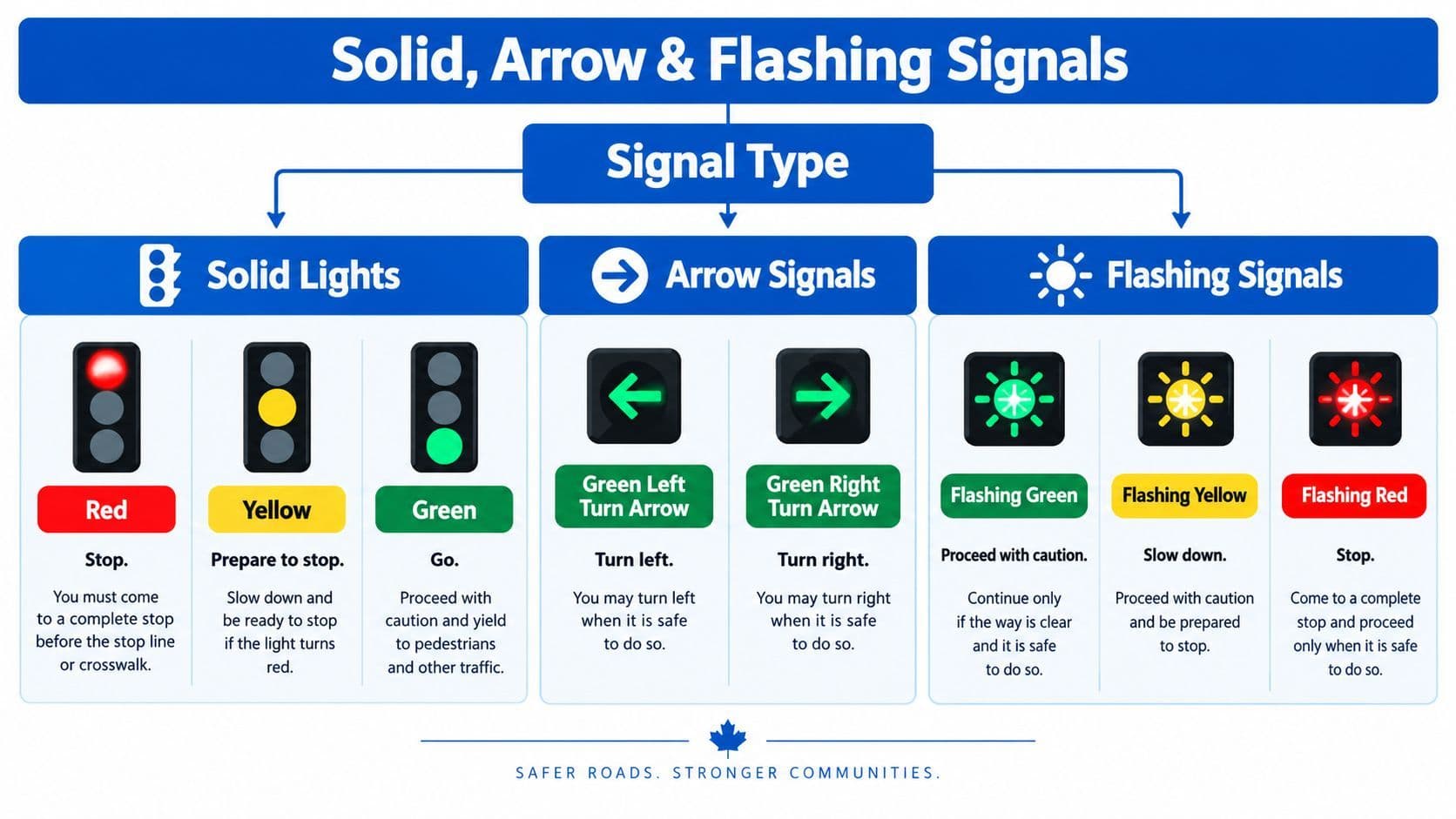
A solid red light requires a complete stop and waiting until the signal changes. If you're considering a right turn, stopping means the vehicle must stop, not merely slow down or roll past the line. A solid yellow means the green phase is ending. Stop if you can do so safely; if stopping would be unsafe because you're already too close, continue with caution.
A solid green permits you to proceed, but it doesn't guarantee an empty intersection. You can go straight when the path is clear, and you can turn when the movement is legal and you yield to pedestrians and other road users who have priority.
A green light gives permission to move. It never gives permission to ignore the intersection.
Arrow signals
A green arrow usually gives a specific movement its own permission. A green left arrow can protect a left-turn movement from opposing traffic during that phase. A green right arrow can provide a dedicated right-turn movement. Even with an arrow, check the crosswalk and the space you're entering.
The G1 trap is assuming that every green arrow means every direction is open. It doesn't. An arrow points to the movement it controls. If the arrow disappears and a circular green remains, your permitted movement may change from protected to permissive, depending on the road layout and other signs.
Flashing signals
A flashing red signal is treated like a stop sign. Stop completely, check the intersection, and proceed only when it's safe and lawful. A flashing yellow signal tells you to proceed with caution, but it doesn't remove your responsibility to watch for conflicting traffic or pedestrians.
A flashing green signal can be especially confusing for learners because it may indicate an advance green phase in Ontario. The important exam habit is to identify the direction and road arrangement, then check for pedestrians and oncoming traffic before turning. Don't assume that flashing means “speed up.”
Signal What to do Common G1 mistake Solid red Stop and wait, unless a permitted turn is made after stopping Rolling through Solid yellow Stop if you can do so safely Accelerating automatically Solid green Proceed when clear and yield as required Treating green as absolute priority Green arrow Follow the arrow's permitted direction Moving in another direction Flashing red Stop, then proceed when safe Treating it like a flashing yellow Flashing yellow Proceed cautiously Failing to scan the intersection
The yellow-light decision deserves extra attention. If the light has been green for a while, prepare for yellow and assess your stopping distance. If you're too close to stop safely, continuing cautiously is safer than creating a sudden rear-end risk. The correct response is based on control and distance, not fear.
Pedestrian Signals and Turning Interactions
A vehicle signal and a pedestrian signal can show different information at the same time. The driver's job is to read both the intended vehicle movement and the people crossing the road.
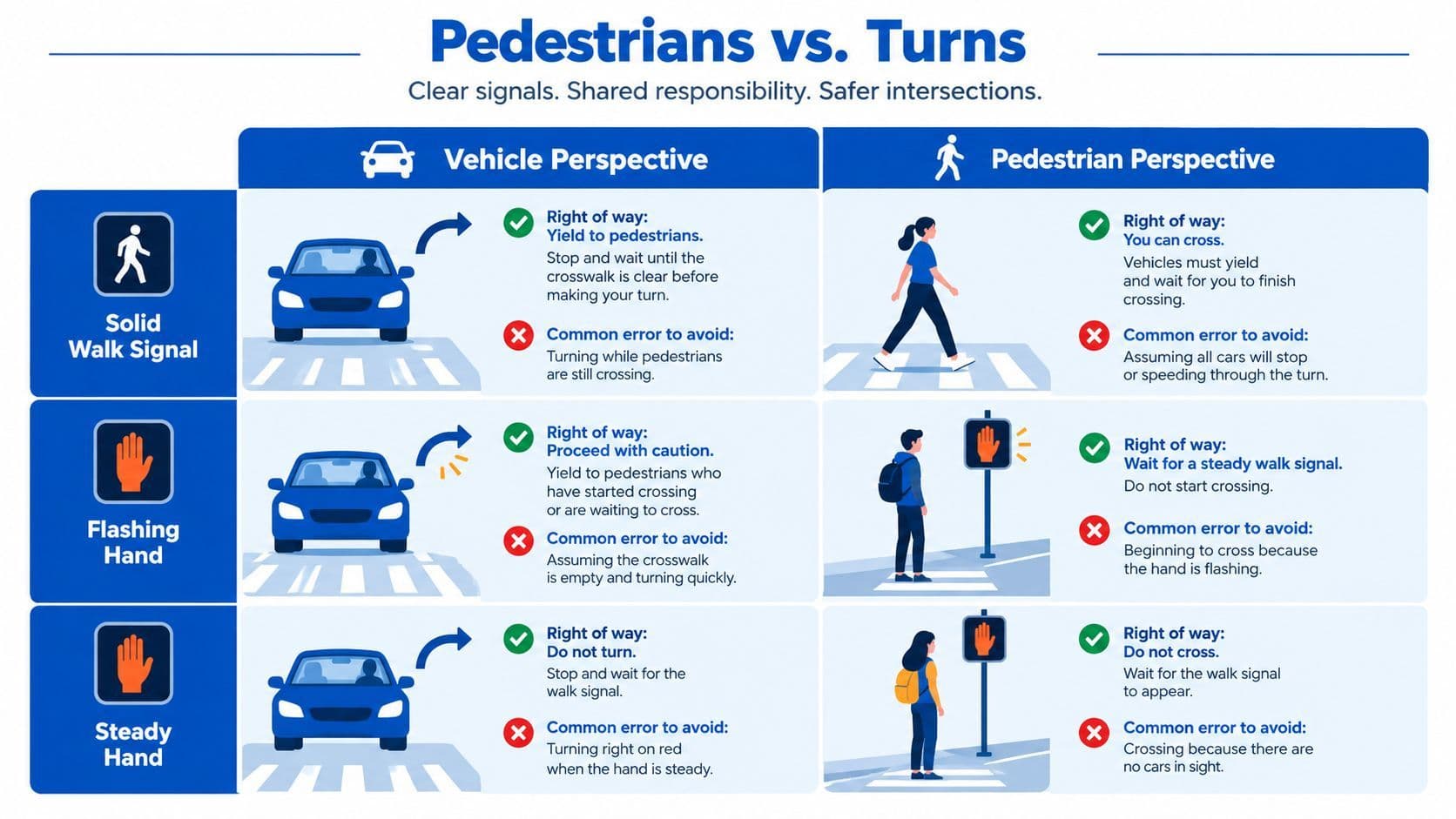
Ontario's pedestrian-signal guidance is precise. A pedestrian facing a walk symbol may cross. A pedestrian facing a flashing or steady hand shouldn't begin crossing. Pedestrians may cross on a green vehicle light when no pedestrian signal is provided, but they may not cross on a flashing green light or a left-turn green arrow. These rules are set out in Ontario's pedestrian signal guidance.
Right turns beside a walk signal
You're stopped at a red light and want to turn right. The signal changes, but a person is walking across the street you intend to enter. Your turn must wait. Ontario's handbook requires drivers to yield to pedestrians and others using the road when turning.
The same principle applies on a green light. You may have permission to turn, but the pedestrian crossing your path has priority. Scan the crosswalk before beginning the turn, keep the vehicle controlled, and don't let a following driver pressure you into moving early.
A guide to pedestrian crossing rules in Ontario can help you practise these crossing and turning interactions separately from basic colour recognition.
Left turns and opposing movement
A green left arrow gives a different situation from a circular green. During a protected arrow, opposing traffic is stopped for that movement, but pedestrians can still affect your path if the crosswalk is active. With a circular green, you may need to yield to opposing vehicles before turning left, and you must also yield to pedestrians crossing your intended path.
Use this three-part scan before any turn:
- Signal: What colour or arrow is facing your lane?
- Crosswalk: Is anyone walking, cycling, or about to enter your path?
- Conflict: Is another vehicle, streetcar, or cyclist already entitled to move?
The most common mistake is treating the vehicle light as the only relevant instruction. A driver turning right on red may focus on the gap in traffic and overlook a pedestrian. A driver turning left on green may watch oncoming vehicles but fail to check the near-side crosswalk. Safe turning requires both checks.
Ontario Specific Rules and Provincial Variations
At an Ontario intersection, a red light is a three-part checklist. Stop completely first. Then check traffic and pedestrians, and finally look for a sign that prohibits the turn. Treating red as a shortcut is a common G1 mistake.
Unless a sign says otherwise, Ontario permits a right turn on red only after a complete stop and a clear check of the intersection. A left turn from one one-way road to another one-way road on red is also permitted after stopping, confirming the road arrangement, and checking that the way is clear. The Ontario handbook's red-light rules gives the provincial wording for these manoeuvres.
Manoeuvre Allowed in Ontario Key condition Right turn on red Yes, unless prohibited by a sign Complete stop, then turn only when the way is clear Left turn on red from one one-way road to another one-way road Yes, unless prohibited by a sign Complete stop, confirm both the road arrangement and clear way Turn on red where a sign prohibits it No Wait for a permitted signal
For recent changes, review Ontario's new driving rules, then use the handbook wording when answering G1 questions.
Why signal locations aren't random
Ontario municipalities use traffic-signal warrants rather than installing lights just because an intersection feels inconvenient. One common minimum-volume standard requires at least 720 entering vehicles per hour on each of the heaviest eight hours of an average day and at least 170 minor-street vehicles per hour during those same hours. Pedestrian-based warrants may also apply when crossing demand creates enough delay on the major street. York Region's signal justification material explains this data-driven approach.
For a learner, the practical point is that a signal may reflect repeated congestion, pedestrian demand, or crash experience. A quiet moment does not show why the light was installed, especially near schools, busy walking routes, or neighbourhoods where drivers are adapting to Ontario road customs.
Toronto shows how enforcement can operate across a larger network. The city had 299 red-light-camera sites in 2025, compared with 296 in 2024. Average penalties per camera fell from 543 to 497 across those reported years, as described in this Toronto red-light enforcement account. For the G1 exam, keep the rule simple: a red light requires a complete stop before any permitted turn.
Provincial comparisons need care. Other provinces may present turns, flashing signals, or local signs differently. On an Ontario G1 question, follow Ontario's handbook and the signs shown at the intersection.
Common G1 Exam Traps and How to Avoid Them
Many wrong answers sound reasonable because they describe what a hurried driver might do. The G1 test asks what is legal and safe, not what someone might get away with on a quiet road.

Trap one is confusing slow with stopped
A rolling stop feels cautious because the vehicle is moving slowly. It still isn't a complete stop. If a question includes a red light, flashing red signal, or red-light turn, look for the answer that says stop completely before checking the way.
Trap two is treating yellow as “go faster”
Yellow doesn't automatically mean stop in every physical situation, because a driver who is already too close may not be able to stop safely. It also doesn't mean accelerate. The correct reasoning is distance, speed, and control. Stop when you can do so safely, or continue cautiously when stopping would create a greater hazard.
Trap three is forgetting the person in the crosswalk
A green light or legal turn doesn't cancel pedestrian priority. If the question describes a person crossing your turning path, yield. If it mentions a walk signal, flashing hand, or steady hand, read that detail carefully instead of answering from the vehicle signal alone.
Trap four is missing the sign beside the signal
A turn can be normally permitted and still prohibited at a particular intersection. Before selecting “turn right on red,” check whether the question includes a sign banning the movement. On a real drive, scan the entire signal assembly and nearby signs, not just the coloured lens.
Memory cue: Stop first, scan second, move third.
A final trap is confusing a flashing red with a flashing yellow. Flashing red requires a stop before proceeding. Flashing yellow calls for caution. If you reduce both to “slow down,” you'll choose the wrong answer.
Practice Q and A and Your Next Steps to Pass
Use short scenarios rather than rereading definitions. Ask yourself what the signal permits, what must happen first, and who might conflict with your movement.
Question: The light is yellow and you're close enough to stop safely. What should you do?
Answer: Stop safely. Don't accelerate just because the light is changing.
Question: The light is red and you want to turn right. What comes first?
Answer: Make a complete stop, check that the way is clear, yield to pedestrians, and confirm that no sign prohibits the turn.
Question: You're turning on green and a pedestrian is crossing your path. Who yields?
Answer: You yield to the pedestrian.
Question: You face a flashing red signal. Do you treat it like a flashing yellow?
Answer: No. Stop completely, then proceed only when the intersection is safe and the movement is allowed.
A focused study routine works better than repeatedly taking random quizzes. Begin with signal-specific questions, then mix lights with signs, right-of-way, and pedestrian scenarios. Review every wrong answer immediately and write down the condition you missed, such as “complete stop” or “yield while turning.”
You can use Ontario G1 practice tests focused on traffic lights and road rules as one part of that routine. Continue until you can explain why an answer is correct, not merely recognise the wording. Finish with mixed practice and a full simulator so you can apply the rules when several details appear together.
Before booking, check that you can consistently identify solid, arrow, and flashing signals, explain both red-light turns, and handle a pedestrian crossing during a permitted turn. Confidence comes from making the correct decision repeatedly, including when the question changes the order of the details.
G1ready.ca offers free, registration-free Ontario practice exams, targeted traffic-signal quizzes, mixed tests, explanations, hints, progress tracking, and a realistic exam simulator. Visit G1ready.ca to practise the signal and pedestrian scenarios that often separate memorisation from confident G1 decision-making.


