
You're sitting at a red light during a G1 practice question. The intersection looks empty, your intended turn seems harmless, and then you notice the rectangular No Turn on Red sign. Do you stop and wait, or can you turn after checking for traffic? The correct answer depends on more than the colour of the signal. You need to identify the sign, stop in the legally correct place, and know which turning exceptions Ontario law allows.
For Ontario learners, the most reliable memory rule is simple: a red light requires a complete stop, and a no turn on red sign removes the usual permission to turn right while the light remains red. That rule becomes much easier to apply when you understand where to stop and why the left-turn exception is so narrow.
Understanding the No Turn on Red Sign
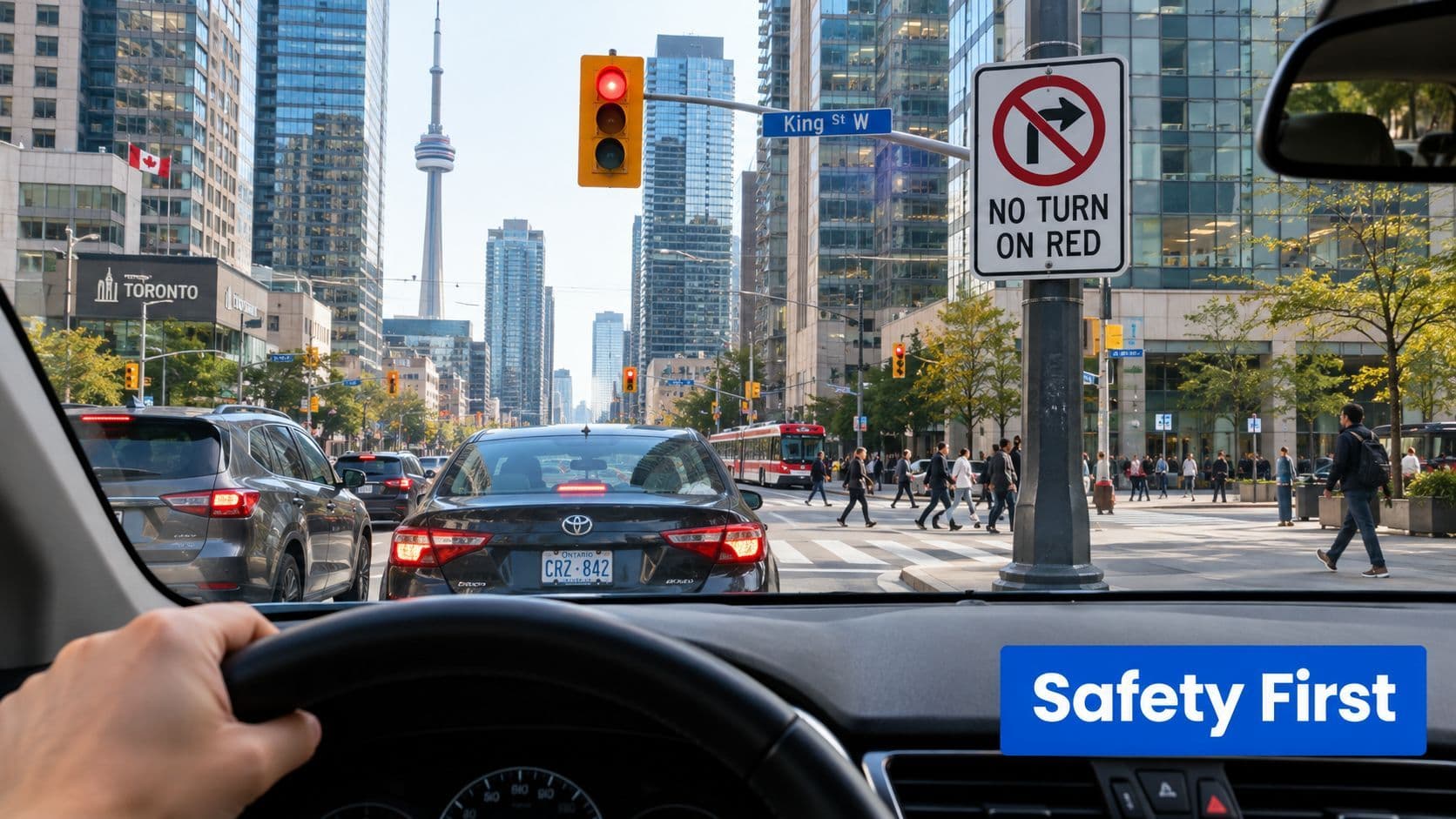
A No Turn on Red sign is a regulatory traffic control. It doesn't merely suggest that you should be careful or consider waiting. It gives you a direct instruction: while the sign applies to your approach, you must not turn right on the red signal.
Ontario normally allows a right turn on red under specific conditions. You must make a complete stop, confirm that the movement is safe, and yield to pedestrians and other road users. The Ontario Ministry of Transportation Driver's Handbook guidance on changing directions makes clear that this permission applies only when no prohibiting sign is present.
That means the sign changes the decision before you even start checking for a gap. If the road looks empty, there are no pedestrians nearby, and you've stopped correctly, the sign still prohibits the right turn. You remain stopped until a green signal allows the movement.
The rule to remember
Think of Ontario's normal right-turn rule as a conditional permission, not an automatic right:
- Red light: Stop completely.
- No prohibiting sign: A right turn may be allowed after stopping and yielding.
- No Turn on Red sign: Stay stopped and wait for green.
- Pedestrians or other road users: Yield whenever the movement is legally permitted.
This is why a G1 question may include an apparently safe intersection. The test isn't asking only whether you can see traffic. It's asking whether a sign has withdrawn the legal exception that would otherwise permit the turn.
You can review this distinction alongside other Ontario regulatory controls in G1ready.ca's information signs guide. For test purposes, don't treat the sign as a warning about busy conditions. Treat it as the instruction that controls your movement.
Memorable rule: Stop first. Read the sign second. Turn only if both the signal and the signs allow it.
The Legal Stopping Hierarchy at Red Lights
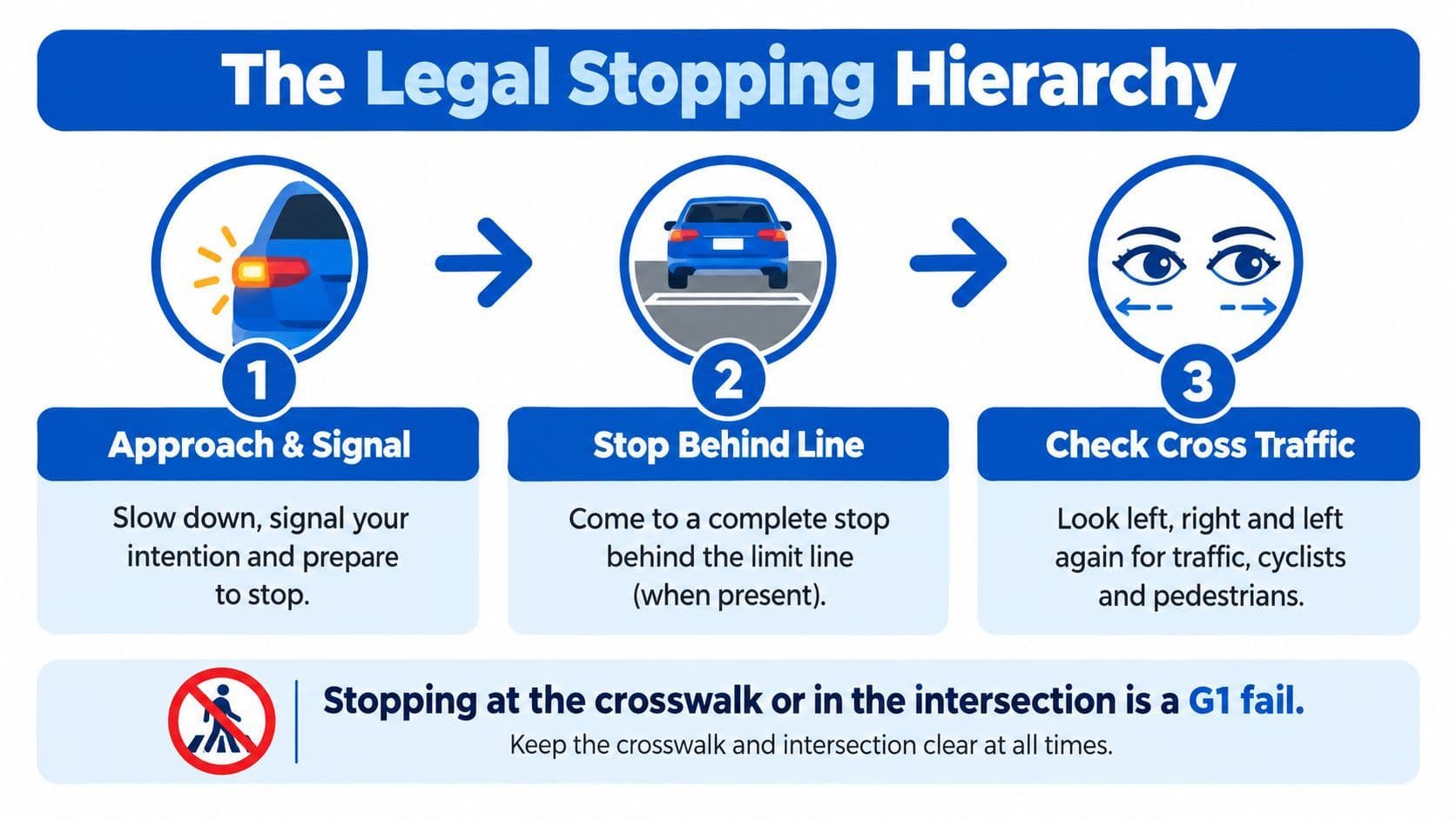
Knowing that you must wait is only part of the skill. You also need to know exactly where your vehicle must stop. Ontario uses a specific stopping hierarchy, and the order matters when a no turn on red sign requires you to remain at the light.
The Ontario Driver's Handbook traffic-light guidance sets out the sequence:
- Marked stop line: Stop before the line. This is your first reference point, even if the crosswalk is farther ahead.
- Crosswalk: If there's no stop line, stop before the crosswalk. The crosswalk may be marked or unmarked.
- Edge of the sidewalk: If there's no stop line and no crosswalk, stop at the edge of the sidewalk.
- Edge of the intersection: If there's no sidewalk, stop at the edge of the intersection.
Why the order matters
A common nervous-driver habit is to stop at the line, then creep forward to improve visibility. That may feel cautious, but it can put your vehicle over the legally required stopping point. When a no turn on red sign is posted, you can't cross the line or move into the crosswalk just because you want to see farther into the intersection.
The stopping point protects the crossing area and keeps your vehicle out of the path used by pedestrians and other traffic. It also gives an examiner a clear indication that you understand the signal, the sign, and the location where the stop must occur.
Road marking or feature Correct stopping location Stop line present Before the marked stop line No stop line, crosswalk present Before the marked or unmarked crosswalk No stop line or crosswalk, sidewalk present At the edge of the sidewalk No stop line, crosswalk, or sidewalk At the edge of the intersection
Use this sequence every time you approach a red light. The G1ready.ca guide to right-of-way rules can help you practise how the stopping position fits with yielding and intersection decisions.
Right Turns Versus Left Turn Exceptions
The red-light rule becomes confusing because Ontario doesn't treat every turning movement identically. A no turn on red sign specifically removes the usual right-turn permission, while the Highway Traffic Act recognises a narrow left-turn exception in a particular road arrangement.
The Highway Traffic Act section governing red indications and turning exceptions establishes the baseline: a driver facing a circular red indication must stop and may not proceed until a green indication appears. After stopping and yielding, the law permits a right turn where no sign prohibits it. It also permits a left turn from a one-way road onto another one-way road, again only after stopping and yielding.
Compare the movements
Movement at a red light What the learner must know Right turn May be allowed after a complete stop and yielding, unless a sign prohibits it Right turn with a no turn on red sign Not allowed until the applicable green signal Left turn from a two-way road Not permitted on red under this exception Left turn from one one-way road to another one-way road May be allowed after stopping and yielding
The left-turn exception is easy to overgeneralise. It doesn't mean that drivers may turn left at any red light when the road appears clear. Both the road you're leaving and the road you're entering must fit the one-way-to-one-way condition.
A test-day comparison
Suppose a question asks whether you can turn right on red because no pedestrians are present. If a no turn on red sign is displayed, the answer is no. The absence of pedestrians doesn't cancel the sign.
Now change the question. You're on a one-way road, facing red, and intend to turn left onto another one-way road. That movement may fall within Ontario's narrow exception, but you still need a complete stop and must yield. If the road arrangement isn't clearly one-way to one-way, don't assume the exception applies.
G1 shortcut: Don't ask only, “Is the road clear?” Ask, “What movement am I making, what signs control me, and does the road layout meet the legal exception?”
Why the Sign Exists for Intersection Safety
A no turn on red sign can feel inconvenient when the intersection appears quiet. Its purpose is broader than preventing an individual driver from taking a quick turn. It helps manage conflicts where a turning vehicle could interact with pedestrians, cyclists, cross traffic, transit movements, or another signal phase.
The Ontario Ministry of Transportation Driver's Handbook identifies improper turns, failure to yield, and running red lights among driver-error behaviours associated with collisions. A driver can also violate the rule without entering the intersection in an obviously dangerous way. Rolling past the stop line, turning from the wrong lane, or treating another signal or nearby sign as permission to ignore the prohibition can each create a separate conflict.
The hidden problem with a “clear” intersection
Your view may be limited by a vehicle, a building, a bicycle, or a pedestrian approaching from the side. A driver who focuses only on vehicles approaching from the left can miss someone crossing the road they intend to enter. At a complex intersection, the sign removes the need to make that judgement during the red phase. You wait, and the signal sequence manages the competing movements.
The sign also reduces ambiguity. Drivers don't need to guess whether a particular lane, pedestrian phase, or turning path is safe enough for a red-light manoeuvre. They follow the same instruction until the permitted signal appears.
The following video can support visual review of intersection movements, but remember that Ontario's sign and stopping rules control your G1 answers.
When a turn is legally permitted, you still need to signal and yield. The no turn on red sign doesn't replace those responsibilities. It establishes that the right turn cannot begin during the red phase at that location.
Fines and Penalties for Disobeying Regulatory Signs
The no turn on red sign carries legal force because it is a regulatory sign. Ignoring it isn't the same as choosing a more cautious driving style. If you turn right while the sign prohibits the movement, you've disobeyed a traffic control even if you stopped first and no collision occurred.
The Highway Traffic Act identifies contravention of the red-light requirement as an offence. On conviction, the statutory fine can range from $200 to $1,000, as set out in the Ontario Highway Traffic Act provision on red-light offences.
The exact consequence depends on the offence charged and the circumstances. The important G1 lesson is that a complete stop doesn't automatically make the turn lawful. Stopping is required, but the sign may still prohibit the movement that follows.
Why this matters during training
New drivers sometimes treat regulatory signs as suggestions that apply only when traffic is heavy. That mindset creates inconsistent decisions. A driver might obey the sign at a busy downtown intersection but ignore it late at night when the roadway looks empty.
Build the opposite habit:
- Read the sign: Identify whether the restriction applies to your movement.
- Stop correctly: Use the stopping hierarchy instead of rolling forward.
- Wait when required: Don't let an empty intersection change a clear prohibition.
- Follow the signal: Proceed only when the applicable signal permits the movement.
A G1 question often tests whether you can apply the same rule under different visual conditions. The road may be crowded, quiet, wet, or wide open. The regulatory instruction remains the same.
Applying These Rules to Your G1 Practice Tests
Practice questions become more useful when you verbalise the decision instead of memorising the sign in isolation. Before selecting an answer, describe the situation in order: signal, sign, stopping location, intended movement, and road users who must receive the right of way.
Start with the stopping point. If you see a stop line, your answer should account for stopping before it. If the question removes the line, move through the hierarchy to the crosswalk, sidewalk edge, or intersection edge. Don't replace the legal stopping point with “where I can see best.”
Use contrast questions
Ask yourself these questions while reviewing a practice item:
- Is a right turn allowed? Only after a complete stop, when the way is clear, and when no sign prohibits it.
- Does the no turn on red sign matter if nobody is crossing? Yes. It removes the right-turn permission during the red phase.
- Can I turn left on red? Only under the narrow one-way-to-one-way exception, after stopping and yielding.
- Can I creep forward after stopping? Not beyond the applicable stopping point while waiting at the red signal.
- Does stopping make every turn legal? No. The signal, signs, road layout, and traffic conditions all matter.
Use G1ready.ca's traffic rules practice questions to target mistakes involving regulatory signs, red lights, right of way, and turning exceptions. Its practice format provides immediate feedback and explanations, so you can identify whether the problem was the sign, the stopping hierarchy, or the movement itself.
Build a repeatable routine
Before test day, practise saying the rule aloud: “Stop behind the line, scan for pedestrians, yield when required, and obey the no turn sign.” Then add the road-direction check for left turns. This makes the one-way exception easier to recognise without applying it to situations where it doesn't belong.
On the official assessment, avoid answers based only on what seems convenient or safe at first glance. Choose the answer that follows the complete legal sequence. A quiet intersection doesn't erase a sign, and a correct stop doesn't authorise a prohibited turn.
G1ready.ca offers free, registration-free practice exams, targeted quizzes, mixed tests, a diagnostic test, marathon practice, and a G1 exam simulator aligned with the Ontario handbook. Visit G1ready.ca to practise no turn on red questions, review immediate explanations, and strengthen the stopping and turning rules before your test.


