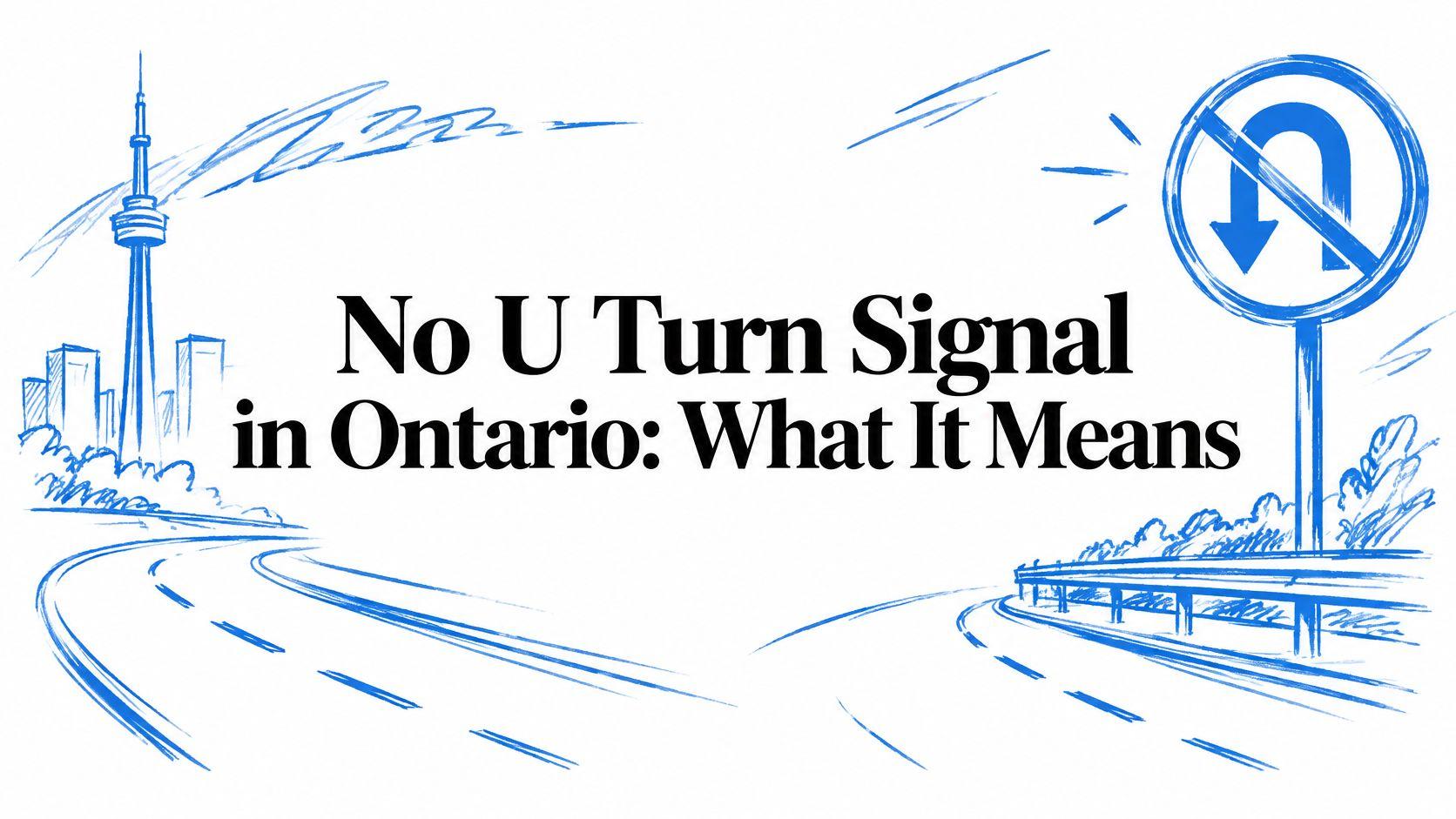
A no U-turn sign means you must not turn around on that roadway or intersection, even when the road looks clear, and you cannot U-turn without a sign where you cannot see 150 metres both ways.
You're at a quiet junction with the handbook still in your bag, and the pavement ahead looks empty. The wheel feels easy to swing. That empty stretch is only half the decision. Ontario splits the problem into a posted ban and a sight line, and a G1 stem often puts the clue in where the car is sitting, not in a big sign at the edge of the picture. The no U-turn signal you flick on tells other people what you intend. It doesn't grant the turn.
What a No U-Turn Sign Means on Ontario Roads
You're rolling toward a junction and the sign on the right shows a bent arrow with a slash through it. A no U-turn sign means you must not turn around to travel in the opposite direction at that spot. The Ontario Ministry of Transportation handbook defines it as a regulatory traffic-control device with that meaning, and Ontario law requires drivers to obey prescribed movement-prohibition signs at intersections. It is an order, not a hint you can set aside because the gap looks easy.
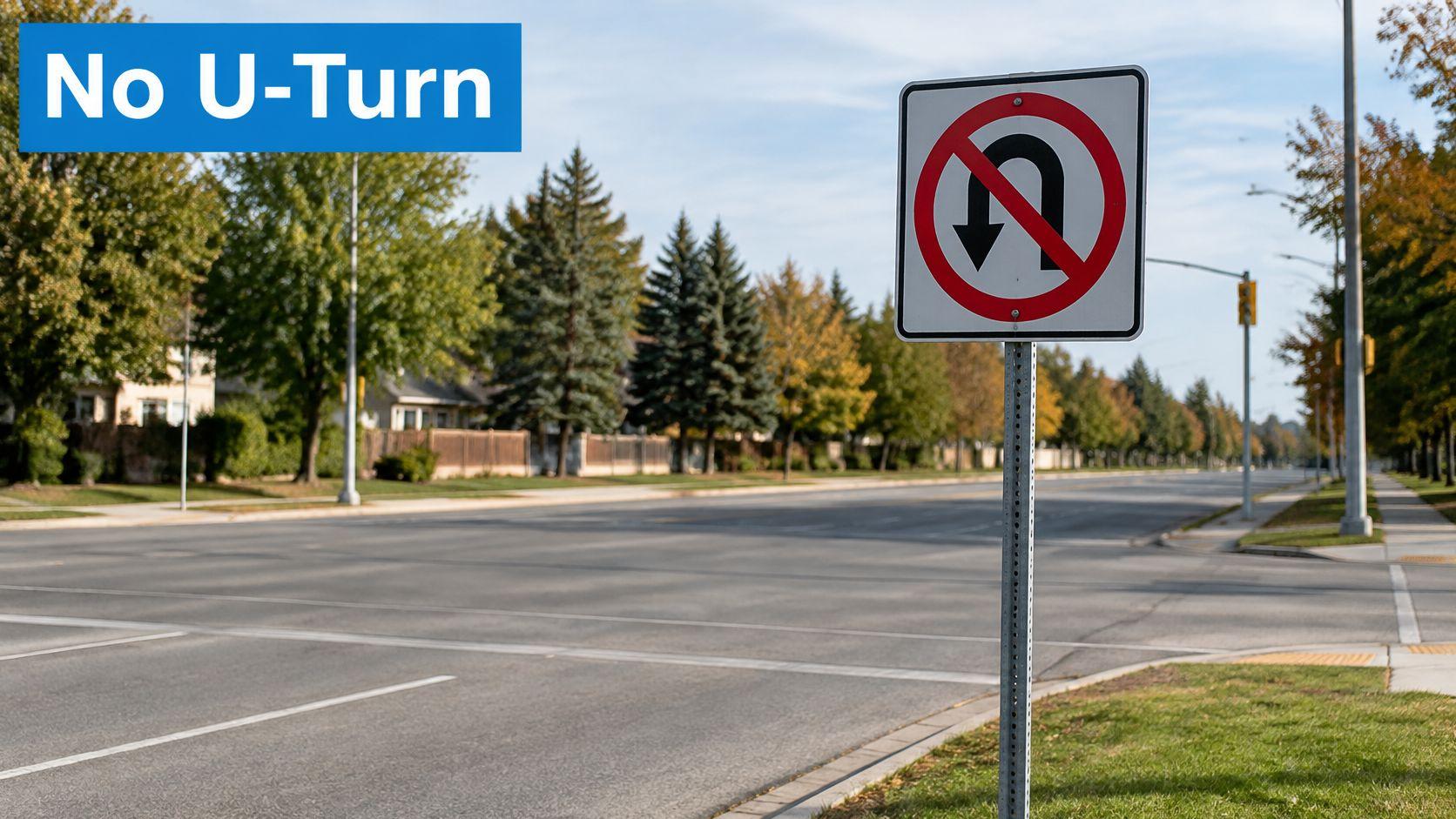
Under Ontario Regulation 615, the sign must be rectangular and measure at least 60 cm by 60 cm. You'll usually meet it at an intersection, or posted along a stretch before the restricted point. It governs the roadway or intersection it is posted for, so look for where that restriction ends rather than treating one placard as a ban on the whole street.
Think of the sign as a closed gate. An empty road on the far side doesn't swing the gate open. A legal U-turn is only conditionally permitted when no prohibiting sign is present and the manoeuvre can be completed safely. Our guide to regulatory signs in Ontario shows how these movement bans sit beside stop signs and lane controls.
If you see the sign, the answer is no, whatever the traffic looks like.
Where U-Turns Are Banned Even Without a Sign
A road can look empty and still fail the sight-line test. Before turning around, check the location itself and how far you can see approaching traffic. Both tests matter.
Location Rule Threshold Posted no-U-turn sign Prohibited The sign applies Curve where approaching traffic cannot be seen Prohibited You must be able to see at least 150 metres in both directions Hilltop with blocked sight line Prohibited You must be able to see at least 150 metres in both directions Railway crossing Prohibited On the crossing and within 30 metres of it Near a bridge or tunnel where the view is blocked Prohibited You must be able to see at least 150 metres in both directions Straight road with no posted prohibition and a clear view Permitted if the manoeuvre can be completed safely At least 150 metres visible in both directions
The official MTO Driver's Handbook gives the 150-metre sight-line rule for curves and hills. A curve that blocks your view of approaching traffic fails this test, even if there is no sign. A U-turn is also prohibited on a railway crossing and within 30 metres of it.
A hill that looks quiet still fails
Suppose you are on a gentle hill and can see only about 60 metres of pavement. The lane beside you is empty, but a vehicle may be hidden beyond the crest. With so little road in view, that driver has less time to spot you and respond. A hill, curve, or blocked view near a bridge or tunnel can hide approaching traffic in the same way.
Railway tracks create a separate location test. The crossing and the area within 30 metres are off limits, even when the road is straight and the sight line is clear.
A sign and a sight line are two separate tests. Both must pass before a U-turn is allowed.
How to Check Before You Turn Around
Run the checks in this order. Stop at the first one that fails.
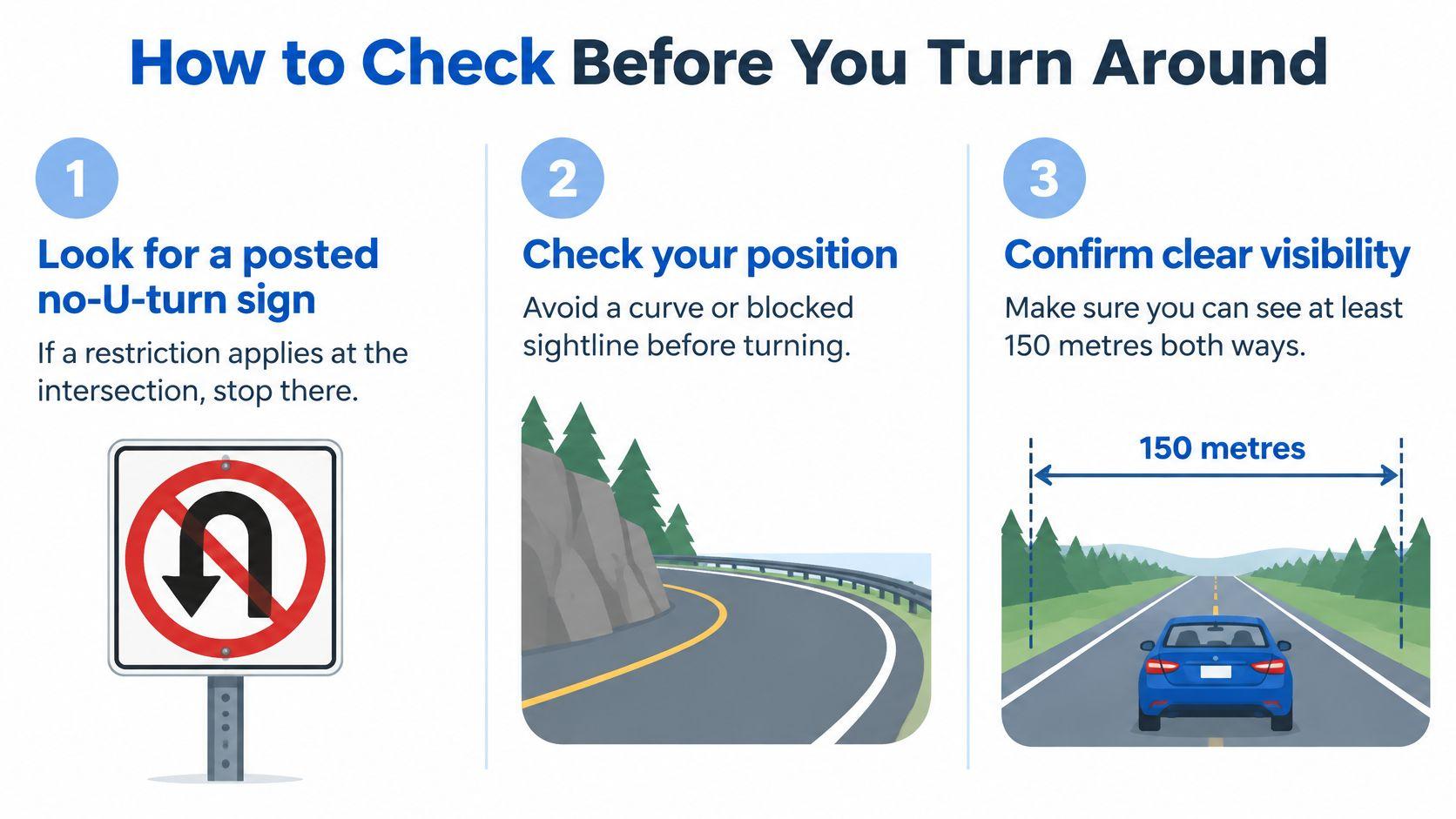
- Look for a posted ban or any turn restriction at the intersection. If one applies, stop there. A wide road doesn't cancel a placard.
- Check your position. A curve, a hilltop, a bridge or tunnel approach with a blocked view, or a spot within 30 metres of a railway crossing means no U-turn. The location is the rule, even with no sign in the frame.
- Confirm you can see at least 150 metres of road in both directions. A quick glance at the nearby lane misses traffic hidden past a bend. Scan the whole visible roadway before you commit.
- Signal early, so people behind and ahead have time to react. Moving the instant the lamp flashes gives them nothing.
- Confirm the way is clear, including pedestrians and cyclists, before the wheels move. Brake lights belong in the same warning, not as an afterthought once you've already slowed hard.
- Complete the turn only when every check has passed. One green item on the list isn't a pass.
The official MTO Driver's Handbook treats the signal as an advance warning, not permission to proceed. You use turn signals and brake lights before stopping, slowing, turning, changing lanes, leaving the road, or moving out from a parked position, and you check that the way is clear before you act. A posted intersection restriction is controlling, so a sign that forbids a U-turn or a left-turn movement overrides any assumption that the roadway is wide enough.
The order a G1 answer wants
Sign check first, sight distance second, then the signal and the gap. An answer that starts with the blinker has the steps backwards.
Signalling Your U-Turn Correctly
A signal works like an advance announcement: it gives other road users time to understand what you intend to do. Under Ontario's Highway Traffic Act, a mechanical or electrical signal must clearly show your intention and be visible and understandable from the front and rear for 30 metres. From one-half hour after sunset until one-half hour before sunrise, it must also be self-illuminated. A signal that is visible to you but unclear to others does not communicate your move.
Signal before slowing or beginning the turn, while the vehicle is still travelling straight. Use the timing and visibility rules for ordinary turns and lane changes as a useful comparison, too: the turn-signal and light guidance explains those situations.
Two mistakes that mislead everyone else
Signalling only once the turn has started. Following drivers may already be close, and oncoming traffic may have little time to react. For example, a driver who signals as the car crosses the centre line on a rural road gives others almost no warning.
Leaving the signal on after the manoeuvre. A blinking lamp can suggest that another turn is coming. Drivers behind may brake or hesitate when the vehicle has already completed its move.
The signal communicates your intention; it does not decide whether the turn is permitted or safe. The sign and sight-line checks still need to pass, and the gap must be clear.
Ontario Penalties for Improper Turn Signals
A driver who signals too late can mislead other road users, even when the turn itself is allowed. Ontario records improper turn-signal use separately from failing to signal a stop.
Year Improper turn-signal use (s. 142(7)) Failing to signal a stop (s. 142(8)) 2018 11,387 45 2019 10,654 33
Ontario's 2018 Driver Annual Statistics recorded 11,387 convictions for improper use of a turn-signal device and 45 for failing to signal a stop. The 2019 Driver Annual Statistics listed 10,654 and 33, respectively. The 2019 total for improper signal use was 733 lower than in 2018, a decrease of about 6.4%.
What the counts do and don't prove
The Highway Traffic Act treats signalling as a separate duty. A late signal, the wrong signal, or one left on after a manoeuvre can give drivers, cyclists, and pedestrians the wrong impression. These figures count convictions, not every instance of unsafe signalling.
A U-turn that violates a sign, a sight rule, or a signalling requirement may lead to a charge, along with fines and demerit points. For current penalty information, consult the Ontario Highway Traffic Act fines and demerit points guide. On the G1 test, assess each part of the situation separately: whether the turn is permitted, whether the signal is correct, and whether the location allows the manoeuvre.
Exceptions and Traps on the G1 Test
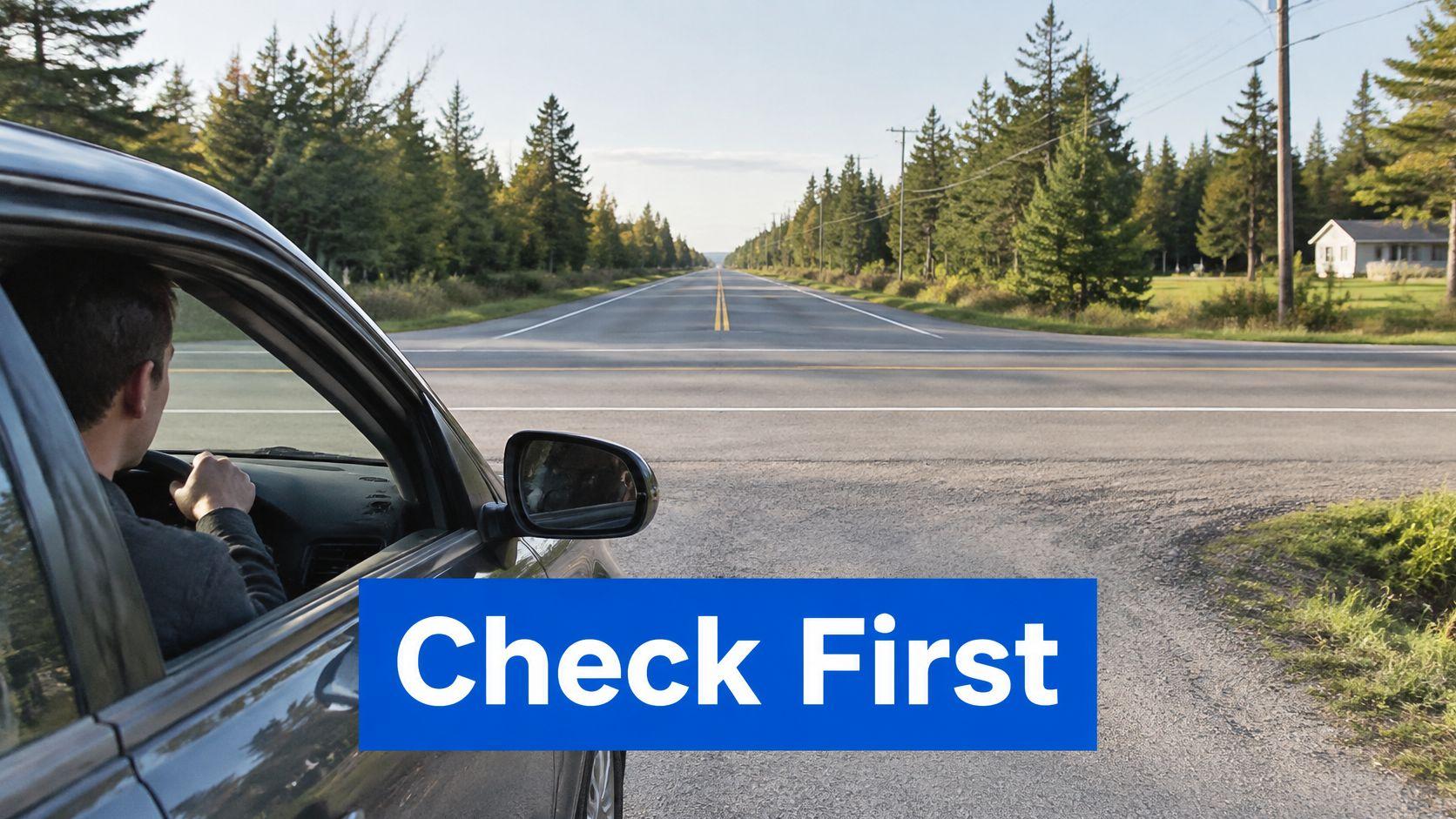
A U-turn is permitted only when no prohibiting sign is posted, the road is straight with a clear view of at least 150 metres both ways, and you can finish the manoeuvre safely. Everything else in a test question is a trap dressed up as a normal road.
Tempting wrong answers
An empty road. The stem says "no traffic," and the tempting pick is to turn. Find the sign in the stem first. A posted ban doesn't care that the junction is quiet.
A clear nearby lane on a curve or hilltop. The cars you can see aren't the cars the rule is about. If the sight line is short, the turn is out, even though the photo looks calm.
A railway crossing with a good view. Location prohibits the turn, including the zone within 30 metres. Don't trade the tracks for a visibility argument.
A signal that's already on. The lamp is never enough on its own. It warns. It doesn't clear the gap or cancel a restriction.
A left-turn or other movement sign at the same intersection. That placard can still limit a U-turn there. Read every sign in the scene before you choose.
Read the full scenario before you tap an answer. The clue is often the place, a crest, a bend, a crossing, rather than the symbol you noticed first.
Practise Turn Rules Before Your G1 Test
Practise until the order is automatic: sign, sight distance, then signal. Start with the topic quiz on intersections, signals, and right-of-way, which targets the rules in this guide. Move to the Road Signs Test so regulatory signs, including the no U-turn sign, stay familiar. Then take a mixed practice test.
The 200-question practice test includes a traffic signs section of 50 to 60 questions covering regulatory, warning, information, and construction zone signs. Work a topic quiz, read the explanation for every wrong answer, and retake those questions until the sight-line reasoning sticks. If you can explain why a no U-turn sign or a blocked 150-metre view stops the turn, you're ready for a mixed test before you book the G1.
G1ready.ca gives you free, registration-free practice that follows the Ontario G1 handbook, including topic quizzes on intersections, signals, and right-of-way plus a Road Signs Test for regulatory bans like the no U-turn sign. Each question comes with feedback so you can fix a missed sight-line or signal rule on the spot. Visit G1ready.ca and run a short quiz before your next study session.