
You're standing in line at a DriveTest centre, clutching your handbook, trying to figure out whether you're looking at a learner permit, a full licence, or some halfway point that nobody has explained properly. That confusion is normal. The Ontario Class G licence sits at the centre of the province's everyday driving system, and once you understand what it covers, who qualifies, and how the test path really works, the whole process gets a lot less intimidating.
What the Ontario Class G Licence Actually Means
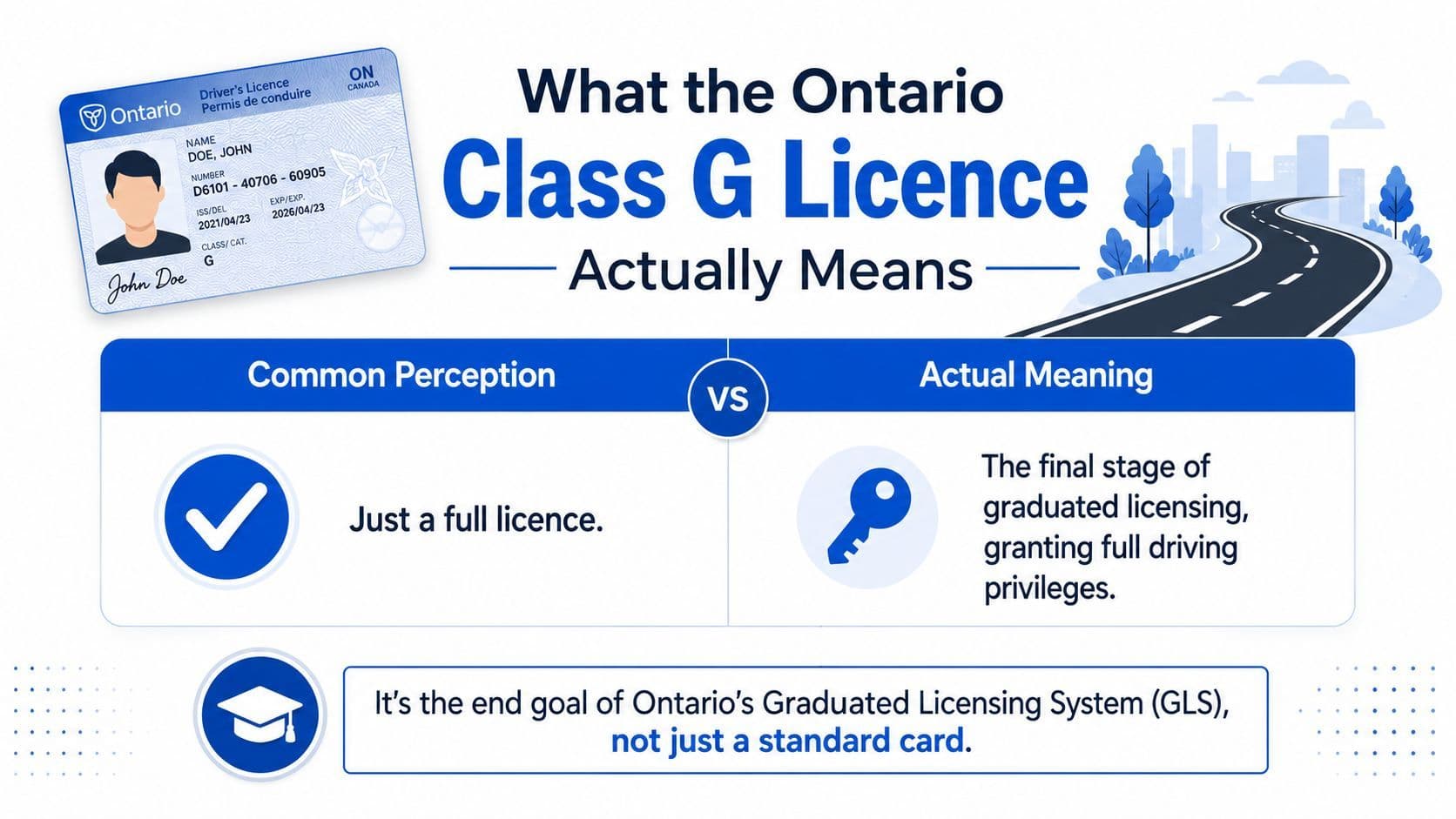
A lot of people hear “Class G” and think it just means a normal car licence. In Ontario, it is the province's standard passenger-vehicle licence, the one people rely on for commuting, school drop-offs, errands, and weekend driving. Provincial driver-population reporting shows how central it is, with over 11.1 million licensed drivers recorded in December 2022 and over 95% of them holding a G-class passenger vehicle licence. That is why Class G sits at the center of everyday driving in the province, rather than marking out a special category for unusual vehicles. Ontario Auditor General driver training report
What Class G lets you drive
Ontario's handbook says a Class G licence allows you to drive a car, van, recreational vehicle, small truck, or a vehicle-and-towed-vehicle combination as long as the combined weight stays within the legal limit and the towing rules are followed. The practical cap is 11,000 kg for the combined vehicle and trailer, and the towed vehicle must not be over 4,600 kg. Ontario Ministry of Transportation handbook
That detail matters because “car licence” sounds simple, while the legal definition is more exact. A pickup pulling a house trailer can still fit under Class G if the combination stays within the mass limits. Once that clicks, the licence reads less like a label and more like a set of operating rules.
Practical rule: If the vehicle setup is larger than a normal passenger car, check the combined weight and trailer weight before assuming it still fits Class G.
Ontario also uses Class G as the final stage of its graduated licensing system. DriveTest describes the path as G1, then G2, then full G. That sequence matters because the province is not handing out a full licence on day one. It builds drivers toward it in stages, and Class G is the endpoint. DriveTest Ontario driver licences for cars
Class G Versus G1 and G2 in Plain Language
A new driver in Ontario usually starts at the bottom of the ladder, not the top. G1 is the learner stage, G2 gives more independence, and G is the full passenger-vehicle licence at the end of the path. The system is designed to build skill in layers, so each step adds responsibility after the driver has had time to practise it.
G1 and G2 in real-world terms
A G1 driver has to stay with a fully licensed driver with at least four years of driving experience. Ontario's Canadian driver licence reference material also lays out the other G1 limits, including a BAC below 0.05% for the accompanying driver, no solo driving on certain highways, and no driving between midnight and 5 a.m. unless the situation fits the rules. Canadian Driver's Licence Reference Guide.pdf)
A student at the G1 stage is still learning how traffic feels in real time. That means lane choice, speed control, following distance, and watching what other drivers do around them, all while a qualified driver is beside them to step in if needed.
G2 works differently. DriveTest says a G2 holder may drive without an accompanying driver, although younger drivers can still face extra conditions. That is the main shift new drivers need to understand. G1 is supervised learning, G2 is partial independence, and G is full driving privilege. DriveTest Ontario driver licences for cars
Why the final G matters
Full Class G removes the graduated restrictions attached to the learner and intermediate stages. That is why the final licence carries so much weight. It is the point where Ontario recognizes that the driver has finished the full passenger-vehicle pathway.
In ordinary life, that broader licence matters because people do not always drive a plain car with no cargo and no trailer. A family loading luggage, a contractor using a small truck, or a parent towing a trailer for a weekend move all need the same question answered, whether the vehicle setup still fits Class G. If it does, the licence covers it. If it does not, the vehicle class has changed.
Who Qualifies for the Ontario Class G Licence
Ontario's entry rules are straightforward, but people still miss them because they mix up the start of the process with the end of it. To apply for a driver's licence in the province, a person must be at least 16 years old, be an Ontario resident, pass a vision test, and pass a knowledge test on road rules and signs. Once those tests are passed, the applicant receives a G1 licence. Get a G driver's licence for new drivers
The eligibility checklist that actually matters
The paperwork side is where newcomers and parents often lose time. DriveTest appointments run more smoothly when the applicant arrives with acceptable identity documents, proof of residency, and any documents needed to show legal status where required. Ontario also says that, as of May 11, 2026, a G licence applicant must declare Ontario as their primary place of residence and that their presence in Canada is legal. That turns the process into more than a skills check, it's also an eligibility and compliance gate. Get a G driver's licence for new drivers
What families should check before booking
A clean first appointment usually means handling the basics before anyone gets to the counter. Bring what DriveTest asks for, make sure the applicant's address is current, and confirm that the vision requirement won't surprise you at the last moment. If glasses or contacts are part of daily life, they may become part of the licence condition after the screening.
- Age and residency: The applicant must meet the minimum age and be an Ontario resident.
- Identity: Bring acceptable documents that prove who the applicant is.
- Vision: Don't treat the vision test as a formality.
- Status and residence: Newer applicants should be ready for the residency and legal-presence declaration tied to the provincial process.
- Timing: Book only after the documents are ready, because a missing piece can waste the appointment.
That's the essential pre-flight checklist. If the foundation is wrong, the rest of the licence path gets delayed before it even starts.
How the G1 Knowledge Test and Two Road Tests Work
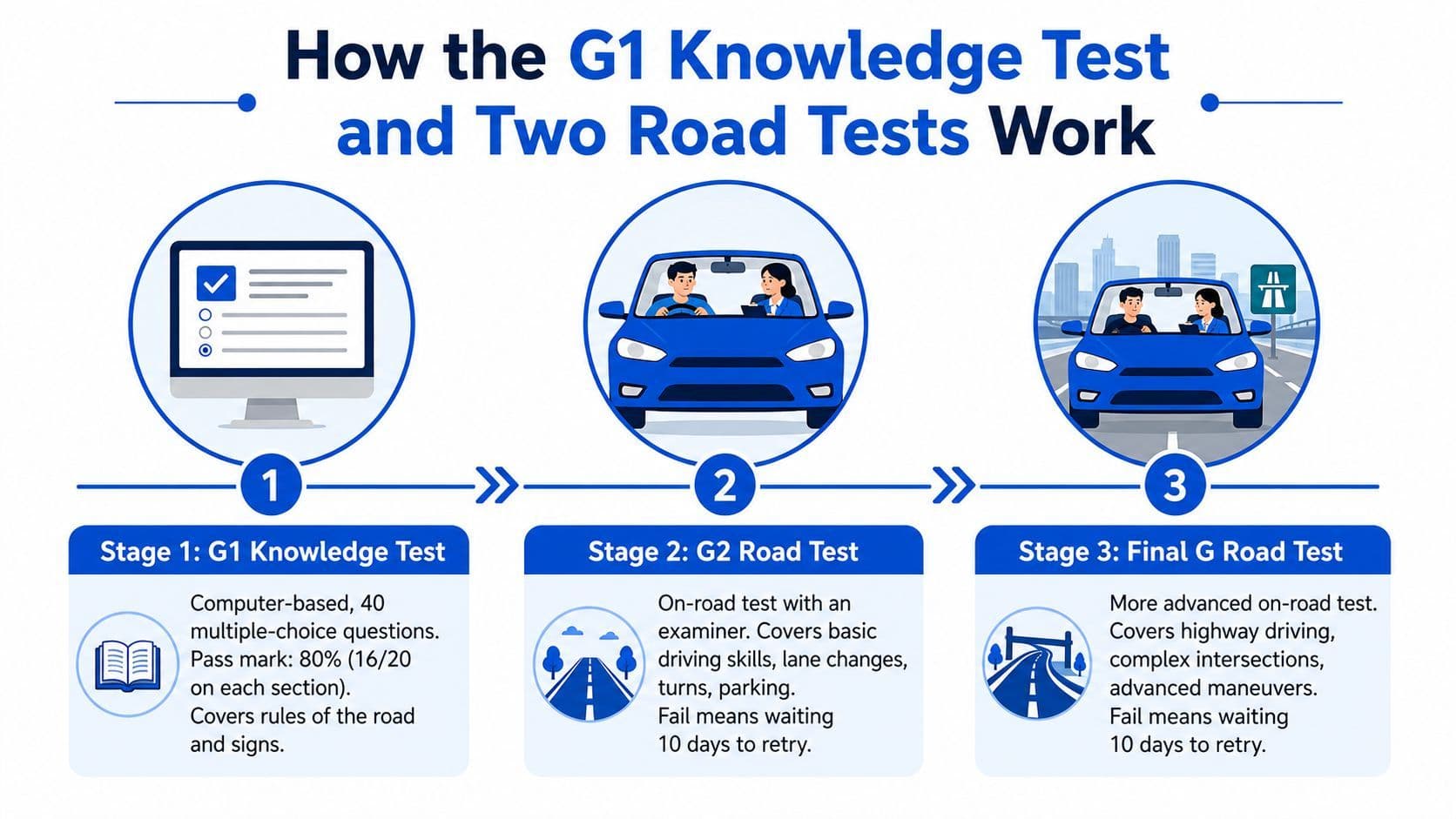
A new Ontario Class G driver moves through a clear sequence. First comes the G1 knowledge test, then the G2 road test, and finally the final G road test. Each stage checks something different, and that difference matters. The written test shows whether you know the rules. The road tests show whether you can use those rules while someone is watching, in traffic, and without hesitating at the wrong moment. Getting your driver's licence
The written test gate
The G1 test is the first checkpoint because it decides whether a new driver can begin supervised driving. Ontario's handbook materials describe it as a knowledge test on road rules and road signs, and that fits the role it plays in the wider licensing system. It is the part of the process that sorts “I have read the rules” from “I am ready to practice them.” Provincial reporting also shows how much of the system depends on that step, with Serco handling large volumes of knowledge tests and road tests across Ontario. Ontario driver training and testing overview
A useful way to read the G1 stage is this. It protects the road tests by making sure drivers already understand signs, right-of-way, and basic responsibilities before they ever get into a car with an examiner waiting at the curb.
The road tests and what they're for
The road-test stages are about execution, not memory. A G2 test checks whether the driver can manage basic vehicle control, traffic flow, and everyday judgement. The final G test asks for a stronger level of consistency, especially on faster roads and in more complex traffic patterns. Both tests are measuring whether the driver can make safe decisions in motion, not just recite rules from a page.
The timing between stages matters too. Ontario's graduated system sets a waiting period between G1 and G2, then another waiting period from G2 to full Class G, and a failed road test also triggers a waiting period before the next booking. That means timing is part of the journey, not just performance on test day. A student can be ready in skill but still lose time if the booking calendar is tight or a test goes poorly. G road test booking guide
Why Real Timelines Often Beat the Official Minimums
A learner can satisfy the waiting rules and still not get a test date that fits the plan. Ontario's stage requirements set the earliest point someone can book, while DriveTest availability decides whether that booking happens on time. The two are connected, but they are not the same thing. DriveTest booking and service information
Availability changes the calendar
That is the reality many families run into in 2025 and 2026. A centre may list G2 and G tests, while another location has limited service, reduced capacity, or no practical opening for the exact test a driver needs. The rulebook sets the minimum wait, but the booking system sets the actual date.
A student in a quieter part of Ontario may move through the licensing steps close to the expected timeline. In a busier area, the calendar can stretch even when the driver has done everything right. The law has not changed, but the local booking situation has. A sensible plan leaves room for that gap.
What to do instead of assuming the date will stick
The better habit is to check local listings early, compare nearby centres, and keep a flexible backup. If one centre has no G slot, a nearby one may have space. If a preferred date disappears, the backup option should already be in mind. If someone fails a road test, the 10-day waiting period before rebooking makes a rushed attempt cost more time.
Book the test you can realistically reach, not the one that looks nicest on paper.
That advice is simple, but it prevents a lot of frustration. The provincial minimums tell you when you are allowed to try. Local availability tells you when you will get behind the wheel for the test.
For learners who want to use the waiting period well, G1 license study material can help turn that time into focused review instead of idle waiting.
How Targeted Practice Tests Build Real G1 Readiness
The handbook gives you the rules. Practice gives you recall under pressure. That difference matters because most learners don't fail from ignorance alone. They fail because they know the material loosely, then blank when the question is phrased a different way.
G1ready.ca is one option that turns that vague familiarity into sharper memory. It offers free Ontario G1 practice tests that mirror the structure of the official exam, along with topic-specific quizzes, mixed tests, a diagnostic test, marathon practice, and a realistic G1 simulator. G1 license study material
How the study modes help
A topic quiz on road signs is good when you keep mixing up shapes, colours, or warning symbols. A mixed test is better when you want to check whether different topics stay clear once they're scrambled together. A diagnostic run is useful when you don't want to guess where you're weak, you want the platform to show you. A simulator helps the final few days feel less like revision and more like rehearsal.
Every question comes with feedback, hints, and explanations, so the point isn't just to mark answers right or wrong. It's to correct the mistake while the idea is still fresh. The platform also tracks progress and performance patterns, which helps a learner spend less time rereading the whole handbook and more time drilling the parts that keep slipping.
How to use it with the handbook
Use the handbook for the official rule set, then use practice exams to expose what you haven't retained yet. That combination is especially useful when booking timelines are uncertain, because you can't always rely on a long runway before test day. If the date moves closer faster than expected, structured practice gives you a way to compress study without guessing.
A good routine looks like this.
- Start with the handbook: Read for understanding, not speed.
- Take a diagnostic test: Find weak areas early.
- Drill by topic: Fix the mistakes that repeat.
- Switch to mixed exams: Build recall under shuffled conditions.
- Finish with the simulator: Make the test format feel familiar.
That approach is simple, but it works because it matches how people learn to drive in Ontario. The rulebook is the base layer. The practice screen is where confidence gets built.
Common Reasons People Fail and How to Avoid Them
A learner can know the handbook and still stumble on test day. That usually happens when the questions start to look similar. Road signs blur together, speed rules get mixed up, and right-of-way questions become guesses instead of decisions.
One student I watched kept missing sign questions because they memorised the colour, not the shape. Another breezed through practice at home, then froze when the official screen presented two nearly identical answers. The issue wasn't a lack of effort, it was a gap in pattern recognition.
The mistakes that cause the most trouble
The most common errors are usually practical, not dramatic.
- Similar road signs: People confuse warning, regulatory, and informational signs when they don't study them in groups.
- Speed and road context: Urban rules and highway rules get mixed up when the learner studies them separately but not comparatively.
- Right-of-way confusion: Uncontrolled intersections expose weak understanding fast.
- BAC and drug rules: Learners often remember the idea of impairment rules but not the exact limits and exceptions.
- Rushing the format: Some people answer too quickly and second-guess themselves into wrong choices.
Structured practice helps because it shows the same ideas in different clothing. That is why exam-style repetition matters more than passive rereading. A learner who has seen the same rule appear in five question formats is less likely to panic when the wording changes.
What to do before test day
Use timed practice to get comfortable with the pace. Read every question all the way through before answering. If two choices look close, compare the wording carefully instead of trusting the first familiar phrase. If a topic keeps failing, stop broad review and drill that topic directly.
A weak area is only a surprise if you never looked for it.
The value of practice tests is that they turn vague discomfort into a clear study plan. That is a lot more useful than hoping a last-minute reread will fix everything. For a closer look at the traps learners keep hitting, see the common G1 test mistakes guide.
Your Class G Roadmap From First Study Session to Test Day
A solid G1 run starts with a simple plan. In the first week, read the handbook once for the structure, then take a diagnostic test so you're not guessing where the gaps are. In the second and third weeks, use topic quizzes to correct the weak areas that keep showing up. In the final week, shift into mixed exams and the simulator so the questions feel familiar under pressure.
A realistic weekly rhythm
Keep the work short and repeatable. A focused half-hour with the handbook, then a targeted quiz, does more than a long unfocused session where nothing gets remembered. The goal is to finish each study block with one clear takeaway, not with a sense that you've “done a lot.”
- Week 1: Read the handbook, then identify weak areas with a diagnostic.
- Weeks 2 to 3: Drill by topic, especially signs, rules, and right-of-way.
- Final week: Use mixed tests and simulator-style practice.
- Day before test day: Review lightly, check documents, and stop cramming.
That pattern prepares you for more than the G1. It builds the habit you'll need for G2 and the full G test too. The students who do well in Ontario usually aren't the ones who cram hardest, they're the ones who build a routine and stick to it.
The mindset that gets results
A lot of first-time drivers treat the G1 like a pass or fail hurdle that depends on luck. It doesn't. If you study the handbook, practice with intention, and keep your timing realistic, the test becomes a predictable checkpoint. Once you pass it, the rest of the graduated system makes a lot more sense.
If you want structured practice that lines up with the Ontario handbook, G1ready.ca offers free G1-style quizzes, mixed exams, a diagnostic test, and a full simulator to help you study with purpose. Visit G1ready.ca and build a test-day routine that fits the way Ontario's licence system works.


