You're practising a G1 question in Spanish, and the answer sounds familiar. Then you look at the Ontario sign beside it and hesitate. Does the translated word mean the same thing you learned back home, and does it require the same action?
An Ontario G1 practice test in Spanish can help you understand the material without getting stuck on unfamiliar English. But readiness means more than recognising a translation. You need to connect the Spanish explanation, the Ontario term and the driving action, so you can choose a safe answer even when the wording changes.
What the G1 Knowledge Test Covers and How Many You Must Pass
The G1 knowledge test uses 40 multiple-choice questions, taken on a computer at a DriveTest centre. It separates road signs from rules of the road, and you must pass each section independently.
G1 knowledge test structure and pass marks
Section Questions Pass mark What it covers Road signs 20 16 correct Regulatory, warning and guide signs Rules of the road 20 16 correct Right-of-way, lane changes, speed, parking, safe driving Total test 40 Pass both sections Multiple-choice questions from the MTO handbook
A strong result in one section doesn't make up for a weak result in the other. For example, a learner who answers 19 of 20 rules questions correctly but only 14 of 20 sign questions hasn't passed. A combined score can therefore hide the area that needs attention.
The Official Ministry of Transportation Driver's Handbook is the authoritative study reference for Ontario's road rules, safe-driving practices, licensing procedures and road signs; it also confirms that knowledge-test questions use a multiple-choice format. Practise choosing between possible answers, rather than only reading definitions.
Study the action behind the answer
For each question, ask yourself what the driver must do. Recognising a sign's name isn't enough if you can't explain whether it requires stopping, yielding, changing speed or watching for a hazard.
Multiple-choice practice also helps you notice small differences between answers. An option may describe a sensible action generally but still fail to answer the specific situation in the question.
First-session task: Take a practice test and record your signs score and rules score separately. Use the weaker result to choose your next study topic.
Keep those results in a notebook or simple spreadsheet. Add a short explanation beside each mistake, such as “confused the sign category” or “missed who must yield,” so your study plan starts with a specific problem rather than a general feeling that you need more practice.
Spanish Practice Tests and the Language Options at DriveTest
You may understand a G1 question in Spanish, then hesitate over an Ontario sign or legal term because the English wording is unfamiliar. Spanish practice can clarify the meaning, but readiness also means connecting that meaning to the Ontario rule.
Ontario has offered written tests in languages beyond English and French. In its announcement about adding Farsi, the provincial government said the expansion was intended to help newcomers learn Ontario's rules and improve road safety. The announcement does not confirm which languages a particular DriveTest centre offers now, so check directly with your chosen centre before your visit.
Confirm the presentation before your visit
- Ask about current language options. Check whether your chosen centre offers the written test in Spanish.
- Ask how questions are presented. Confirm whether the test appears in Spanish alone or whether English wording is also available.
- Study the Ontario term alongside its Spanish explanation. For a sign or rule, learn the action it requires, not only its translated name.
The guide to G1 test languages can help you prepare questions about language availability and presentation.
A translation can sound reasonable without matching the precise Ontario rule. For example, a broad everyday word for “yield” may not make clear which driver must give way. Use Spanish to understand the question, then check the English wording in the Official Ministry of Transportation Driver's Handbook. Move on when you can explain the required action in your own words, rather than relying on one translation.
A Two-Week Study Routine That Targets Your Weak Spots
Use a two-week schedule as an organised study framework, not a promise that everyone will be ready within that time. Move more slowly when you're still guessing, and spend less time repeating topics you can already explain accurately.
Start with testing and tagging, then build your review around the mistakes you find.
Follow a repeatable study loop
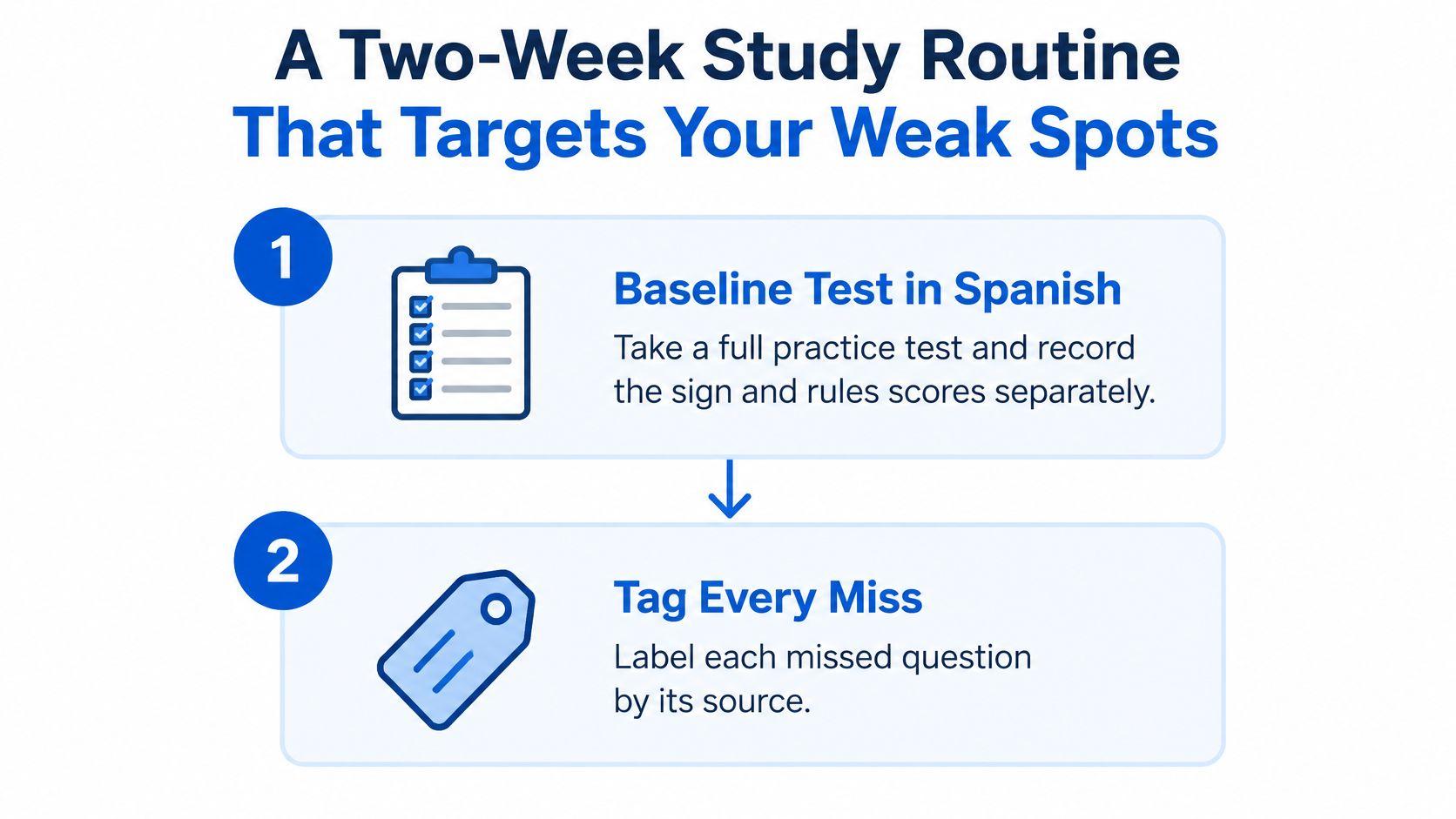
- Take a full baseline practice test in Spanish. Record signs and rules separately, without looking up answers during the attempt. You need an honest starting point, not a score improved by checking.
- Tag every missed question by its source skill. Use traffic signs, right-of-way, defensive driving, licensing law or numerical rules. Add a note if vocabulary, rather than the rule itself, caused the error.
- Read the matching handbook section in English. Use Spanish to clarify difficult wording, then explain the Ontario rule in your own words. Don't stop at recognising the correct answer.
- Build a focused 20-question drill around your weakest tag. Mix the situations and answer wording so you practise the rule rather than memorise a sequence.
- Repeat a full practice test every three to four days. Compare your error tags, not just your total score. If one category remains weak, return to its handbook section before another full attempt.
- Use the final 48 hours for two full simulations. Aim for at least 16 correct in each section on both attempts, without hints or interruptions. Treat this as a readiness check, not a guarantee of an official pass.
These intervals are a suggested study routine. The study-plan guide can help you fit the cycle around school, work or family responsibilities.
Diagnose the rule, not just the wording
The MTO sample knowledge-test questions include applied situations involving skids, lending a licence, entering a highway from a private road, lane changes, night-time speed and stopping distance. They require you to connect a condition with an appropriate response.
Suppose you miss a question about entering a highway from a private road. Tag it right-of-way, then review who must yield before trying another full test. If you understood every Spanish word but selected an unsafe answer, translation wasn't the main problem.
Your routine is working when your weakest category moves from the most-missed list towards the least-missed list, and you can explain why the corrected answers are safe.
Translation Traps and How to Avoid Them
The translation trap is understanding the sentence but applying the wrong driving rule. A familiar Spanish term may suggest an everyday meaning that's less precise than the Ontario sign or legal requirement.
Use a vocabulary list that connects words to actions. Keep the sign image alongside the terms whenever possible, because road recognition shouldn't depend on remembering a translated sentence.
Spanish practice terms and the Ontario names to verify
Spanish practice term Ontario term to check What to verify ceda el paso Yield sign Slow down and give way; it does not automatically require a full stop alto Stop sign Full stop at the line, then proceed only when safe zona escolar School zone sign Check posted hours and any applicable lower speed limits límite de velocidad Speed limit sign Read the number on the sign; the word alone does not give the limit
Check meaning against the driving action
For each unfamiliar term, find the Ontario name in English and read the associated rule. Then write what you must do, including any condition that changes the answer.
A yield sign doesn't impose the same automatic stop requirement as a stop sign, but you must stop when necessary to give way safely. Likewise, don't attach a universal speed to the phrase school zone. Read the actual signs, including supplementary information about when a posted restriction applies.
Ontario's guidance for new drivers identifies road rules and traffic signs as knowledge-test subjects. Your vocabulary review should therefore connect each term with a rule you can apply, not merely an English equivalent.
Practice questions are unofficial and can't guarantee identical questions on test day. When a Spanish explanation conflicts with the Ontario handbook, follow the handbook and add the disputed term to your personal review list.
Road Sign and Rule Drills With Ontario Examples
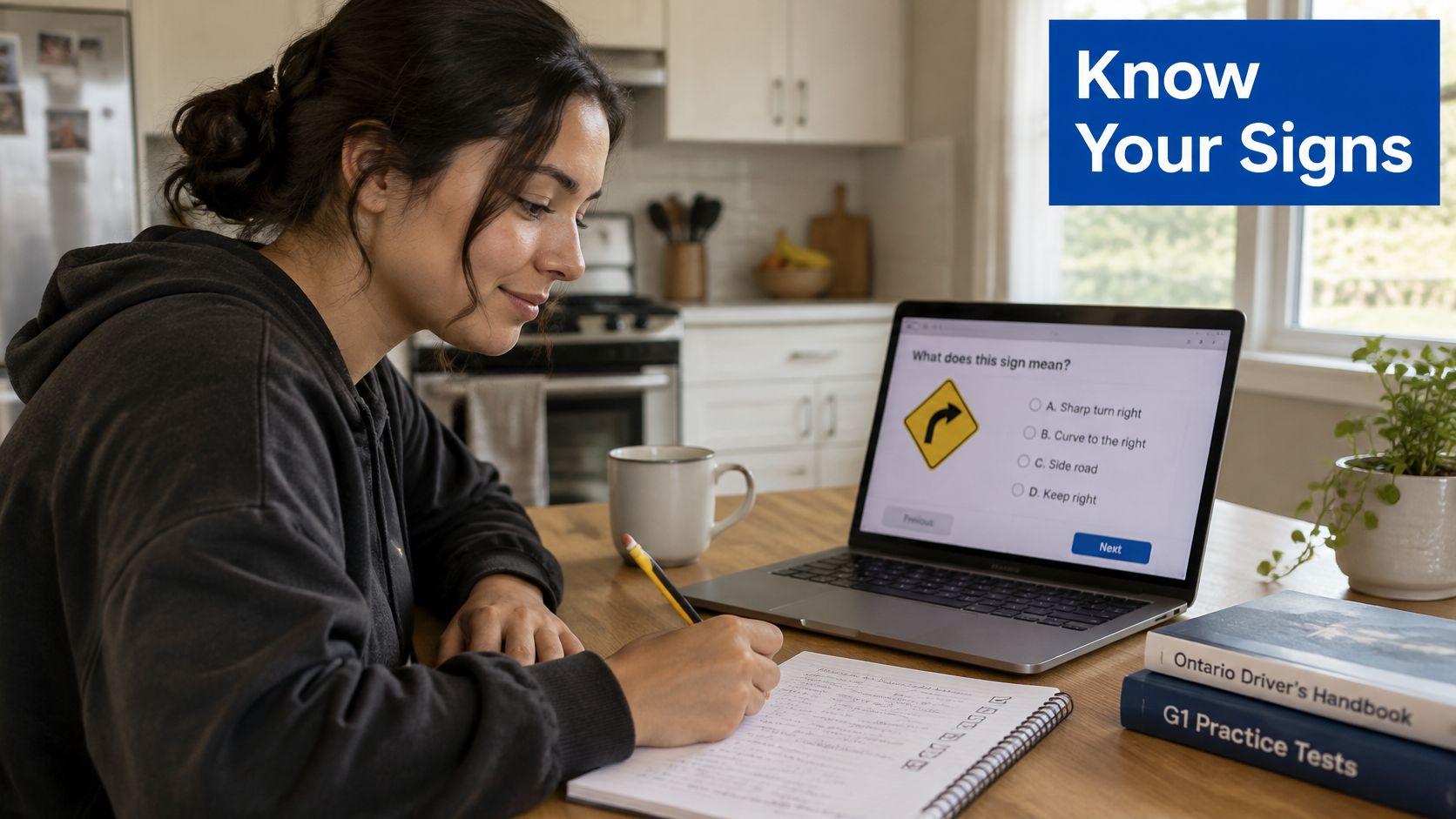
Start your sign drills with the image, not the translated label. Cover the answer, identify the sign's shape and colour, then explain what a driver should do.
Keep a notebook beside your practice screen so you can record the action as well as the name.
Separate recognition from recall
Organise your flashcards into these groups:
- Regulatory signs control behaviour, including speed limits, stopping and yielding.
- Warning signs alert you to conditions ahead, such as hills, curves and school-related hazards.
- Guide signs help with navigation, including highway exits and directions.
For a practice session, build a set of 20 flashcards. Sort them by shape and colour before attaching the Spanish label and Ontario name. This suggested drill makes you inspect the sign instead of guessing from a word you recognise.
Then shuffle the cards and explain each required action aloud. If you name a yield sign correctly but describe a mandatory stop every time, keep that card in the review pile.
Work through the whole scenario
Consider a practice scenario in which a car enters a highway from a private road at night. The night-time detail may attract your attention, but first identify the rule governing entry onto the highway.
Use this sequence:
- Read the complete situation, including where each vehicle is travelling.
- Name the controlling rule before looking for a familiar answer.
- Choose the response that follows that rule.
- Check the English handbook wording and explain why the alternatives don't fit.
Use the video as a separate review break, then return to answering questions without prompts.
Include licensing-law scenarios alongside signs and manoeuvres. Under Ontario's driver-licensing regulation, a G1 driver must have a qualified accompanying driver seated beside them, generally with at least four years of licensed experience; the learner must have zero blood-alcohol concentration, and the accompanying driver must be below 50 milligrams per 100 millilitres of blood.
Finish each drill by writing a fresh question for each rule you practised. Answer from memory before checking, so you test understanding rather than familiarity with an answer key.
G1 Supervision Rules for Newcomers
Years of driving abroad can help with vehicle control, but they don't automatically establish that you understand Ontario's learner restrictions. The MTO handbook's licensing guidance cautions drivers from other countries to learn Ontario laws because driving customs differ.
Treat supervision as a practical eligibility check before every drive, not just a question of finding someone willing to sit beside you.
G1 supervision and seating rules
Rule Requirement Detail Accompanying driver Seated beside the G1 driver Required while the G1 driver drives Accompanying licence Appropriate full licence Generally licensed for at least four years G1 driver blood-alcohol Zero No alcohol permitted Accompanying driver blood-alcohol Below 50 mg per 100 mL Limit for the supervising driver Front seats Novice and accompanying driver only No other occupants in front Rear passengers Not more than working seat-belt assemblies Count of working belts sets the limit
Test whether the friend qualifies
Suppose you've driven abroad for years, and a friend offers to supervise you. They say they obtained their full Ontario licence five years ago.
That history suggests they may meet the experience requirement, but it isn't the whole assessment. Confirm their current licence is valid and appropriate, that they meet the accompanying-driver conditions, and that they'll sit beside you.
A willing passenger isn't necessarily a qualified accompanying driver.
Use the G1 licence restrictions guide to organise your review of learner conditions. For study practice, write a question about each table row and answer it from memory, including the seating and passenger rules that are easy to overlook.
Booking Checklist and Readiness Rule
A practice score helps you judge your preparation, but it cannot confirm your paperwork or the language options at a test centre. Check these details before choosing a test date.
- Confirm identification. Check the current Ontario G1 handbook for the identification documents required for the knowledge test, then make sure your documents meet those requirements.
- Prepare payment and vision needs. Bring payment and corrective lenses if you use them.
- Review current guidance. Check the handbook for updated instructions rather than relying only on saved notes or older study material.
- Confirm language arrangements. Contact your chosen DriveTest centre to ask whether Spanish is available and how the questions will be presented.
Choose practice that reveals what to review
G1ready.ca offers free practice tests built around the 2026 Ontario MTO Driver's Handbook. Choose from the Road Rules Test, Road Signs Test, 200-Question Test and Diagnostic Test. Start with the Diagnostic Test to identify topics that need more attention, then practise those areas.
Set a readiness rule before booking: aim for at least 16 correct answers in each section on two separate full practice runs. Then explain your answers without hints. A passing score is more meaningful when you can describe the rule behind it.
Memorised answer positions can fail you when a question is phrased differently. Vary your review questions and say the required driving action aloud. When a scenario uses unfamiliar wording, identify the Ontario rule first, then reject choices that sound plausible in Spanish but describe an unsafe action.
Book when your results show understanding, not because a calendar plan has ended.
G1ready.ca's free practice tests include instructor-reviewed answers. Start with the Diagnostic Test and keep your Spanish-to-English terminology notes nearby as you practise.