
You're sitting at a red light in Mississauga with your signal on, your hands at 9 and 3, and your foot firmly on the brake. Pedestrians are still crossing, a cyclist is approaching on your right, and there's no green arrow. You can't see a no right turn sign, so the question feels immediate: can you turn, or must you wait?
Ontario's basic rule is straightforward, but the road rarely feels simple. A right turn on red may be allowed after a complete stop when no sign prohibits it and the way is clear. The difficult part is reading the intersection, finding the restriction, checking the passenger-side blind spot, and yielding before the vehicle moves. Treat the right turn sign as a permission check, not as an instruction to turn.
Why the Right Turn Sign Confuses New Ontario Drivers
New drivers often learn the right-on-red rule as a short sentence and then meet an intersection full of competing information. A bus lane may begin just beyond the corner, a cyclist may be travelling beside the curb, and a pedestrian may step into the crossing while the driver is checking the traffic signal. The absence of a visible prohibition can feel like permission, but it never removes the duty to make the movement safely.
The Ontario handbook says a right turn on red is allowed only after a complete stop, unless a sign forbids the turn, and only when the way is clear. It also directs drivers to yield to pedestrians and check for cyclists and other smaller road users before completing the turn, as described in the Ontario driver handbook's changing-directions guidance.
Practical rule: No sign prohibiting the turn does not mean “turn now.” It means you may assess whether the turn is legal and safe.
Friends and relatives can pass along habits from other provinces, U.S. states, or driving environments with different rules. One person may say a red-light turn is always allowed. Another may stop at every red light even where the movement is permitted. Your G1 answer must follow Ontario's rule and the signs at the intersection, not someone else's routine.
Read the intersection in an order
Start with the sign and signal. Then look at the stop line, crosswalk, sidewalk edge, bike lane, and traffic approaching from every relevant direction. A right-turn decision is complete only when you've confirmed that the movement isn't prohibited, you've stopped properly, and no pedestrian, cyclist, moped rider, or vehicle has priority over your path.
That's why the right turn sign matters beyond memorising an icon. It identifies a restriction, but the final decision still depends on yielding, visibility, and control.
What a Right Turn Sign Actually Is in Ontario
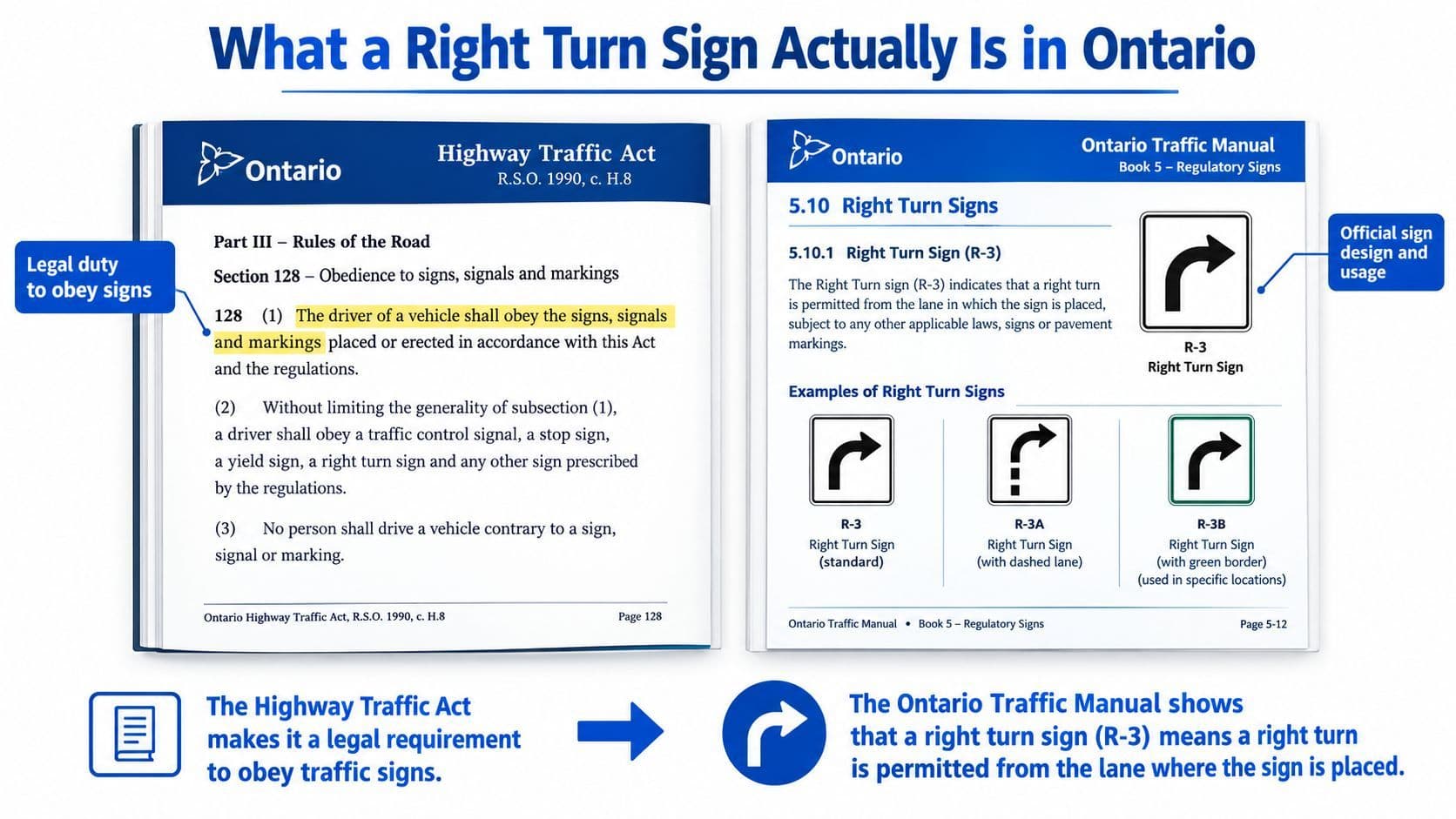
In Ontario, a right-turn restriction is a regulatory traffic control, not merely a suggestion. The Highway Traffic Act requires drivers to obey a posted sign that forbids a right turn, while the Ontario Traffic Manual provides a standardised sign system for prohibiting that movement. The OTM identifies Rb-11 as the dedicated NO RIGHT TURN sign and also recognises related versions for timed restrictions and red-light restrictions.
A regulatory sign tells you what the law requires. Its design, symbol, and supplementary information work together. A warning sign may alert you to pedestrians, a curve, or another road condition, but it doesn't automatically prohibit a right turn. Before interpreting the arrow, identify whether you're looking at a regulatory prohibition or a warning about conditions near the turn.
Ontario also defines minimum sign dimensions. A basic no-right-turn control must be at least 60 centimetres by 60 centimetres, while a sign restricting right turns must be at least 90 centimetres high by 60 centimetres wide and include the prohibited time periods, according to Ontario Regulation 615. Those standards help authorities present restrictions consistently so drivers can recognise them in busy streetscapes.
What the sign authorises
A no-right-turn sign doesn't tell you where to position the vehicle. It tells you that a particular right-turn movement is prohibited under the conditions shown. Lane position comes from road markings, the Highway Traffic Act, and the layout of the approach.
The distinction matters on the G1 test. A red prohibition symbol means you must identify the restriction before thinking about signal timing or lane choice. A yellow warning sign may affect how cautiously you approach, but it isn't the same legal command.
The Main Right Turn Sign Variations You Will See
Ontario's right-turn signs belong to a family of controls. Learn the visual cue, then translate it into the required action.
- No Right Turn: The Rb-11 family uses a right-turn arrow with a prohibition symbol. Treat the displayed movement as forbidden. Don't turn right at that location, even if the traffic light is green.
- No Right Turn on Red: This restriction applies specifically while the signal is red. If the signal changes to green, follow the lane markings and other controls that govern the intersection.
- Timed restriction: A supplementary plaque can identify periods when the turn isn't permitted. Read the days and times before deciding that the sign applies at every moment.
- Lane-specific control: A plaque or pavement marking can show which approach lane is assigned to the movement. Don't assume that a sign affecting one lane applies identically to every lane.
- Turn-only marking: A lane arrow can require a particular movement from that lane. A pavement marking reinforces the road layout, but it doesn't cancel a posted prohibition.
The Ontario Traffic Manual's sign family includes related restrictions such as NO RIGHT TURN ON RED and NO STRAIGHT THROUGH OR RIGHT TURN. That taxonomy is useful because the arrow or arrows can change the movement being controlled, while a supplementary plaque can change when the restriction applies.
Sign Variant Visual Features Legal Action No Right Turn Prohibited right-turn arrow Don't make the right turn No Right Turn on Red Right-turn prohibition linked to a red signal Wait for the permitted signal phase Timed restriction Right-turn symbol with days or hours Don't turn during the displayed period Lane-specific restriction Symbol or plaque identifying a lane Follow the control for your lane Turn-only pavement marking Directional arrow painted in the lane Make the movement assigned to that lane, while obeying signs
For broader sign-identification practice, review the Ontario information signs guide, while remembering that information signs and regulatory signs don't carry the same function.
How to Make a Legal Right Turn at a Sign
A safe right turn starts before the corner. Ontario's Highway Traffic Act requires a driver turning right to approach in the right-hand lane when lanes are marked. If they aren't marked, the driver should keep immediately to the left of the right curb or roadway edge and then enter the right-hand lane of the road being joined, as set out in the Highway Traffic Act turning requirements.
Use this sequence:
- Signal before braking. Activate the right signal early enough to communicate your intention. Don't wait until the front wheels are already turning.
- Choose the lawful position. Move into the marked right-turn lane, or position close to the right curb without crossing the centre line.
- Stop completely. At a red light or stop sign, stop behind the stop line. If there isn't one, stop at the crosswalk, sidewalk edge, or intersection edge in that order, following the MTO traffic-light guidance.
- Check mirrors and the blind spot. Look for cyclists, scooters, mopeds, and other small vehicles beside or just behind the passenger side.
- Yield before entering the path of others. Give pedestrians space in the crosswalk and wait for approaching traffic or cyclists that have priority. A green light doesn't erase this check.
- Turn into the closest lawful lane. Keep the turn controlled, enter the right-hand lane where required, and cancel the signal once the movement is complete.
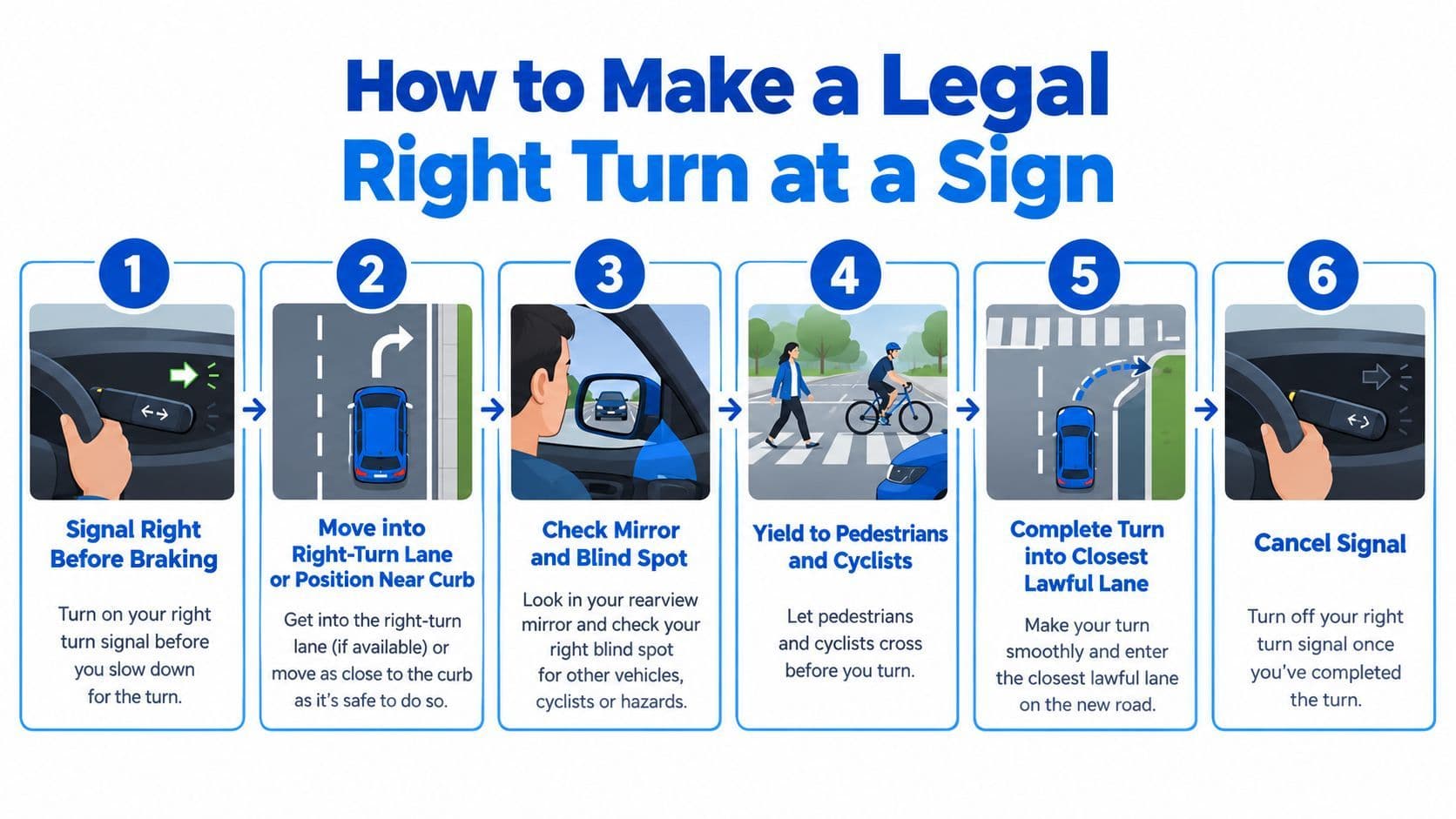
The reason for the shoulder check is simple. Mirrors can show a cyclist approaching from behind, but they may not reveal a road user beside the vehicle. A short pause before turning can prevent a right-hook collision.
For another test-focused explanation of yielding and intersection decisions, use the G1 right-of-way rules guide.
Common G1 Misconceptions About Right Turn Signs
A few incorrect shortcuts appear repeatedly in learner conversations. They sound plausible because they remove uncertainty, but they don't match Ontario's rules.
Misconception Correct Rule “Right on red is always permitted.” It's allowed only after a complete stop, when the way is clear, and when no sign prohibits it. “If I don't see a no-right-turn sign, I can turn immediately.” You still have to stop, inspect the crossing, check the blind spot, and yield. “The sign tells me which lane to use.” A prohibition sign controls whether the movement is allowed. Lane position comes from markings, road layout, and the law. “A green light or permitted turn overrides pedestrians.” You must yield to pedestrians crossing your path and wait until the turn is safe. “A bike lane is just another motor-vehicle lane.” Check for cyclists travelling straight before crossing the lane to turn. Their presence changes the risk and may affect when you can proceed.
Consider a Toronto intersection with a marked bike lane beside the curb. A driver may have a green signal and still need to wait for a cyclist travelling straight. In Ottawa, a timed restriction may apply during the hours shown on a plaque, even if the driver has made the same movement legally at another time. In Hamilton, a pedestrian crossing can remain the decisive factor after the signal changes.
The G1 question may be phrased as “What must you do before turning right on red?” Look for the complete answer: stop fully, check that the way is clear, yield, and confirm that no sign forbids the turn. If an answer says “turn whenever there's no green arrow,” it's missing the required safety checks.
Right Turn Signs and Vulnerable Road User Safety
A green signal does not make a right turn automatic. At a Toronto intersection, a cyclist may continue straight beside your vehicle while a pedestrian begins crossing in front of you. The sign is therefore a permission check, followed by a yield and a blind-spot scan. Toronto-area collision data compiled in the York-region pedestrian safety material identifies right-turn manoeuvres as a recurring source of cyclist and pedestrian conflicts. The same document reports research finding that dedicated right-turn lanes can increase driver-pedestrian conflicts in some situations.
Ontario's handbook directs drivers to yield to pedestrians, cyclists, limited-speed motorcycles, and mopeds before completing a right turn. The bicycle safety rules guide explains cyclist-specific checks in more detail. A cyclist can disappear behind the vehicle's front pillar or approach along a lane you have just crossed, so check the full path rather than only the signal.
Use the sign as a pause point
Treat a right-turn restriction like a doorway with a checkpoint. Before moving, ask:
- Is the movement prohibited now? Check the sign, time plaque, and whether the restriction applies during the red signal.
- Who could cross my path? Scan the crosswalk, sidewalk, bike lane, and space beside the passenger door.
- Can I turn without making anyone brake or change direction? If a person or cyclist is approaching, wait until the path is clear.
Ontario's road safety report records pedestrian fatalities, reinforcing why the Ontario road safety report supports a people-first approach to right turns.
Painted conflict zones, curb extensions, and dedicated cycling space can change the turn's shape. Slow down, keep the wheels straight while waiting at a red light, and scan over your shoulder and through the blind spot before crossing any cycling space. Complete the turn only after vulnerable road users have cleared your path.
Quick Recognition Drills for the G1 Test
Train yourself to connect visual cue, legal meaning, and physical response. On the test, don't spend too long describing the sign in your head. Identify the restriction, then choose the action.
- Regulatory no-right-turn sign: A red prohibition symbol over a right-turn arrow means the movement isn't allowed. Continue according to the available legal route, such as straight or left, if those movements are permitted.
- No right turn on red: The restriction is tied to the red signal. Stop and wait for the signal phase that permits the turn, while still checking lane markings and road users.
- Timed weekday restriction: Read the plaque instead of guessing. If the displayed period applies, don't make the turn. If it doesn't, continue with the normal intersection checks.
- Cyclist-conflict advisory: A warning or advisory sign doesn't necessarily prohibit the turn, but it tells you to increase attention. Check the adjacent lane, shoulder, and crossing before moving.
The correct self-test cues are short:
- Red circle and slash: prohibited movement.
- Time plaque: restriction applies only during the displayed period.
- Red-light wording or symbol: restriction applies to the red phase.
- Yellow warning shape: caution, not automatically a prohibition.
- Arrow marking in the lane: follow the assigned movement and check for other controls.
The Official MTO Driver's Handbook signs and signals guidance is the reference point for learning Ontario's sign system. You can also practise with targeted sign-identification modules, including timed flash formats, on G1ready.ca. Give yourself about ten seconds to turn recognition into action: identify the sign, confirm the signal, check the crossing, shoulder-check, and decide whether the movement is legal and safe.
Right Turn Sign Questions G1 Learners Still Ask
Do I have to stop before turning right on a green light?
No, not solely because you're turning right. A green light permits movement when the intersection is clear, but you still have to slow as needed, check the crosswalk and bike lane, and yield to anyone with priority. If a stop sign, red signal, or other control requires a stop, obey it.
Does a right-turn sign override a dedicated bike lane?
A prohibition sign can prevent the turn, but a permitted turn doesn't give you permission to cut across a cyclist's path. Check the lane before crossing it, signal your intention, and wait until the movement can be completed without interfering with a cyclist travelling straight.
Do cyclists travelling straight have priority over a turning driver?
A cyclist moving through the intersection can have priority over a driver turning across their path. Treat the cyclist like any other road user whose direction of travel conflicts with your turn. If you can't see the full lane, wait until visibility is clear.
What happens if I disobey a mandatory turn sign?
The Highway Traffic Act makes posted prohibitions legally enforceable. The exact consequence depends on the offence and circumstances, so don't treat a sign as optional just because the road appears empty. For the G1 test, the key point is that a regulatory restriction creates a legal duty to comply.
Are the rules different in school or construction zones?
The same core habits still apply: identify the sign, follow the signal, position correctly, stop when required, and yield. Extra signs or temporary controls can change the permitted movement, so read every supplementary plaque and temporary direction instead of relying on your usual route.
Sign compliance, yielding, and blind-spot checks aren't three separate items to memorise. They're one habit: confirm that the turn is permitted, confirm that nobody is in your path, then move only when you can complete it safely.
Practise right-turn questions until the sign, signal, stop, shoulder check, and yield sequence feels automatic. Visit G1ready.ca to work through Ontario road-sign and traffic-light practice modules, review explanations after each answer, and test yourself with targeted quizzes before the G1 exam.


