
You're sitting at a red light in Ontario, signalling right, with no car immediately crossing in front of you. A cyclist may be travelling along the bike lane, a pedestrian may be waiting beside the curb, and a sign may change the answer. The question feels simple, but the safe response depends on more than whether the lane looks open.
Right turns on red are generally permitted in Ontario, but they're conditional. You must stop completely, check whether a sign prohibits the movement, yield to pedestrians and other road users, and proceed only when the way is clear. The manoeuvre is a privilege, not an obligation, and the same legal movement can be treated differently at an individual intersection because of local safety concerns.
The First Time You Sit at a Red Light in Ontario
Your first real red light as a learner can feel longer than it is. You stop at the line, signal right, and notice a car waiting behind you. The cross street looks open, yet a cyclist could be beside the curb, a pedestrian could be preparing to cross, or a sign could make the turn illegal.
Use one question to organise the decision: what must be true before I move? The Ontario Driver's Handbook guidance on changing directions gives G1 learners the procedure to understand. A right turn on red begins with a complete stop, continues with checks for signs and people with priority, and ends only when the path is clear. The rule permits the turn in many places, but it never requires you to take it.
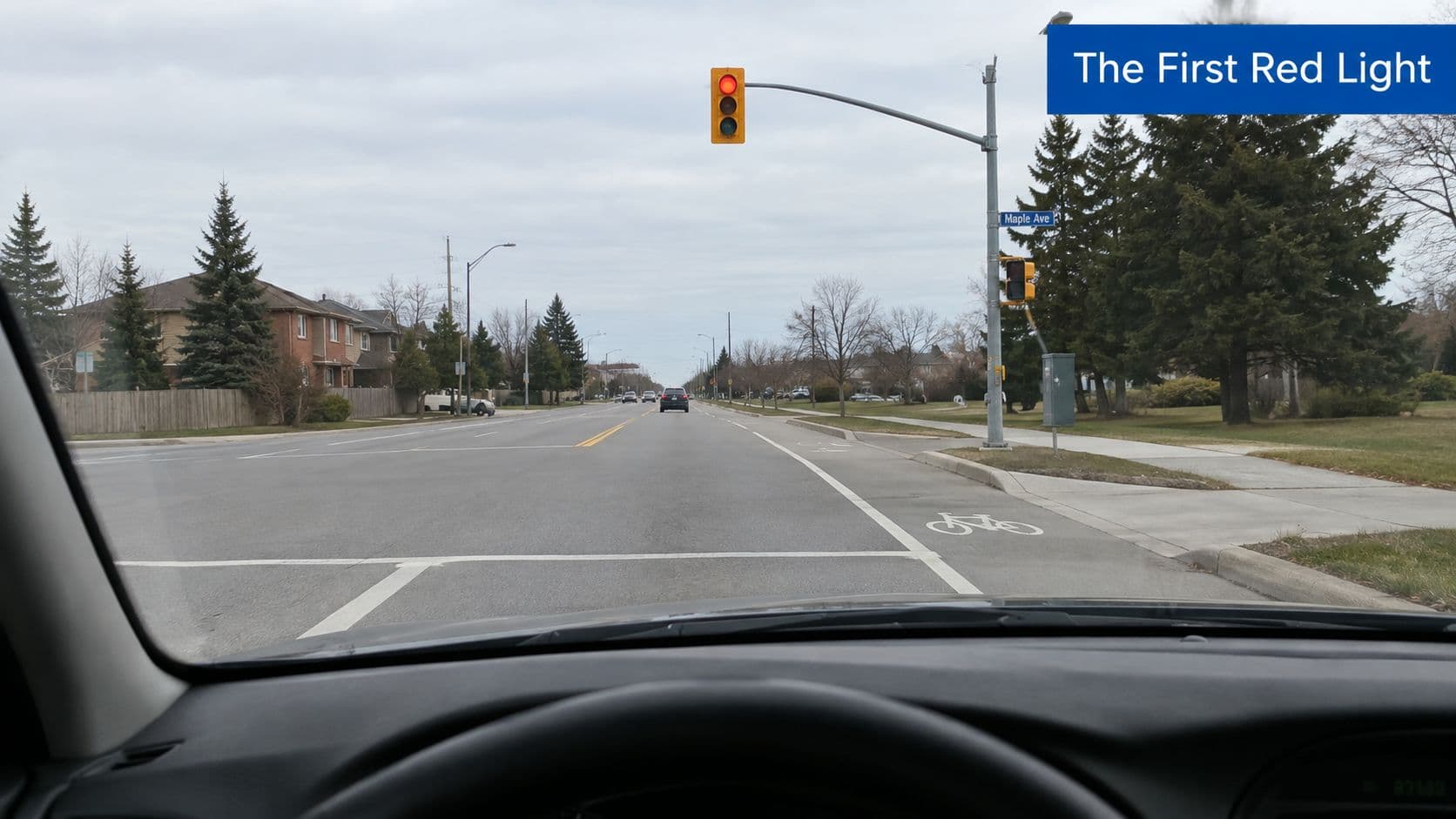
Treat the intersection like a shared doorway. A green light for the cross street, a cyclist in the adjacent lane, or a pedestrian entering the crossing gives someone else the right to pass through first. Your signal tells others what you intend, but it does not give you priority. Local signs and signal designs can also reserve the corner for waiting, even though Ontario's general rule permits right turns on red.
That makes this more than a driving-law question. It is also an intersection-level safety choice. Collision summaries from York Region report that 62% of pedestrian and cyclist collisions involve a turning vehicle, with right-turning vehicles accounting for 30% of pedestrian collisions and close to 50% of cyclist collisions. The Canadian Association of Road Safety Professionals summary also cites Toronto Public Health's finding that right turns on red were responsible for 13% of vehicle-pedestrian collisions in Toronto between 2008 and 2012.
Some municipalities are responding at specific high-conflict locations rather than applying one rule everywhere. Waterloo Region has been reported as moving towards no-right-on-red restrictions at 12 major intersections, according to regional reporting on the proposed restrictions.
At each corner, ask three things: is the turn allowed, have I completed every check, and does this intersection give me a good reason to wait? A patient pause is a legal driving choice, not a failure to act.
What Ontario's Right-on-Red Rule Actually Says
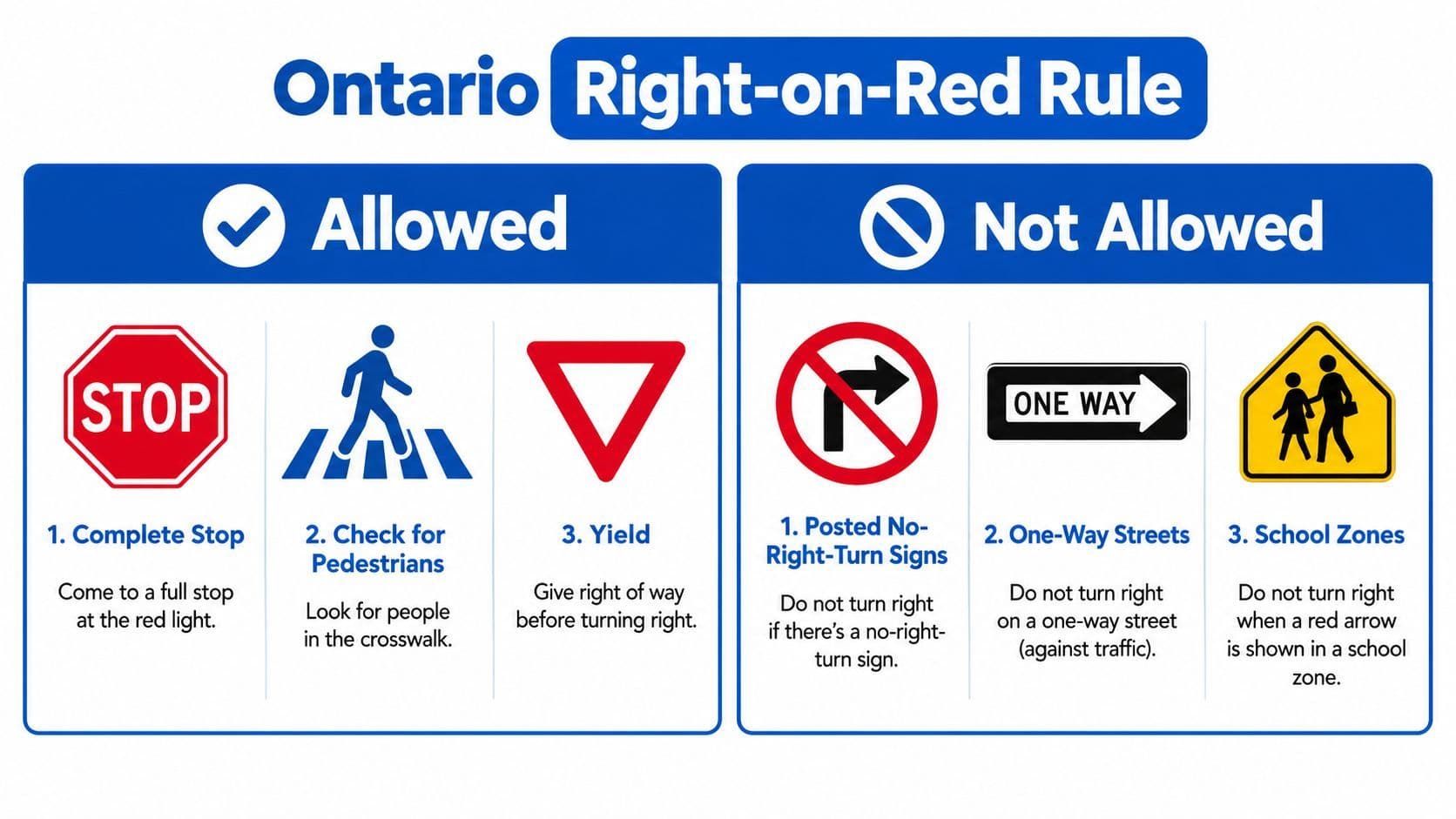
Ontario's basic rule is straightforward. Unless a sign prohibits the movement, a driver facing a red circular signal may turn right after making a complete stop, yielding to pedestrians and cross traffic, and confirming that the way is clear. The legal foundation is found in the Highway Traffic Act, including section 144(19), while the handbook turns that legal permission into practical driving behaviour.
The stop comes before the turn
A full stop means the vehicle's wheels stop moving. It isn't enough to slow down, glance left, and roll through the corner. Ontario's official traffic-light guidance sets out where to stop: at the stop line when one is marked, otherwise at the crosswalk, then at the edge of the sidewalk, and finally at the edge of the intersection if no sidewalk exists. Read the MTO traffic-light stopping guidance as a location rule, not merely a reminder to brake.
After stopping, you must yield. That includes a pedestrian crossing your path, a cyclist continuing through the intersection, and vehicles that have the right of way on the cross street. If someone is approaching the crossing and you can't confidently tell whether they'll enter your path, waiting is the proper choice.
Signs and arrows override the default
A No Right Turn on Red sign changes the answer at that location. It may apply at all times or during specified hours, so read the supplementary plate rather than assuming the sign is permanent or temporary. A red right-turn arrow also requires you to wait. You can't treat a red arrow like a red circular signal and use the general permission.
The rule applies across Ontario, but municipalities can use local signs and signal arrangements to respond to their own intersections. A downtown corner with heavy pedestrian movement may prohibit the turn, while a quieter suburban intersection may permit it. The Highway Traffic Act establishes the legal framework, and the handbook explains how a learner should carry it out safely.
Lane position matters too. Ontario law requires a driver turning right to approach in the right-hand lane when lanes are marked, or otherwise keep immediately to the left of the right curb or road edge. The turn should enter the right-hand lane of the intersecting road, or remain nearest the right curb where no lane is marked, as set out in the Ontario Highway Traffic Act turning provisions.
How to Make a Legal Right Turn on Red
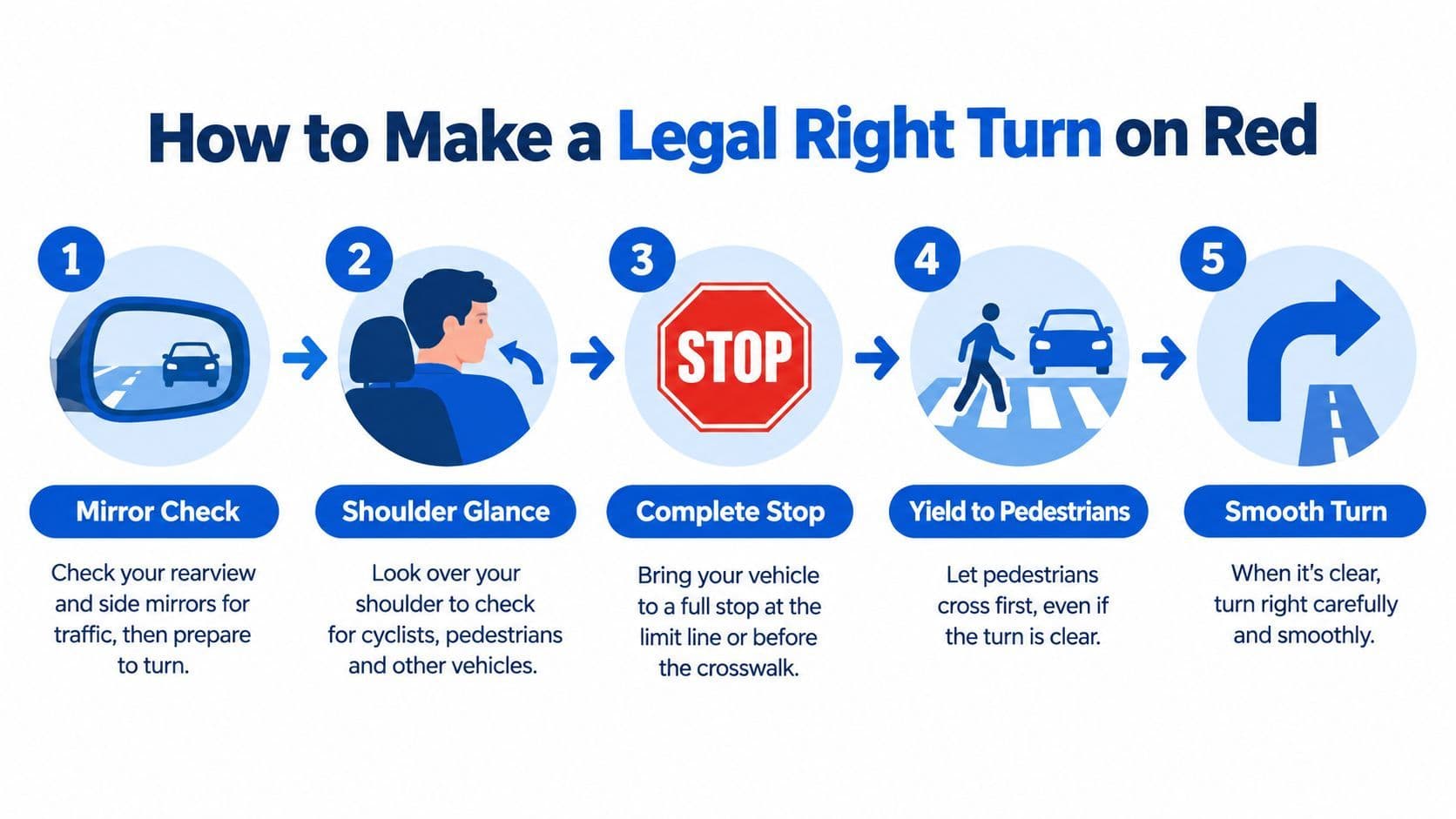
You are stopped at a red light, a car is waiting behind you, and the cross street seems empty. Treat that quiet moment as a safety decision, not an invitation to hurry. A legal right turn on red is a connected process: stop, observe, confirm, then turn. The same check also tells you when the intersection's design makes waiting the better choice.
Start before reaching the corner. Check the interior and right-side mirrors, then look over your right shoulder for a cyclist or another road user beside your vehicle. Signal your intention and move into the proper right-turn position where road markings allow it. Reduce speed smoothly so the stop feels controlled rather than rushed.
At the red signal, stop completely behind the stop line. If there is no stop line, stop before the crosswalk, sidewalk edge, or intersection edge, following the stopping locations described in the handbook. Keep the vehicle stopped while you assess the situation.
A driver behind you may be impatient, but that pressure does not change the rule. Scan again after stopping. A pedestrian may have approached the crossing, a cyclist may have entered the bike lane, or cross traffic may now be close enough to make the turn unsafe.
Practical rule: If you look left for a gap, deliberately look right again before turning.
The right-side check protects the road user most easily hidden by your vehicle. Ontario's handbook guidance on sharing the road highlights checking the right mirror and blind spot so you do not cut off a cyclist. A bike lane is a travel path, not spare pavement. It can remain occupied even when the through lanes appear clear.
If parked vehicles, buildings, or other traffic block your view, you may creep forward only after making the complete stop. Move gradually, keep the wheels straight, and avoid stopping across the crosswalk. Straight wheels help prevent a rear-end impact from pushing your vehicle into the path you are checking. Creep only to improve your sightline. Do not make pedestrians walk around your bumper.
Turn only after the crossing is clear and no sign or signal prohibits the movement. Release the brake, enter the right-hand lane smoothly, cancel the signal when appropriate, and match traffic speed without surging. If the scan leaves you uncertain, wait for green. The legal permission is optional, and an intersection may be safer when drivers choose not to use it.
Where Drivers Get Caught Out at the Intersection
Most mistakes happen when attention settles on one conflict and misses another. Right turns on red are therefore an intersection-level safety choice, not merely a permission to use whenever a gap appears. The same movement may work at a quiet corner and create too much conflict where cyclists, pedestrians, or turning vehicles meet.
The cyclist beside the turning car
A painted bike lane runs along the passenger side at a downtown Toronto intersection. The cross street looks open, so your attention stays left. At the same moment, a cyclist travelling straight reaches the corner. An instructor might say, “Hold the brake. Check the mirror, then make the shoulder glance.” The cyclist's path must remain clear before your turn begins.
The risk comes from searching for cross traffic while overlooking the road user beside your vehicle. A bike lane is a travel path, not spare pavement. The Ontario sharing-the-road rules explain why the right-side mirror and blind-spot check matter: they help prevent a turning vehicle from crossing a cyclist's path.
The pedestrian who has not crossed yet
A student steps toward the crossing at a Mississauga school zone while the light is still red. You have stopped, but the student's first pause does not mean the route is clear. Keep watching the near-side crosswalk, because a pedestrian can enter after your initial scan.
Stopping beyond the line creates a problem before the turn starts. Your bumper may occupy the pedestrian's route, leaving you to choose between backing up and continuing. A proper stop leaves the crossing open and gives you time to make one clear decision.
The blocked view at a suburban corner
A left-turning vehicle opposite you blocks the view of cross traffic at a Kitchener-area corner. The lane nearest you appears empty, but the obstruction means you do not have a usable sightline. Stay stopped until you can see the relevant approach, or wait for your signal.
Creeping has one narrow purpose: improving visibility after a complete stop. It does not make an unseen conflict disappear. If your bumper enters the crosswalk or you still cannot see the approaching traffic, the movement has gained no safety.
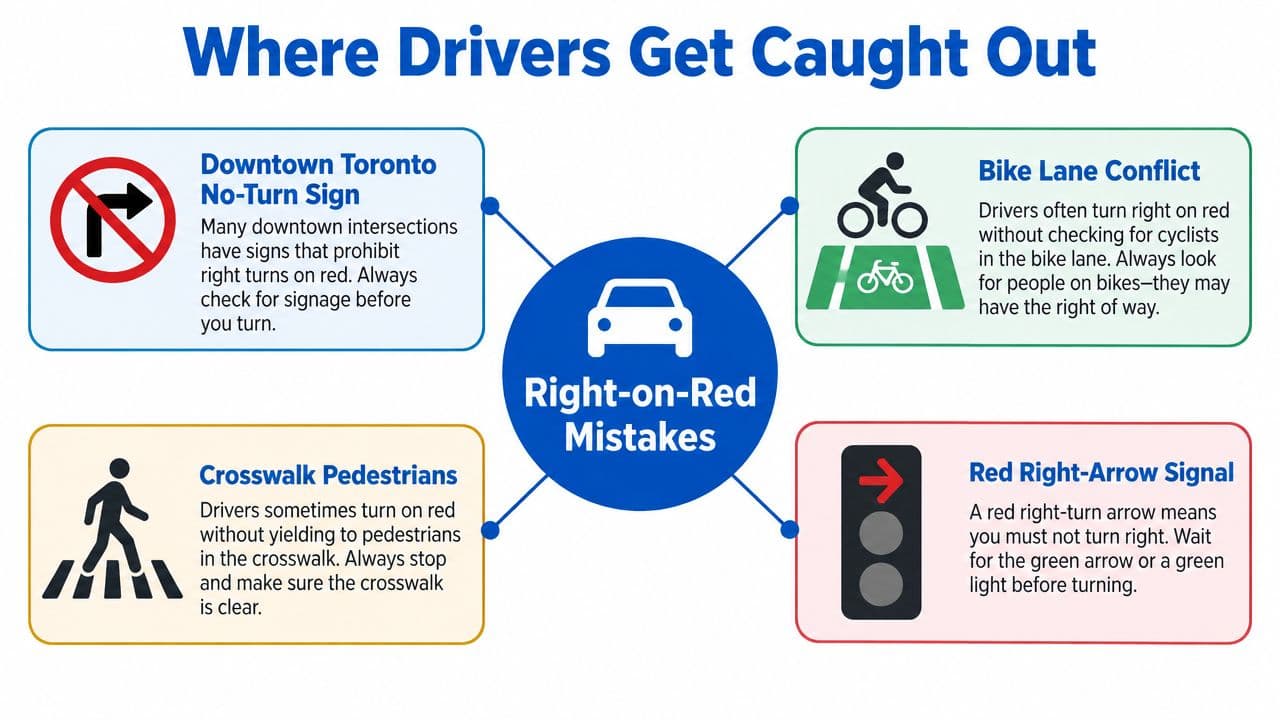
These patterns are predictable: looking left and missing the cyclist, stopping too far forward, or treating a blocked view as an open lane. The G1 right-of-way rules guide can help learners practise identifying each conflict before considering the turn. Ask, “Who might cross the path I am about to enter?” That question keeps the focus on people and movement, not just on whether the vehicle can fit.
When You Must Not Turn on Red
A red light may leave the right turn open, restricted, or ill-advised. Before moving, read the entire intersection. A No Right Turn on Red sign ends the usual permission, even if the road looks empty. A red right-turn arrow gives the same instruction through the signal itself. Wait until the sign no longer applies or the arrow changes.
Read the whole signal assembly
At a quiet suburban corner, a green signal may allow turning traffic to share space with pedestrians, cyclists, and vehicles moving through the intersection. At a busy downtown corner, a dedicated arrow, pedestrian signal, or posted ban may separate those movements. The first colour you notice is only one part of the instruction.
Municipal restrictions reflect the same safety reasoning. Ontario cities are increasingly examining no-right-on-red rules at intersections where turning vehicles and people crossing have repeated points of conflict. The decision is made for the whole corner, not for one driver's view of an apparently clear lane. A restriction can give pedestrians a simpler crossing phase and remove a movement that would otherwise compete for attention.
The signal may permit movement while the intersection remains occupied. If a vehicle blocks the lane you need, or a person is still crossing, stay stopped until the route is available. The Ontario pedestrian crossing rules explain why priority must be settled before a driver enters a crossing.
Condition What the Driver Sees Required Action Posted prohibition A No Right Turn on Red sign, possibly with an hours plate Stay stopped and wait for a permitted signal Red right-turn arrow A red arrow aimed to the right Do not turn until the arrow changes Pedestrian or cyclist conflict A person crossing or a cyclist travelling through the turn path Yield and remain stopped until the path is clear Blocked sightline Cross traffic hidden by a vehicle, queue, or roadside feature Wait, or creep only after a full stop when doing so improves visibility Clear, permitted movement No prohibiting sign, complete stop made, and the way is clear Turn only if you choose to do so safely
Ontario reporting has described enforcement for turning where a ban exists as including a $110 fine and two demerit points, according to The Globe and Mail's explanation of right-on-red restrictions. The penalty is only one reason to read the restriction correctly. A sign or signal changes the intersection's design and ends the default permission.
Right on red is a permission, not an obligation. Waiting for green is legal when the turn is prohibited, and sensible when the corner feels crowded or difficult to read. A patient driver follows the full signal assembly, not just the light facing forward.
Why This Matters on the G1 Exam and Beyond
The first time you face this question on the G1 test, the safest answer is rarely a simple “yes” or “no.” Right on red is permitted only after the required checks. You must stop fully, confirm that no sign or signal prohibits the turn, yield to pedestrians and other road users, and move only when the route is clear. On a road test, the examiner can see those decisions, not just hear that you know the rule.
A useful habit is to treat the turn as a small intersection-safety decision. The traffic light gives you a possible movement, while signs, sightlines, crossing people, cyclists, and the corner's layout determine whether that movement is sensible. The same York Region evidence shows the pattern is especially serious for cyclists, with close to half of those collisions involving a turning vehicle. That is why checking the blind spot and the full turn path deserves particular attention in both exam preparation and real driving.
Municipal policy reflects the same concern. Ontario keeps a general right-on-red permission, but cities can restrict it at intersections where turning vehicles and vulnerable road users repeatedly meet. A ban changes the corner's design by removing the need for drivers to judge whether a right turn can fit safely during the red phase. It also gives pedestrians and cyclists a clearer expectation of what a vehicle should do.
The rule is legal, but the design can change
A strong G1 answer includes the process, not only the permission:
- Check the sign: Look for a No Right Turn on Red sign and read any hours plate.
- Read the signal: A red right-turn arrow means wait until it changes.
- Stop properly: Stop at the stop line, or before the crosswalk, sidewalk edge, or intersection edge when required.
- Scan the whole corner: Check both sides for pedestrians, cyclists, and cross traffic.
- Protect the sightline: Keep out of the crosswalk and wait if a vehicle or other obstacle blocks your view.
- Choose patiently: You may wait for green, even when a turn is allowed.
For targeted practice, G1 traffic rules questions reinforce the conditional wording learners often miss. G1ready.ca provides free, registration-free practice exams, traffic-rule quizzes, explanations, hints, progress tracking, and a mobile-friendly Ontario G1 exam simulator. Visit G1ready.ca to practise right-on-red questions and build the scanning habits needed at real intersections.
Right on red remains a permission, not an obligation. The signal assembly, posted signs, and safety design at that particular corner decide what you should do.


