
A rolling stop is when a driver slows at a stop sign without bringing the vehicle to a complete, motionless halt, and Ontario law treats it as failing to stop entirely. The offence can carry an $85.00 set fine, or $120.00 in a community safety zone, along with 3 demerit points.
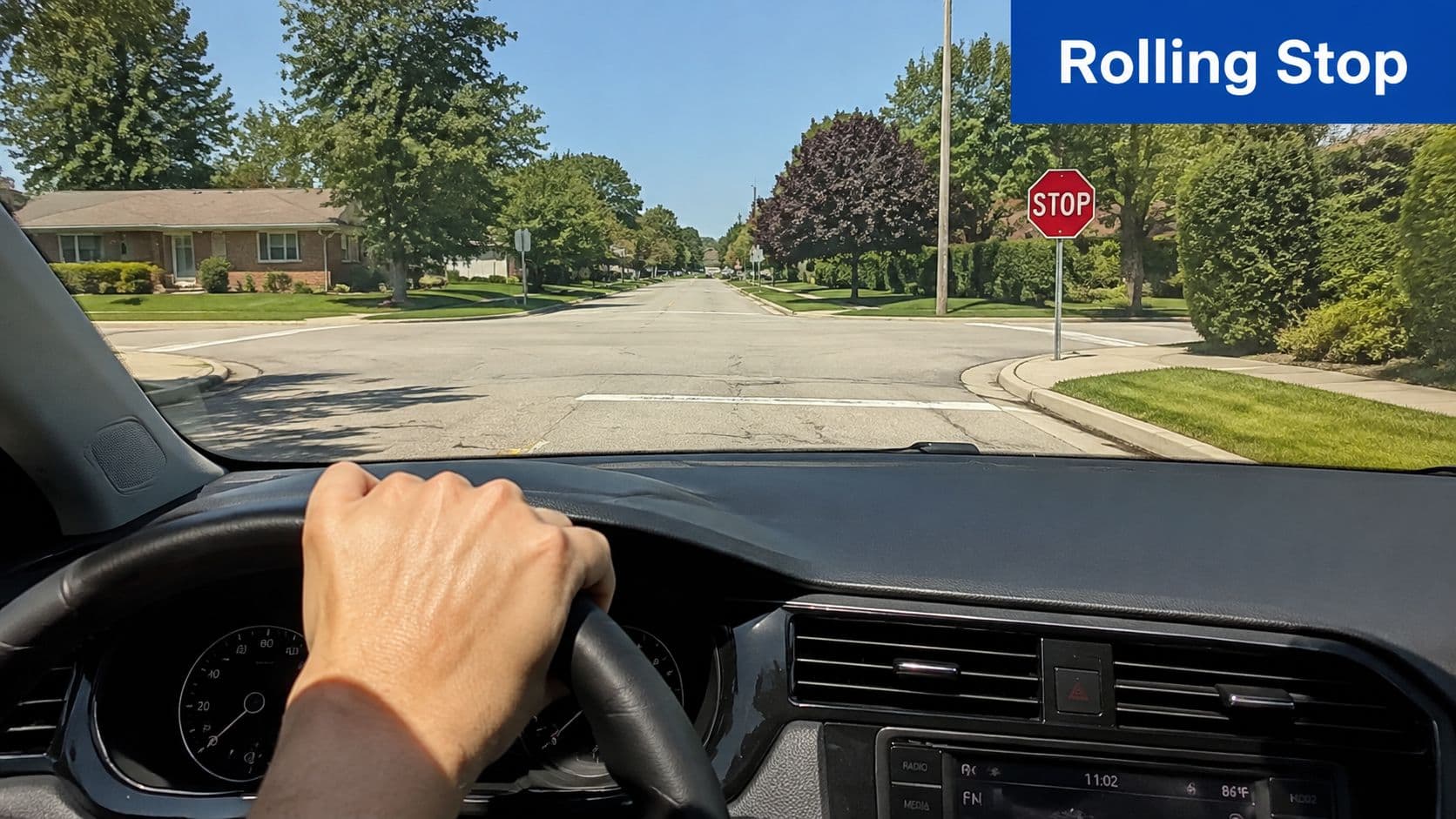
You may be sitting in this exact situation as a nervous G1 learner, approaching a quiet suburban intersection while your accompanying driver says, “It's clear.” You look left, look right, see no cars or pedestrians, and let the vehicle ease forward without ever fully settling. The car creeps through, perhaps at a walking pace, but the wheels never stop turning. That small movement is a rolling stop, not a legal stop.
The distinction matters on Ontario roads and during a road test. A stop sign requires a physical action, not a quick visual check. Your vehicle must become completely motionless at the correct stopping point before you observe the intersection and proceed. The Ontario Highway Traffic Act stop-sign guidance treats a roll-through as a failure to stop, even when the road appears empty.
The Moment You Roll Through a Stop Sign
You approach the sign slowly. Your foot is touching the brake, but you never press firmly enough to settle the vehicle. The speedometer hovers around 3 to 5 km/h, the front of the car dips slightly, and then the vehicle continues across the intersection. You've checked both directions, but the car hasn't reached zero.
From the driver's seat, that movement can feel like stopping. You might even remember the moment as a pause because the car slowed dramatically. An examiner or police officer sees something different, however. The vehicle continued moving, so the required stop never occurred.
Why an empty intersection doesn't change the rule
Ontario's rule doesn't ask whether traffic was light or whether you could see far down the road. It asks whether the driver stopped at the sign. A clear intersection may help you decide when to proceed, but it doesn't remove the obligation to stop first.
A rolling stop is therefore more than an informal driving habit. It means the driver decelerates but fails to bring the vehicle to a complete, motionless halt before entering. Ontario law treats that failure as disobeying the stop sign, not as a nearly correct manoeuvre.
Practical rule: If you can feel the car still creeping forward, you haven't completed the stop.
For a G1 learner, this is one of the most useful distinctions to practise early. Don't focus only on looking left and right. Build the habit of stopping the vehicle completely, then observing, then proceeding when it's safe.
How Ontario Law Defines a Proper Stop
Ontario's Highway Traffic Act sets the stopping requirement under section 136(1). A driver approaching a stop sign must stop at the marked stop line. If there isn't one, the driver must stop immediately before the nearest crosswalk, or, if there isn't a crosswalk, immediately before entering the intersection. The Ontario Ministry of Transportation handbook describes the same sequence for everyday driving and test preparation.
The law doesn't specify a minimum number of seconds that the vehicle must remain stopped. It does require a complete halt, which means the vehicle must stop moving before you proceed. A brief but genuine motionless pause satisfies the physical stopping requirement. A slow roll does not, even if it lasts long enough for you to scan the road.
Use the stopping points in the right order
Your position matters as much as your brake control. Stop:
- At the stop line, if one is painted on the road.
- Before the crosswalk, if there's no stop line.
- Before the sidewalk edge, where the handbook identifies that stopping point.
- Before entering the intersection, when none of the other markings or features are present.
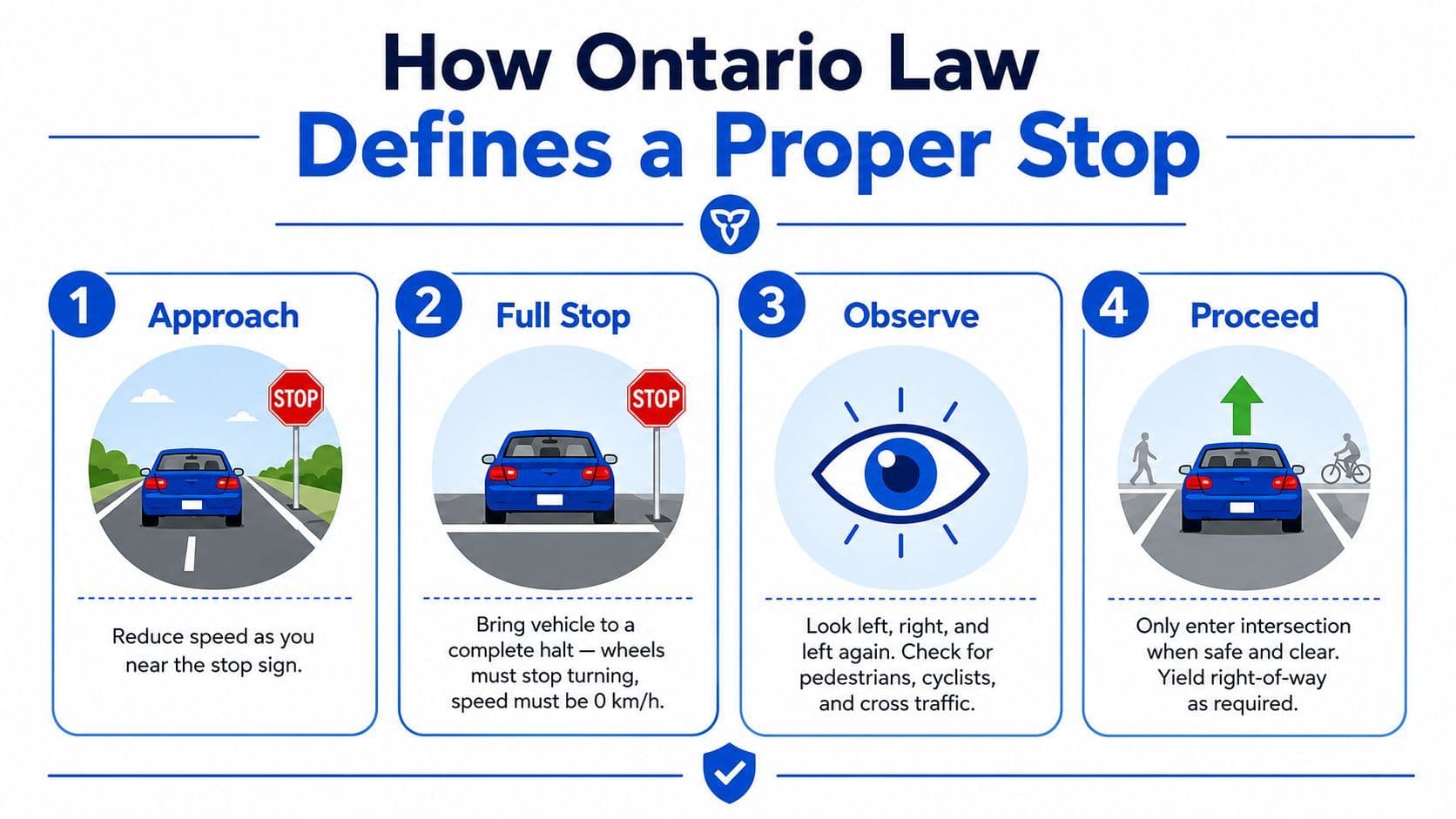
After stopping, wait until the way is clear before entering. Look for pedestrians, cyclists, vehicles, and other road users who may have the right of way. The Ontario G1 road rules guide can help you review how stop signs fit with other rules of the road.
Stop signs are regulatory signs, so they impose an obligation rather than offering a suggestion. The requirement applies in a quiet residential area, at night, in light traffic, and whenever the intersection appears empty. The law makes no separate category for a “careful” roll. If the wheels never stop, the driver hasn't made the required stop.
Rolling Stop vs Complete Stop Explained
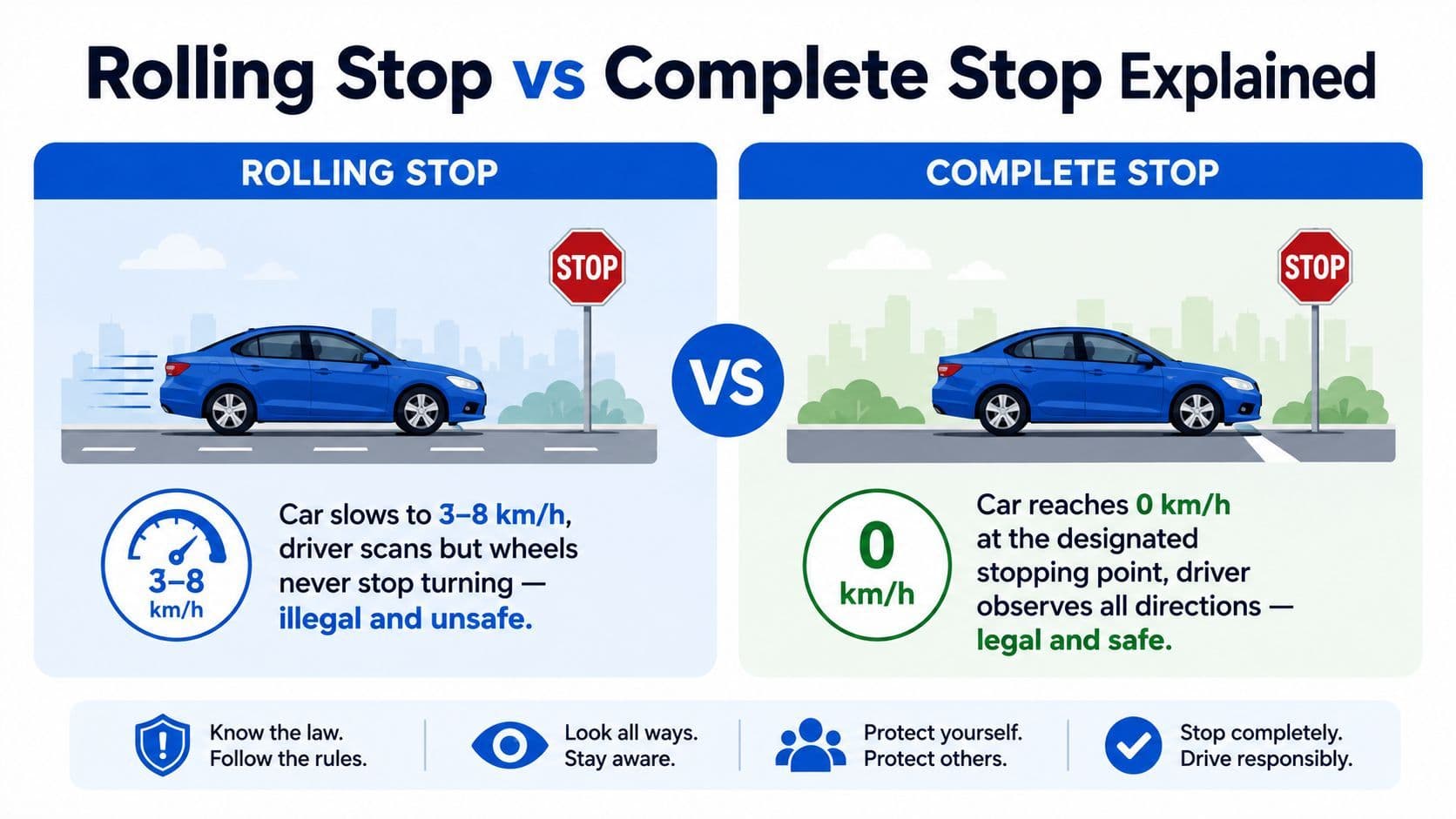
The easiest way to tell the two manoeuvres apart is to focus on motion rather than intention. During a rolling stop, the vehicle slows to roughly 3 to 8 km/h, the driver looks around, and the car continues forward without reaching zero. During a complete stop, momentum ends, the vehicle is stationary, and the driver pauses before moving again.
A rolling stop often feels smooth because the driver maintains light brake pressure. The suspension may dip, but the car keeps creeping. A complete stop feels different. You'll feel the vehicle settle after braking, and the speedometer will read 0 km/h while you hold the car in place.
Driving detail Rolling stop Complete stop Wheel movement Wheels continue turning Wheels stop completely Brake control Light pressure slows the vehicle Firm, controlled pressure brings it to rest Speedometer Shows low speed Reads 0 km/h Driver action Scans while still moving Stops, observes, then proceeds Legal standing in Ontario Treated as failing to stop Meets the stop-sign requirement when done at the correct point
The difference can seem minor from inside the vehicle, especially when no one else is nearby. It's much easier to recognise from outside, where continued wheel movement and forward travel are visible. That's why relying on how the manoeuvre feels can mislead a learner.
A complete stop also gives you a stable moment to assess the intersection. You can confirm the correct stopping location, look for people crossing, and determine whether another driver has priority. The pause isn't about performing for an examiner. It creates a clear break between stopping and entering.
Fines and Penalties for Stop Sign Violations
You are waiting at a stop sign during your G1 road test. The car slows, the wheels keep turning, and you continue through the intersection. Even if the road looks empty, the examiner can mark that as failing to stop. Ontario treats a rolling stop as a traffic-control violation, not as a harmless shortcut.
Ontario courts list a set fine of $85.00 for failing to obey a traffic-control stop sign and $120.00 in a community safety zone, as explained in this Ontario stop-sign penalty summary. A conviction can also result in 3 demerit points. See this guide to demerit points in Ontario for how the point system works. The conviction record may remain relevant for years.
Ontario Courts data recorded 167 charges for “Disobey stop sign, fail to stop” in 2016 and 273 charges in 2017. These figures offer a historical snapshot of court activity for this offence. They do not show that every rolling stop reaches court, but they do show that failing to stop is an enforcement matter, not merely a handbook rule.
Violation Type Fine Range Demerit Points Insurance Impact Failing to obey a traffic-control stop sign $85.00 set fine 3 A conviction may affect your insurance record Failing to obey a stop sign in a community safety zone $120.00 set fine 3 A conviction may affect your insurance record
Read the “fine range” column carefully. The listed Ontario court schedules identify set fines for these circumstances. They do not justify a broad range or a promised insurance increase. Informal figures may give a misleading impression of the outcome.
For a G1 learner, the test-day consequence is immediate. A rolling stop shows the examiner that you have not followed a core traffic-control instruction. The examiner must see a complete halt, correct positioning, observation, and safe entry. Treat each stop sign like a required checkpoint: bring the vehicle fully to rest, then continue only after you have assessed the intersection.
How to Make a Legal Stop Every Time
A reliable stop follows the same sequence whether you're alone on a residential street or waiting at a busy multi-way intersection. Practise the sequence until your hands, feet, and eyes perform it without rushing.
Approach with control
Begin reducing speed before you reach the sign. Scan for the stop line and identify whether a crosswalk or sidewalk affects your stopping position. If you're turning, signal early enough to communicate your intention, but don't let the signal distract you from the stopping requirement.
Brake to the correct point
Apply steady pressure rather than braking sharply at the last moment. Stop behind the line, before the crosswalk, or at the appropriate point before the intersection when no markings exist. You must bring the vehicle to a complete cessation of movement, not merely reduce it to a crawl.
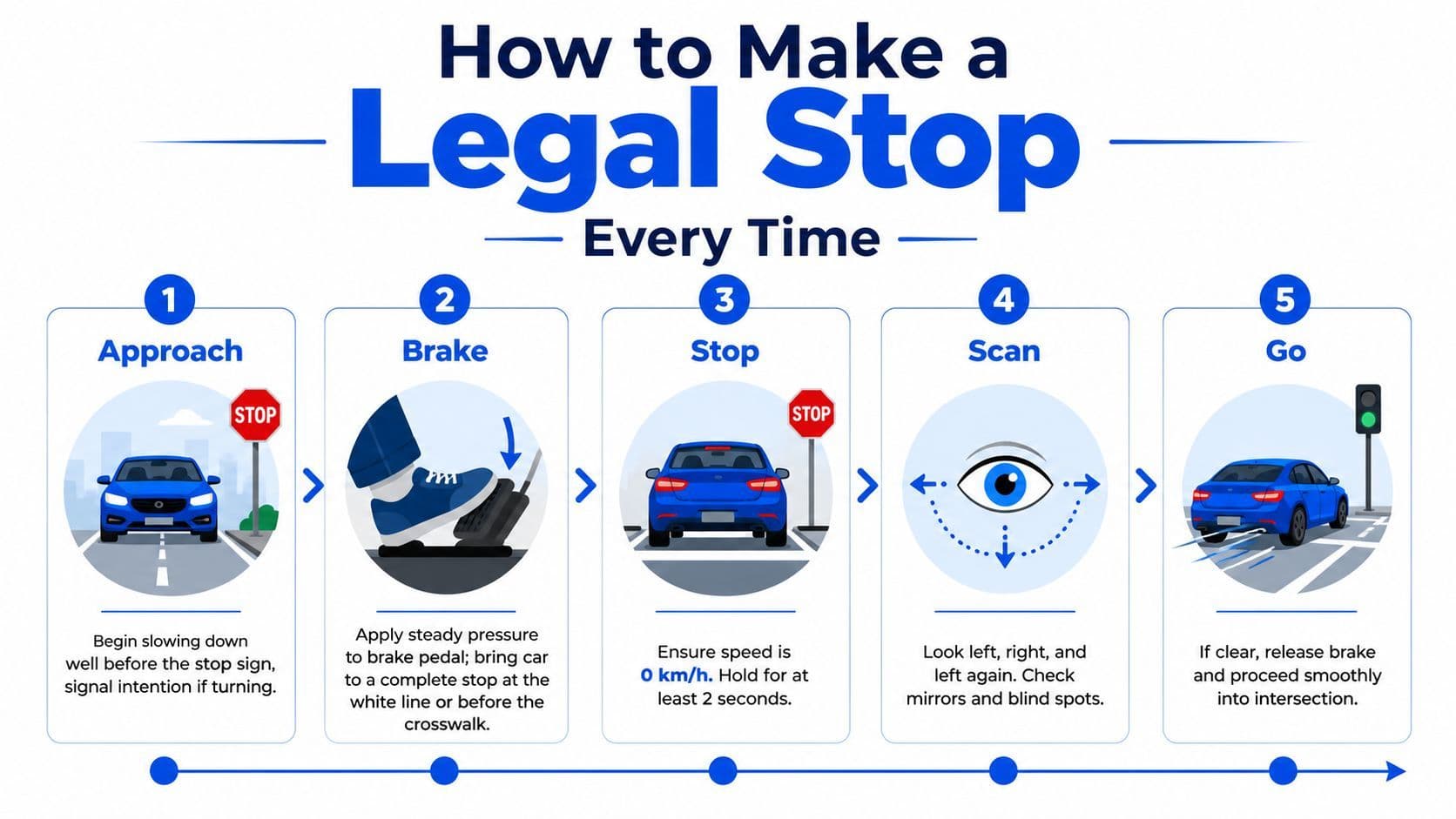
Stop, scan, and proceed
Once the car is motionless, keep it stopped while you observe. The MTO handbook says to wait until the way is clear before entering. A deliberate pause gives you time to look left, right, and left again, check for pedestrians and cyclists, and assess cross traffic.
The law doesn't prescribe a minimum stop time, so don't treat a particular count as a legal magic number. A two- or three-second pause can be a useful practice technique because it makes creeping less likely and gives you time to observe. The important point is that the vehicle must be stationary during the pause.
Use these techniques to develop consistency:
- Count only after stopping: Say “one, two” or “one, two, three” once the vehicle has reached zero, not while it's still moving.
- Choose a reference point: Learn where the stop line appears through the windshield so you can stop behind it without crossing forward.
- Handle poor visibility patiently: Stop at the correct point first, then use the available sightline carefully. Don't move ahead because you want a better view.
- Treat multi-way stops deliberately: Make the complete stop, observe other vehicles and pedestrians, and proceed only when you have the right of way.
- Stay alert near railway crossings: A stop sign near a crossing still requires a full stop at the applicable stopping point. Watch for the separate hazards around the tracks before continuing.
The Ontario G1 driving practice guide can support supervised practice planning. Ask your licensed accompanying driver to watch the wheels and stopping position, not just whether you looked both ways.
Common Myths About Rolling Stops
“No one is around” is not an exception. The stop sign still controls your movement when the road is empty, and a learner can't replace the required stop with a personal judgement that the intersection looks safe.
“A slow crawl counts” is another common misunderstanding. Slowing down and stopping are different physical actions. If the vehicle keeps moving, it hasn't met Ontario's complete-stop requirement.
Why familiar habits cause trouble
Many new drivers learn by observing people around them. If an experienced driver rolls through quiet intersections, the behaviour can look normal, especially when nothing goes wrong. Familiarity doesn't make it legal, and a G1 learner is being assessed on the rule itself rather than on the habits of surrounding drivers.
“Police don't ticket rolling stops” is also unsafe thinking. The recurring stop-sign charges in Ontario court activity show that failing to stop is an enforcement issue. A driver shouldn't assume that a quiet street, low visibility, or a short roll will be ignored.
Safety isn't based only on what you can see
A clear view may not reveal a cyclist, pedestrian, child, or vehicle approaching from a blocked angle. Stopping first creates time to examine the intersection from a stationary position. The few moments involved aren't a meaningful reason to trade away control or legal compliance.
A stop sign isn't asking whether you feel safe enough to continue. It requires you to stop, then decide whether continuing is safe.
On a G1 road test, inconsistent behaviour can expose the same misconception. The examiner can't award credit for a roll just because the intersection was empty. Build the correct habit in every setting so your decision doesn't depend on traffic volume or confidence.
Building Stop Sign Habits That Pass the G1 Test
A complete stop becomes easier when you practise it as a repeatable routine instead of treating every sign as a new decision. Reduce speed, locate the correct stopping point, bring the vehicle to zero, observe in all directions, and proceed only when the intersection is clear and you have the right of way.
Practise with a licensed driver at quiet residential intersections first. Ask them to call out whether you stopped before the line, whether the car stayed motionless, and whether you waited long enough to check the full intersection. Counting aloud after the vehicle stops can help you separate the observation pause from the approach.
Keep these reminders in mind:
- Rolling means moving: Any continued creep means you haven't completed the stop.
- Position matters: Stop at the line, then the crosswalk, then the sidewalk edge, or before entering the intersection when no earlier point exists.
- Observation comes second: Look for pedestrians, cyclists, and cross traffic after the car is stationary.
- Consistency builds confidence: Use the same sequence at quiet, busy, familiar, and unfamiliar intersections.
Your preparation should include both written rules and practical habits. G1ready.ca provides free, registration-free Ontario G1 practice exams, targeted quizzes, mixed tests, a diagnostic test, and an exam simulator, with immediate explanations for questions about traffic regulations and right of way. Visit G1ready.ca to practise stop-sign rules, review mistakes, and build a steady study routine before test day.


