A slip road sign marks the exit or entrance ramp that joins a freeway to the crossing road, tells you which lane to use, and shows what control waits at the end. In Ontario, an exit runs through three stages, a deceleration lane, an exit ramp and a terminal intersection where a stop sign, yield sign or traffic light decides who goes, and each stage asks something different of you.
You're in the right lane of a busy Ontario freeway, the exit you want is coming up, and a green panel with two arrows slides past your window before you've finished reading it. The driver behind is close. The gap you were aiming for closes. That half-second of panic is where most slip road confusion starts, and nearly all of it comes from treating the sign as one object instead of the first move in a sequence. Learn the sequence and the sign stops being a blur you react to.
What a Slip Road Sign Tells You on an Ontario Freeway
Think of the sign as the departure board at an airport. It tells you which gate to head for long before you walk there, so you aren't sprinting down a corridor with a bag bouncing off your knee. On a freeway, the sign does the same job at the same remove: it points to the ramp connecting the freeway to the crossing road, and it tells you which lane leads there while there's still room to move.
Ontario treats a freeway exit as an ordered system rather than a single instant. The Ontario Ministry of Transportation's driver's handbook sets out an exit as a deceleration lane, an exit ramp, and a terminal intersection controlled by a stop sign, yield sign or traffic light. Three parts, three jobs, three actions.
The three parts in the order you drive them
The deceleration lane is the lane that lets you leave the main flow of high-speed traffic before you drop speed. The handbook's instruction is precise: signal before moving into it, but don't slow down while you're still in the freeway's through lane. Once you're established in the lane, ease off gradually toward the ramp's posted speed.
The exit ramp is the curved road that carries you away from the freeway. It's where the posted ramp speed applies so you can hold the curve under control.
The terminal intersection sits at the end of the ramp. Whatever control is there, a stop sign, a yield sign or a traffic light, is what governs your next move.
Component What It Is Driver Action Deceleration lane Lane that lets you leave high-speed traffic before slowing Signal early, then ease off gradually once in the lane Exit ramp Curved road that leads off the freeway Reduce speed to the ramp's posted speed Terminal intersection Junction at the end of the ramp, controlled by a stop sign, yield sign or traffic light Stop, yield or proceed as the control requires
Why the order matters more than the sign itself
Advance exit signs are positioned far enough ahead to permit safe lane changes, so the sign is a lane-selection tool first and a direction marker second. That's the whole reason it appears early. It isn't decoration on the roadside, it's the point where you're meant to commit to a lane.
And if the exit goes past you anyway? The handbook's answer is blunt. Continue to the next exit. Don't stop, don't reverse, don't attempt a last-second manoeuvre on the freeway.
Before you read on: name the three parts out loud, and say what you do in each. If you can do that from memory, you already understand more about slip roads than most learners do on test day.
Reading Lane Arrows and Exit Panels
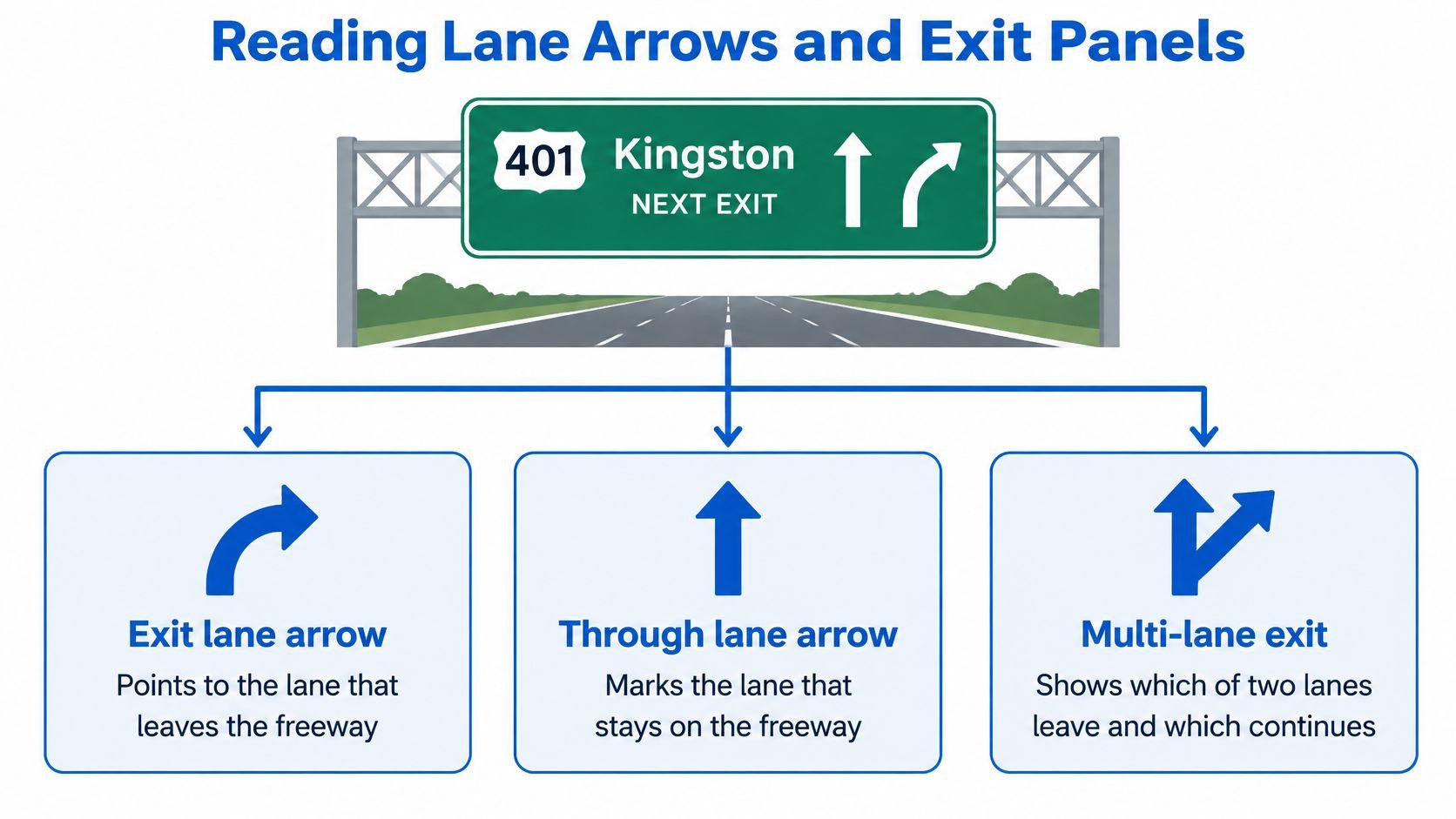
The signs arrive in a set order as you approach, and each one refines the same decision. First an advance sign, then often a yellow panel, then ground-mounted signs at the physical split. The MTO's signs chapter explains why so many signs are needed: urban exit ramps can carry more than one lane, so signs have to show which lanes leave the freeway and which stay on it.
The marks have specific meanings. Advance signs use arrows to identify the exit lanes. Where one or more lanes leave the freeway, the arrows for those lanes sit inside a yellow box labelled "exit." Ontario also numbers freeway interchanges, and the number reflects distance from the beginning of the freeway, which makes it a position marker as much as a name.
A two-lane exit, read from the driver's seat
Say the advance sign shows two lanes and a fork. The right arrow curves away under the word exit, the left arrow runs straight on. That's the freeway telling you, in one glance, that the right lane leaves and the left lane continues.
If you want the exit, you need to be in that right lane before the painted triangle appears where ramp and freeway separate. That triangle is the gore, and it's the point of no return for lane choice. Crossing it late means either an abrupt swerve or a missed exit, and the second is much safer than the first.
Sign Element What It Shows Driver Action Advance exit sign Arrows for the lanes that leave the freeway, placed well ahead of the exit Move into the correct lane before the exit area Yellow exit panel Arrows for lanes that leave the freeway, labelled exit Confirm your lane is one of the arrowed exit lanes Ground-mounted exit sign Repeats the exit arrows at the physical split Confirm your lane once more as you reach the split Interchange number Distance from the beginning of the freeway Use it to track your position and anticipate the exit
The lane rule that follows from all of this is short enough to memorise in one pass.
Lane rule: choose your lane before you reach the ramp area, never after you enter it. If you missed your lane, take the next exit.
Exit Ramp Steps and the Errors That Derail Them
The risk at a slip road junction comes from converging paths and the short window you get to work out whether traffic is entering, leaving or crossing the main route. Treat the ramp as a staged sequence: read, position, slow, curve, obey. Each stage prevents a different error, and skipping one pushes the problem into the next stage with less room to fix it.
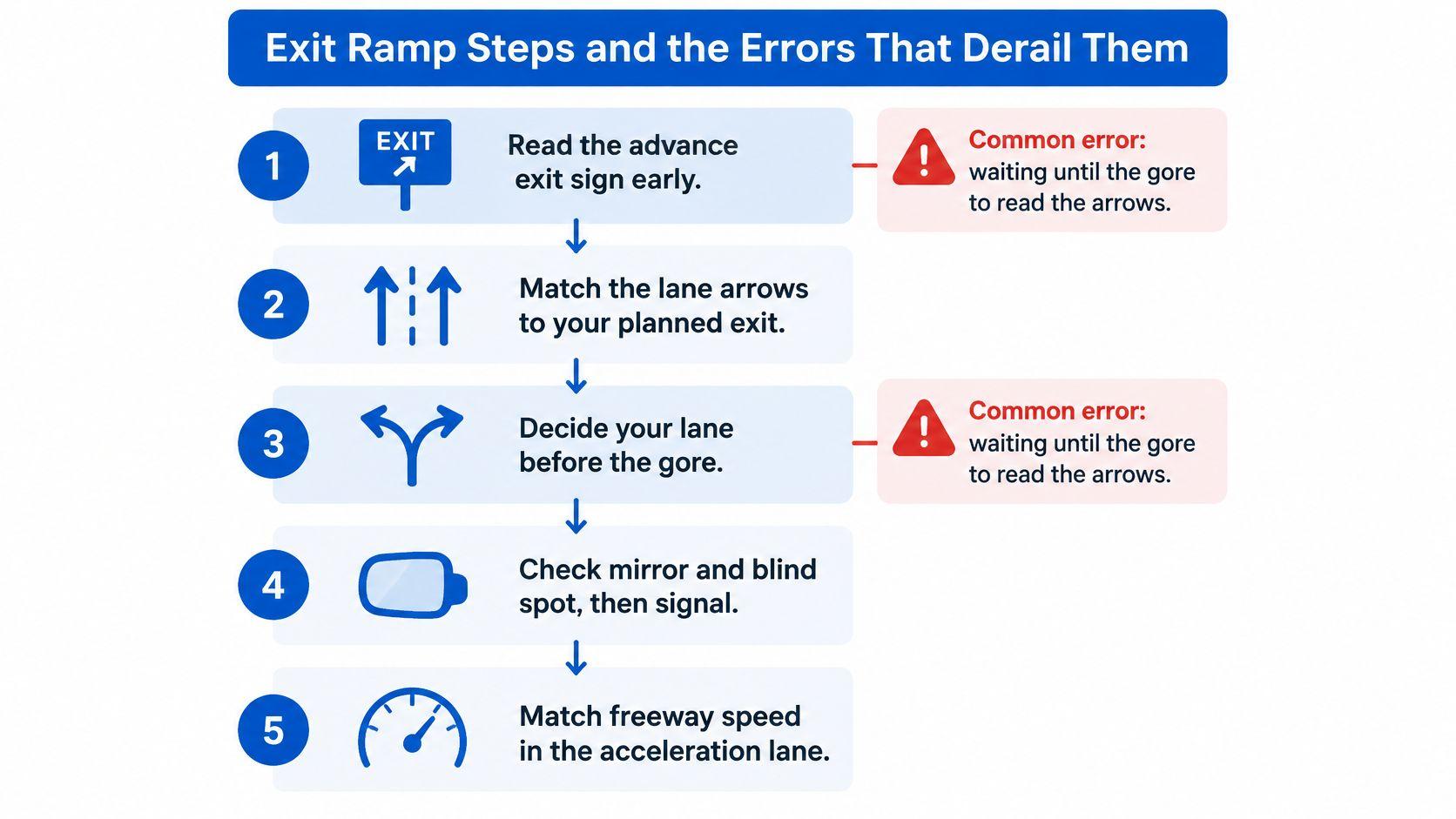
Steps and the Errors That Derail Them
- Read the advance exit sign early. The common error is waiting until the gore to read the arrows, when reading time has run out and lane changes cost you a swerve. At freeway speed you cover a lot of ground between glances, which is exactly why the sign is placed where it is.
- Signal before the move, then take the deceleration lane as one committed action. Drivers behind read your lights, not your intentions. A signal given before the move gives the following car time to adjust; a signal flashed while you cross the line is a surprise.
- Check the mirror and blind spot, then leave the through lane without braking hard in it. As general driving practice, keep your speed steady until the car is fully in the deceleration lane. Slowing while you are still surrounded by through traffic can make the driver behind brake or swerve, and braking before signalling turns a routine exit into a rear-end risk.
- Once in the deceleration lane, ease off gradually toward the ramp's posted speed. Gradual is the whole point. The MTO truck handbook's signs chapter notes that ramp signs can show a maximum safe speed and warns that wet pavement is slippery. Treat that number as a maximum in good conditions, never a target to chase: slow further for rain, snow, spray, a tight curve or congestion.
- At the terminal intersection, identify the control and obey it. Stop, yield or proceed, whichever the sign or signal requires. Assuming the ramp gives you priority over the crossing road is the error that ends in a collision you'd be found at fault for.
Why the sequence matters more than any single sign
Ontario's handbook requires drivers approaching intersections to look carefully for pedestrians, cyclists, motor vehicles, yield signs, stop signs and traffic lights, and where a yield sign faces you, to slow or stop as needed and yield to traffic in the intersecting road. Applied to a ramp, that becomes: decelerate before the branch point, hold a lane position that keeps your sight distance, identify the control, then proceed only once the right-of-way condition is met, as set out in the MTO chapter on driving through intersections.
That order reduces the chance of a late brake application or an abrupt lane change, particularly where the branch road is hidden by curvature, parked vehicles, vegetation, darkness or winter spray. A warning sign and a legal control do different jobs: the first tells you what the road may do, the second tells you what you must do.
On a busy multi-lane freeway, the calm version looks uneventful. You read the arrows early, signal once, move into a clear gap, then do the slowing where the road gives you space to slow.
What a smooth exit looks like
It works like stepping off a moving walkway: match the flow before you step aside, then lose speed in the space meant for slowing. The car leaves through traffic without sudden braking and without a late lane change. Speed drops on the ramp, not before it and not in a rush. If you could watch your own exit in a mirror, that's the shape you're aiming for.
Stop, Yield or Proceed at the End of the Ramp
The misunderstanding to clear up first: being on an exit ramp does not give you priority over traffic on the intersecting road. The ramp is just the road you're on. The control at its end is what you obey.
Control at Ramp End Required Driver Action Legal Basis Stop sign Stop, then proceed only when it is safe Obey signs erected under the Highway Traffic Act Yield sign Slow to a reasonable speed, stop if necessary, and yield to traffic in the intersection or approaching closely Highway Traffic Act yield obligation Traffic light Obey the signal and yield where the signal or the rules require it Obey signs and signals under the Highway Traffic Act
Ontario law requires drivers to obey the instructions shown on traffic signs erected under the Highway Traffic Act, and the Act's yield rule spells out what a yield demands. You approach at a speed reasonable for conditions, stop if necessary, and yield to traffic in the intersection or approaching so closely that it creates an immediate hazard. Once you've yielded, you proceed with caution.
Put plainly: a yield sign isn't a stop sign and it isn't a go sign. It's a judgement call made at the line.
Practical rule: the sign at the end decides which action applies, and the traffic decides whether you can safely take it. Two different questions, answered in that order.
A warning sign or a ramp speed sign advises you. The sign at the terminal intersection instructs you, and that one is enforceable. Keep the two separate and exam questions about slips roads stop being tricky.
Say a yield sign sits at the end of your ramp and a car is coming along the crossing road. You slow, watch the approaching car, and wait. You don't inch forward hoping it turns off. You wait until the hazard isn't there, then go. If you want the right-of-way rules around yield controlled junctions spelled out further, this guide on yield signs in Ontario walks through where drivers get them wrong.
Merging Onto the Freeway From an Entrance Ramp
A freeway entrance usually has two parts, the entrance ramp and the acceleration lane, and the MTO's freeway driving chapter describes both in just that way. The ramp is where you plan the merge. It is not where you stop and wait for a gap to appear.
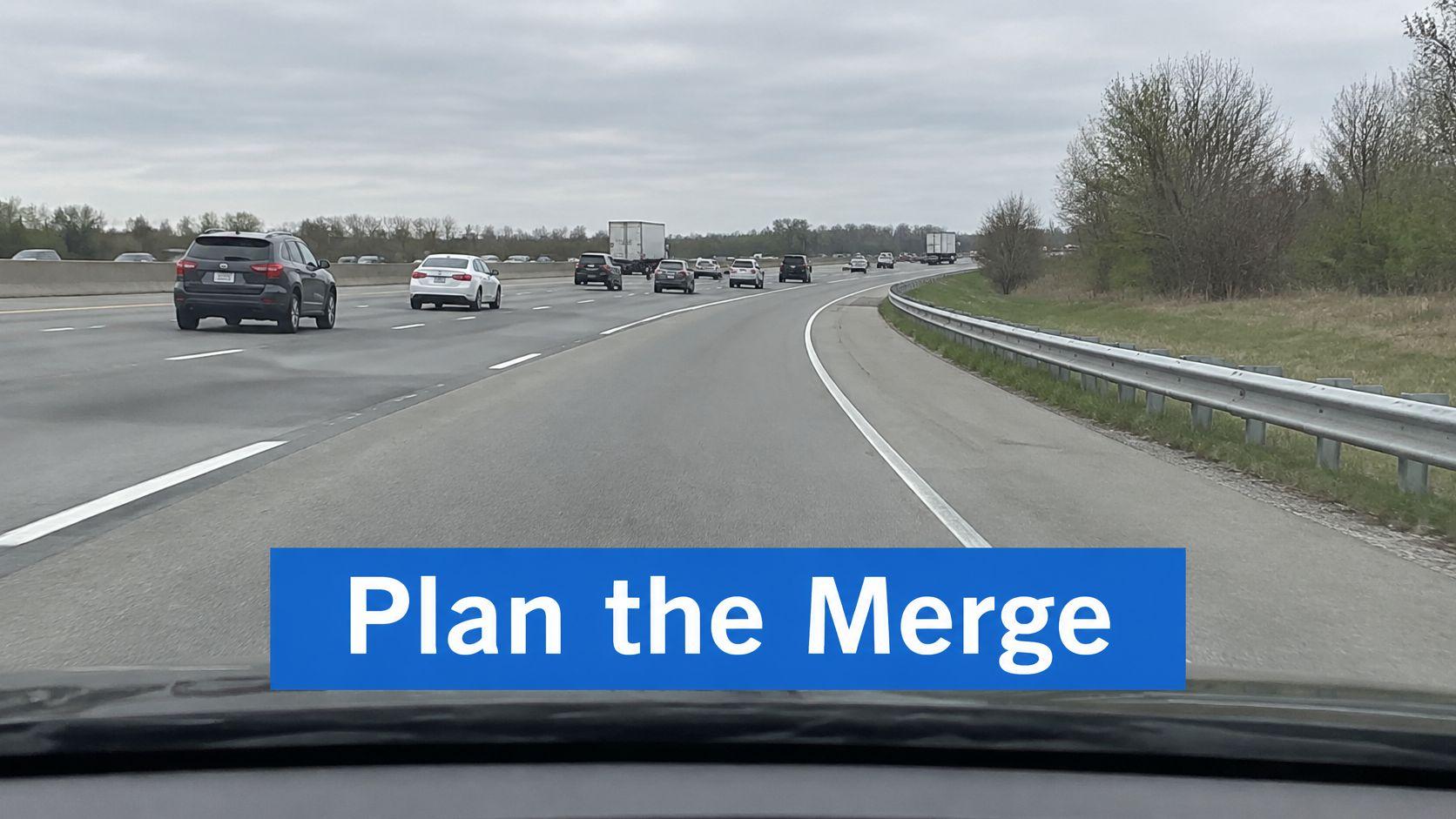
Look ahead, check your mirrors, check the blind spot, and pick the nearest freeway lane where a safe gap is opening. Build speed while you're still on the ramp, and use the acceleration lane to finish the merge. Match the traffic you're joining rather than arriving at it.
The yield duty applies. Vehicles already on the freeway have the right of way, so you fit into their gap instead of expecting them to make one for you.
Here's the sequence in motion, from the ramp through to the lane:
Say you're on a short ramp and traffic is bunched in the nearest lane. You hold your speed, watch for a gap, and merge at matching speed. What you don't do is stop at the end of the ramp and wait, because a stopped car at the end of an acceleration lane is a hazard to everything behind it.
Two errors cause most merge collisions. Entering too slowly, which disrupts the traffic you're joining and leaves the car behind guessing. And changing lanes without a blind-spot check, which is how a car that was never in your mirror ends up beside your door. If you want the wider picture on lane discipline and following distance, this guide to driving on a highway covers the habits that make merges uneventful.
Practise Slip Road Signs Before Your G1 Test
Ontario's road signs material is grouped into regulatory signs, warning signs and guide signs, and exit and slip road signs sit in the guide signs group. That matters for study planning, because on a practice test they arrive mixed in with signs from the other groups rather than in a neat ramp-only set.
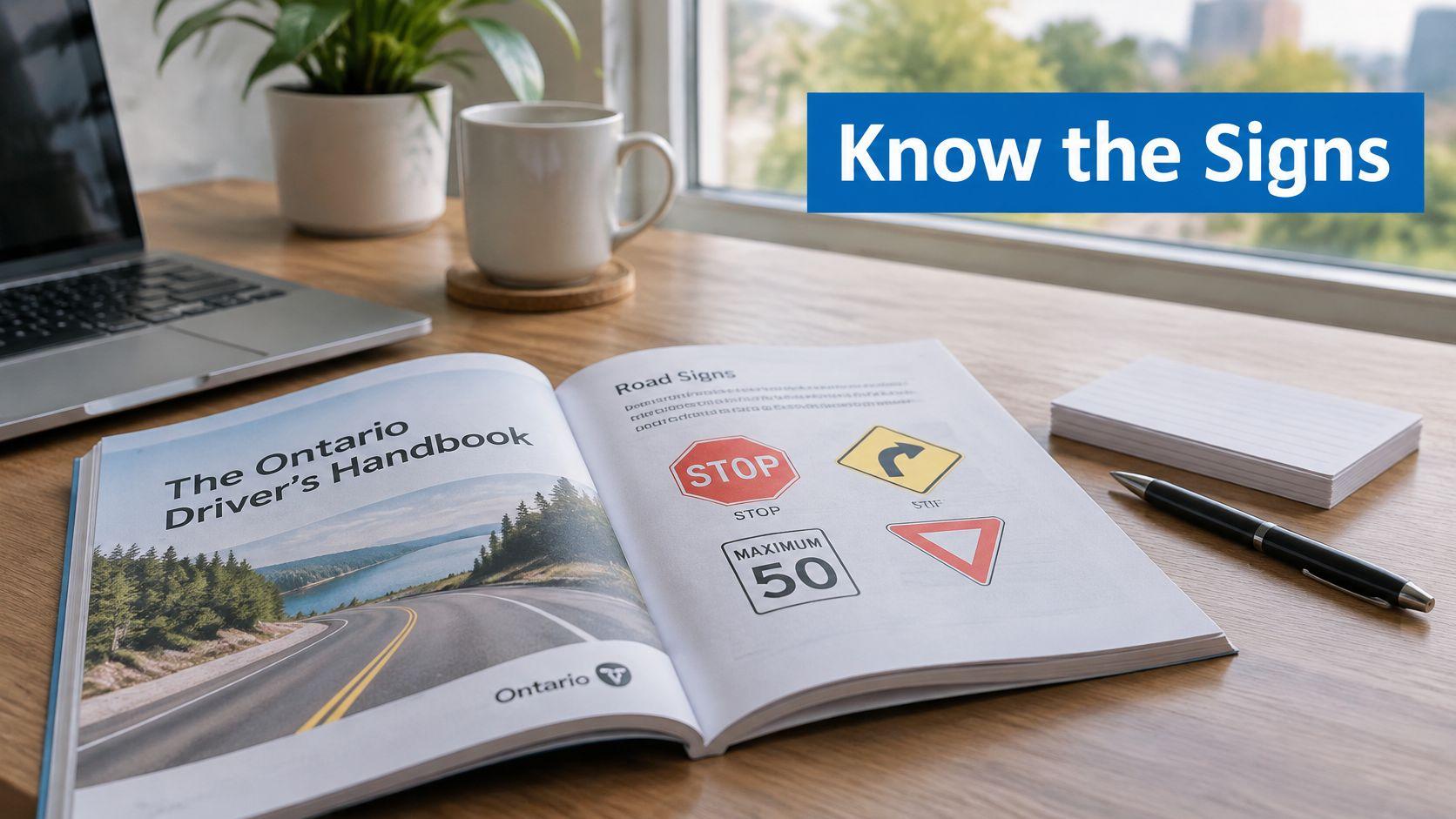
Work through it in this order.
- Take the road signs practice test first, purely to find out which signs you don't yet recognise. G1ready.ca runs the signs test and the road rules test as separate practice exams, so you can isolate the visual material.
- Review each missed sign by category, then reread the matching part of this article. A missed exit panel is a lane question. A missed yield sign is a right-of-way question. Treat them differently.
- Review the right-of-way and yield rules that apply at ramp ends, because sign recognition without the rule behind it fails the moment a question asks what you do next.
- Finish with a mixed test covering all chapters, so you practise under something close to test conditions rather than in a familiar sign-only set.
When you sit down to study, choose a test from the list of available tests, either one section of traffic regulations or a mixed test covering all chapters. Sign study materials that build visual recognition help here, and repetition is what turns a yellow exit panel into something you read without effort.
Before test day, be able to do three things without notes. Name the three parts of an exit. State the lane rule. And name the control that waits at the end of any slip road sign you see.
G1ready.ca keeps the signs and the rules in separate practice tests, so you can drill exit and ramp signs until the arrows and the yellow panel read themselves. Every answer comes back with immediate feedback and a plain explanation, which is what turns a wrong response into a rule you remember under pressure. Take the G1ready.ca road signs test before your next study session and find out which slip road signs you already recognise.