
You're approaching an Ontario intersection when the vehicle's indicator stops working. A cyclist is beside you, a motorcyclist is moving through the next lane, and traffic behind you needs to know whether you're turning, changing lanes, slowing, or stopping. That's when traffic rules hand signals become practical road communication, not just G1 memorization.
This guide shows the arm position, palm direction, timing, real Ontario use case, and G1 study takeaway for six important signals. Use this quick visual key: a straight arm communicates a lateral movement, a bent arm identifies a turn, and a downward arm warns of slowing or stopping. A stationary gesture holds one position, while a moving gesture draws attention to a change in speed.
Ontario's official handbook recognizes hand and arm signals as a backup when turn signals or brake lights aren't working. After learning the movements, you can practise traffic-regulation questions with G1ready.ca, including targeted quizzes and mixed practice.
1. Left Turn Hand Signal
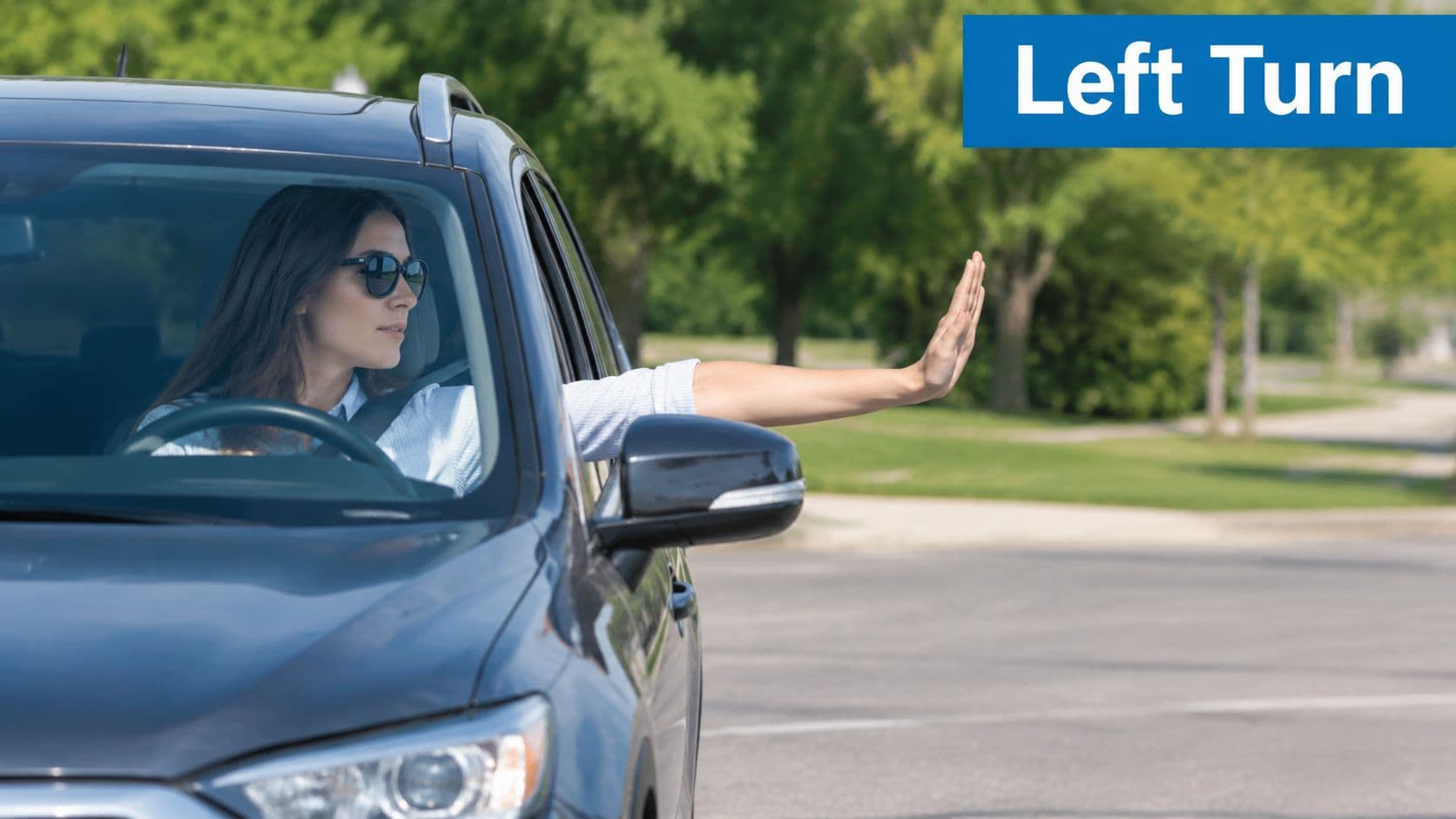
The left-turn signal uses the left arm extended straight out from the vehicle, with the arm held horizontally and the palm facing forward. The straight line matters. A bent elbow can change the meaning and make the gesture look like a right-turn signal.
In Ontario, the Highway Traffic Act allows a required signal to be given “by means of the hand and arm.” Section 142(4) identifies the recognized movements for left and right turns, while the official Ontario Driver's Handbook describes these as nationally recognized hand and arm signals. This makes the gesture relevant to drivers, cyclists, and motorcyclists sharing the road.
Make the movement unmistakable
Give the signal before you begin positioning for the turn, and keep watching the direction you intend to travel. Your arm should be fully extended and visible to people behind you. A driver on a rural Ontario road with a failed indicator might use this signal before turning into a side road, while a cyclist can use it at an intersection without electronic indicators.
The signal communicates intention, but it doesn't give you priority. You still need to observe traffic, check for pedestrians and cyclists, and turn only when the movement is safe.
G1 study takeaway: Straight left arm means left turn. Bent upward left arm means right turn, so learn the difference by looking at the elbow first.
For a focused review of positioning and road procedure, practise the Ontario left-turn rules guide. On the G1 test, concentrate on the gesture itself and the reason for using it, especially when a vehicle's mechanical signal isn't available.
2. Right Turn Hand Signal
A right turn is shown by extending the left arm outward and bending it upward at the elbow, forming an L-shape. The palm faces forward. The upper arm should project far enough from the vehicle to remain visible to following road users.
Ontario teaches the left-arm, bent-upward gesture as the standard hand signal for a right turn. Some cyclists may extend the right arm straight out instead, particularly when that position is more comfortable or visible, but G1 learners should recognize the conventional left-arm signal.
A cyclist approaching a busy Toronto intersection may use the gesture before moving across a lane to turn right. A motorcyclist can also use it when communicating with traffic behind them, while a driver with defective indicator lights can use the same arm position as a legal backup where it can be seen.
Don't confuse the elbow position
The most useful memory cue is simple: left arm straight means left turn, left arm bent upward means right turn. Hold the bent position until you've completed or begun the turn, while continuing to scan mirrors, the roadway, and the area beside the vehicle.
A signal doesn't replace a shoulder check or a yield. A pedestrian may be crossing, a cyclist may be beside the curb, or another vehicle may already be occupying the intended path.
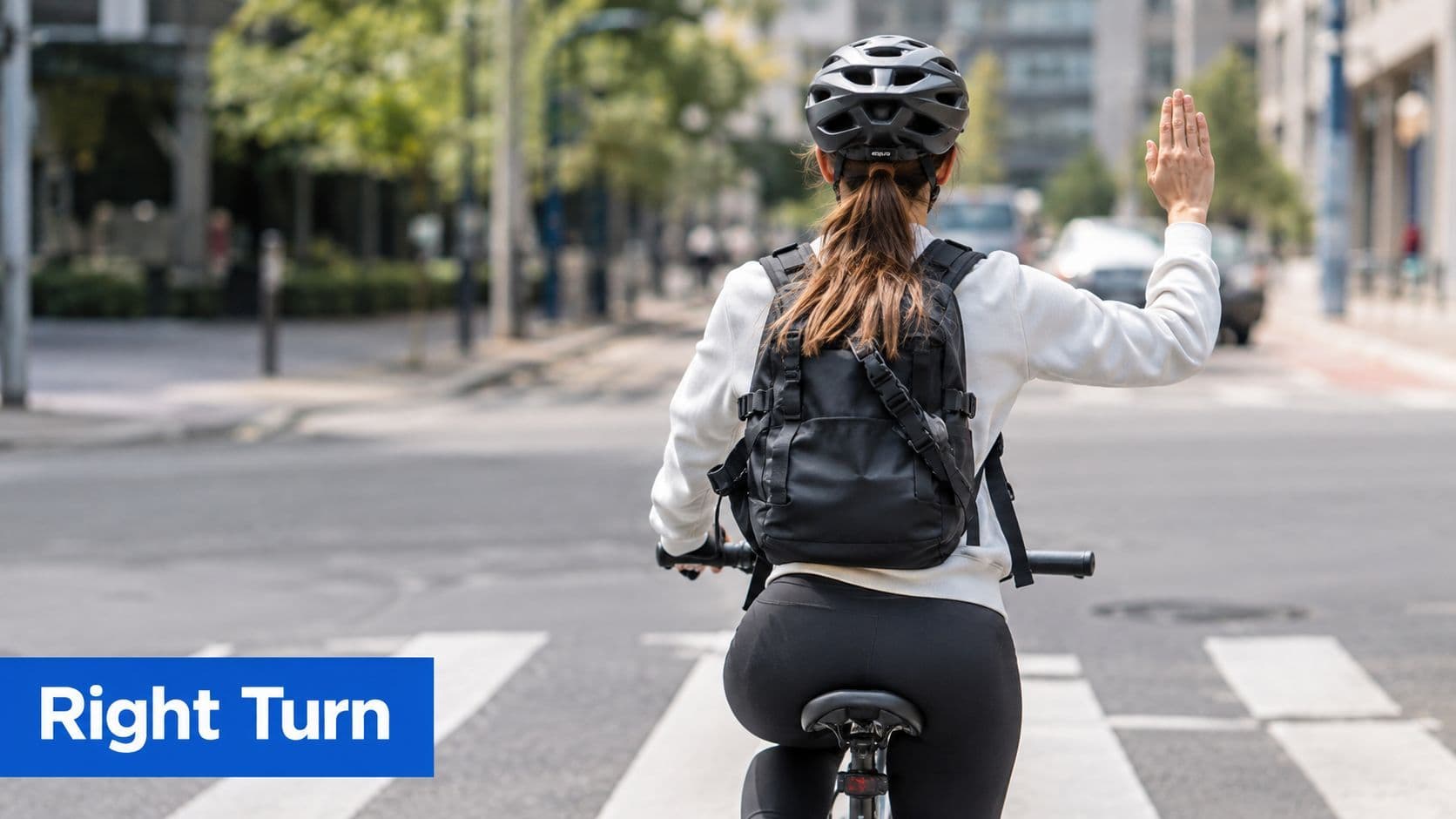
The bend in the left arm is the visual difference to remember. If the arm is straight, you're communicating a lateral movement, not the standard right-turn gesture.
For G1 preparation, practise identifying the signal from the road user's perspective. Don't rely only on the direction of the vehicle. Look at which arm is used, whether the elbow is bent, and whether the arm points upward or outward.
3. Slowing Down or Stopping Hand Signal
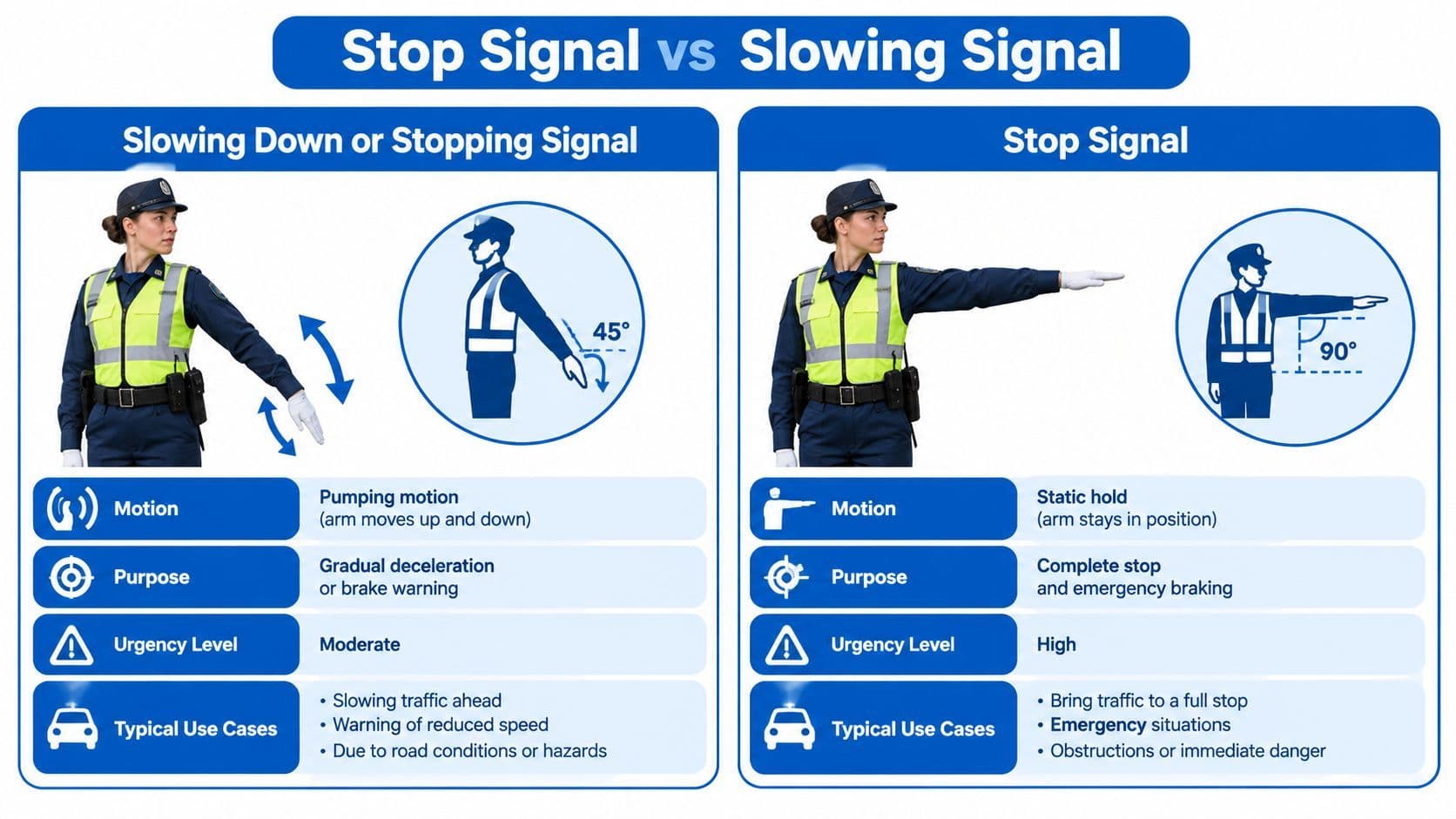
The downward signal warns traffic behind you that you're reducing speed or preparing to stop. Extend the left arm downward beyond the vehicle's left side, with the hand and arm pointing toward the pavement. The official Ontario rule is especially important when other traffic may be affected by a stop or sudden reduction in speed.
A cyclist riding through crowded Toronto traffic might use the signal before braking for a queue. A motorcyclist could use it when traffic slows unexpectedly, and a vehicle with failed brake lights may need the manual gesture to alert following drivers. Large vehicles, tow trucks, and buses also benefit from giving extra visual warning when their speed changes.
Hold the warning where others can see it
The arm should extend far enough to be visible. Keep it in position while slowing or stopping, and use your brake lights as well when they're functioning. The Highway Traffic Act describes the manual stop signal as extending the hand and arm downward beyond the left side of the vehicle, alongside its requirements for rear stop lamps.
Ontario's official traffic law text makes the practical point clear: a visible signal is required when a stop or sudden decrease in speed could affect other traffic. The manual gesture is therefore more than a test illustration. It's a way to maintain communication when equipment fails or when a vulnerable road user's braking action may not be obvious.
Practical rule: Use the downward arm when your speed is changing. Keep it distinct from the held signal used to communicate a complete stop.
For the G1 test, focus on the direction of the arm and the situation. A downward gesture warns of slowing or stopping, while an extended horizontal arm communicates a turn or lateral movement. The safe sequence remains observation, signal, and controlled braking.
4. Stop Hand Signal
The stop signal communicates that you're coming to a complete stop. In the commonly recognized Ontario road-user version, extend the left arm horizontally and keep the palm facing downward. Hold the position steadily rather than pumping or repeatedly moving the arm.
That stationary quality separates it from a warning about gradual deceleration. A cyclist may use it before stopping at a red light, a motorcyclist may show it before a hard stop in traffic, and a convoy or tour leader may use it to tell people behind that the group is coming to rest.
Stationary means stop
Keep the arm visible until the vehicle has stopped. If the stop is unexpected, the gesture gives following traffic another cue to react, but it cannot make an unsafe stop safe. Leave enough room to stop under the road and weather conditions, and remain aware of vehicles approaching from behind.
Ontario's official Driver's Handbook states that drivers should use hand and arm signals if their turn signals and brake lights aren't working. The same handbook also reminds drivers to turn off a signal after completing a turn or lane change, which prevents an old signal from misleading others.
The handbook separately explains that an orange hand symbol at a pedestrian signal means pedestrians must not begin crossing. That symbol belongs to a traffic control device, not the driver or cyclist hand signal described here.
G1 study takeaway: A held, palm-down gesture indicates a complete stop. A downward arm used with movement or speed reduction warns that you're slowing.
Practise the two situations separately. Ask yourself whether the road user is communicating “I'm reducing speed” or “I'm stopping now.” That distinction helps with both recognition questions and real-world decisions.
5. Right Lane Change or Passing Hand Signal for Cyclists
A cyclist moving to the right uses a right arm extended straight out horizontally, with the palm facing forward. The arm stays straight. That makes it different from the bent-upward left-arm gesture for a right turn.
This signal is useful when a cyclist moves right to pass a slower rider on a shared path, adjusts position within a multi-lane road, or prepares for a right-side lane movement. A Toronto bike courier may use it while navigating traffic, and a recreational cyclist may need it when moving around an obstruction or positioning for a later manoeuvre.
Check before you move sideways
The arm signal tells others what you intend to do, but it doesn't confirm that the space is open. Check behind you, look over your shoulder, and make eye contact with drivers when possible. Hold the arm out while completing the movement, then return both hands to the handlebars when you're stable.
A motorcyclist changing lanes on an Ontario highway also needs the same core habit, even when the vehicle has working indicators. Signal early enough for others to understand your plan, check the blind spot, and move only when the lane is clear.
The mirror, shoulder-check, and signal guide reinforces the order that G1 learners should remember. A signal announces your intention, while observation confirms whether the movement can happen safely.
Here's a short visual demonstration of the arm positions:
G1 study takeaway: Straight right arm means a rightward lane movement or passing movement in this comparison. A bent left arm points upward for a right turn.
6. Left Lane Change or Passing Hand Signal for Cyclists
A cyclist moving left or passing around an obstacle can extend the left arm straight out horizontally, with the palm facing forward. The arm remains fully extended from the body. This looks similar to the standard left-turn gesture, so the surrounding action matters.
At an intersection, a left-turn signal tells others that the rider intends to turn left. During a lane change or pass, the same straight arm can communicate a lateral movement without a turn. A cyclist may use it to move around a parked car, pothole, or slower rider, while a motorcyclist may use a mechanical signal and observation routine when changing lanes in traffic.
Use the road position to identify the meaning
Before moving left, check the blind spot and look for a driver, cyclist, or motorcyclist approaching from behind. Signal well before the movement, maintain the gesture while crossing into the new position, and avoid drifting until the path is clear.
A cyclist approaching a left-turning vehicle may also need to make their intended path clear if they plan to continue straight. The arm gesture helps communicate position, but it doesn't override another road user's right of way or remove the need to yield.
For Ontario-focused bicycle review, use the bicycle rules guide. It's useful for connecting hand signals with the broader road-sharing habits that G1 learners need to understand.
G1 study takeaway: Don't identify this signal from the arm alone. Straight left arm can mean a left turn or a leftward lane movement. Read the road situation and intended path.
6-Point Traffic Hand Signals Comparison
Signal 🔄 Implementation complexity ⚡ Resource requirements 📊 Expected outcomes Ideal use cases ⭐ Key advantages / 💡 Tips Left Turn Hand Signal Low, simple arm fully extended; momentary one-handed control Minimal, one free hand; visible when daylight/clear weather Clear left-turn intent; moderate effectiveness in low light Drivers/cyclists/motorcyclists with faulty indicators; routine left turns Widely understood; give well in advance (≈100 m on highways); keep arm visible Right Turn Hand Signal Moderate, bent-arm (L-shape) requires finer control Minimal, one free hand; may be obscured by clothing Distinct right-turn intent; generally reliable if visible Cyclists/motorcyclists turning right; drivers with failed right signal Distinct from left turn; hold until initiating turn; ensure arm height high enough Slowing Down or Stopping Hand Signal Low–Moderate, downward arm with pumping motion needs clarity Minimal, one free hand; relies on rear visibility Advance warning of deceleration; reduces rear-end risk Cyclists/motorcyclists braking; vehicles with inoperative brake lights Use downward pumping motion; combine with brake lights for max effect Stop Hand Signal Low, static held position (horizontal or vertical) but must be maintained Minimal, one free hand; longer hold time may be needed Unambiguous full-stop message; high urgency when done correctly Emergency stops, cyclists at traffic lights, convoy/group stops Hold steady until stopped; distinguish from slowing by avoiding pumping Right Lane Change / Passing (Cyclists) Low, straight right arm extension; steady hold required Minimal, stable one-handed control; shoulder-check recommended Clear lateral movement intent; reduces lane-change ambiguity Cyclists passing or moving right on multi-lane roads Keep arm fully extended and parallel; maintain signal until lane change complete Left Lane Change / Passing (Cyclists) Low, straight left arm extension; steady hold required Minimal, stable one-handed control; visibility can be limited by traffic Clear leftward lateral movement intent; lowers side-impact risk Cyclists passing, avoiding obstacles, moving left on multi-lane roads Signal early, check blind spot, hold signal throughout movement
Signal Clearly, Then Confirm It Is Safe
Hand signals communicate intention. They don't replace mirror checks, shoulder checks, yielding, speed control, or a safe gap. A driver with failed lights, a cyclist approaching an intersection, and a motorcyclist changing lanes all need to make sure the movement is safe before relying on other road users to respond.
Use this five-step review every time:
- Choose the correct position: Straight, bent upward, or downward arm positions carry different meanings.
- Signal early: Give people behind you enough time to understand your plan.
- Check the road: Look in mirrors and check the blind spot before turning, stopping, or changing lanes.
- Confirm visibility: Make sure your arm is extended beyond the vehicle or clearly visible to nearby road users.
- Move only when safe: Complete the manoeuvre smoothly, then cancel any mechanical signal after the movement.
Ontario's Highway Traffic Act requires a visible signal before turning, changing lanes, or leaving a roadway, and it allows either a hand-and-arm signal or a mechanical or electrical signal device. Mechanical signals must meet Ontario's visibility requirements, including visibility from 30 metres in day or night conditions under section 142(6) of the Highway Traffic Act. The official handbook also explains that hand signals should be used when turn signals and brake lights aren't working.
The easiest pairs to confuse are left turn versus left lane change, right turn versus right lane change, and slowing versus stopping. A bent upward left arm means right turn, a straight arm identifies a lateral movement or left turn depending on direction and context, and a held downward or palm-down gesture communicates stopping rather than ordinary speed reduction.
Use G1ready.ca's targeted quizzes to practise individual traffic regulations, then switch to mixed tests to check whether you can recognize the signals without prompts. Review each incorrect answer before retaking the question so the arm position becomes a confident road habit, not a last-minute memorization exercise.
Visit G1ready.ca to practise Ontario G1 questions on hand signals, lane changes, turns, and other traffic regulations. Choose targeted quizzes for focused review or mixed practice tests to apply the rules in a realistic study routine.


