In Ontario, a driver facing a yield sign must slow down, stop if necessary, yield to traffic already in the intersection or closely approaching on the intersecting road, and proceed only when the way is clear.
You're approaching that red-and-white triangle, your foot is easing off the accelerator, and you're wondering whether you're supposed to stop. That uncertainty is understandable. The useful question isn't whether your wheels must stop moving. It's who must go first, and whether you can enter without getting in their way.
What a Yield Sign Means and Why Yielding Is Not Stopping
Under section 138 of Ontario's Highway Traffic Act, a driver facing a yield sign must slow to a speed reasonable for conditions, stop if necessary, yield to traffic already in the intersection or approaching closely enough to create an immediate hazard, and then proceed with caution.
The key distinction is stopping is conditional, but yielding is mandatory. You don't decide whether to respect another road user's priority. You decide whether slowing is enough to give them that priority or whether you need to stop.
A yield sign is a white triangle with a red border, identified in the Official MTO Driver's Handbook. It's a regulatory control, not a suggestion to be polite. The Act also requires yield signs to be erected in accordance with Ontario regulations, rather than through informal placement.
Think of a narrow doorway
Suppose you're walking towards a narrow doorway and someone is already passing through it. You ease your pace, see whether there's room, and let that person finish before you enter. If nobody is there and you can see clearly, you don't need to freeze at the doorway.
That comparison helps separate giving priority from coming to a halt. Your responsibility is to avoid entering another person's path, not to perform a stop regardless of what's happening.
Driving requires a more careful version of that decision because traffic moves faster and your view may be limited. An intersection that looks empty from a distance may reveal a pedestrian or approaching vehicle as you get closer.
Separate observation from entry
Treat your approach as two distinct tasks:
- Slow enough to observe. Reduce speed before reaching the conflict point so you can look for vehicles and pedestrians while remaining able to stop.
- Choose whether the opening is safe. Enter only when the available space and approaching traffic allow you to proceed without creating a conflict.
A gap means more than an empty patch of pavement. You need enough opportunity to make your movement safely before approaching traffic reaches your path.
Stop whenever visibility, traffic position, pedestrian activity, or the available opening makes continuing unsafe. If you can't see enough to make that judgement, you haven't established that the way is clear. On the other hand, a clearly empty intersection doesn't automatically require a complete stop.
This distinction matters even when nothing dramatic happens. A driver can fail to yield without causing a collision, because the obligation is to give priority before entering. For G1 preparation, recognising the triangle is only the beginning. You also need to understand what the driver must do after recognising it.
Yield Versus Stop Signs at a Glance
Sign Legal requirement Mistake to avoid in G1 questions Yield Slow down, stop if necessary, and give priority before proceeding Choosing a full stop as an automatic requirement Stop Come to a complete stop before proceeding safely Treating a slow roll as a stop
A stop sign requires a stop. A yield sign requires a traffic-based decision. The MTO's sign descriptions distinguish the complete-stop instruction from the conditional stopping requirement at a yield sign.
At a stop sign on an empty road, you still stop at the stop line or, where appropriate, before the crosswalk. Having nobody else nearby doesn't remove that requirement. The explanation of what counts as a rolling stop is useful if you're unsure about the difference between slowing almost to a halt and coming fully to a stop.
At a yield sign on an otherwise clear road, you slow, look both ways, and proceed cautiously if it's safe. You don't add a compulsory stop merely because stopping feels like the more cautious answer.
For a knowledge-test question, identify the sign before reading the answer options. Then match it to its legal requirement. Otherwise, an answer that sounds careful can distract you from what the sign requires.
Who Goes First at a Yield Sign
Situation Must you stop? Who has priority What you do Empty intersection, no vehicles or pedestrians Not required if you can proceed safely You may proceed once the way is clear Slow, look both ways, proceed with caution Vehicle already in the intersection Stop if needed The vehicle in the intersection Wait until it has cleared Vehicle on the intersecting road close enough to create an immediate hazard Yes That vehicle Stop and let it pass Vehicle far away with a safe gap Stop only if the gap is unsafe You may enter if the gap is safe Proceed cautiously once clear Pedestrian in your intended path Yes The pedestrian Stop and wait until they have crossed You are signalling a turn No change to the rule Your signal confers no priority Yield as normal
Read the table by starting with who would be affected by your entry, not with whether you want to keep moving. A vehicle already crossing your intended route presents a different situation from a vehicle far away. Both deserve attention, but they don't necessarily require the same response.
The safe-gap row isn't permission to rush ahead of another driver. It means you may proceed only when your movement won't create the immediate hazard described in the legal rule.
A signal communicates intention, not permission
The MTO's guidance on driving through intersections makes clear that signalling doesn't give you right-of-way. Your indicator tells other people what you intend to do. It doesn't require them to make room.
Suppose you're signalling right and a vehicle is approaching on the road you want to join. The signal doesn't settle the question. You still need to determine whether that vehicle will reach the conflict point before you can enter safely.
This deserves particular attention at channelised turns, where a separate turning lane curves towards another road, and at merge-style intersections. A strip of open pavement ahead can make the manoeuvre look independent of surrounding traffic. Follow the lane with your eyes to where your path meets someone else's.
Build a reliable approach habit
- Approach under control. Leave yourself the ability to stop rather than making that decision at the last moment.
- Scan the whole intended path. Include pedestrians as well as vehicles.
- Resolve the conflict before entering. Don't begin the manoeuvre while relying on another person to avoid you.
Don't substitute an arrival-order rule for this assessment. If you're also studying Ontario's four-way stop rules, keep those situations separate from an approach controlled by a yield sign.
A useful practical test is: would entering now put you in another road user's path? If it would, wait.
Where Ontario Places Yield Signs
A side-street driver may see a yield sign before reaching a through road, while a driver entering a roundabout sees one at the approach. The sign's location identifies the approach it controls. Your next task is to work out which road users have priority.
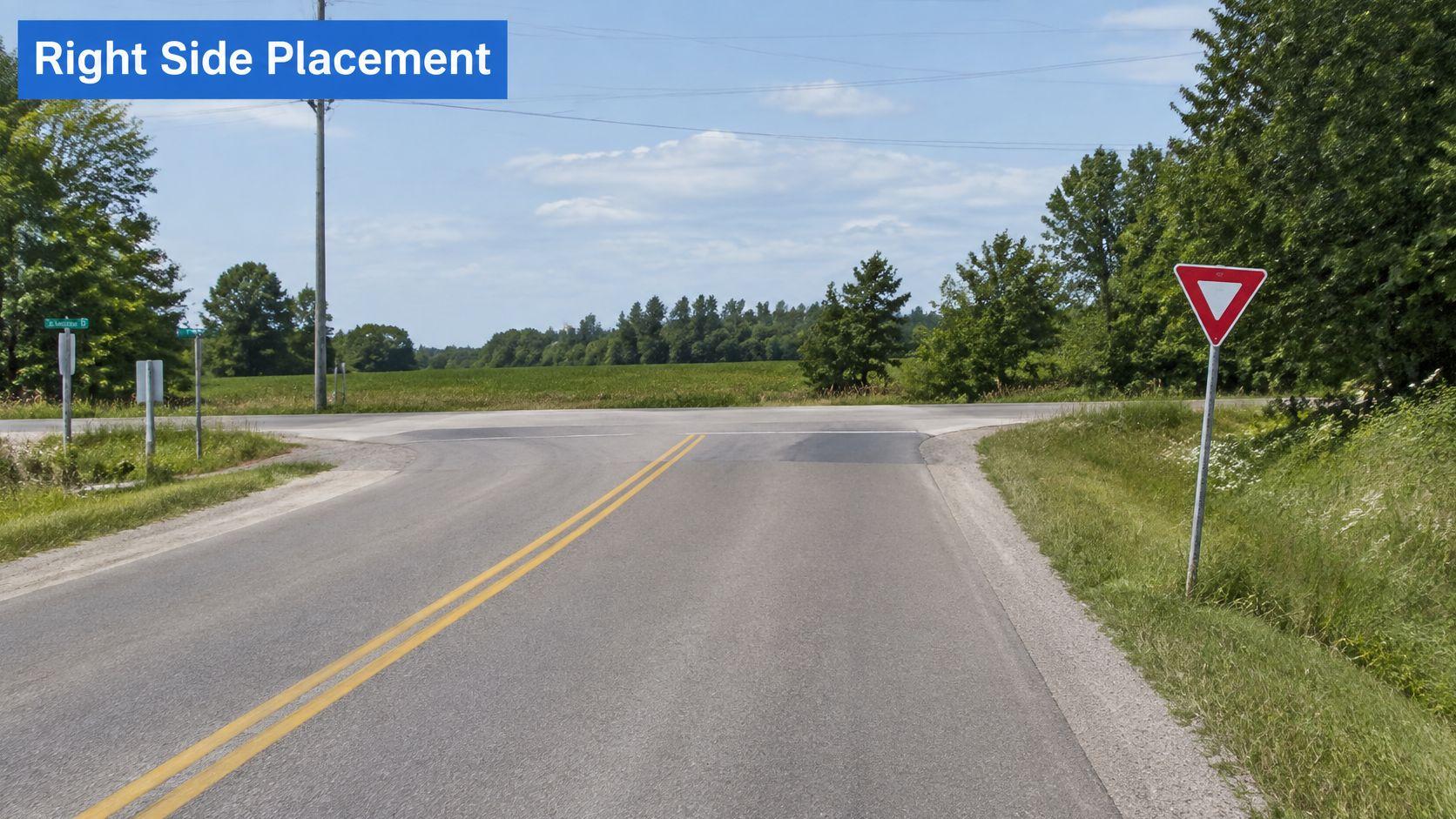
Yield signs can appear beside side-street approaches, at highway entrances, and before roundabout entries. Exact placement varies with the road layout. Check the official sample knowledge-test questions for Ontario examples, then read the signs and road markings on the approach in front of you.
Placement Typical location Driver's main task Side street meeting a through road On the side-street approach before the intersecting roadway Yield to traffic with priority on the through road Highway entrance ramp Where a yield-controlled ramp joins the highway Decide whether highway traffic has priority before entering Roundabout entry On the approach to the entry yield line Yield to vehicles already circulating Channelised turn or lane merge Where the turning or joining lane meets through traffic Identify who has priority where the paths meet
Connect the sign to the road ahead
A sign on your right controls your approach; it does not mean you should look only to your right. Depending on the layout, the traffic you must yield to may come from either direction or already be moving through the area ahead.
As a passenger, practise tracing the road from the sign to the point where paths meet. For example, at a side street, follow your lane forward and note where it crosses the path of traffic on the through road. That helps connect the sign's message to the priority decision, rather than relying on its shape alone.
Use the video to practise identifying the sign and the road layout around it.
Road layouts differ, and not every entrance or joining lane has the same controls. Read the signs on your approach, identify which paths meet, and determine who must proceed first. Yielding is required when another road user has priority; stopping is needed only when necessary to give way safely.
A yield sign marks a conflict point. Find that point, then decide who goes first.
How the Rule Changes at Roundabouts and Highway Merges
At a roundabout, priority depends on where the traffic is, not just who arrived first. Ontario's guidance on changing directions tells entering drivers to slow towards the yield line, look left, and yield to vehicles already circulating.
If a circulating vehicle is approaching your entry, let it pass and reassess the opening behind it. Don't treat its passage as an automatic invitation to enter, because another vehicle may be following. Adjust your speed or stop as necessary until a safe gap is available.
Entering and circulating are different tasks
Once you're inside, generally keep moving and stay in your lane, stopping if necessary to avoid a collision. Don't stop merely to wave an entering driver into the roundabout. That would confuse the distinction between circulating traffic and entering traffic.
Roundabout reminder: Look at whether the vehicle is already circulating, not whether you reached your approach before it did.
For diagrams and further practice with lane choice and entry decisions, use the Ontario roundabout rules guide. Keep the entry decision separate from the decisions you'll make while following your lane towards your exit.
A highway entrance requires a moving assessment
At a yield-controlled highway entrance, faster traffic can make an opening harder to judge. The ramp driver still has to yield. Reaching the end of the ramp doesn't transfer priority, and a flashing indicator doesn't make the opening safe.
As a practical gap-selection technique, consider how soon an approaching vehicle will reach your intended path, rather than judging distance alone. A vehicle that appears far away may close that distance quickly. Adjust your approach speed to use a suitable gap rather than attempting to force one.
Keep looking ahead along your own lane, too. Watching highway traffic so intently that you stop monitoring the space in front of you creates a different problem.
The observation task changes with the layout:
- Ordinary intersection. Scan both directions and assess the crossing or turning movement before entering.
- Highway entrance. Identify a suitable opening while monitoring the ramp ahead and adjusting your approach.
- Roundabout. Look left for circulating traffic before entry, then continue monitoring your lane and exit.
The surroundings change, but the legal question remains: who must proceed first?
Common Yield Traps and the Pre-Entry Check
A wrong answer can sound sensible when it uses familiar safety language. Being cautious is valuable, but a G1 answer still needs to match the sign, the traffic, and the particular situation described.
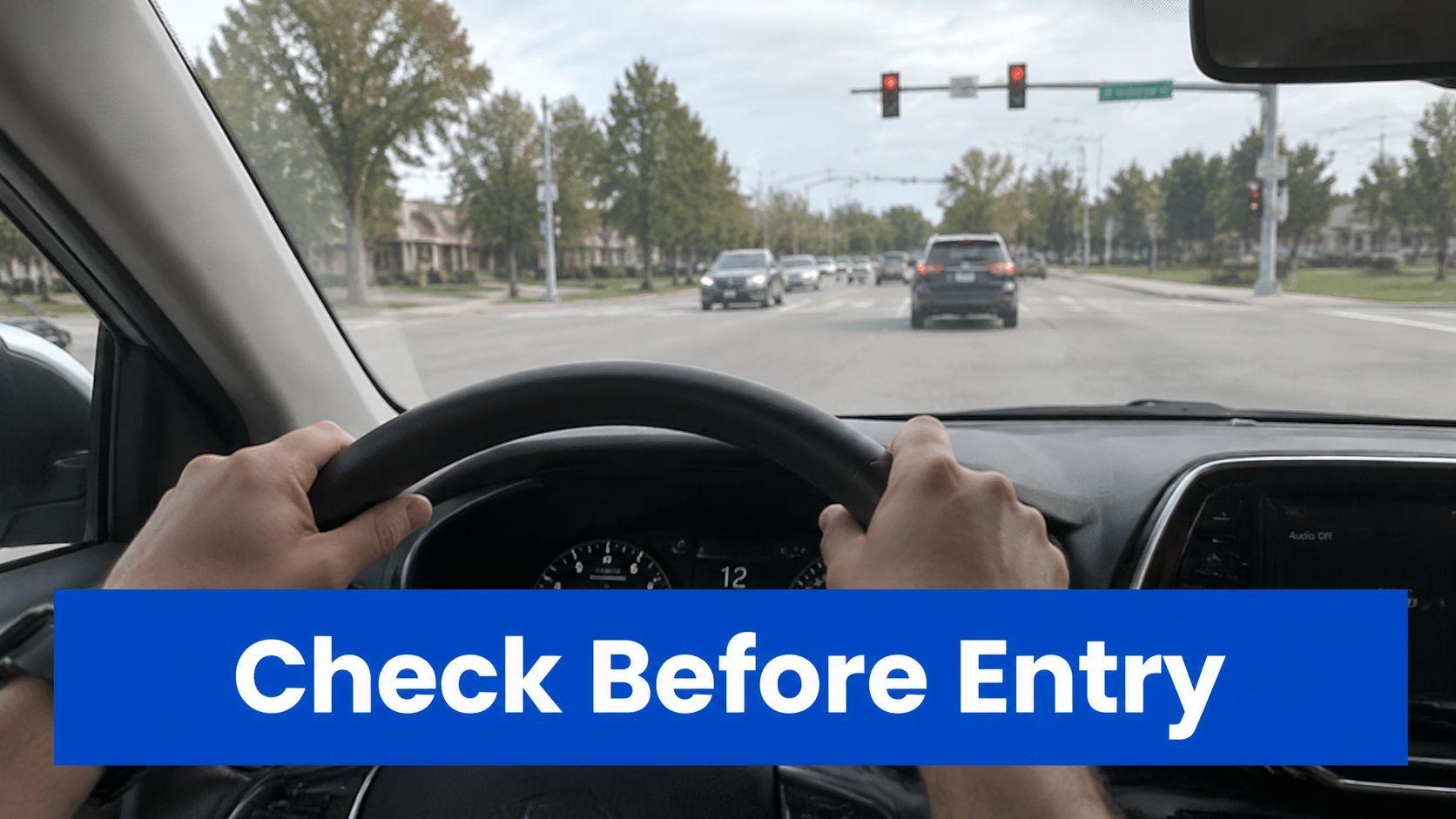
The view from behind the wheel is a reminder to identify the control that is really facing you. A red traffic light, for example, isn't a yield sign, even if you're thinking about turning.
Beliefs that lead to the wrong decision
- Yield always means a full stop. Correction: stopping depends on whether you can safely give priority without stopping.
- The stop-sign routine fits every intersection. Correction: identify the actual control rather than carrying an automatic-stop answer into a yield scenario.
- The other driver will probably let me in. Correction: use an opening you can establish is safe, not one that depends on someone accommodating you.
- The closer, larger, or faster vehicle automatically has priority. Correction: apply the legal relationship between the approaches, while considering speed and distance when assessing danger.
The final trap needs care. Speed matters when you judge whether a vehicle presents an immediate hazard. But speed itself isn't a special entitlement to right-of-way, just as a larger vehicle doesn't acquire priority because of its size.
Ask before you enter
Use this short pre-entry check to make the situation concrete:
- Already inside? Is anyone already in the intersection?
- Approaching hazard? Is anyone approaching on the intersecting road closely enough that entering would create a hazard?
- Crossing your route? Is anyone crossing in your intended path?
If any answer is yes, wait and resolve that conflict. If every answer is no, continue only after you've slowed, looked, and confirmed a safe opening. Not seeing anyone because your view is blocked isn't the same as establishing that nobody is there.
Visibility check: If you can't assess the conflict, you can't yet call the way clear.
When practising with a parent or instructor, say what you see: an approaching vehicle, a pedestrian near your route, or a clear opening. Naming the observation helps separate a reasoned decision from a guess.
Finally, leave your signal out of the priority calculation. It communicates your plan, but it doesn't change who must go first.
Sample G1-Style Yield Questions With Answers
Answer each practice question before checking the explanation. These are teaching examples, not reproductions of official test questions. Keep your attention on the road user whose path could conflict with yours.
A clear side-street intersection
You approach a yield sign. You have a clear view, with no vehicles or pedestrians in sight. What should you do?
- A. Stop completely every time.
- B. Slow, look both ways, and proceed if clear.
- C. Sound your horn and wait.
Answer B. There's no conflicting road user to yield to in this example, so a compulsory stop isn't required after you've confirmed the way is clear.
A vehicle already crossing
A car coming from your right is already in the intersection as you approach the yield sign. Should you enter because there appears to be room beside it?
Answer: Wait until it has cleared. You must yield to the vehicle already in the intersection, rather than treating unused pavement as permission to proceed.
An approaching vehicle on the through road
A vehicle approaches from your left on the through road. It's close enough that entering would create an immediate hazard. Should you enter before it or stop?
Answer: Stop and let it pass. You must yield to the approaching through-road vehicle because the available opening isn't safe.
A signalled left turn
You signal left at a yield sign while a vehicle approaches on the intersecting road. Does your signal allow you to turn ahead of it?
Answer: No, yield as the situation requires. The signal gives you no priority over the approaching vehicle.
Traffic inside a roundabout
You reach a roundabout's yield line while a vehicle is circulating towards your entry from the left. You reached your approach before that driver reached theirs. Who proceeds first?
Answer: The circulating vehicle. You must yield to traffic already inside the roundabout, regardless of that arrival-order comparison.
A pedestrian in your path
A pedestrian steps off the kerb into your intended path as you approach a yield-controlled turn. There are no approaching cars. Can you continue?
Answer: Stop and let the pedestrian cross. You must yield to the pedestrian in your path, even though the vehicle lanes appear clear.
Read these questions aloud with an instructor or study partner, then point towards the conflict in a simple sketch. Explain your answer using the person or vehicle involved, not just the word stop. For further practice, use free traffic-sign and road-rule quizzes with instant feedback so you can check the reasoning behind each choice.
Alongside the official handbook and instructor-led practice, G1ready.ca offers free, registration-free G1 practice quizzes with immediate feedback and explanations. Visit its traffic-sign and road-rule quizzes to practise distinguishing mandatory yielding from conditional stopping, then review the explanations for any decisions you miss.