
You're approaching a wide Ontario intersection and the light is still green. It may have been green since before you reached the previous block, the pedestrian countdown is nearly finished, and your right foot is caught between the accelerator and the brake. You're close enough to wonder whether stopping would be awkward, but far enough away to worry that continuing could put you in the intersection when the signal changes.
That's the moment drivers describe as a stale green light. It isn't a separate colour or a special signal. It's a green light that has been active long enough that you should expect it may turn yellow soon. The skill is not guessing the exact second of the change. It's reading the intersection early, adjusting your speed, and making a calm decision before panic takes over.
The Moment a Green Light Stops Feeling Safe
A G1 learner often notices a stale green light in the least convenient place, somewhere between the last driveway and the stop line. The light is green, traffic behind is following, and the dashboard clock seems to make the approach feel longer than it really is. You glance toward the signal, then back to the road, while the phone mount sits at the edge of your vision and your foot hovers uncertainly.
Your mind starts asking two questions at once. Can I reach the intersection before the yellow appears, and if it changes, can I stop without braking harshly? Those questions are more useful than asking how many seconds the light has been green, because Ontario intersections don't provide a visible timer for the vehicle phase.
A fresh green feels different. It has just appeared, traffic from the cross street has only recently been stopped, and you generally have more time to proceed with normal caution. A green that has been showing for a while demands a different mental setting. You shouldn't speed up because the signal is currently green.
Practical rule: A long-held green is a cue to plan, not a cue to accelerate.
The rest of the decision comes from details around the signal. Look for the pedestrian phase, watch the cross street, consider your speed and sight distance, and identify the stop line before you get too close to it. Ontario's official guidance connects a long-held green with preparing to stop if the signal turns yellow, while also recognising that a vehicle already too close to stop safely should continue through cautiously Ontario stale-green guidance based on the official driver handbook.
This is practical intersection behaviour, not a test of nerve. Your objective is to avoid both extremes, charging forward to beat the light and braking suddenly because you waited too long to decide.
What a Stale Green Light Actually Means
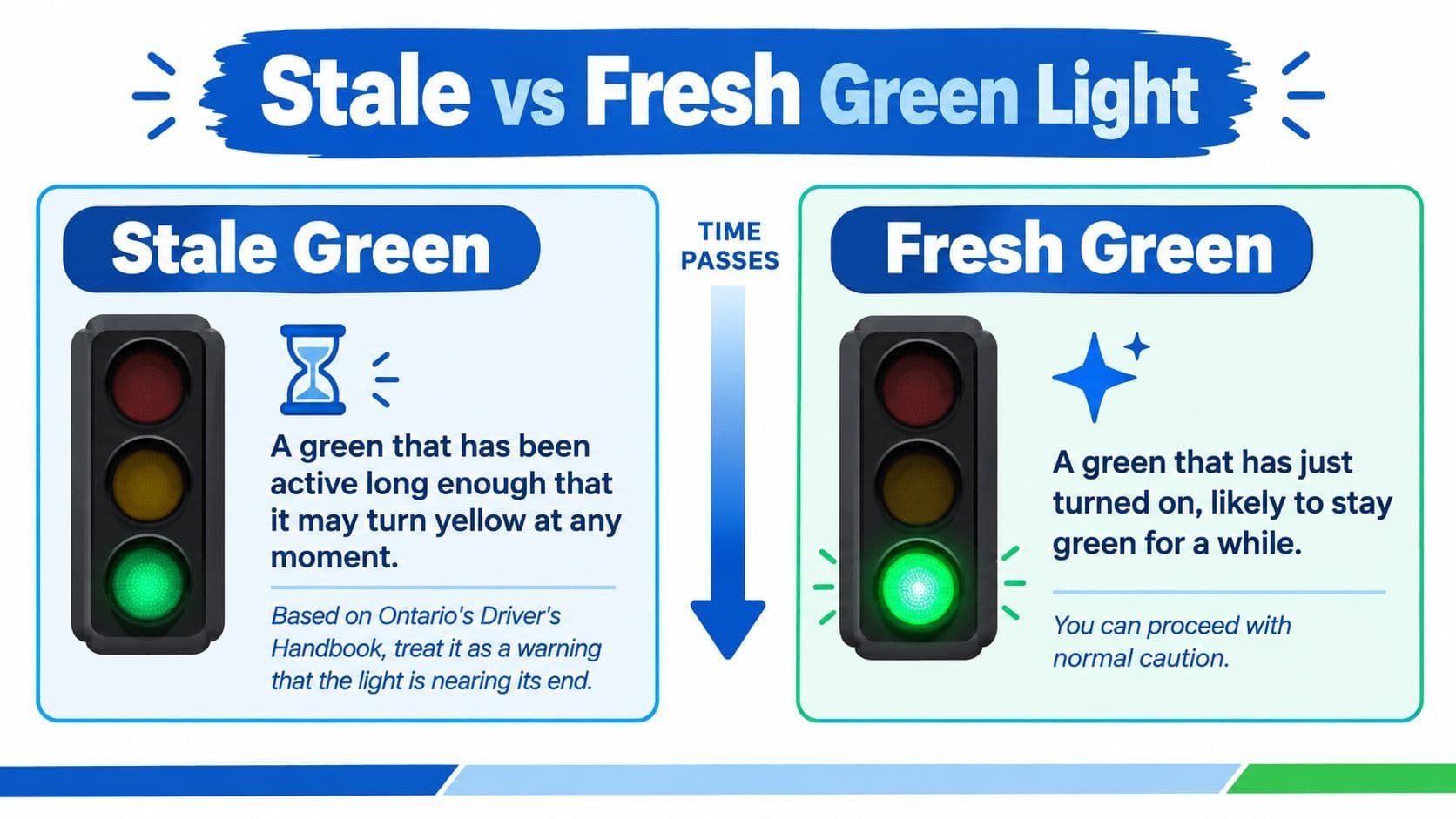
A stale green light is a green signal that has been active long enough to be approaching the end of its phase. Ontario's official driver handbook says to proceed at a steady speed on green, while preparing to stop if the signal changes to yellow after the green has been showing for a while. If you are already too close to stop safely, continue through the intersection with caution Ontario's explanation of traffic lights and green-light responsibilities.
A fresh green has just changed in your direction, so its phase is likely still developing. You must still check for pedestrians, vehicles already in the intersection, and road conditions. Green permits you to proceed straight, turn left, or turn right only after yielding to people and vehicles already in the intersection.
At an Ontario intersection, a green on Hurontario that has been showing since you passed the last side street may be stale. You cannot see a timer for the vehicle signal, but you can read nearby clues, such as a pedestrian countdown nearing its end or a queue building on the cross street. These signs do not predict the exact change. They tell you to stop treating the green as brand new.
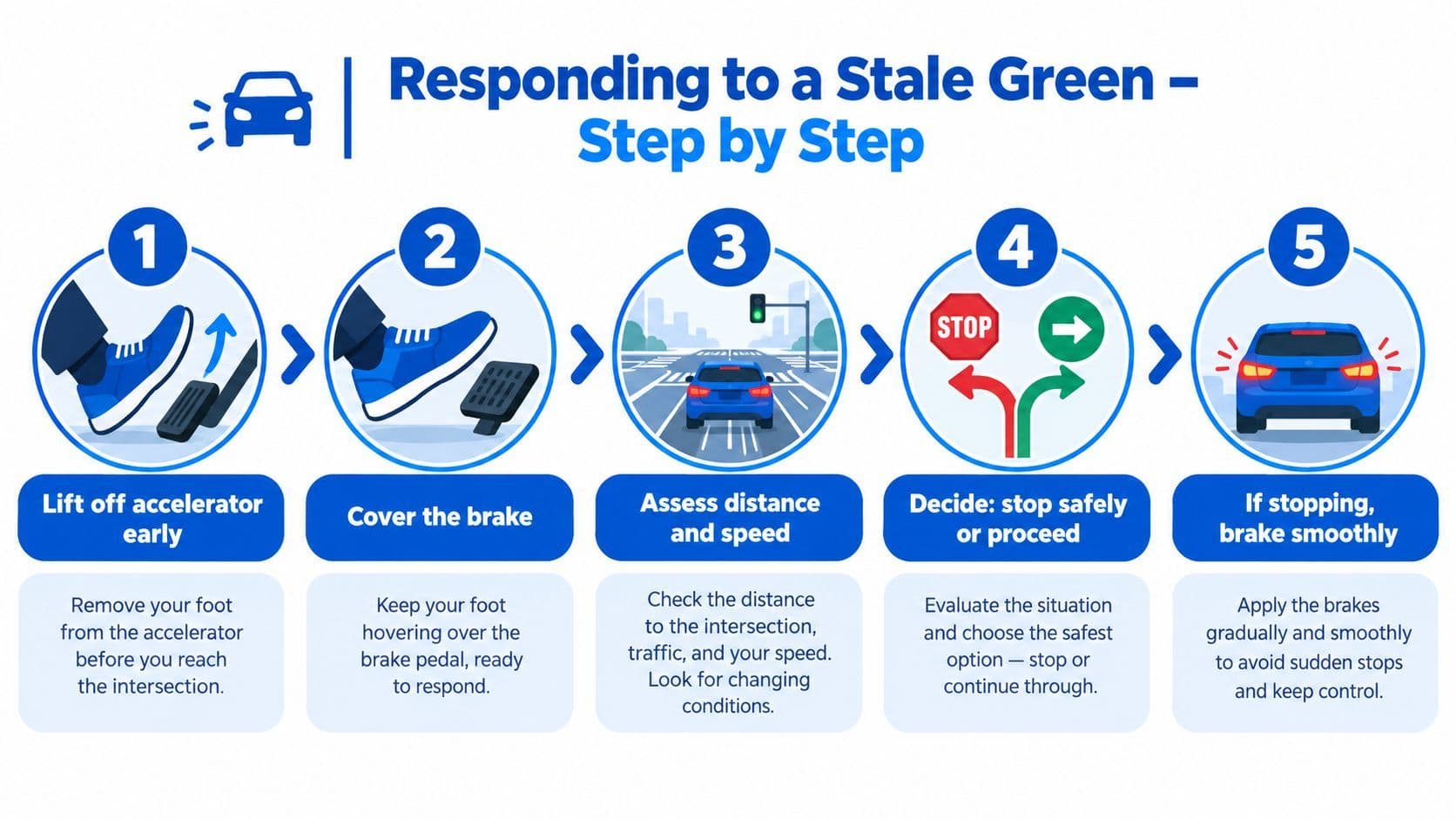
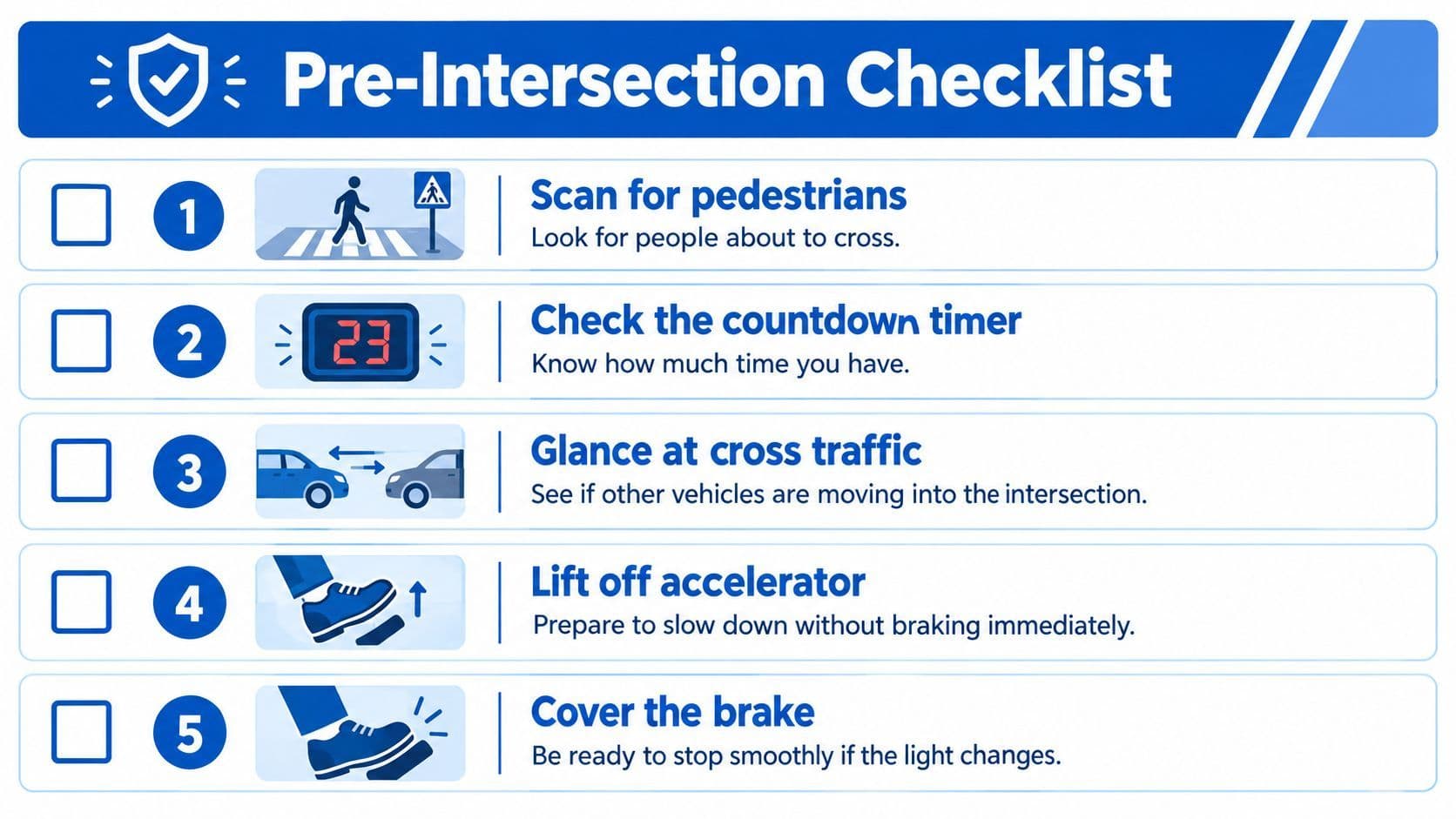
The label changes how you control the vehicle. Continue on green when the path is clear, but shift from acceleration planning to deceleration planning. Lift off the accelerator, cover the brake, and assess your speed, distance, visibility, and ability to stop smoothly.
A stale green does not guarantee that entering is safe. You still yield to pedestrians and vehicles already in the intersection. For the G1 knowledge test, remember the distinction: green means permission to proceed after yielding, not an unconditional right of entry.
How to Spot a Stale Green in the Real World
The signal head alone may not tell you how long the green has been active. Ontario drivers can often read the phase by scanning the rest of the intersection. Start with the pedestrian signal, then check cross traffic, then return your eyes to your path and the stop line.
A pedestrian countdown showing under 5 seconds is taught in Ontario driver-education material as a sign that the green may be stale. If the countdown is low, ease off the accelerator and cover the brake when you're still far enough from the intersection to make a smooth choice Ontario driver-education guidance on pedestrian countdown cues. A flashing or ending pedestrian indication communicates that the pedestrian phase is closing, so the vehicle green may be approaching its own change.
The cross street provides a second source of information. A long line of stopped vehicles, cars edging forward, or drivers beginning to prepare for movement suggests that their red phase may soon end. You don't need to count the vehicles. Notice whether the side street looks like it has been waiting and whether its traffic is beginning to organise.
Use a simple scan pattern:
- Look ahead first. Find the signal, stop line, lane markings, pedestrians, and vehicles that could affect your path.
- Check the pedestrian display. A low countdown or flashing don't-walk indication increases the need for caution.
- Glance across the intersection. A waiting queue or vehicles poised to move tells you the opposing phase may be close.
- Return to your lane. Judge your remaining distance and speed rather than staring at the light.
One cue can be misleading. A pedestrian countdown may be absent, a queue may be short, or a signal may be difficult to see because of rain or glare. Several cues pointing in the same direction make the decision clearer. The practical message is simple: the more signs you see that the cycle is ending, the earlier you should stop accelerating.
Don't treat the countdown as a promise that the vehicle light will change at one exact moment. Treat it as an external timing clue that tells you the green has likely been active for a while.
The Right Way to Respond as a Driver
Your response should begin before the yellow appears. Once the green looks stale, lift your foot from the accelerator. You may not need to brake yet, but removing power gives the car time to slow naturally and gives you more room to respond.
Next, move your foot into a brake-coverage position. Your foot hovers ready over the brake, without pressing it unnecessarily. This small change reduces the delay between recognising a yellow and beginning a controlled stop.
Do a quick awareness check, not a distracted inspection. Use the mirrors to see whether a vehicle is following closely, and check the space beside you for a cyclist or another road user. Keep your eyes moving back to the road ahead. You're trying to understand the traffic around your vehicle, not stare at the signal.
Then re-anchor your attention to the stop line. Ask yourself whether you have enough distance to stop smoothly, whether the pavement is wet, and whether your current speed would make a stop abrupt. If the vehicle is already too close to stop safely when the signal turns yellow, continuing through cautiously follows the Ontario handbook approach. If you have room, prepare to stop in gear with steady brake pressure.
The decision should happen early
A common learner error is delaying the decision until the front of the vehicle is almost at the line. By then, the options have narrowed and the driver may panic. Another error is pressing the accelerator harder to “beat” the yellow. That turns a manageable approach into a speed and stopping problem.
Use this sequence:
- Lift off the accelerator when the green appears aged.
- Cover the brake while keeping your steering steady.
- Assess distance and speed against the stop line.
- Choose to proceed or stop before the decision becomes urgent.
- Brake smoothly if stopping is safe.
Don't stare at the signal head while neglecting pedestrians, cyclists, lane position, or traffic ahead. A controlled decision depends on the whole intersection. You're building a habit that should feel just as natural during G1 practice as it does after you earn a full licence.
The following video can help reinforce the visual decision process while you practise your own scan pattern.
Why Speed, Sight Distance, and the Dilemma Zone Matter
“Always brake when you see a stale green” sounds safe, but it's too simple. A driver travelling at a modest approach speed on a clear, level suburban road may have plenty of room to stop. A driver approaching faster on a downhill grade, with wet pavement or a heavy vehicle behind, may need a different response because sudden braking can create a new hazard.
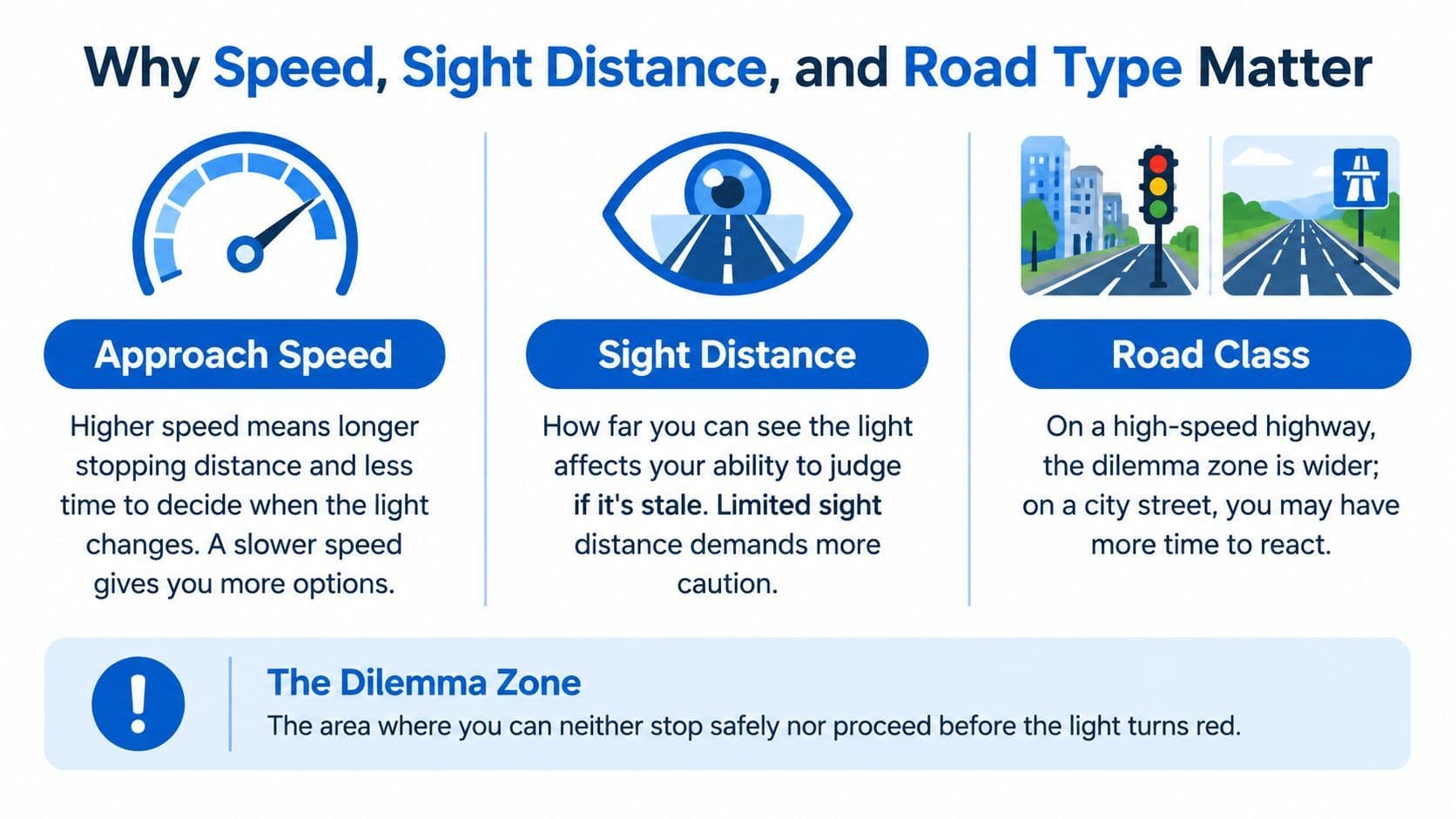
The dilemma zone is the part of the approach where a driver may feel too far away to stop comfortably but too close to clear the intersection before the phase changes. Higher approach speeds make that window more difficult because the vehicle covers more ground while the driver is deciding and needs more distance to stop. A crest, bend, parked vehicles, trees, or glare can hide the signal until late, leaving less time to interpret its age.
Engineering guidance used in Canada warns that poor visibility, higher approach speeds, and long uninterrupted road sections can make amber decisions erratic. It also notes that some warning signs can increase rear-end risk, which is why long-distance detection is preferred on higher-speed corridors Canadian engineering guidance on signal decisions and dilemma zones.
Four factors change your margin
- Approach speed: More speed means less time and more stopping distance. Slow earlier when the road layout permits.
- Sight distance: If you can see the signal and stop line well ahead, you can plan. Limited visibility calls for caution before the light becomes urgent.
- Road type: A quiet city street and a high-speed rural approach don't give you the same decision margin.
- Surface and load: Wet pavement and a heavily loaded vehicle can make a smooth stop require more space.
A stale green doesn't automatically mean “brake now.” It means stop adding speed and evaluate the available choices. Review Ontario's speed-limit expectations before practising this judgement with the G1 speed limit rules guide.
Stale Greens in Everyday Ontario Intersections
The same green can demand different planning in different places. The cue may be a pedestrian timer downtown, a queue on a suburban arterial, or the distance required to slow on a rural highway. The underlying question stays the same: can you proceed without rushing, or can you stop without creating a sudden hazard?
Consider these common settings:
Intersection Type Staleness Cue Typical Risk Safer Response Suburban arterial, such as a King Street or Hurontario-style corridor A long green, visible cross-street queue, or vehicles edging forward Accelerating to beat the change or braking late behind traffic Lift off early, cover the brake, and assess the stop line School zone during drop-off A flashing pedestrian indication, people waiting near the crossing, or unpredictable movement Focusing only on the signal while a child approaches the roadway Reduce speed early, scan both sides, and give pedestrians priority where required Downtown intersection A low pedestrian countdown or frequent walk and don't-walk changes Missing a pedestrian because attention stays on the vehicle signal Scan the crossing area, then decide whether a smooth stop is available Rural highway crossover Long sight distance, high approach speed, or a signal seen late over a rise Entering too quickly to avoid stopping, or braking sharply with traffic behind Read the signal as early as possible, ease off, and preserve stopping room
At a suburban arterial, the queue on the cross street can be especially useful because it shows how long another movement may have been waiting. It doesn't tell you the precise change time, but it supports an early lift-off. On a school-zone approach, the pedestrian environment matters more than your desire to maintain momentum. A green signal doesn't remove the need to watch for people already crossing or about to enter the crossing area.
Downtown, pedestrian phases often provide the clearest visible warning that the green is aging. A rural approach demands more forward planning because speed and sight distance can leave little room for a late decision. Review the related Ontario pedestrian crossing rules guide before practising near busy crossings.
Building the Habit and Preparing for the G1 Test
A learner builds judgment by practising the timing, not by memorising a five-step script. On a 50 km/h street, begin your intersection scan about 150 metres away. That distance gives you time to notice whether the green has been showing for a while and to adjust without a rushed stop.
Use each practice run to answer three questions: What changed? What choices remain? What control action keeps those choices open? A pedestrian countdown nearing its end, a growing queue on the cross street, or a green that appeared before you reached the block can all signal that your options may soon narrow. Treat these cues like an early weather change. They do not predict the exact signal change, but they tell you to prepare.
During supervised driving, your goal is consistent timing. Say “150 metres,” then assess the intersection again as you approach. If the scene changes, repeat the cue and check whether your speed still leaves room for a smooth stop. A supervisor can listen for whether you are explaining a reason for your decision, rather than reacting at the line.
For the G1 test, learn the principle behind each question. The Ontario handbook explains that a green permits movement only after required yielding, and that a green held for some time calls for preparation if yellow appears. Review that guidance by name, then test yourself with scenarios instead of memorising a trick.
Start on quiet neighbourhood streets with a qualified supervisor. Once your timing is steady, practise on busier roads in suitable conditions. Practice-driving exercises and study guidance can complement targeted quizzes and mixed practice tests by showing which intersection decisions still need work.
Common Questions About Stale Green Lights
Can a stale green lead to a red-light ticket in Ontario?
The phrase itself isn't an offence. The concern is entering after the signal has changed to red. A driver should follow the signal and the Ontario Highway Traffic Act, while using the handbook's guidance to prepare before the change.
Is accelerating safer on a downgrade?
Usually, adding speed reduces your stopping options. A downhill approach, wet pavement, limited visibility, or traffic behind you calls for earlier planning, not a last-second attempt to beat the signal.
Do cyclists and pedestrians follow the same idea?
They must still obey their applicable signals and yield requirements. A driver facing green must yield to pedestrians and vehicles already in the intersection, so never treat a stale-green assessment as permission to cross through someone's path.
Does this apply to a protected left-turn arrow?
The arrow has its own phase, so read the arrow and the surrounding intersection separately. If the protected movement ends, don't assume the general green or the opposing traffic conditions allow the same turn.
Use G1ready.ca to practise the traffic-signal questions and intersection decisions that often trouble new Ontario drivers, with free registration-free practice exams, targeted quizzes, explanations, and mixed-test options. Visit G1ready.ca to rehearse the stale-green checklist and build confidence before test day.


