
You're parked at the curb with both hands on the wheel, waiting for a quiet Sunday morning to feel less intimidating. Then you notice the stop sign ahead and wonder whether a slow roll through an empty intersection really counts as a traffic rules violation. It does. Ontario's road rules apply even when there's no nearby traffic, and a small mistake can matter more for a G1 or G2 driver than it does for someone with a full Class G licence.
The easiest way to learn these rules is to connect each one to three questions: What did the driver do? What penalty can follow? What changes for a novice licence holder? That approach turns short G1 test scenarios into practical decisions you can recognise on the road.
What Counts as a Traffic Rules Violation in Ontario
A traffic rules violation is an action that breaks a rule in Ontario's Highway Traffic Act or a municipal traffic bylaw while a vehicle is being driven or parked on a road. The violation might involve how fast you travel, where you position the vehicle, how you respond to a traffic signal, or whether you use a device while driving.
The first useful distinction is between moving and non-moving violations.
Moving and non-moving violations
A moving violation happens while the vehicle is in motion. Speeding, running a red light, failing to stop at a stop sign, making an unsafe turn, and holding a phone while driving all fit this category. These are especially important for G1 preparation because the official knowledge test uses brief road situations that ask you to identify the lawful and safe response.
A non-moving violation generally concerns a parked vehicle or an administrative requirement. Parking in a prohibited location or displaying an expired permit can create a ticket, but those issues aren't the main focus of the road-rule questions covered here.
Ontario's enforcement records show why learners need to take these rules seriously. Ontario courts recorded 2,581,185 Highway Traffic Act charges in 2024, while the 2025 court statistics recorded 2,053,579 Highway Traffic Act charges under provincial offences activity, according to the Ontario Court of Justice provincial offences statistics. The categories that appear frequently include speeding-related matters, unsafe driving behaviours, and licence-related offences.
Practical rule: If a question describes a driver choosing convenience over a posted rule, treat the choice as a possible violation, even if the road looks empty.
For focused preparation, practise recognising short scenarios involving Ontario traffic-rules questions. Start by identifying the road feature, such as a stop sign, signal, lane marking, or speed sign. Then decide what the driver must do before considering what would be faster or more convenient.
The Five Most Common Violations G1 Students See
Most learner mistakes aren't caused by bad intentions. They happen when a driver is rushed, distracted, or uncertain about what counts as a complete and lawful manoeuvre.
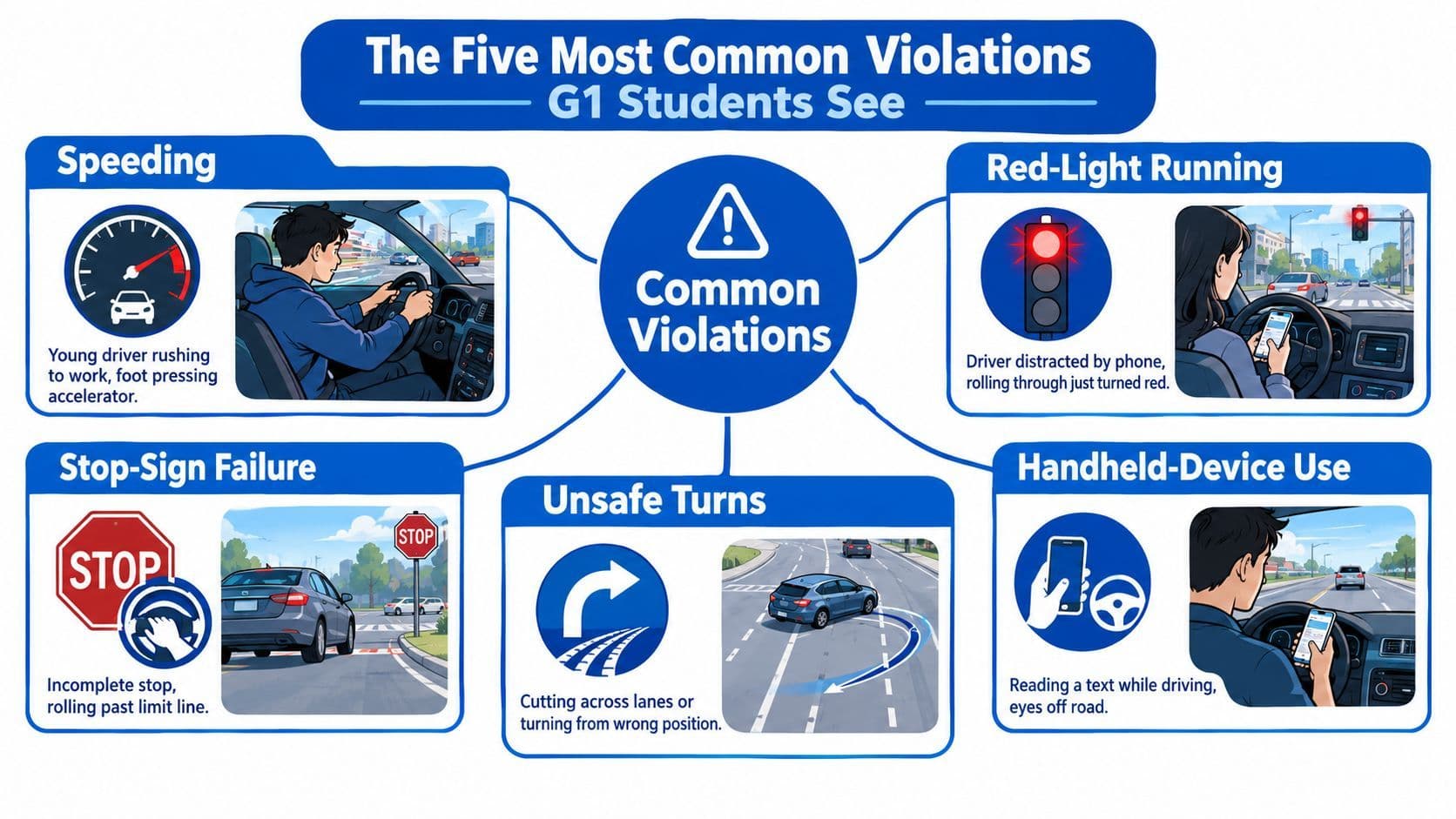
Speeding
A driver late for work may see a 400-series highway moving freely and gradually increase speed from 90 km/h to 115 km/h. If the posted limit changed after an interchange, the driver may not realise the violation until an officer stops them. The issue isn't whether the driver felt in control. The issue is travelling faster than the posted limit.
Ontario's enforcement data identifies speeding as a central road-law concern. The Ontario Provincial Police reported 167,242 speeding offences in 2024, and the Ontario Ministry of Transportation's 2022 conviction data recorded 337,697 speeding convictions out of 559,140 Highway Traffic Act convictions, representing 60.4% of those convictions. These figures are reported in the Ontario traffic and driving statistics summary. The source isn't linked as a study here, but the figures show why speed-limit questions appear so often in learner preparation.
Red-light running
A tired commuter might approach an intersection while watching a stale green signal, misjudge the timing, and enter after the light turns red. That's a red-light violation. The driver's intention to “beat the light” doesn't change the signal's meaning.
Stop-sign failure
Rolling through a quiet residential stop sign is still a failure to stop. A proper stop requires the vehicle to become fully stationary at the stop line, crosswalk, or intersection edge, whichever applies. A driver who glides forward without stopping has violated the rule, even if they look both ways and see no vehicles.
Unsafe turns
A driver cutting across a gore area on an off-ramp or swinging wide into a bike lane during a right turn creates a positioning and safety problem. The correct turn starts from the proper lane, follows the lane markings, and checks for people, cyclists, and other vehicles before crossing their path.
Handheld-device use
A driver waiting at a red light may glance down at a navigation prompt. In Ontario, stopping at a light doesn't make handheld phone use safe or lawful. The driver is still operating a vehicle in traffic, and looking at the screen takes attention away from the road.
The Ontario distracted-driving rules explain that a first conviction can involve a $615 set fine if settled out of court, or up to $1,000 if fought in court and lost, along with 3 demerit points and a 3-day suspension. For a G1 or G2 driver, the novice-licence consequences are different, as explained later.
Fines and Demerit Points Behind Each Violation
A ticket isn't just a dollar amount. For a learner, the important questions are whether the conviction adds demerit points, whether a suspension follows, and whether the offence breaches a graduated-licensing condition.
Ontario's speeding rules can be especially costly in higher-risk locations. Under the Highway Traffic Act, a driver travelling less than 20 km/h over the limit faces a fine of $3 for each kilometre per hour over the limit, according to the Ontario Highway Traffic Act. Administrative penalty rates are steeper in community safety zones and school zones, ranging from $5.00 per km/h for 1 to 19 km/h over, to $19.50 per km/h for 50 km/h or more over.
A driver who speeds through a red light may face separate consequences for separate acts. The speeding and signal violations don't automatically become one mistake just because they happened during the same event. Read the offence notice carefully and get legal advice if you don't understand what has been charged.
Violation Fine Range (CAD) Demerit Points Speeding below 20 km/h over the limit $3 for each km/h over Varies by offence Speeding in a school or community safety zone $5.00 to $19.50 per km/h over, depending on speed band Varies by offence Red-light violation Depends on the charge and resolution May apply Stop-sign violation Depends on the charge and resolution May apply Unsafe turn Depends on the charge and resolution May apply Handheld wireless-device use, first conviction $615 set fine out of court, or up to $1,000 if fought and lost 3
The table uses only figures specifically available in the official penalty material and does not assign unverified fine or point values to offences where the supplied data doesn't specify them. For a separate explanation of how points can affect a licence, review this Ontario demerit-points guide.
The handheld-device penalty escalates. A second conviction can bring up to a $2,000 fine, 6 demerit points, and a 7-day suspension. A third or later conviction can bring up to a $3,000 fine, 6 demerit points, and a 30-day suspension. Those amounts and consequences come from Ontario's distracted-driving rules.
How Penalties Hit G1 and G2 Drivers Differently
Graduated licensing changes the result of a conviction. A novice driver isn't a Class G driver with fewer years behind the wheel. G1, G2, M1, and M2 holders face special conditions, and distracted-driving offences use suspensions rather than ordinary demerit-point treatment for novice drivers.
Ontario's distracted-driving rules state that a G1 or G2 driver receives a 30-day suspension for a first conviction, a 90-day suspension for a second, and licence cancellation with removal from the Graduated Licensing System for a third. The same source explains that the offence doesn't add demerit points to a novice licence in the ordinary way. Review the Ontario new-driving-rules guide while studying, but always check current provincial requirements before driving.
Comparing licence consequences
Penalty Trigger Class G Driver G1 / G2 Novice Driver Handheld-device first conviction $615 set fine out of court or up to $1,000 if fought and lost, 3 points, 3-day suspension 30-day suspension Handheld-device second conviction Up to $2,000, 6 points, 7-day suspension 90-day suspension Handheld-device third conviction Up to $3,000, 6 points, 30-day suspension Cancellation and removal from the Graduated Licensing System Alcohol or drugs while subject to zero-tolerance rules Immediate and conviction consequences apply Immediate novice-driver consequences apply
A G1 holder must follow learner conditions, including driving with an accompanying fully licensed driver who meets the provincial requirements, maintaining zero alcohol and drug presence, and obeying restrictions attached to the licence. A G2 holder has more independence but remains subject to novice conditions and escalating licence action.
Ontario's impaired-driving rules state that drivers age 21 and under, and anyone with a G1, G2, M1, or M2 licence, must have no alcohol or drugs in their system while driving. Immediate consequences for these zero-tolerance drivers include a 7-day immediate licence suspension, a $60 to $1,000 fine if convicted, an 8-hour education course, and a $250 penalty. A second time can bring a 30-day immediate suspension, according to the Ontario impaired-driving rules.
The key lesson is simple. A novice driver can lose driving privileges through a suspension that feels disproportionate to the original action, because the graduated system is designed to protect inexperienced drivers and the public.
How Ontario Officers Catch Violations in the First Place
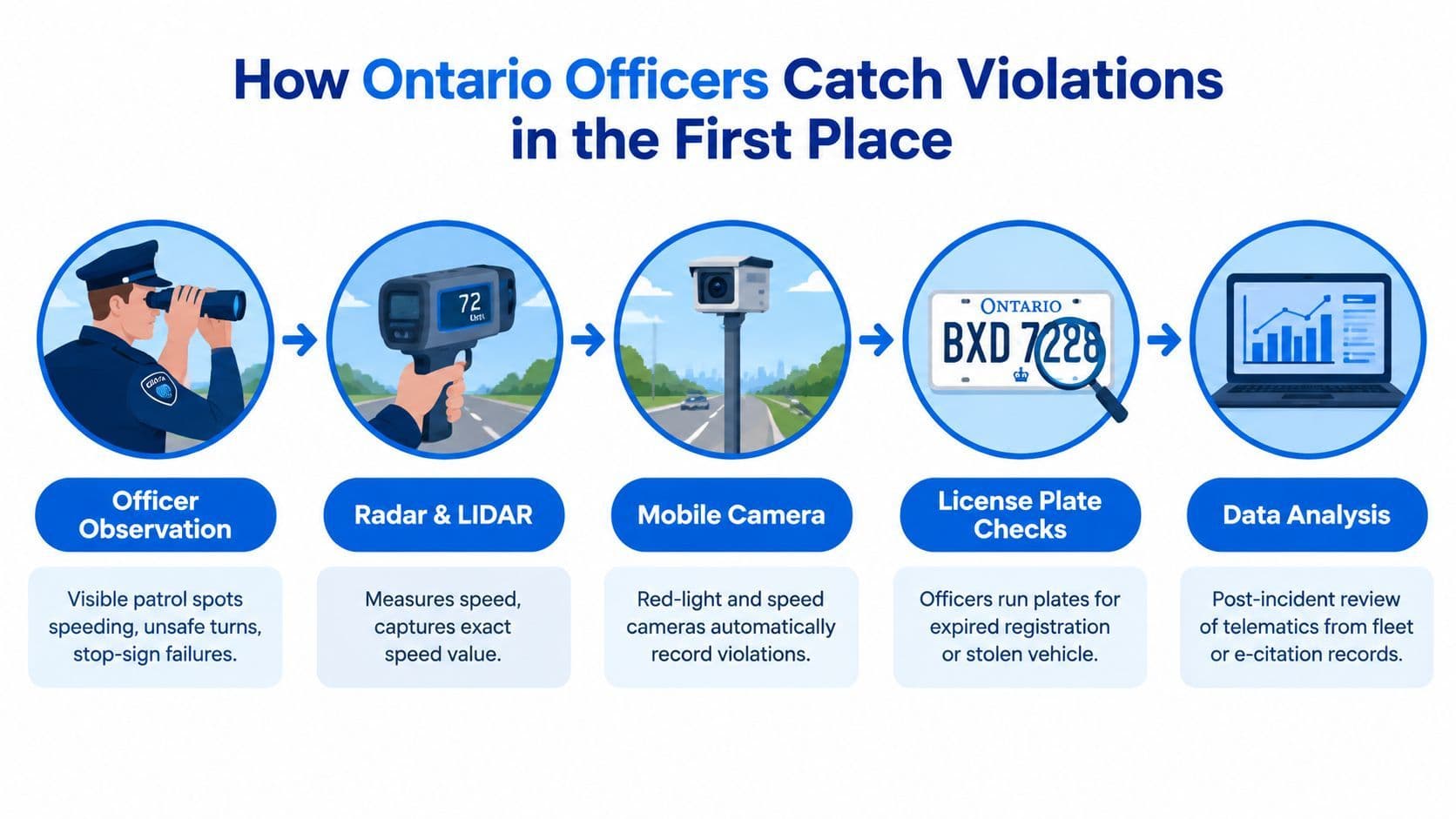
A traffic stop often begins with something ordinary. An officer sees a vehicle move faster than surrounding traffic, drift across a lane, turn from the wrong position, or pause at a red light while the driver looks down at a phone. The officer's observation can be enough to investigate the behaviour.
The Ontario Provincial Police reported 441,316 traffic stops in 2024, with a traffic stop occurring every 71 seconds, according to the OPP 2024 annual report. The same report recorded 333,781 Highway Traffic Act charges, including the speeding and impaired-related offence volumes discussed earlier. These figures show that enforcement occurs during routine road use, not only after a dramatic collision.
From observation to measurement
For speed-related concerns, officers may use radar or lidar equipment to measure the vehicle's speed. That measurement helps document the alleged offence. For signal-related behaviour, automated systems can record a vehicle entering an intersection against a red signal where those systems operate.
Officers can also check licence plates and registration details during roadside enforcement. A driver may think only the visible movement matters, but a stop can reveal separate licensing or documentation concerns.
What happens after detection
An officer-issued ticket is generally handled during the roadside interaction. The driver receives information about the alleged offence and the next steps. An automated enforcement notice is sent through the applicable process, so the registered owner needs to read the notice carefully rather than ignore it.
On-road habit: Treat every intersection and every speed change as visible. You won't always know whether an officer, camera, or another road user has observed the decision you just made.
The safest response isn't trying to predict where enforcement is located. It's maintaining the same lawful routine on a quiet residential street, a busy arterial road, and a highway interchange.
Practical Habits That Keep Violations Off Your Record
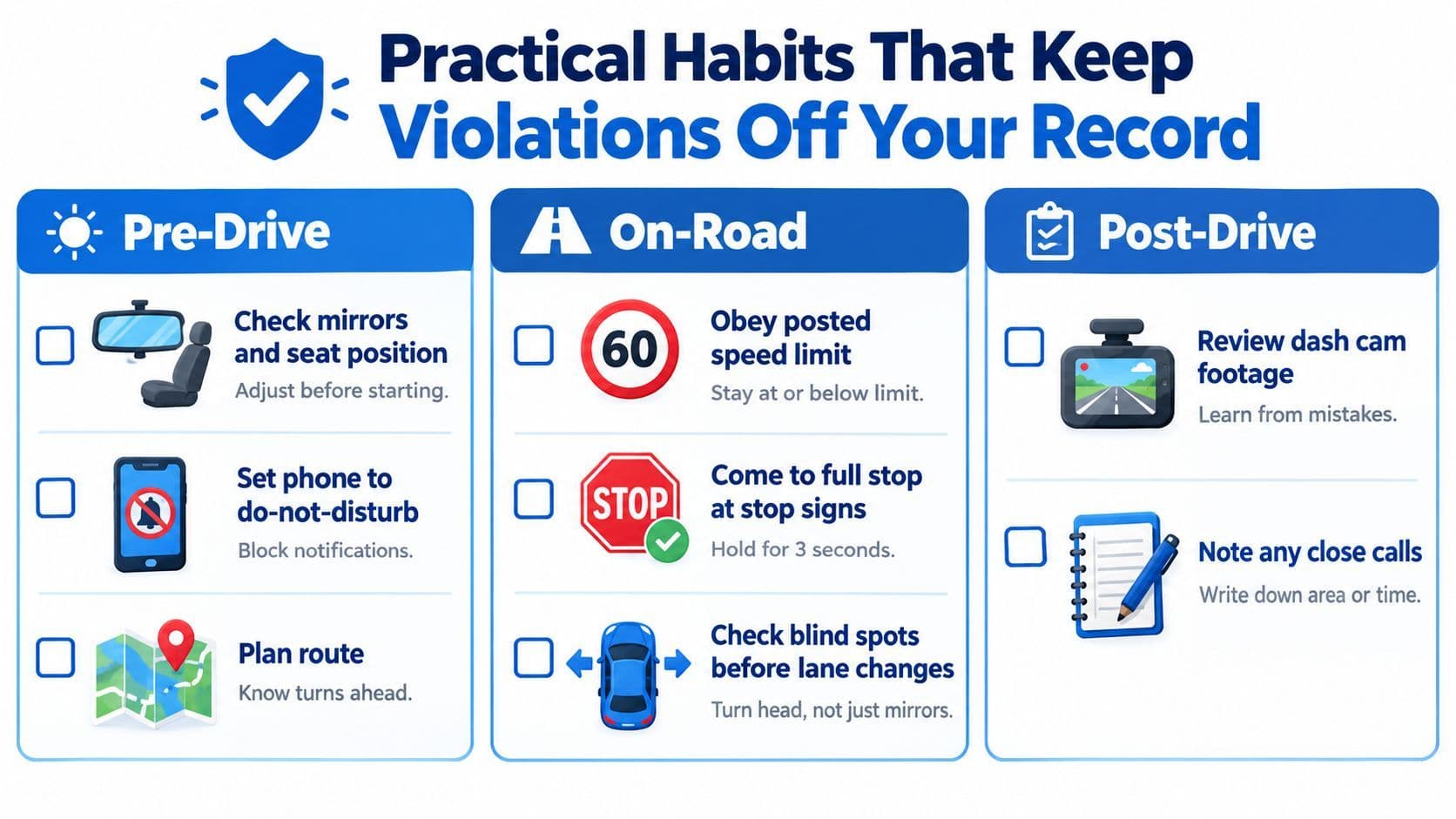
A nervous G1 learner benefits from routines that happen in the same order every time. Use this checklist before, during, and after a drive.
Before you move
- Set your position: Adjust the seat and mirrors before starting so you aren't reaching or looking down while moving.
- Silence the phone: Activate do-not-disturb and place the device where you can't reach it. This directly removes the temptation behind handheld-device use.
- Plan the route: Check the next turns and speed changes before leaving. Route planning reduces last-second lane changes and unsafe turns.
- Check the vehicle: Look at the tyres, mirrors, lights, and surrounding space before backing out. A clear setup gives you time to notice hazards.
While driving
Scan well ahead instead of staring only at the vehicle in front. Cover the brake as you approach intersections, watch for a changing signal, and begin slowing early rather than trying to pass through a stale green.
At stop signs, practise the same sequence every time: brake smoothly, stop completely at the correct point, check in all relevant directions, and proceed only when the intersection is safe. For turns, signal early, choose the correct lane, check mirrors and blind spots, and keep your path within the marked roadway.
The following video can reinforce the visual habits that support safer decision-making:
After the drive
- Review mistakes: If you use a dash camera, review a difficult intersection with an experienced supervising driver.
- Record close calls: Note the location, time, and decision that felt rushed. Turn that note into a practice target.
- Connect practice to testing: When a quiz asks about a stop sign, signal, turn, or phone, imagine the exact physical routine you'll use behind the wheel.
These habits help with the knowledge test because they turn memorised rules into observable actions. A correct answer isn't just a phrase in a handbook. It's a full stop, a mirror check, a controlled speed, or a phone that stays untouched.
Building a Violation-Free Study Plan for Test Day
A focused study plan doesn't need to separate “test rules” from “real driving”. Use the same categories for both.
Days one through three
Read the relevant sections of the official Ontario driver's handbook, concentrating on speed limits, traffic signals, stop signs, turning procedures, distracted driving, impaired driving, and graduated-licensing conditions. After each topic, complete one practice quiz that uses short scenarios rather than only definitions.
Write down every missed answer. For each mistake, record the road feature, the driver's action, the correct response, and the possible consequence. This method helps you identify whether the problem is recognising the sign, understanding right of way, or confusing a standard licence penalty with a novice-driver consequence.
Days four through seven
Review the fine and demerit-point information, then practise mixed questions so you can't rely on topic order. Spend time in a quiet parking area with a qualified supervising driver rehearsing complete stops, mirror checks before turns, lane positioning, and keeping your phone away before ignition.
If you need more time, extend the same routine through the remaining preparation days. Schedule the knowledge test when you're alert, bring two pieces of ID, and read the graduated-licence conditions again that morning. Pay particular attention to the zero-alcohol and drug requirement for novice drivers and the passenger or accompanying-driver conditions that apply to your licence class.
Don't study only the fine. Ask yourself what behaviour caused the offence and what physical action prevents it. That connection is what helps a rule stay available when traffic becomes busy or a decision feels rushed.
G1ready.ca offers free, registration-free Ontario G1 practice exams, targeted traffic-regulation quizzes, mixed tests, a diagnostic test, marathon practice, and an exam simulator with immediate explanations. Visit the platform to practise the traffic rules violation scenarios covered here, review weak areas, and build the calm, repeatable habits you'll need on test day.


