Use hazard lights when your vehicle is stopped, disabled or dealing with an emergency, and treat them as a warning to other road users, never as a replacement for moving the car out of a live traffic lane. That single rule answers most of the questions learners bring to a lesson.
Say you're heading east on a 400-series highway and the engine starts to stutter. The dash lights flicker, the car loses speed, and the shoulder is a hundred metres behind you. The red triangle button is the quickest way to tell everyone around you that something is wrong. It isn't a licence to sit in the middle lane at 60 km/h while you weigh up your options.
A quieter version of the same question shows up at the curb. You pull over beside a plaza to check a noise, flick on the four-way flashers and sit there with the engine running. Sometimes that's exactly right. Often it isn't.
The button does one job, warning other road users that your car is an unusual obstruction, and it does that job badly when it's asked to cover a turn, stand in for headlights in rain, or make a no-parking zone feel temporary.
When Hazard Lights Are the Right Call
Hazard lights, also called four-way flashers or emergency flashers, tell other road users that a vehicle is stopped, disabled or creating an unusual obstruction. They are a warning about a situation. The situation itself is what you deal with next, by getting the car off the lane, out of the intersection or clear of the traffic flow.
The Ontario Ministry of Transportation driver's handbook pairs the flashers with an action every time it mentions them. For a stuck accelerator, the guidance is hazards on, shift into neutral, stop as soon as it's safely possible, preferably off the road, and call for help. The lights buy space and time. They don't replace either one.
Situation Hazard lights? What to do Breakdown on a highway shoulder Yes Signal, steer onto the shoulder and stop off the lane Stalled in a live driving lane on a freeway Yes, then move Get out of the lane as fast as safely possible; never stop in the lane Stuck accelerator Yes Shift into neutral, stop as soon as safely possible, preferably off the road, and call for help Headlights fail at night Yes Bring the vehicle to a safe stop off the road; driving without lights is dangerous and illegal Heavy rain or fog while moving No Use headlights and reduce speed Changing lanes or turning No Use the correct turn signal Ordinary parking or dropping off passengers No Follow parking rules; hazards do not make an illegal stop legal Vehicle stopped on the roadside after a collision Yes Turn on hazards and follow emergency guidance for moving the vehicle
The two wrong calls behind most of the confusion
The first is using the flashers where the car needs a different light. In heavy rain, fog or a darkening afternoon, hazard lights don't help you see and they don't help the driver behind judge your speed. Headlights do both, and lifting off the accelerator does the rest.
The second is using them as a parking permit. Flashers don't change what a sign says. They don't make a stop legal in a no-stopping zone, on a fire route or in a bike lane. A car sitting where it shouldn't be is still a car other people have to steer around.
The test to run at the wheel: if the car is stopped, broken or unsafe and the moment isn't part of normal driving, the flashers probably belong on. If the car is doing something ordinary, they don't.
Hazard Lights Versus Turn Signals and Headlights
Four lights sit within reach of your fingers and each one sends a different message. Mixing them up is the single most common source of confusion in the first few months of driving, and it's worth fixing before it becomes a habit.
Light Main job Use when Do not use when Hazard lights Warn traffic that the vehicle is stopped or unusual Breakdown, collision or emergency stop Turning, changing lanes or driving normally Turn signal Announce a specific turn or lane change Turning, changing lanes or merging Replacing hazards for a stopped car in danger Headlights Let you see and be seen while moving Night, rain, fog or low light Relying on hazards in place of them while driving Parking lights Show a standing vehicle where permitted Standing vehicle where parking lights are allowed The vehicle is moving or as a substitute for hazards
Where drivers blur the signal
Hazard lights flash all four corners at once. A turn signal flashes one corner. When both are running, the driver behind can't tell which way you plan to go, because everything is already blinking.
That matters most in the seconds before a lane change or an exit. If the flashers are still on, your intent disappears into the noise and the car moves. The guide to turn signals and lights walks through how the stalk, the dial and the flasher button interact, which is the piece most learners skip.
Ontario's lighting rules show what a standing-vehicle light is actually for. The Highway Traffic Act allows a non-commercial vehicle standing on a highway, when lights are required, to display one left-side lamp visible to the front and rear for at least 60 metres, showing white to the front and red to the rear, provided the lamp isn't displayed while the vehicle is moving. That distance is about being detected while parked. It doesn't turn parking lights, or hazard lights, into headlights.
One question before you touch a switch: what is this car about to do, and which light says that most clearly?
How to Stop Safely and Switch On Hazard Lights
A roadside stop for trouble has an order, and the order is what shows whether a driver understands the button. The flashers are close to the last thing you switch on, not the first, because until the car is stopped they're describing a manoeuvre rather than a situation.
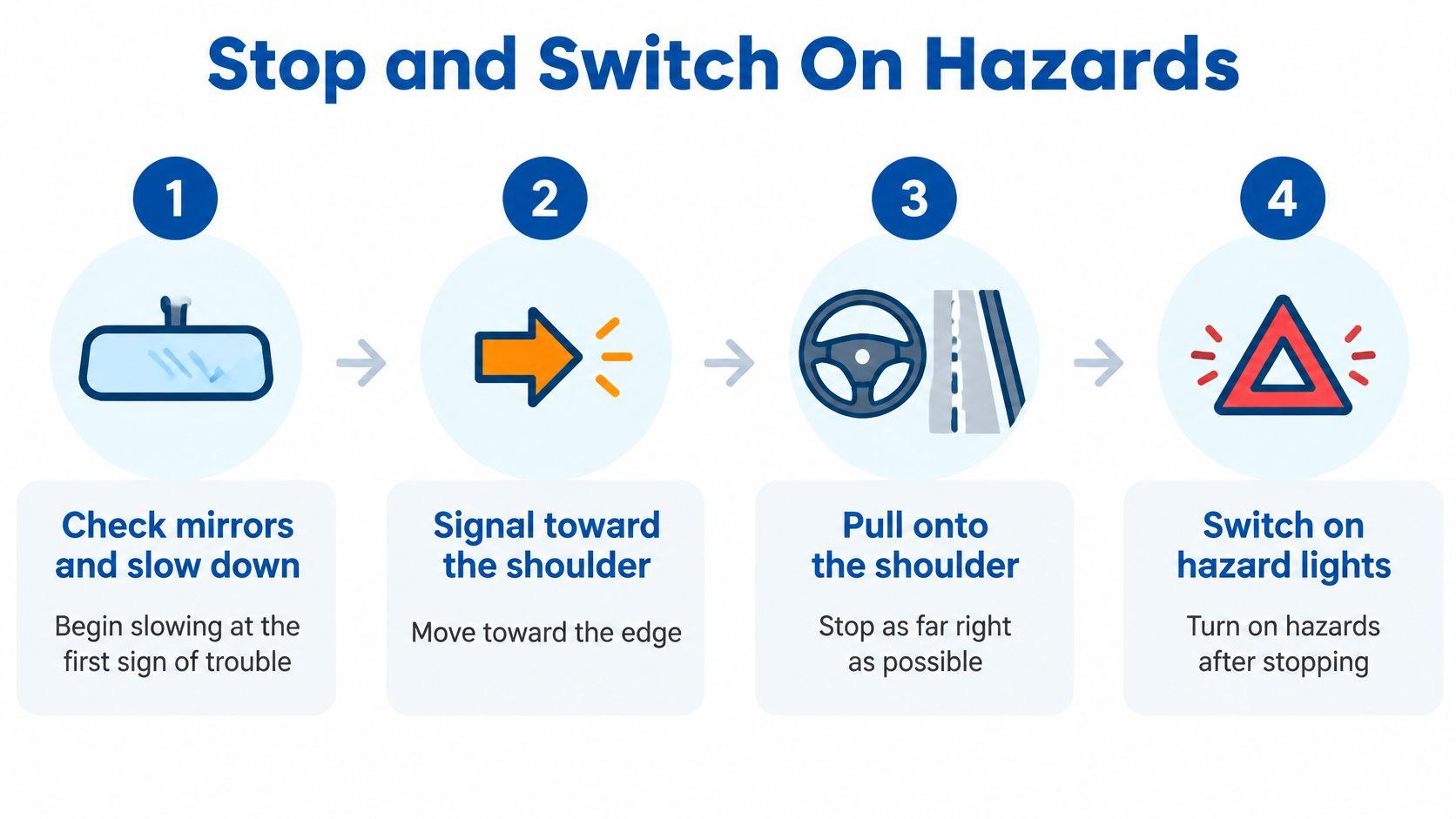
- Check your mirrors and start slowing at the first sign of trouble. Waiting for a perfect gap usually means slowing down inside a live lane, which is the exact position you're trying to leave.
- Signal toward the edge. The indicator tells drivers behind which way the car is going. It goes on before the flashers, because it's announcing a move rather than a state.
- Ease the car parallel to the curb or road edge and stop about 30 cm from it. The MTO Driver's Handbook sets that gap and gives the reason behind it: leave room so you don't block traffic.
- Stop clear of the travel lanes. If the shoulder is narrow, take the widest part of it. A car with flashers on that sits half in a lane is a bigger problem than a car sitting fully outside one.
- Cancel the turn signal. Two signals arguing with each other is worse than one clear signal.
- Press the hazard button. All four corners flashing together reads as "stopped vehicle" rather than "turning vehicle".
- Keep yourself out of the traffic flow and call for help if the car isn't going anywhere. Work from the side away from moving vehicles, not the traffic side.
Why the sequence is signal first and flashers second
A turn signal announces one specific manoeuvre. Four-way flashers announce a condition that lasts. The handbook's sequence, reduce speed steadily, pull parallel to the edge, avoid blocking traffic, then cancel the indicator and switch on the hazards, keeps those two messages apart. The moment they overlap, the driver behind stops reading either one.
The slips that show up most often
- Flashers before the car is stopped. Drivers hit the button at highway speed and then coast, which warns people about a stop that may still be a kilometre away.
- Stopping in the lane when the edge was reachable. A hundred metres of driving on a rim beats a stopped car in a live lane, every time.
- Hugging the curb so the driver's door opens into traffic. Pull close as the handbook says, then check the mirror before you swing the door out.
Where the car sits and which lights it shows overlap more than most learners expect, and the guide to parking lights on a car covers the standing-vehicle rules that sit behind this manoeuvre.
A safe finish looks like this: the car is well clear of moving traffic, all four corners are flashing, you're standing on the safe side, and you know whether you're waiting for a tow or driving away.
Breakdowns on Freeways and Other Emergencies
A car losing power at 100 km/h isn't a slow-moving car. It's a stopped car that hasn't stopped yet, and every second you spend deciding is a second the traffic behind you spends closing the gap.
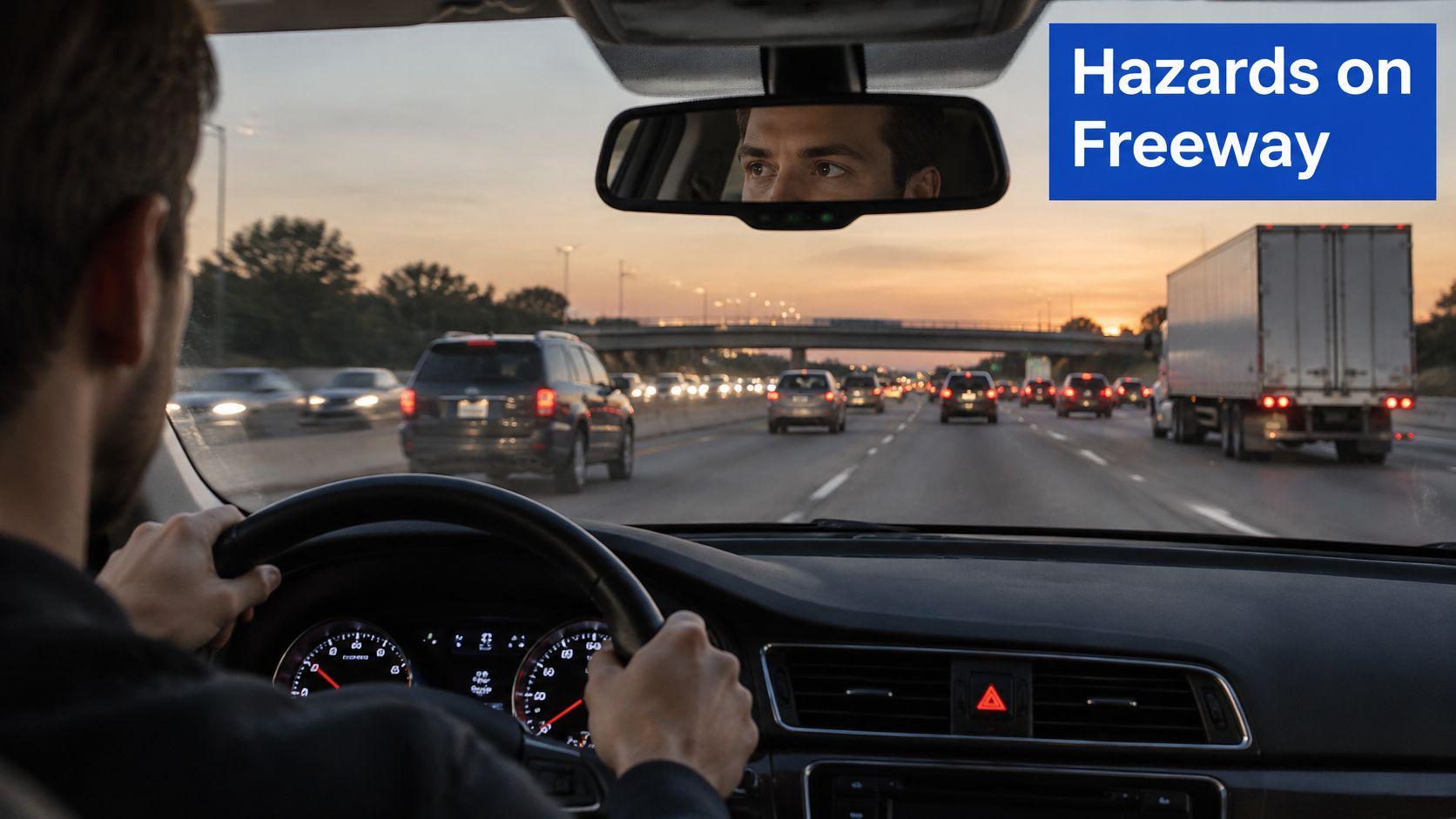
The instinct in that moment is to keep rolling with the flashers going, as if the lights grant a temporary right to travel slowly in a live lane. They don't. The MTO handbook's emergency guidance is to begin pulling over at the first sign of trouble, check the mirrors, switch on the hazard lights, take your foot off the accelerator and reach the nearest shoulder as quickly as possible, and it warns plainly against stopping in a freeway driving lane.
The slow-driving myth worth ending
Hazard lights are a temporary visibility warning. They aren't permission to keep travelling indefinitely, permission to stop in a live lane, or permission to treat the shoulder as a normal driving lane.
Picture a car losing power in the left lane of a busy 400-series highway. The driver who understands the button doesn't roll along at 40 km/h with all four corners blinking and hope for the best. They warn the traffic behind, find a gap, cross the lanes and stop fully outside the travel lanes. On a road where the basics of highway driving include a minimum speed, a crawling car is a hazard to everyone approaching it.
Failed headlights at night follow the same logic with a shorter bridge. The flashers go on so the car is visible, and the car comes to a safe stop off the road, because driving at night without lights is dangerous and illegal. The lights get you to the shoulder. They don't get you home.
Commercial vehicles carry an extra layer of warning. A truck or trailer that's disabled, stalled, broken down or in a collision should be moved as far off the roadway as safely possible with the flashers left on. Where it can't leave the road, visibility is limited and the speed limit is over 60 km/h, the MTO Truck Handbook requires an approved warning device about 30 metres (100 feet) in front of the vehicle and the same distance behind it.
Switching Hazards Off and Rejoining Traffic
The stop is only half the job. Leaving is the other half, and it's where the flashers have to come off. They stay on for as long as the car is stationary and forming a visibility or collision risk. The moment you're ready to move, they've done their work.
- Check the mirrors and the shoulder before anything else, including the traffic approaching in the lane you want.
- Confirm the move can be made safely. A shoulder on a fast road gives you a short run-up, so the gap you pick has to be a real one.
- Switch the hazards off. This happens before the car moves, not during.
- Show the turn signal for the direction you're joining, then build speed and merge.
The reason for that order sits in how the lights look from behind. Four-way flashers blink on both sides at once, so a following driver can't tell a left turn from a right turn while they're running. Switching them off and showing one indicator restores a clear message.
Ontario's Highway Traffic Act recognises vehicular hazard-warning signal lamps, the four-way flashers, as an exception to the general restriction on lamps that produce intermittent red flashes. In plain terms, the system built into your car is legal equipment and isn't treated as unauthorised flashing. The same Act requires a driver to make sure a move can be made safely before moving from a parked or stopped position, so pressing the button doesn't hand you the right of way to pull out.
Two situations make that concrete. Waiting on a shoulder for a gap in fast traffic is the first: the flashers stay on until the gap is real, then they go off and the indicator takes over as you build speed. A tow operator arriving is the second: follow their direction, stay clear of the work area, and let them tell you when it's safe to move.
The habit worth building: hazards on while you're stopped, hazards off before the wheels move.
Responding to Other Drivers' Hazard Lights
Everything so far is about your own car. The other half of the skill is reading the cars around you, and flashing lights ahead are information you act on early rather than study up close.
The method is short. Ease off the accelerator as soon as you see flashers, scan the mirrors, move over a lane if it's clear and safe to do so, and don't stop behind the vehicle that's already pulled over. Stopping behind a broken-down car puts a second stationary obstacle beside a live lane.
Three scenes you'll meet on Ontario roads:
- A car on the shoulder with hazards on. Someone may be standing beside it. Give the space, because a door can open without warning.
- A tow truck working at the roadside. The operator is often outside the truck, between it and traffic. Change lanes if you can, and slow down if you can't.
- A police car with lights flashing. This is the case the law is built around, and the drivers who ignore it are the ones who get ticketed.
That last point has a price attached. In 2025, the Ontario Provincial Police issued approximately 170 Slow Down, Move Over tickets to drivers who failed to change lanes or slow down near emergency vehicles with flashing lights, as reported by BradfordToday.
Most drivers already treat flashing lights as a cue. In 2025, 64% of drivers observed by the AAA Foundation for Traffic Safety slowed down or moved over when approaching roadside emergency activity, a figure reported by CAA North & East Ontario. The behaviour is common because it works.
Flashing lights ahead mean slow down and make space. They never mean stop and take a look.
Check Your Hazard Light Choices Before Test Day
An examiner isn't grading a recital of situations. They're watching the transition between lights, because that's the part that carries onto real roads after the licence arrives.
Run this four-step check until it's automatic:
- Decide what the car is. Is it doing something ordinary, or has it become an unusual obstruction?
- If it's ordinary, leave the hazards off. Rain, a turn, a legal park: headlights or the turn signal do the job.
- If it's a breakdown, collision or failed lights, get the car out of the live lane first. The flashers stay on once it's stopped.
- Before any move away from the curb or shoulder, confirm the move is safe, cancel the hazards, then show the turn signal.
An examiner who says the car is losing power on a freeway is watching whether you stay in the lane. One who says you're pulling away from a curb is watching whether the turn signal, not the hazards, is showing before the wheels move.
For extra drills, the safe driving section of our 100-question G1 Practice Test covers defensive driving, hazard perception and how to act appropriately in an emergency situation, and the topic quizzes on intersections, signals and right-of-way explain a wrong answer on the spot. Say the light and the next action out loud during practice until the order stops needing thought.
G1ready.ca exists to help Ontario learners understand the rules rather than memorise them. Our free, registration-free practice exams mirror the structure of the official assessment and give instant feedback on every question, so a wrong call on hazards or signals becomes a correction instead of a habit. Work through a mixed test at G1ready.ca before your next lesson and bring the results to your instructor.