It's a Tuesday evening in Collingwood, the MTO Driver's Handbook is open at the kitchen table, and someone in the house has just turned 16. Maybe you're the one studying. Maybe you're the parent who has been asked to sit in the passenger seat for the next year of practice drives. Either way, the same question tends to surface before anything else happens: what comes first?
The G1 is where nearly every Ontario driving story starts, and it's also where most of the confusion lives. The rules look like a list of restrictions. They work more like a set of stages, each one opening the way to the next. Once you can see the stages clearly, the studying, the booking and the practice driving all get simpler.
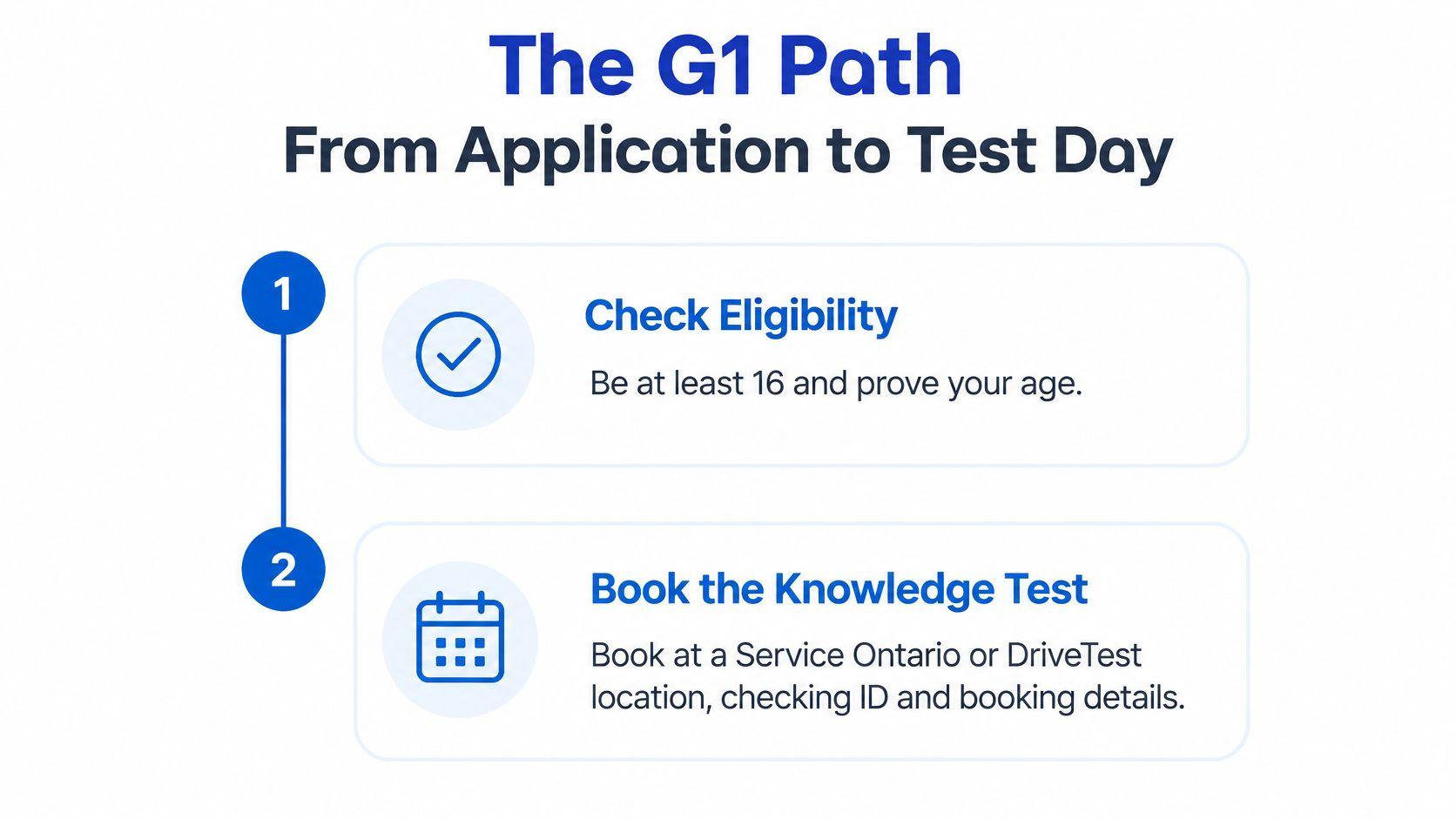
The G1 Path From Application to Test Day
Ontario's licensing system isn't a single event. It's five gates, and each one opens only after the one before it is cleared. Find the row you're standing in and the next move becomes obvious.
Stage What You Do What You Need 1. Check eligibility Confirm you are at least 16 Proof of age 2. Book the knowledge test Choose a Service Ontario or DriveTest location Identification and booking details 3. Pass the knowledge test Score at least 16 of 20 on road signs and on road rules Study time with the Ontario handbook 4. Hold the G1 licence Drive only under G1 conditions with a qualified accompanying driver Supervising driver for every drive 5. Progress to G2 Book the G2 road test after the minimum G1 period Logged G1 time and the current MTO minimum period, confirmed before you book
Two stages cause most of the lost time: eligibility and booking. A learner who arrives with the wrong identification document loses the appointment, and in busy months the next available slot can be weeks away. That's why the document check comes first, before anything is booked.
Here's the booking sequence in the order that avoids repeat trips.
- Confirm your identity documents against the current MTO list of accepted ID. This is the single most common reason people lose a booking, so settle it before you pick a date.
- Find your nearest centre and check its current hours and whether an appointment is required or walk-ins are accepted.
- Book your test, or arrive during open hours if that location handles walk-ins.
- Set a study window of two to three weeks. Long enough to work through the handbook properly, short enough that you don't forget the early chapters.
- Plan the day itself. Eat something, get enough sleep, bring your glasses if your licence will require them, and arrive early enough to settle in.
- Sit the computer-based test and read every question in full. Wording like "must" and "may" changes the answer, and the test shows your score for each section as soon as you finish.
- Act on the result. Pass and you take your documents to the next counter to complete the licence. Fail and you check the retest waiting period, then rebook.
Each stage depends on the last. A missing document or a failed section doesn't just cost a day, it resets the timeline for everything downstream.
Before you leave the house: original ID, any required forms, your glasses if you need them to drive, and your booking confirmation details.
What the G1 Knowledge Test Covers
The scoring rule catches more candidates than any single question. The test has two scored sections, and you must reach the pass mark on each one separately. A strong score on road signs will not rescue a weak score on road rules.
Section Questions Pass Mark Topics Covered Road signs 20 16 Regulatory, warning and guide signs Road rules 20 16 Right-of-way, lane changes, parking, signals, impaired driving and demerit points
Road signs splits into three families, and the test expects you to recognise each on sight. Regulatory signs tell you what the law requires, such as a stop sign or a posted speed limit. Warning signs flag a hazard ahead, such as a curve, a hill or a school zone. Guide signs give direction and distance information, such as highway exits and the distance to the next town. Learn them by colour and shape first, because that's how they're grouped on the road and how you'll spot them at a glance.
Road rules draws on the Ontario Highway Code. Expect questions on right-of-way at intersections, lane changes, parking rules and signals, plus the consequences side of driving: impaired driving and demerit points. These are the questions that reward understanding over memorisation. If you know why a rule exists, the answer usually follows.
Practical rule: track your practice scores section by section. A candidate who clears the pass mark comfortably overall but sits below it on road signs is not ready.
A Study Routine That Builds Test-Ready Skills
Most failed first attempts don't come from a lack of effort. They come from studying without feedback, which means nobody ever finds the weak topic until the screen does. Build the routine around finding gaps early.
- Take a diagnostic practice test first. You want to know which topics you already handle and which ones need work before you open the handbook. Guessing wastes weeks.
- Work through the handbook chapter by chapter, starting with whatever your diagnostic missed. The chapters you already know go faster on a second pass anyway.
- Group road signs by colour and shape. Red and white for regulatory, yellow for warning, green or blue for guide. Grouping gives your memory a structure to hang individual signs on.
- Study in twenty to thirty minute blocks, one topic at a time. A focused half hour on intersections beats a four-hour weekend session you can't recall by Wednesday.
- Run a full timed mock test once a week. Time pressure is part of test day, and weekly timing shows you whether your scores are holding up on both sections.
- Review every wrong answer and rewrite the rule in your own words. If you can't explain why the right answer is right, you'll miss the same question when it's phrased differently.
- Schedule a light review two days out and skip new material the day before. Cramming a fresh chapter the night before tends to shake loose things you already knew.
A structured set of G1 licence study materials helps here, particularly if it separates road signs from road rules so your practice scores map onto the two real sections.
How do you know you're ready? Three full practice tests in a row above the pass mark on each section, with no single weak topic left unreviewed. If road rules keeps landing at 15, you're not there yet, no matter what the overall average says.
G1 Restrictions That Shape Every Drive
The G1 restrictions read like a list of things you can't do. Look at them together and they're a control system, designed to limit a new driver's exposure while skills catch up with confidence.
Rule Limit Risk It Controls Blood alcohol Zero for the G1 driver Impairment Passengers Every occupant must wear a working seatbelt Injury in a crash Time of day No driving from midnight to 5 a.m. Fatigue and low visibility Road type No 400-series highways or high-speed expressways such as Highway 401, the QEW or the Gardiner Expressway High speed and merging exposure Accompanying driver Fully licensed, at least four years of experience, blood-alcohol concentration below 0.05, or zero if 21 or younger Lack of experience and supervision
The rules work as a linked system, which is exactly how Ontario's graduated licensing documentation frames them. Supervision supplies experience the learner doesn't have yet. Time and passenger limits cut exposure to the situations where peer distraction does the most damage. The alcohol rule removes impairment entirely rather than trying to manage it.
Distraction deserves its own line here. Ontario reports that drivers aged 16 to 25 are more likely than any other age group to drive distracted, and are the most likely to be killed or injured in a distracted-driving collision. For a G1 holder, the phone in the cupholder is a bigger risk than any sign on the test.
Pre-trip check: run the trip through six filters before you turn the key. Licence level, time of day, road type, passengers, impairment and distraction. If any filter fails, change the plan, not the rule.
This classification habit is what separates a learner who memorised the handbook from one who can apply it. A route that's legal at 4 p.m. with a qualified supervisor may be illegal at 12:30 a.m., or once the route app reroutes onto Highway 400. For a walkthrough of each restriction and the reasoning behind it, this guide to Ontario's G licence restrictions follows the same order as the table above.
Collingwood Roads and Young Driver Collision Risk
Provincial data gives the clearest age-specific baseline available for local learners. In 2021, Ontario had 85,608 licensed 16-year-old drivers, and 494 of them were involved in a reported collision, an involvement rate of 0.58 per cent, split 0.64 per cent among males and 0.51 per cent among females, according to Ontario's Road Safety Annual Report.
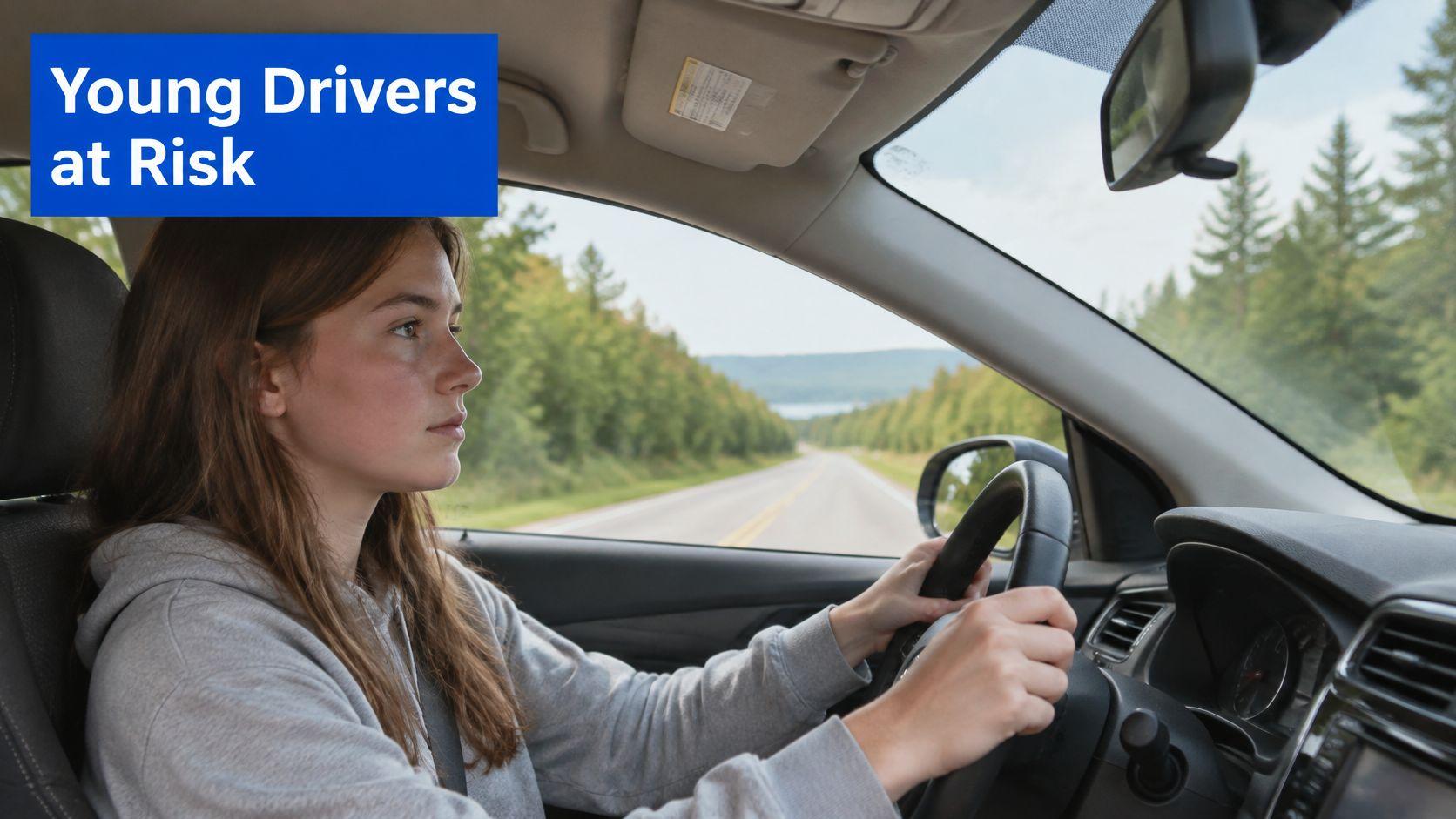
Risk climbs with experience, not away from it. The same report series recorded 679,825 licensed drivers aged 21 to 24 and 33,164 of them in collisions, an involvement rate of 4.88 per cent. The longer trend is genuinely encouraging: between 1998 and 2017, casualties among 16 to 19-year-old drivers fell by 50 per cent. Encouraging still isn't solved.
Locally, the picture is one of volume. The Collingwood and The Blue Mountains OPP detachment recorded 45 non-fatal injury collisions and 579 property-damage-only collisions in one reported year, including 57 speed-related and 143 inattentive-related collisions, per the detachment's board annual report. Those figures cover every driver on local roads, not just young ones, so treat them as community context rather than a youth rate.
Three priorities follow for anyone learning here. Scan for hazards early rather than reacting late, adjust speed to weather and road conditions instead of the posted number alone, and keep full attention at intersections, where most of the avoidable conflicts happen.
Why Passing the G1 Is Not the Same as Being Ready
A pass on test day proves you can recognise signs and recite rules. It doesn't prove you can judge a gap in traffic on a wet November evening. Ontario's own audit data makes that gap uncomfortable to look at.
The province's Auditor General report on driver training found that novice drivers who used the Beginner Driver Education time discount had a higher rate of causing collisions for roughly six months after obtaining their G2 licence. The same audit found that drivers who had passed both the G2 and G road tests later had a 6.31 per cent collision rate, against 3.60 per cent for average newly licensed G-class drivers.
That second figure deserves a plain reading. It doesn't say testing makes people worse. It says the skills that get you through a road test and the skills that keep you out of a collision aren't the same set, and the second set takes longer to build.
So the question for a Collingwood family isn't "how fast can we get through the system". It's "how much structured practice sits behind the licence". A shorter timeline is a legitimate choice, as long as it's a choice and not an accident.
A practice plan that closes the gap:
- Log supervised hours across varied conditions. Rural roads, rain, dusk and snow each teach something dry daylight can't. Keep a simple running total so you can see what's missing.
- Practise highway transitions with a qualified supervisor before any independent highway driving. Merging is a skill, not an instinct.
- Keep your own passenger limits for the first months of solo driving, even after the legal restrictions lift.
- Revisit the basics monthly. Shoulder checks and following distance can degrade when nobody's watching.
Test success marks the start of safe driving. It has never marked the finish.
Timeline From G1 to G2 Without Shortcuts
Treat the road to G2 as a sequence of conditions rather than a date on a calendar. The minimum G1 holding period is the number most likely to change, so confirm it against current MTO rules before you plan anything around it.
- Record two dates. The day you passed the knowledge test, and the day your G1 holding period began.
- Log supervised drives as you go, including rural roads, rain and dusk, with a running hour total.
- Confirm both requirements before booking: the minimum period has passed, and your logged practice meets the standard.
- Book the G2 road test with the same document and location checks you used for the knowledge test.
- Practise highway and night driving with a supervisor before you drive those conditions alone.
Beginner Driver Education can shorten the holding period, but a compressed timeline isn't automatically a safer one. Track each checkpoint separately. A missed step or a failed test resets only the stage it belongs to, not the entire plan.
Book Your G1 Test and Start Practising Today
The decision in front of you is small and specific: book the knowledge test, or start a structured study plan this week. Everything else follows from that.
Three things first. Confirm your eligibility and the identification you'll bring. Choose a test location and check its hours and contact details before you travel, using the interactive map of Service Ontario and DriveTest locations, which lists addresses, hours, contact information and the licence services offered at each. Then take a diagnostic test so your study time goes where it's really needed.
If you want a structured route through the material, G1ready.ca offers four practice tests, the Road Rules Test, the Road Signs Test, the 200-Question Test and the Diagnostic Test, alongside free practice tests with instructor-reviewed answers. Use them as one option among several, alongside the handbook and your supervised driving hours.
Today's action is one of two things: book the knowledge test, or complete the diagnostic test. Whichever comes first, write down the result by section.
G1ready.ca is built for Ontario learners working through exactly this stage, with practice tests aligned to the 2026 Ontario MTO Driver's Handbook, free registration-free quizzes, instructor-reviewed answers and a streak system that keeps daily study honest. Whether you're a teen in Collingwood preparing for the knowledge test or a parent helping a new driver build habits that outlast test day, the diagnostic test is the fastest way to see where to start. Visit G1ready.ca and take the diagnostic test before the week is out.