
You might be here with a simple question that turns into five more the moment you start reading Ontario licensing rules. You pass the written test and get your G1. Then someone tells you not to drive after midnight. Another person says you can't use the 400-series highways. A parent asks when you'll be ready for your full licence, and suddenly “driver license G” sounds less like one licence and more like a long staircase.
That confusion is normal. Most learners don't struggle because they're careless. They struggle because Ontario's system asks you to grow into driving one layer at a time. If you only study to pass the G1 knowledge test, you can miss the rules that matter most once you're on the road.
This guide follows the full path from G1 learner to full Class G licence. The goal isn't just to help you get through a test. It's to help you understand what changes at each step, where new drivers usually get tripped up, and how to move forward with fewer surprises.
Understanding Ontario's Graduated Licensing System
A lot of new drivers think they're applying for one licence and then discover they're entering a process. Ontario does it this way on purpose. You don't start with every driving privilege on day one. You earn them in stages.
Learning to swim starts in the shallow end with an instructor close by. Then you move into deeper water where you can do more on your own, but you're still building judgment. Only after that do you swim independently. Ontario's licensing ladder works much the same way.
The three stages in plain language
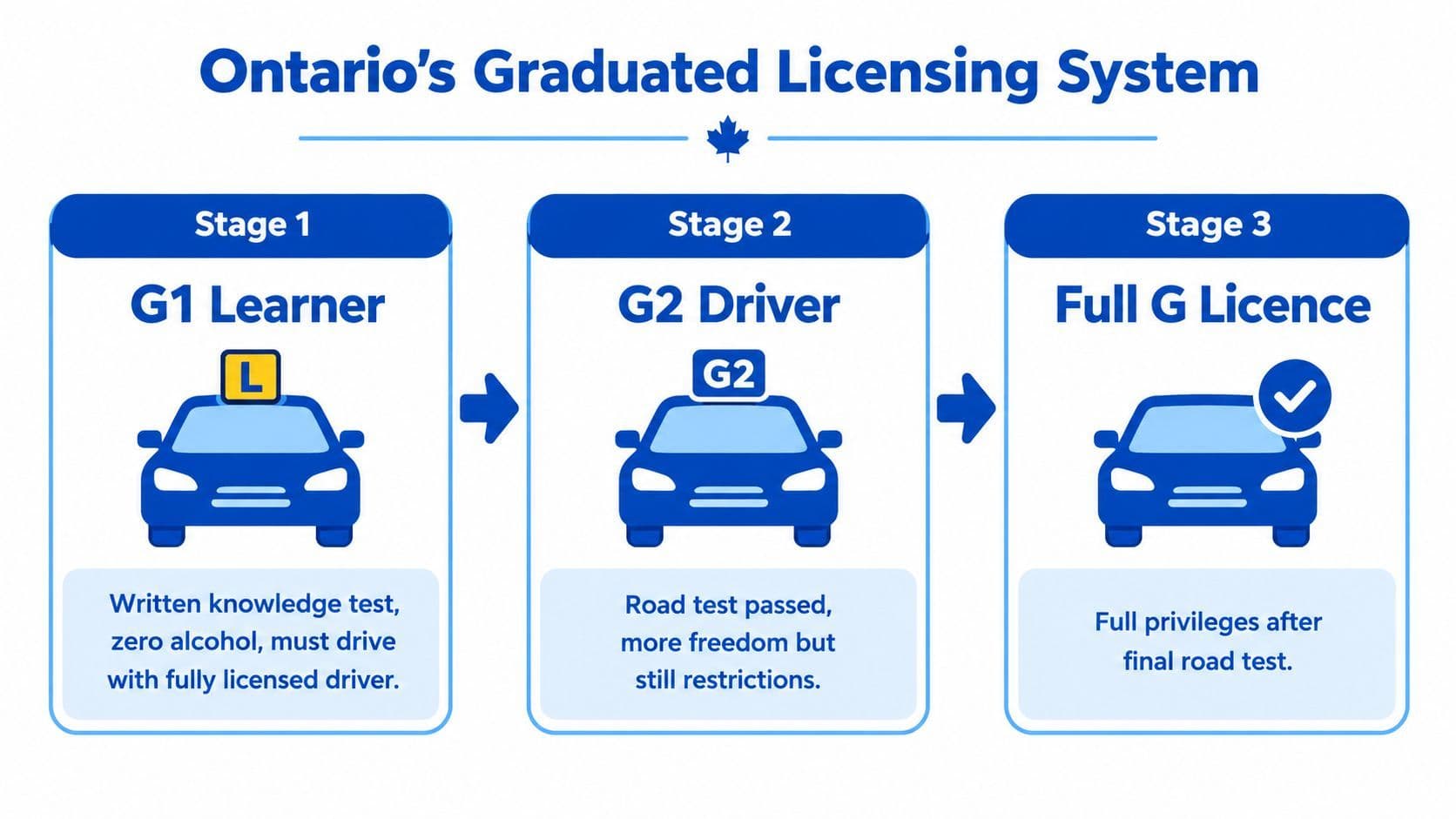
Ontario's official licence page says you must complete two learning levels, G1 and G2, and pass two road tests before getting a full G licence, which makes G1 the first required step in the system. You can see the structure on the Ontario licence pathway explained here.
Here's the simplest way to picture the ladder:
Stage What it means in everyday terms What you're building G1 Learner stage with close limits Basic habits and supervised confidence G2 More independence on real roads Decision-making in everyday traffic Full G Standard passenger driving privileges Consistent safe driving without novice limits
The part many learners miss is that each stage prepares you for the next one. G1 isn't just paperwork. G2 isn't just a waiting room before full G. Each level gives you a little more freedom and expects a little more judgment.
Why the timing matters
Ontario also ties progress to time spent driving at each level. The province's graduated licensing framework requires a minimum of 12 months at G2 before attempting the full G road test, though that wait can be reduced when an applicant presents at least 12 months of foreign driving experience, according to the Ontario graduated licensing rules.
Practical rule: Ontario isn't only testing whether you can drive. It's also asking whether you've had enough time to build steady judgment.
That matters for newcomers, teens, and adults getting licensed later in life. Different people start at different ages, but the system still follows the same logic. First you learn the rules. Then you practise under limits. Then you prove you can handle the full road environment.
What Makes Class G Different from G1 and G2
People often say “I'm getting my G” when they really mean one of three different things. That's where confusion starts. G1, G2, and full G are related, but they are not interchangeable.
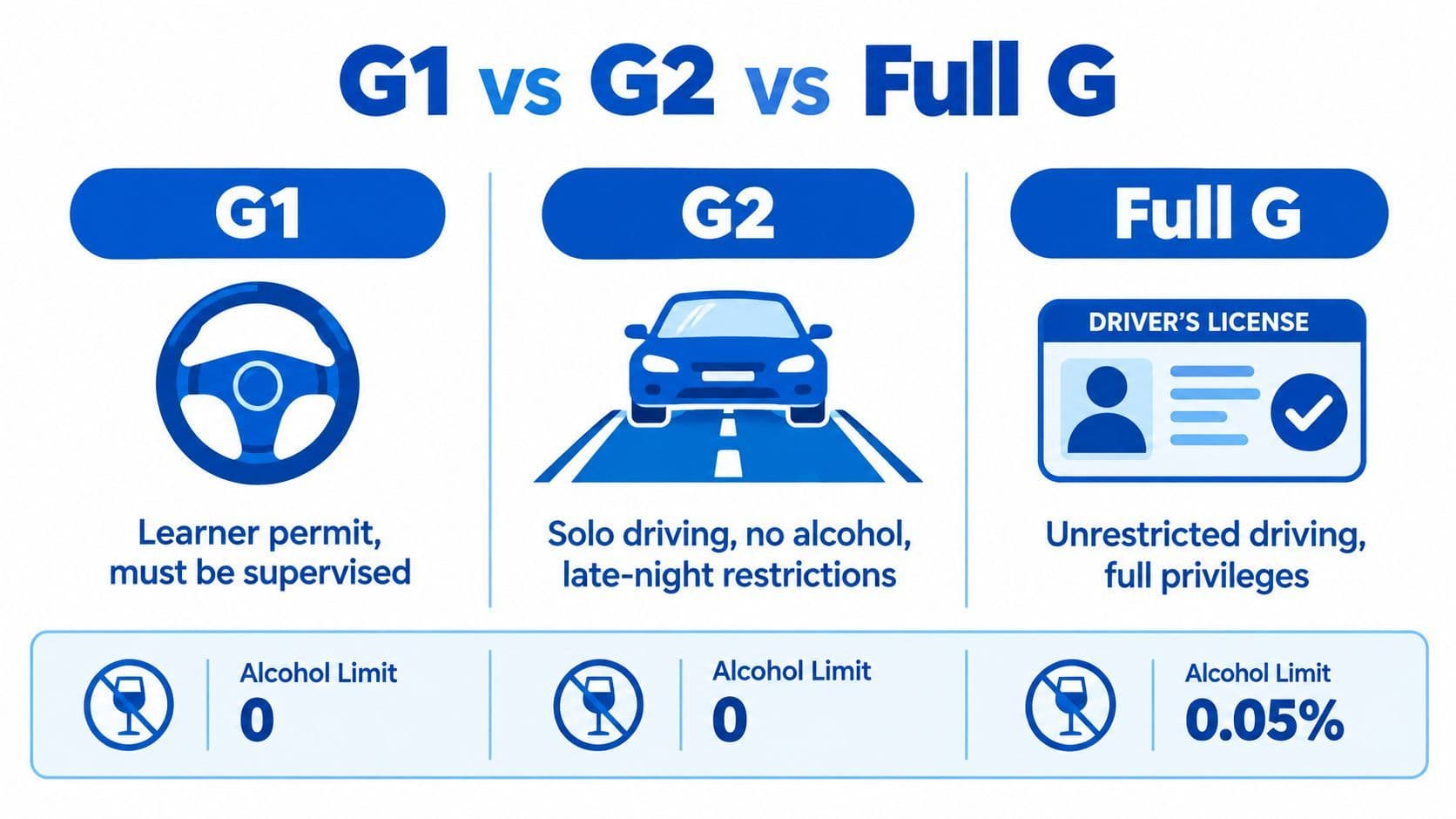
The easiest way to separate them is to ask four questions. Can you drive alone? Can you use all regular highways? What alcohol rule applies? What kind of vehicle does the licence cover?
The practical differences
This comparison helps:
Licence stage Solo driving Highway access Alcohol rule Big idea G1 No Limited Zero Learning under supervision G2 Yes Broader access Zero Independent driving with novice obligations Full G Yes Full normal access Standard Class G rules apply Full passenger-vehicle privileges
A full Class G is the point most Ontario drivers are aiming for. It's the standard licence for everyday passenger driving. Ontario says a Class G licence covers cars, vans, small trucks, and combinations of vehicle plus towed vehicle up to 11,000 kilograms, with the trailer itself capped at 4,600 kilograms, as set out in the Ontario driver's handbook licence class description.
That weight rule sounds technical until you picture a real example. A family pickup towing a house trailer may still fall within Class G if the combined rating stays inside the provincial limit. In other words, “full G” doesn't just mean more freedom than G1 or G2. It also defines the normal passenger-vehicle category most non-commercial drivers use.
Why the labels matter
A lot of learners treat G1 and G2 like temporary stickers on the way to the “real” licence. That mindset causes mistakes. Each label tells police, examiners, insurers, and supervising adults what privileges and responsibilities apply at that moment.
If you want a clearer side-by-side explanation, this guide to G1, G2, and full G differences can help sort out the terms.
Full G is not a better-looking version of G2. It's a different level of legal driving privilege.
That's why it helps to stop thinking of the driver license G journey as one test. It's better understood as a progression from supervised driving, to independent practice, to full responsibility.
Class G1 Requirements and Common Mistakes
The G1 stage is where most misunderstandings happen because the rules are strict, specific, and easy to half-remember. A learner might know they need another driver in the car, but not realise that not every licensed adult qualifies.
Ontario's official handbook says Class G1 is the starting point for most new drivers. It also says G1 holders may drive only Class G vehicles with an accompanying fully licensed driver who has at least four years of driving experience. The same source says a G1 driver must keep a zero blood-alcohol concentration, can have only the accompanying driver in the front seat, must not drive between midnight and 5 a.m., and generally cannot use Ontario's 400-series highways or high-speed expressways unless supervised by a licensed driving instructor. The G1 stage lasts at least 12 months, but that waiting period can be reduced to 8 months by completing an approved driver education course, according to the Ontario road safety annual report and handbook summary.
The restrictions learners mix up most often
Here are the rules that tend to cause trouble in real life:
- Who can supervise you: The person beside you must be more than “someone with a licence.” The accompanying driver must hold a valid Class G licence or higher, have at least four years of driving experience, and keep a blood-alcohol level below 0.05%, as noted in the official Ontario accompanying driver requirements.
- When you can drive: Midnight to 5 a.m. is off-limits for G1 driving. Learners often remember the supervision rule and forget the clock.
- Where you can drive: Many beginners assume a supervised drive automatically allows any road. It doesn't. The highway restriction is one of the easiest rules to break by accident.
- Front seat confusion: The accompanying driver is the only person allowed in the front seat with the G1 driver.
Everyday examples that clear up the grey areas
Say your older cousin has a licence and offers to supervise you. That sounds fine until you ask the important follow-up questions. Do they have the right class of licence? Do they have enough experience? Are they legally fit to supervise at that moment?
Or picture a learner leaving a late shift at 12:15 a.m. with a parent in the passenger seat. The learner may feel compliant because they aren't alone. But the time restriction still applies.
Common trap: A rule isn't optional just because the road is quiet, the trip is short, or the supervising driver seems experienced.
How to avoid beginner errors
A simple checklist before each G1 drive helps more than cramming handbook pages:
- Check the driver beside you. Are they qualified to supervise today, not just in general?
- Check the route. Don't assume your navigation app avoids restricted roads.
- Check the time. If a trip could run past midnight, make another plan.
- Check yourself. Zero BAC means zero. Not “almost none.”
Most G1 mistakes aren't reckless. They're rushed, casual, or based on bad advice from another novice driver.
Advancing from G1 to G2 and Building Experience
Once you've settled into G1, the next question is usually, “When can I move up?” That's the right question, but there's a better one underneath it. “How do I use this stage so I'm ready?”
Ontario's official licence page says applicants must complete G1 and G2 and pass two road tests before getting a full G licence. That's the basic map set out on the Ontario new driver licence page.
What changes when you earn G2
The biggest emotional shift is simple. You can drive on your own. For many learners, that feels like the moment driving becomes real.
That new freedom can create overconfidence if you treat G2 like “full G lite.” A better mindset is this: G2 is your practice stage for independent judgment. You're no longer proving that you can memorize signs. You're proving that you can manage traffic, speed choice, lane position, timing, and distractions without someone coaching every move.
How to use the waiting period well
The waiting period frustrates learners who want to move faster. But time by itself doesn't build skill. Repetition with attention does.
Use your G1 months to practise situations that beginners avoid:
- Residential driving: Great for turns, stop control, scanning, and right-of-way decisions.
- Busy arterial roads: Useful for lane changes, mirror checks, and reading traffic flow.
- Parking lots and curb work: These low-speed areas expose sloppy steering and poor observation quickly.
- Mixed weather and lighting: Don't let all your practice happen on bright, quiet afternoons.
What parents and supervisors often overlook
Many supervising adults correct only obvious mistakes. They'll notice if you miss a stop sign. They may not notice that you brake late, drift too close to parked cars, or wait too long to decide at an intersection.
A calm learner with weak habits can still fail a road test. Smoothness matters, but observation and judgment matter more.
When you move into G2, try to keep practising with purpose even though you can drive alone. Independent driving is useful. Reflective driving is what makes you better. After each trip, ask yourself what felt uncertain, what you misread, and what took too long to decide.
That's how the path to a full driver license G gets shorter in practice. Not by rushing the calendar, but by reducing the number of surprises when your next test arrives.
Preparing for Your Full G Road Test
By the time you're eligible for the full G road test, most of the obvious beginner nerves are gone. What replaces them is something trickier. Familiarity. You've been driving long enough to feel comfortable, and comfort can hide weak habits.
That's why preparation for the full G test needs a different mindset than G1 prep. You're not just trying to remember rules. You're trying to perform consistently under observation.
G2 habits versus full G expectations
A useful comparison is to ask what examiners expect beyond ordinary daily driving.
Everyday G2 habit What a full G examiner wants to see Driving where you feel comfortable Competence in a wider range of road environments Merging when there's lots of space Timely, confident speed matching and lane choice Checking mirrors casually Deliberate observation at the right moments Getting through the trip safely Showing repeatable technique and judgment
The full G test is where highway driving matters more. Examiners look for clean merges, steady lane discipline, proper following distance, and decisions that show you can read fast-moving traffic without hesitation.
How to practise for the actual test
Many learners prepare in the wrong order. They book first, panic second, and practise only what feels comfortable. A better sequence is the reverse.
- Start with route types, not rumours: Don't chase second-hand stories about one exact test route. Practise highway entries, lane changes, exits, and urban transitions.
- Use focused feedback: If one person always says “you're fine,” that feedback won't help much. Practise with someone who can point out late mirror checks, weak shoulder checks, and rushed merges.
- Review the licensing path clearly: If you need help with timing and test logistics, this guide on booking the Ontario G road test is a practical reference.
- Use study tools for weak knowledge areas: G1ready.ca offers Ontario practice tests, topic quizzes, diagnostic practice, and an exam simulator aligned with the handbook. For some learners, that's useful when road practice reveals knowledge gaps they thought they had already solved.
Road-test mindset: Drive as if you're showing a safe process, not just trying to avoid one big mistake.
A visual walkthrough can also help you picture the pace and expectations before test day.
What to watch for in the final week
Don't spend the last days only drilling parking. Full G is broader than that. Pay attention to the habits that slip when drivers relax:
- Mirror timing before speed or lane changes
- Shoulder checks when they matter, not just when you remember
- Choosing highway speed smoothly
- Keeping space around your vehicle instead of following traffic blindly
The strongest full G candidates usually don't look flashy. They look organised.
Why Thorough Preparation Matters Beyond the Test
A lot of articles stop at “how to pass.” That's too narrow. Passing matters, but the road is where consequences show up.
Recent Ontario reporting highlights that novice-driver enforcement remains active. Ottawa OPP said charges against novice drivers increased from 1,305 in 2024 to 2,376 in the same period in 2025, an 81% jump, according to Ontario reporting on novice-driver charges and language access. That should get every learner's attention.
The risk after the pass
This number matters because many learners study for the test as if the finish line is the licence card. In reality, the risky period often starts after success, when a new driver feels confident but still misses technical restrictions.
The same reporting points to the gap between basic test-prep content and the rules that get novices charged, especially zero-BAC, passenger, and highway restrictions. Those aren't side notes. They're practical compliance rules that affect ordinary evenings, social rides, and weekend trips.
Passing the test proves you met a standard on one day. Safe, legal driving means meeting it every day after that.
Why accessible preparation matters too
Another overlooked issue is language. Ontario materials indicate the G1 knowledge test is available in many languages, and newcomer-focused guidance says it can be offered in 30 plus languages, as noted in the same reporting above. Yet many learners still prepare from English-only explanations that don't clearly define road terms, document expectations, or common licence-stage misunderstandings.
That creates a predictable problem. A learner may understand how to answer a practice question but still struggle with real-world wording at a counter, on a sign, or during a discussion with an instructor or supervising parent.
A better way to think about preparation
Thorough preparation has three parts:
- Rule knowledge: You need the written rules clearly understood, not half-guessed.
- Driving judgment: You need repetition in ordinary situations, not just test-style moves.
- Restriction awareness: You need to know what still applies after you pass your current stage.
If you're teaching a teen, supporting a newcomer, or brushing up as an adult learner, don't frame the process as “just get through the exam.” Frame it as learning the habits and limits that keep you legal once you leave the test centre.
Your Path to a Full Class G Licence
A full Class G licence means more than finishing paperwork. It means you've moved from supervised learning to independent responsibility in a structured way. That structure can feel slow when you're eager to drive, but it exists to build skill before freedom.
For a teen, full G often means true day-to-day independence. For a parent, it can mean relief that the learner has spent time developing judgment rather than being rushed onto faster roads too early. For a newcomer, it can mean settling more fully into life in Ontario with a licence that supports work, family logistics, and ordinary mobility.
What the journey really teaches
The driver license G path teaches more than vehicle control. It teaches patience, planning, and self-checking. Good drivers don't rely on luck. They build routines.
A learner who understands restrictions early is less likely to be surprised later. A G2 driver who practises with purpose is more likely to look composed during the final road test. A full G driver who respects the responsibility behind the licence tends to keep learning, even after the testing stage is over.
A simple way to move forward
If you're at G1, focus on understanding the rules that shape every drive. If you're at G2, focus on sharpening habits that hold up at highway speed and under pressure. If you're close to full G, practise like someone is evaluating your choices, not just your steering.
The best learners don't ask only, “Can I pass?” They ask, “Can I drive safely and legally when nobody reminds me?”
That question leads to better preparation and usually better test results too.
If you're working toward any stage of Ontario's graduated licensing path, G1ready.ca gives you a practical way to study with Ontario-focused practice exams, topic quizzes, diagnostic tests, and a realistic exam simulator. It's a useful companion for learners, parents, and instructors who want clearer preparation from the first G1 study session through the road to a full Class G licence.


