
You're probably sitting on your G2, driving fine in traffic, and still feeling one bad merge away from blowing the whole thing. That's the right instinct. The Ontario driving test full G isn't a casual highway lap, it's the last gate in graduated licensing, and examiners are looking for clean observation, solid control, and calm decisions when speed and space get tight.
Most guides sell it like a city drive with an expressway add-on. That's sloppy advice. The test rewards drivers who can scan, time gaps, hold lane discipline, and prove they can handle highway pressure without drifting into panic braking or lazy mirror habits.
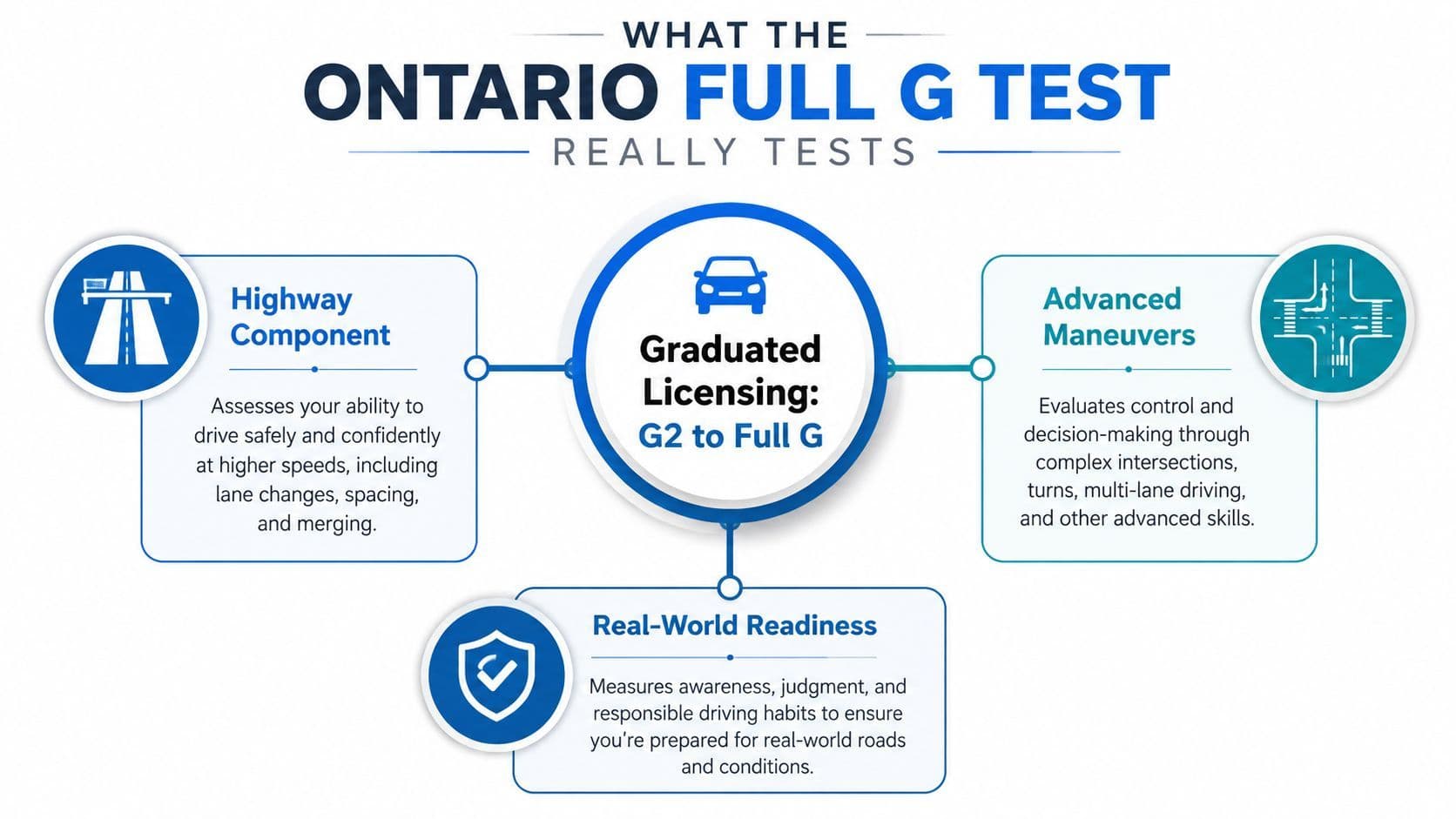
What the Ontario Full G Test Really Tests
The full G is the final stage of Ontario's graduated licensing system, and it's not a glorified lap around town. You have to clear both learning stages first, then take the road test that includes expressway driving, because the province treats full licence readiness as a highway-capable skill set, not just a city-driving one. Ontario's own road-test pathway makes that clear, and the test is tied to the Declaration of Highway Driving Experience, which forces you to account for recent highway time before you even book. The province also requires applicants to hold a G2 for at least 12 months before taking the G test, which tells you exactly what the system expects, time behind the wheel, not wishful thinking. Ontario's full licence pathway is built around that reality.
Stop Thinking Route, Start Thinking Behaviour
The bad habit I see all the time is route obsession. Drivers memorise turns and forget that the examiner is watching hazard recognition and vehicle control, not whether you guessed the right lane at the right light. That's the wrong mental model.
The province's testing system is large and steady. In 2022, Serco administered 1.34 million road tests in Ontario, and about 73% of drivers passed the G road test, with the Auditor General saying the pass rate had been generally consistent over the past five years (Auditor General report). That's not a soft test, and it's not random either. Roughly 1 in 4 candidates still doesn't pass on a given attempt.
Practical rule: If your prep doesn't include sustained highway work, you're practising for the wrong exam.
If you want a plain-language overview of the licence category itself, this Class G licence guide is a useful companion. Keep the framing simple, the full G is a highway-weighted road test, and your job is to prove you can read traffic, hold your lane, and stay controlled when the speed rises.
Eligibility, Documents, and Booking the Test
Show up with the right timing and you avoid the most annoying kind of failure, a wasted booking. Ontario requires you to hold your G2 for at least 12 months before you can take the G road test, and you also need to complete the Declaration of Highway Driving Experience. That declaration asks how many times you drove on a freeway or on a highway with a posted speed limit of at least 80 km/h in the three months before the test. The province is telling you, plainly, that recent highway exposure matters.
Booking the right way
Book through DriveTest only after your highway practice is real, recent, and honest. If you are stretching the truth to get an earlier slot, you are setting yourself up to fail before the examiner even gets in the car. The booking itself should be simple. Your preparation is the hard part.
My advice: book after your highway practice feels routine, not when it still feels daring.
Your check-in can stop the whole day if your paperwork is sloppy. Bring your licence and any vehicle paperwork that applies to the car you are using. If you need glasses to drive, bring them. If you are using someone else's vehicle, make sure it is roadworthy, insured, and set up so you are not fumbling at the curb. I do not care how calm you feel if the car or documents are not ready, because the centre can turn you away.
If your Declaration of Highway Driving Experience is incomplete or inconsistent at check-in, expect delay or a refusal to proceed until it is corrected. That is not the day to explain your way out of a bad declaration. The booking goes smoother when your answers, your practice, and your paperwork all match.
Ontario also keeps a zero-BAC rule for younger drivers. If you are 21 or under, you must have a blood alcohol level of zero, even with full G status (graduated licensing rules). Full licence status does not cancel age-based restrictions.
For the booking flow and the admin details around reserving your slot, use this G road test booking guide if you want a clean checklist before you commit. Once your timing, declaration, and documents line up, the rest is straightforward.
What Examiners Actually Score During the Drive
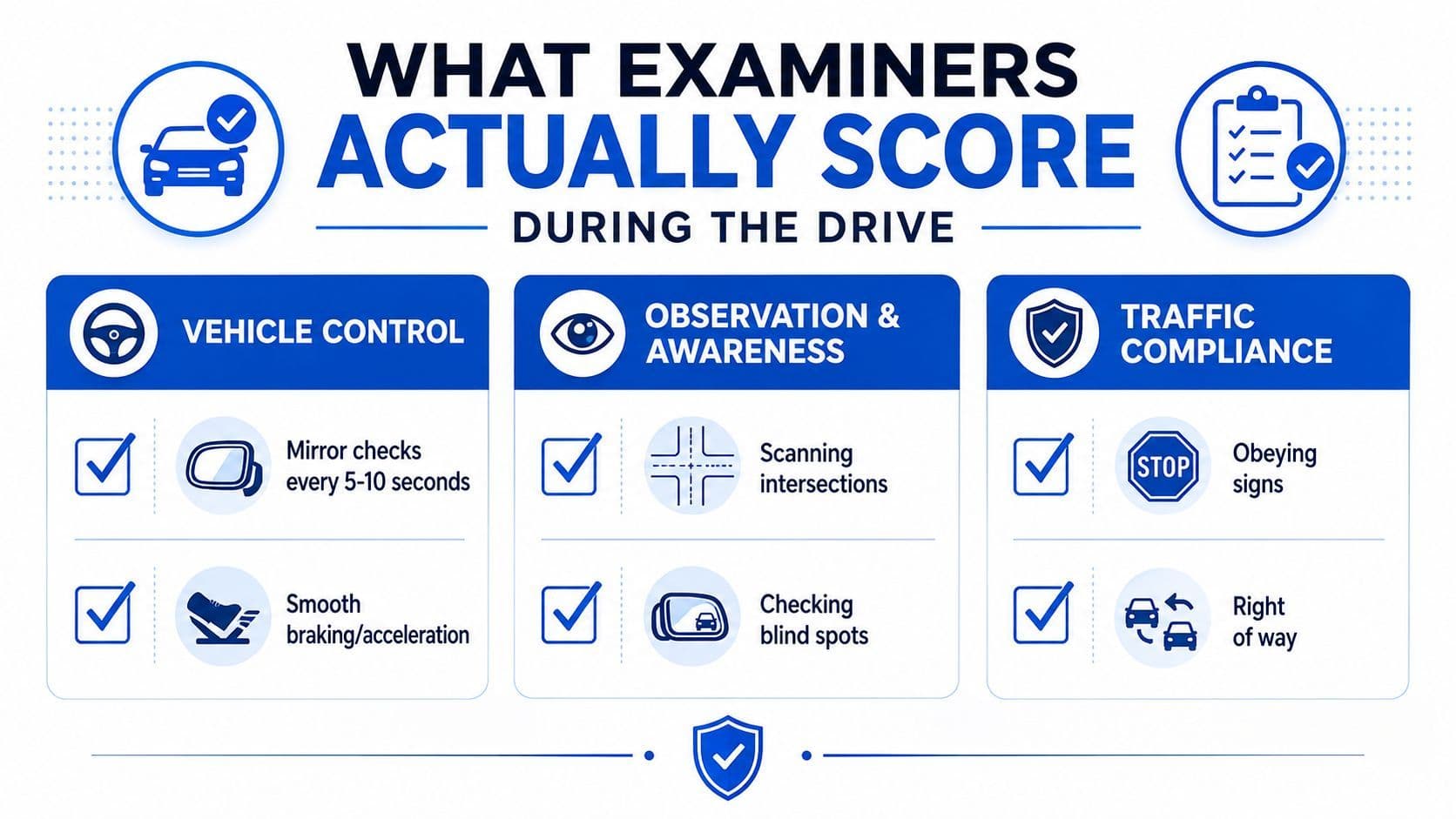
The examiner is not judging your vibe. They're watching for repeatable safe-driving actions, and Ontario's guidance is clear about the behaviours that matter. Mirror checks need to happen every 5 to 10 seconds, blind-spot checks must happen before lane changes, following distance should stay at two to three seconds, and safe left turns require a left-ahead-right scan with the turn completed within four to five seconds when conditions allow (DriveTest road tests guidance). That is the scoring language, not folklore.
The checklist in the examiner's head
Think of every manoeuvre as a short routine:
- Mirror scan first: Check mirrors before you commit to a move, not after.
- Signal early and clearly: Give other drivers time to react.
- Shoulder check every time: Especially before lane changes and pull-outs.
- Hold your speed steady: Don't surge, then brake, then surge again.
- Leave the gap: Two or three seconds is your buffer, not a suggestion.
That's how examiners catch people. They don't need a dramatic error. They mark the small misses, because the system treats faults as individual events against a defined safe-driver standard rather than by vague overall impression. Similar full-licence examiner guidance uses that same model, and the common failure points cluster around missed shoulder checks, late mirror checks, and inconsistent speed during merges or lane changes (examiner assessment guidance).
The highway portion deserves extra respect. That's where lazy spacing, timid merges, and sloppy mirror use get exposed fast. In the city, you can sometimes recover from a weak move. On the expressway, weak habits compound.
Practical rule: If you can't say your mirror-signal-shoulder-check routine out loud, you haven't drilled it enough.
This is why route memory doesn't save anyone. The scoring is about whether you can repeatedly show observation, safety judgment, and vehicle control while the traffic keeps moving. If your hands are okay but your eyes are late, you're not ready.
High-Yield Practice Drills That Move the Needle
Stop practising every possible driving situation and start drilling the ones that cost marks. Ontario's full G is shaped by highway experience, so the highest-value sessions are the ones that train merge timing, lane discipline, and speed stabilisation under traffic pressure rather than generic city wandering (DriveTest road tests guidance). That's the honest focus.
Highway drills that actually matter
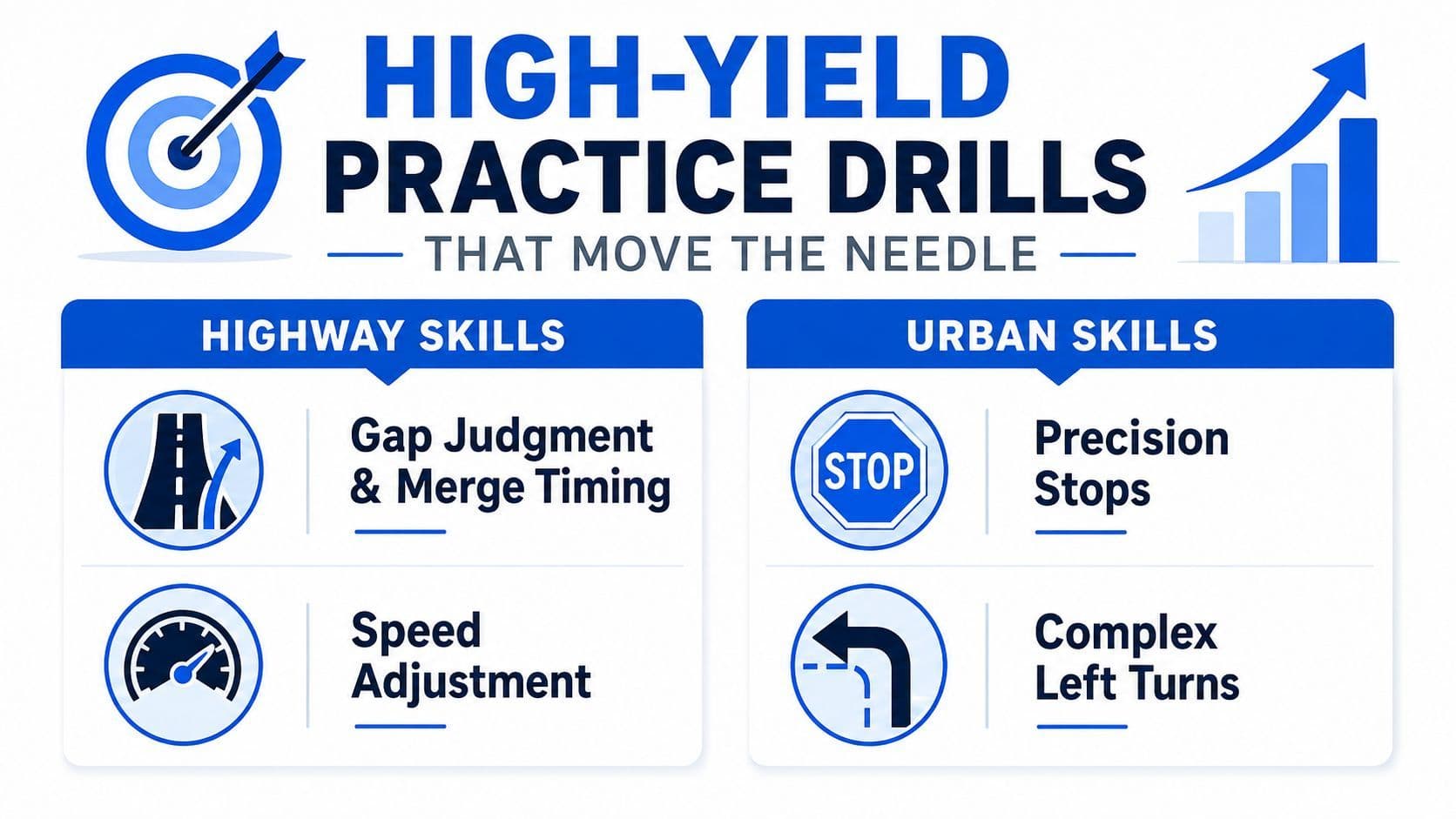
Run merge timing practice with a supervising driver on a real on-ramp. Your target is simple, match the flow without freezing at the end of the ramp or diving in early. Do several repeats, then ask yourself whether you chose a gap, committed to it, and accelerated smoothly through it.
Work on lane discipline at highway speed. Hold your lane, keep your mirrors active, and make lane changes only after the signal, mirror, and shoulder check sequence is automatic. If you're guessing or correcting mid-manoeuvre, you're not ready.
The fourth item is speed stabilisation. Pick a stretch of road where traffic is moving normally and keep your pace even through curves and minor grade changes. Examiners hate speed creep. So do the drivers behind you.
Urban drills you still can't ignore
Parallel parking still matters, because the test isn't highway-only. If that part makes you tense, use this parallel parking practice guide as a structured refresher and then repeat the manoeuvre until your steering inputs are boringly consistent.
Practical rule: A good drill ends with you knowing exactly which step slipped, mirror, signal, shoulder check, gap, or speed.
Add three-point turns and controlled stops at quiet intersections. Your goal is not style, it's predictability. A driver who brakes smoothly, checks properly, and turns without drifting across lane space is the one who passes on consistency.
Your Four to Eight Week Study and Practice Schedule
Build your prep in phases, not random drives. A four to eight week window gives you enough time to rebuild habits, put real highway mileage under supervision, and test yourself under the kind of pressure the examiner is looking for.
Weeks 1 to 2, fix fundamentals
Start with mirror cadence, smooth stops, turns, and parking. Leave the highway alone if your basic observation routine is still sloppy. Get the mirror-signal-shoulder-check sequence so automatic that you do it without thinking at intersections.
Weeks 3 to 5, add the highway
The highway declaration becomes real when you take supervised expressway drives and focus on the moves that matter on test day, merging, holding lane position, and keeping speed steady without panic. The highest-value sessions are the ones that train merge timing, lane discipline, and speed stabilisation under traffic pressure instead of generic city wandering.
If you're hesitating at on-ramps, you're not ready to book. That hesitation shows up fast, and examiners read it as weak judgement.
Weeks 6 to 8, simulate the test region
Drive the roads near your likely DriveTest centre, because region matters. A regional pass-rate compilation shows wide differences between centres, including Brampton at 57%, Kapuskasing at 88%, Espanola at 93%, and Sudbury at 89%. That does not mean one area magically breaks people. It means local traffic patterns and test-centre conditions matter, so practise where you will be evaluated.
DriveTest Centre Reported Full G Pass Rate Source Brampton 57% regional pass-rate compilation Kapuskasing 88% regional pass-rate compilation Espanola 93% regional pass-rate compilation Sudbury 89% regional pass-rate compilation
Checkpoint: book only when your highway driving feels routine, not when it still feels like a performance.
If your first two weeks still show sloppy shoulder checks or uneven speed, push the date. That is not weakness. That is smart scheduling.
Day of Checklist and Calming Routine
Test day should feel organised, not heroic. Eat something light, hydrate, and arrive early enough that you're not sweating through sign-in. Bring your licence, your glasses if you need them, and the vehicle documents for the car you're using. If you forgot paperwork, the rest of your preparation doesn't matter.
Your ten-minute reset
Do a slow walk around the car before you leave the parking area. Check mirrors, then shoulders, then the driving position you'll use before the test starts. That physical rehearsal helps because it puts the same sequence into your body that the examiner wants to see once you start moving.
Use box breathing if your nerves spike. Four in, hold, four out, hold. Then do it again. You're not trying to become a meditation app, you're trying to stop your hands from tightening on the wheel.
When you sign in at DriveTest, keep your answers short and clear. Once you're called, get settled, adjust your seat and mirrors, and stop fidgeting. Fidgeting looks like uncertainty, and uncertainty is exactly what you don't want to advertise before a highway test.
Practical rule: calm drivers don't rush the setup, they repeat it.
The goal is simple. Walk in prepared, sit down already organised, and start the drive with the same calm sequence you practised all week.
Common Mistakes That Cost the Test
Most failures are preventable. The worst ones are boring, not dramatic. A late shoulder check, a rolling stop, a hesitant left turn that eats up your safe window, or speed creep in a lower-limit zone can stack into a bad drive fast. That's why the examiner's fault-by-fault scoring matters, because one small mistake doesn't vanish just because the rest of the drive felt fine (examiner assessment guidance).
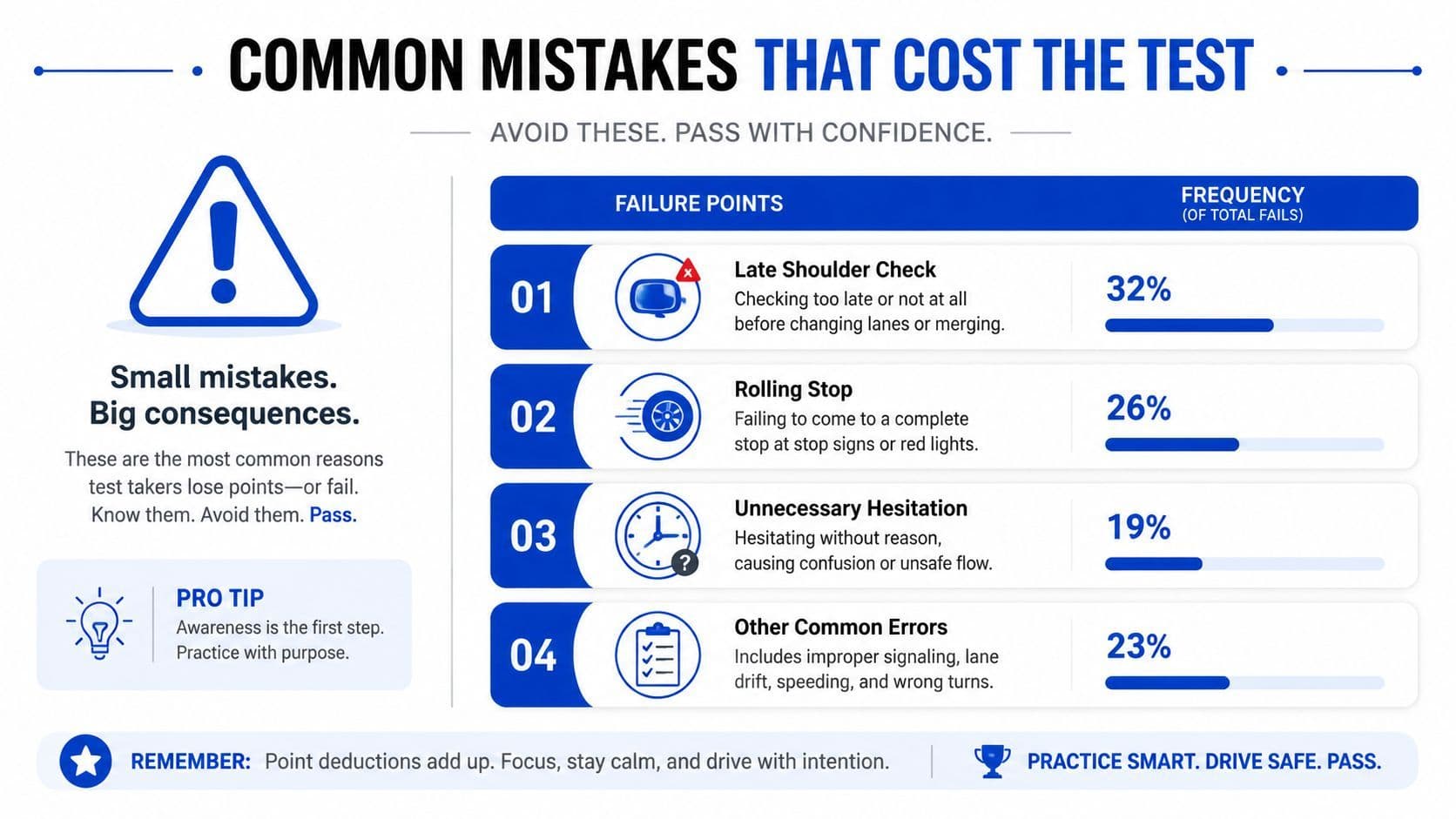
The mistakes I'd fix first
- Late shoulder check: You changed lanes with your eyes already forward. That's a fail risk.
- Rolling stop: You slowed down, but you didn't fully stop. Examiners notice.
- Hesitation at left turns: You waited so long that the turn became awkward or unsafe.
- Speed creep: You drifted above or below the pace and never stabilised it.
- No rear blind-spot check before moving off: Pulling away from the curb without a proper look is lazy and unnecessary.
- Treating it like G2: The full G is highway-weighted. If you drive like it's a simple city test, you're underprepared.
Do not ignore the centre itself either. The regional pass-rate spread shows that local conditions matter, so your vehicle, your route familiarity, and even the time you book can affect how cleanly you settle into the drive. That doesn't replace preparation. It sharpens it.
The fix is simple. Drill the routine until it's automatic, choose a test time when you're sharp, and stop giving the examiner easy reasons to mark faults.
G1ready.ca gives Ontario drivers structured practice support that helps them build test-day habits, not just memorise rules. If you want more Ontario-focused preparation, visit G1ready.ca and use the guides to tighten your routine before you book the full G.


