Getting a Hawkesbury appointment and arriving ready to drive are separate problems. The Hawkesbury DriveTest centre listing helps you confirm the address and schedule, but it cannot supply the car, the documents or the judgement you need on the day. I treat the trip, the vehicle check and local road conditions as one readiness problem: examiners score observation, lane discipline and hazard response, not how far you travelled. A distant centre can work when travel, vehicle and preparation fit together. Choose Hawkesbury because you can demonstrate safe driving there, not because a smaller town promises an easier pass.
Hawkesbury DriveTest Centre at a Glance
The centre is at Hawkesbury Mall, 400 Spence Avenue, Unit 19, as identified in the Hawkesbury testing-area guide. Its limited operating schedule makes checking the actual appointment confirmation particularly important. Don't assume that a weekday visit means the centre will be open.
Hawkesbury DriveTest Centre details
Detail Information Address Hawkesbury Mall, 400 Spence Avenue, Unit 19 Regular days Monday, Wednesday and Friday each week Selected days Some Tuesdays and Thursdays; check the live listing Hours 8:30 a.m. to 5:00 p.m. Phone 647-776-0331 or 1-888-570-6110 Test vehicle Not supplied; candidate provides a Class G vehicle
Treat the schedule as a planning reference, not a substitute for checking current DriveTest information. Selected Tuesday and Thursday dates need confirmation, especially if you're arranging time off, an instructor's car or a long journey.
Know the area, not a fixed route
The local testing network includes Spence Avenue, Main Street East, McGill Street and Tupper Street. The standard G test may also use Highway 17, which connects towards Ottawa as Highway 417. Route descriptions can change, and official DriveTest and Ministry information takes precedence over third-party route guides.
Practise moving between different road environments rather than rehearsing a sequence of turns. Leaving a parking area, joining an arterial road and approaching faster traffic require different decisions about observation, positioning and spacing.
Before setting off, make sure you can identify these essentials without searching through messages:
- Destination: Save the centre address and identify the mall entrance.
- Appointment: Keep the confirmation accessible, including the test category.
- Vehicle: Know which Class G vehicle you're bringing.
- Documents: Put your licence documents somewhere accessible, not underneath luggage.
A screenshot or printed confirmation is useful if your phone loses service or its battery runs low. The practical objective is simple: arrive knowing where to park, where to report and what appointment you've booked.
Is the Hawkesbury Trip Worth It for Your Test
An earlier appointment isn't automatically the better appointment. A remote test adds travel fatigue, unfamiliar roads and a return journey to a task that already demands sustained attention.
Use scenery as a reminder to plan the journey, not as evidence that the driving will be easy.

The centre's appeal to applicants from outside the region doesn't establish a pass-rate advantage. You still need to interpret unfamiliar intersections, adjust to changing speeds and make decisions without relying on remembered landmarks.
Make the travel decision before booking
Hawkesbury is a reasonable choice when you have relevant driving experience, a flexible travel window and an accompanying driver who can manage the journey. A closer centre is usually the stronger option when highway driving is still uncomfortable, your schedule is tight or a delay would leave you stranded.
Answer these questions:
- Departure: Can you leave enough room for traffic, parking and a calm check-in?
- Supervision: Who will accompany a Level One candidate, and are the travel arrangements appropriate for that licence stage?
- Approach roads: Would supervised familiarisation with the Ottawa approach help?
- Return journey: Who drives home if you're tired, disappointed or delayed?
- Fallback: Can you absorb the cost if the appointment can't proceed?
This video can support preparation, but it shouldn't replace supervised practice or current official instructions.
Travel rule: Choose the appointment you can attend rested and prepared, not simply the earliest opening.
Compare at least two centre options and their realistic door-to-door travel times before committing. Include the accompanying driver's availability and the vehicle arrangements in that comparison. A busy remote centre is another booking option, not a licensing shortcut.
How to Book Your Road Test Appointment
Book through the official process and keep control of your confirmation. Ontario's new-driver licensing guide explains that you can schedule, cancel or reschedule online, by phone at 647-776-0331 or 1-888-570-6110, or in person at any DriveTest Centre. The appointment you choose sets the margin for the vehicle check, document review and a calm start, so treat the booking as the first readiness decision rather than an administrative step.
Follow the booking sequence
- Confirm which test you need. A G1 knowledge-test visit is not a G2 or G road-test appointment. Identify your licensing stage first so you do not follow the wrong service pathway.
- Have your Ontario driver's licence number and expiry date ready. Enter them exactly as shown on the licence to avoid a record mismatch while searching.
- Choose Hawkesbury as your preferred location, then prepare second and third choices. Backup locations let you compare real alternatives instead of accepting a date that disrupts your travel and vehicle-check plans.
- Select a date and time that works for the whole journey. Check the centre's limited schedule against your accompanying driver's availability before accepting an opening.
- Complete the booking online, by phone or in person. Review the test category, centre and appointment details before confirming. A familiar town name does not guarantee you selected the service you intended.
- Save the confirmation where you can retrieve it quickly. If plans change, cancel or reschedule through an official channel and retain the updated confirmation.
The Ontario driving-test appointment guide helps organise the booking tasks before you start searching.
Separate booking charges from test fees
Keep booking charges separate from test fees. The appointment is arranged through the official service, so I would question any extra charge presented as a mandatory booking step and establish what the seller is providing before you pay. A paid service might only replicate a booking you can make yourself.
Use this checklist to connect the appointment with the practical arrangements needed to attend it.
If no Hawkesbury slot appears, widen your location search before accepting an unsuitable date. Compare nearby centres, the test category offered and your ability to practise in the relevant road environment. A later Hawkesbury date that lets you arrive with a checked vehicle beats an early date that forces you to rush the pre-test inspection. Do not cancel a workable appointment merely because you hope something better will appear.
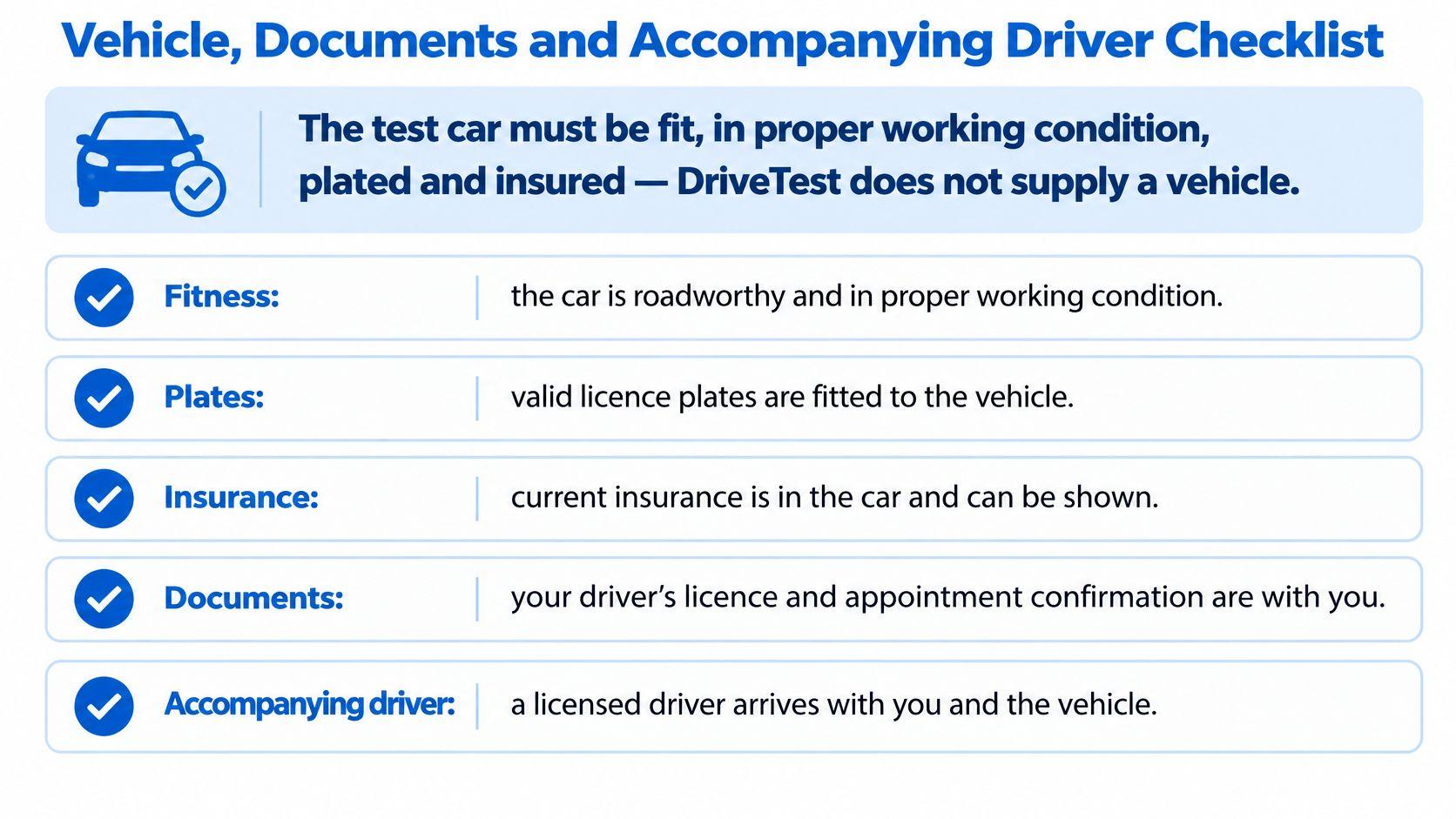
Vehicle, Documents and Accompanying Driver Checklist
A vehicle defect can stop the appointment before your driving is assessed. The official MTO licensing handbook requires a test vehicle that is fit, in proper working condition, plated and insured, and candidates must supply it because DriveTest doesn't provide one. Treat that as test readiness rather than paperwork: a dead brake lamp or a mirror that won't hold position shows up in the observation and signalling the examiner is already scoring.
Inspect equipment by function
Work around the car systematically rather than checking whatever catches your eye. Ask someone to help verify exterior lights while you operate the controls.
- Brake lamps and turn signals: Confirm they work clearly. Other drivers need to understand when you're slowing or changing direction.
- Headlights and wipers: Check operation and visibility through the windscreen. Smearing or poor illumination makes observation harder.
- Horn and mirrors: Test the horn appropriately and set mirrors before moving. You shouldn't be correcting mirror positions mid-lane-change.
- Seat belts: Check that they fasten and operate properly.
- Tires: Inspect for visible damage and check inflation against the manufacturer's guidance.
- Fuel: Leave enough for the trip, the assessment and an unexpected delay.
- Documents: Carry current registration, proof of insurance and your licence.
For a Level One driver, an accompanying driver must attend the test centre. Arrange that person before booking travel, not after discovering the appointment is available.
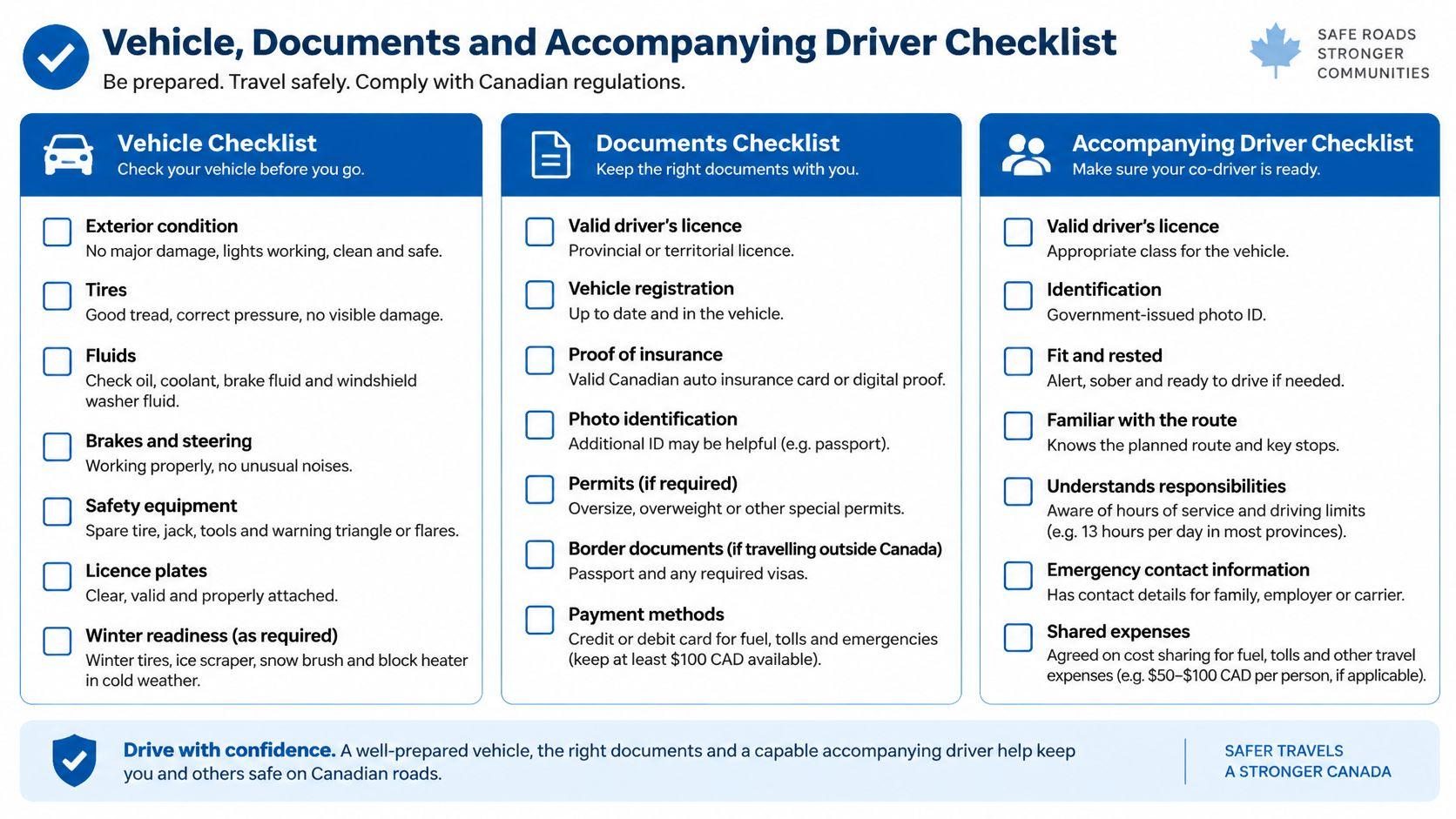
Use a repeatable inspection routine
Run the inspection the day before, when you still have time to fix a problem. Repeat it immediately before departure because a tire can lose pressure or a bulb can fail between checks. I run the light check twice, once cold and once with the engine running.
Keep a written checklist in the car rather than trusting memory. A G-test preparation checklist organises the broader preparation so the inspection covers documents and the accompanying driver, not just the car.
A good practice drive doesn't cancel out a defective test vehicle.
If an item fails, get it properly repaired and verify it again. If you can't resolve it before the appointment, reschedule rather than travelling to Hawkesbury hoping the examiner overlooks it. A second trip costs more than a short delay.
How Examiners Score Your Drive and What Hawkesbury's Roads Demand
Examiners assess observable driving behaviour, not confidence alone. The Ministry's road-test skills include starting, stopping, turning, obeying signs and lights, passing, intersections, parking, reversing and anticipating hazards. The table gives practical errors to eliminate, not a published ranking of failure causes or a numerical scoring formula.
Assessed road-test skills and common errors
Skill What examiners watch Common error that costs points Starting and stopping Smooth start, controlled stop at lines and signs Rolling past stop lines Turning Correct lane, signal use, shoulder checks Cutting corners or late signalling Traffic signs and lights Obeying every sign and signal Missing a sign in busy zones Passing Safe gap, mirror check, signal before moving Passing without enough clearance Intersections Right-of-way at controlled and uncontrolled junctions Misjudging gaps at uncontrolled junctions Parking Position, distance and control Poor reference points and hitting the kerb Reversing Observation over the shoulder at low speed Relying on mirrors alone Anticipating hazards Scanning ahead and keeping safe spacing Following too closely
Turn each skill into a practice drill
On Hawkesbury's town streets, work on lane positioning and controlled intersections without relying on a memorised route. On highway approaches, practise identifying a suitable gap, adapting speed and maintaining space. The full G road-test guide helps distinguish highway preparation from basic town-driving practice.
Use a specific correction for each weak behaviour:
- Starting and stopping: Identify the stop line early and bring the vehicle fully to rest.
- Turning: Plan the receiving lane before beginning the turn.
- Signs and lights: During supervised practice, name changing controls early enough to respond smoothly.
- Passing: Complete mirror, signal and blind-spot checks before moving, and abandon an unsafe manoeuvre.
- Intersections: Explain who has priority before entering.
- Parking: Practise with reference points suited to your actual test vehicle.
- Reversing: Look in the direction of travel and keep checking the surrounding space.
- Hazards: Identify what could enter your path and adjust before braking becomes urgent.
Read the collision figures correctly
The 2021 Ontario Road Safety Annual Report recorded 74 police-reported collisions in the Town of Hawkesbury: 1 fatal, 12 injury and 61 property-damage-only collisions; East Hawkesbury Township recorded 22, including 5 injury collisions. The same report listed 88 in Alfred and Plantagenet, 188 in Clarence-Rockland, 98 in Russell Township and 99 in The Nation Municipality.
Compared with the 153 Town of Hawkesbury collisions recorded in the 2018 Ontario Road Safety Annual Report, the later town total was roughly 51.6% lower. Traffic volume, reporting practices and weather can affect totals, so that decline isn't proof of a proportional improvement in safety.
Collision counts aren't pass-rate statistics. Their practical relevance is the need for right-of-way judgement, safe turns, defensive scanning and hazard response across different road environments.
If your test is a week away, rehearse the two skills producing the most errors on practice drives first. Choose them from observed mistakes, not from whichever manoeuvres you enjoy practising.
What Happens on Test Day
Say you arrive with your accompanying driver and the vehicle you've practised in. Your first task isn't driving the route. It's parking safely, finding the centre entrance and checking in without rushing.
Keep your appointment details and licence documents accessible. Follow the arrival instructions in your confirmation, and leave enough room in your travel plan to handle an unfamiliar car park or a short queue without becoming flustered.
Before the drive
Expect vehicle and document checks before the assessment proceeds. Be ready to operate the controls when asked, rather than searching for a switch you've never used in that car.
A borrowed vehicle deserves particular attention. Adjust the seat and mirrors before the assessment, and make sure you know how to operate the demister, lights and wipers. Familiarity with the controls helps you keep your attention outside the vehicle.
- At check-in: Confirm you're attending the correct appointment.
- At the vehicle: Follow the examiner's instructions and make sure you understand them.
- Before moving: Settle your seating position, secure your belt and observe the surrounding area.
During the assessment
The examiner gives directions while assessing your driving. The selected route may involve town streets and, where appropriate to the test, highway driving. Don't interpret an instruction as permission to ignore a sign, rush a lane change or take an unsafe gap.
If you don't understand a direction, ask for clarification. If you think you've made a mistake, continue driving safely rather than trying to compensate by accelerating or becoming overly hesitant.
Recovery matters: Keep observing and make the next decision safely. Don't let one uncertain moment dictate the rest of the drive.
A useful mental sequence is to observe, decide and then act. Looking repeatedly without using the information isn't effective observation; you need to respond to the pedestrian approaching the crossing or the vehicle slowing ahead.
After the drive
Listen carefully to the outcome and the examiner's explanation of the next step. If you don't pass, review the marked errors before booking again, while the situations are still clear in your memory.
Ask your instructor to turn those errors into targeted practice tasks rather than repeating complete routes without a purpose. Confirm exact arrival procedures, vehicle checks and current test arrangements with DriveTest because operational details can change.
Your Final Week Before the Hawkesbury Test
The final week should make your preparation more reliable, not more frantic. Short, purposeful sessions are more useful than repeatedly driving until you're tired and hoping confidence will replace a weak skill.
Follow a practical action sequence
- Confirm the appointment. Check the date, time, test category and current centre hours against your confirmation and the live DriveTest listing. Resolve uncertainty before arranging the final journey.
- Run the vehicle checklist the day before and repeat it before departure. Assign responsibility clearly if a parent, instructor or friend is supplying the car, so everyone doesn't assume someone else checked it.
- Rehearse the weakest skills. Use supervised practice on suitable approach roads, concentrating on lane positioning, controlled intersections and following distance where those are genuine weaknesses. Ask your supervising driver to record specific errors rather than saying the drive felt good.
- Study the official MTO Driver's Handbook, the designated G1 study source, whose sample questions demonstrate the multiple-choice format used for all knowledge-test questions. Give traffic-law rules particular attention, including right-of-way and the Highway Traffic Act rules that underpin practical driving decisions.
- Check the knowledge stage with focused practice. G1ready.ca offers four practice tests: the Road Rules Test, Road Signs Test, 200-Question Test and Diagnostic Test. We also offer free practice tests, instructor-reviewed answers and a streak system; use an incorrect answer to identify a rule to review, not merely a score to improve.
- Leave early enough for a calm arrival. Prepare the route, documents and personal essentials before departure so you aren't making avoidable decisions under time pressure.
Keep knowledge preparation separate from road-test readiness
A knowledge quiz can show that you understand a rule. It can't establish that you'll observe a cyclist before turning or choose a safe highway gap. For a road-test candidate, the useful connection is to explain the rule during review and then demonstrate it consistently under supervision.
For location planning, our G1 Test Locations page provides an interactive map of Service Ontario and DriveTest locations, including hours, addresses, contact information and the Ontario driver's licence services offered. Check the service offered rather than assuming every listed location handles the same tasks.
Commit to a manageable last-week plan: confirm the appointment, complete the vehicle checks and rehearse your weakest skill each day you practise. Avoid late-night cramming before the test. Rest and organised travel won't replace driving ability, but they help you demonstrate the ability you've developed.
G1ready.ca offers free Ontario G1 practice tests with instructor-reviewed answers to help you strengthen the rules behind safe driving decisions. Visit G1ready.ca, choose a focused rules or signs test, and review your mistakes alongside your supervised Hawkesbury driving-test preparation.