
You're driving north on an Ontario route when a sign announces “Expressway Ahead.” A few minutes later, another sign identifies the road as a highway, and a map labels a nearby route as a freeway. If you're preparing for the G1 test, that wording can feel inconsistent. Are these roads different, or are the terms interchangeable?
The answer depends on access control, road design, traffic separation, and official classification, not just the word printed on a sign. Understanding those details helps you recognise the road environment, interpret questions more accurately, and make safer decisions when you're merging, changing lanes, or approaching an interchange.
Understanding Key Terms
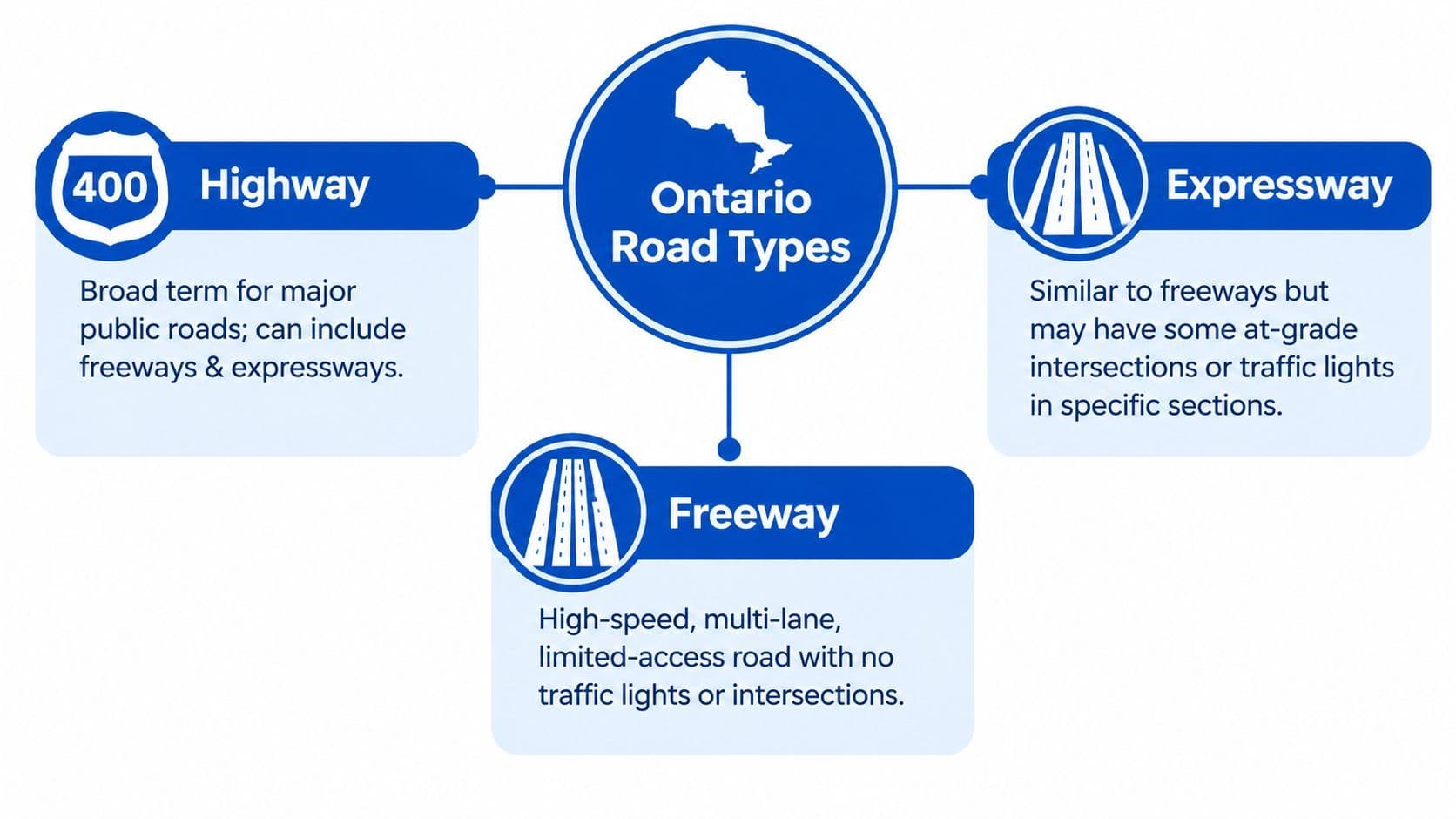
Ontario uses these words at different levels of precision. Highway is the broadest term. Under Ontario's legal framework, public roads are generally highways, so the word can describe roads that vary greatly in lane arrangement, speed, access, and intersection design. A highway may be divided or undivided, rural or urban, and fully controlled-access or connected to driveways and ordinary intersections.
A freeway is a much narrower road category. The Ontario Ministry of Transportation glossary defines it as a multi-lane, divided highway with more than four through lanes total, a continuous median, full control of access, and a posted speed greater than 90 km/h. Full control of access means drivers normally enter and leave using ramps rather than turning directly onto the road from a property or crossing an at-grade intersection. See the Ontario MTO glossary for the official terminology.
An expressway sits between the broad highway category and the stricter freeway standard. Ontario defines it as a divided arterial road for through traffic with full or partial control of access and some interchanges. Because access can be only partially controlled, an expressway may not meet every freeway requirement along its entire route.
Why everyday language causes confusion
People often use highway, freeway, and expressway as casual synonyms. Ontario's driver handbook even states that a freeway is also called an expressway, describing it as a high-speed, multi-lane road with separated directions of travel and ramps for entering and exiting. That practical description is useful for new drivers, but it doesn't remove the more technical difference found in MTO road-classification material.
The safest way to read a question is to look for design clues. Ramps, separated traffic, no traffic lights, and no direct property access point toward a freeway-style road. Divided lanes with some access points or intersections suggest an expressway. A route called a highway may have either arrangement, because highway is the umbrella term rather than a guarantee of freeway design.
For sign recognition practice, review Ontario information signs alongside the road-type definitions in a focused G1 information signs guide. The name matters less than what the road allows you to do.
Comparing Highway Freeway and Expressway Features
The quickest way to compare highway vs freeway vs expressway is to focus on how traffic enters, exits, crosses, and interacts with the route. The table below gives a working Ontario-oriented reference. It's important to remember that “highway” covers a broad range of designs, while freeway and expressway describe more specific operational characteristics.
Feature Comparison of Road Types
Feature Highway Expressway Freeway Meaning Broad legal and road-network term for public roads Divided arterial road for through traffic Stricter category of divided highway Access control May be limited, partial, or full Full or partial control of access Full control of access Entry and exit May include driveways, side roads, intersections, or ramps Often uses interchanges, but some access may remain Uses ramps and interchanges rather than direct access Intersections May include at-grade intersections Some sections may have at-grade access depending on design No ordinary at-grade access under the freeway standard Directions of travel May be divided or undivided Divided Divided by a continuous median Lane standard Varies by route Multi-lane divided arterial design More than four through lanes total under the MTO glossary definition Posted speed Varies and must be read from signs Varies by road and section Greater than 90 km/h under the MTO glossary definition Pedestrians and cyclists Rules depend on the road and posted restrictions May be prohibited where the road operates as an expressway Typically prohibited because access is restricted Median design Varies widely Divided median, design depends on the route Continuous median, with specific design and barrier requirements Driver expectation Check signs, intersections, and access points carefully Expect faster through traffic and restricted access Expect ramp-based movement, separated traffic, and no ordinary intersections
The most important distinction is access control. On a general highway, a driver may encounter a traffic signal, a private entrance, a crossroad, or a section with opposing traffic close by. An expressway reduces those conflicts, but partial access control means the road may still have features that a strict freeway would exclude.
A freeway removes more conflict points. Drivers don't normally turn left across opposing traffic to enter a property, and cross traffic doesn't pass through ordinary signalised intersections. Instead, vehicles use ramps, acceleration lanes, deceleration lanes, and grade-separated interchanges. Those features explain why freeway driving demands early decisions and careful lane positioning.
Speed and lane separation
The posted speed is a clue, but it isn't the definition by itself. The MTO glossary includes a posted speed greater than 90 km/h in its freeway definition, while a road's actual legal speed still comes from the speed-limit sign applying to that section. Never assume that a road's label permits a particular speed.
Lane separation also matters. Ontario describes a freeway as having traffic travelling in opposite directions separated from one another. That separation can involve a wide median or a median barrier. Ontario road-design policy sets the minimum median width for new 4-lane or 6-lane freeways and freeway extensions at 23 m, with a desirable width of 30 m. The policy also says new highways with medians under 23 m should have a median barrier, and medians of 10 m or less require a TL-5 tall-wall median barrier. These specifications illustrate how freeway design manages the risk of opposing traffic crossing into the other direction, as described in the Ontario road-design policy.
Why the label can mislead
A route can be legally classified as a highway without meeting the geometric and access-control standard for a freeway. Likewise, an expressway may operate like a freeway through much of its length but include a feature that prevents the entire route from fitting the stricter category.
Use this recognition order:
- Look for divided traffic.
- Check whether entry and exit occur through ramps.
- Look for traffic lights, driveways, and direct property access.
- Notice whether pedestrians and cyclists are prohibited.
- Read the posted speed rather than guessing from the road name.
That method is more reliable than memorising names alone.
Regional Naming Differences in Canada and the US
Road terminology changes across provincial and national borders. A driver from Ontario may call a divided, controlled-access route a freeway, while another jurisdiction may use expressway or highway. The road's physical design often stays similar even when the label changes.
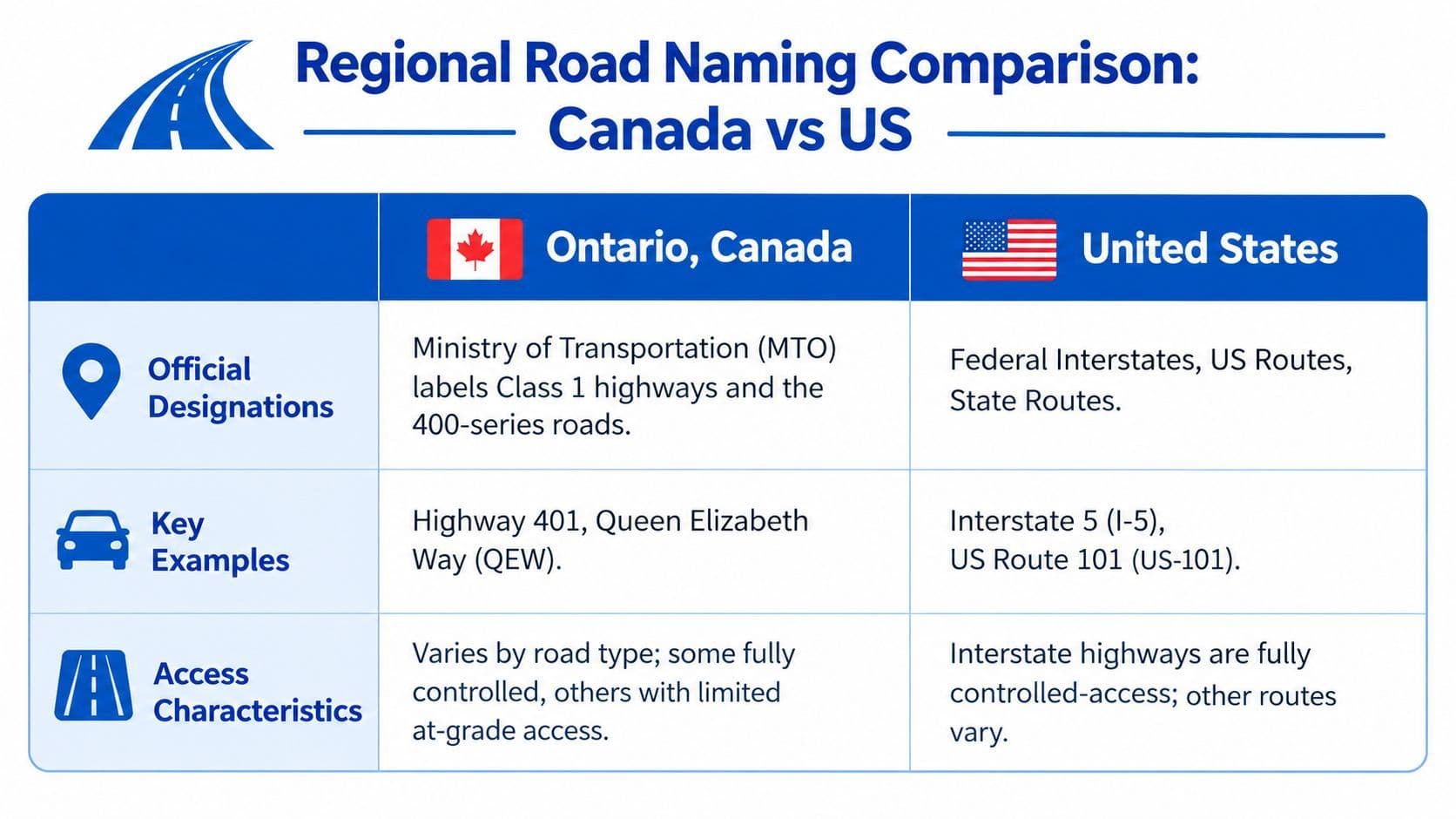
Ontario's official classification adds another layer. All 400-series highways and the QEW are treated as Class 1 highways, but Class 1 status doesn't automatically mean every segment meets the freeway definition. Ontario has also grouped Highway 11 and Highway 17 into Class 1, even where some portions remain two-lane roads. This demonstrates the difference between a legal or administrative highway class and a geometric road standard.
Ontario's map-reading problem
Ontario road maps may separate highway, divided highway, undivided highway, and freeway as different map-legend categories. That's why a route can be strategically important to the province without receiving the freeway label. The broader provincial road network includes more than 250,000 km of roads across municipal, provincial, and resource or recreational systems, so one term couldn't describe every road in the network. The distinction appears in Ontario's legislative and transportation classification materials, including Ontario Bill 43 and its highway-class provisions.
Ontario traffic-volume materials identify a smaller group as the province's freeways for monitoring purposes, specifically Highway 400 through Highway 427 and the Queen Elizabeth Way. That list shows why “freeway” is narrower than the province's complete highway network, as reflected in the Ontario Traffic Manual information-sign guidance.
Comparing terms south of the border
In the United States, Interstate, US Route, and State Route are route-designation systems rather than direct substitutes for the physical terms freeway and expressway. Interstate highways are generally designed as fully controlled-access roads, while US Routes and State Routes can vary from divided freeways to ordinary roads with intersections.
American drivers may also use “freeway” casually for a major limited-access road, even when a local agency prefers “expressway.” Canadian provinces use their own conventions as well. A sign's wording therefore tells you what the road authority calls the route, but the access pattern tells you what driving environment you're entering.
For G1 preparation, keep Ontario as the reference jurisdiction. A practice question written with American terminology may use “freeway” differently from an Ontario handbook question. Translate the wording into physical clues, then apply Ontario's rules.
Implications for Driving Rules
Road classification affects your expectations, but it doesn't replace the posted signs or specific Highway Traffic Act rules. A highway may include an ordinary intersection, while a freeway-style route relies on ramps and grade separation. Those settings create different decisions about merging, yielding, passing, and who may use the road.
Toronto's road-classification system gives a useful operational example. It identifies an expressway through features including no property access, speed limits from 80 to 100 km/h, no local transit service, a prohibition on pedestrians and cyclists, and grade-separated intersections with no traffic signals. Toronto also identifies expressways as receiving the highest-priority winter maintenance. The city's road-classification system shows how agencies classify roads by operation, not just by the name on a sign.
Merging and right of way
When you enter a freeway using an on-ramp, traffic already on the freeway has the right of way. The merging driver must judge a safe gap, match the flow as conditions allow, and enter without forcing another driver to brake or swerve. An acceleration lane gives you space to build speed and identify a gap, but it doesn't give you priority.
At an ordinary highway intersection, the right-of-way question may involve stop signs, yield signs, traffic signals, or the rules for turning across opposing traffic. Don't carry the assumptions of a ramp merge into an at-grade intersection. First identify the control device, then follow it.
Passing and lane discipline
On a two-lane highway, passing may require crossing the centre line, so visibility, pavement markings, signs, and oncoming traffic become critical. A solid centre line or a no-passing sign can prohibit the manoeuvre. On a divided freeway, passing normally occurs by changing lanes in the same direction, but you still need a safe gap, a signal, and adequate space.
Keep right except when using another lane for passing or another permitted purpose. Watch for vehicles entering from ramps, vehicles slowing for an exit, and large vehicles that create blind spots. A road's higher design standard doesn't remove the need for active observation.
Who may use the road
A controlled-access expressway or freeway can restrict pedestrians, cyclists, and certain vehicles. Toronto's operational description confirms that pedestrians and cyclists are prohibited on roads classified as expressways in that system. General highways can have different rules, shoulders, crossings, and local access, so you must read signs rather than apply a blanket assumption.
For a focused review of merging, lane changes, entering, and exiting, use the G2 rules on highways guide. It's especially useful to connect the road-design concepts with the actions the driver must take.
Practical rule: Treat the road name as a clue. Treat the signs, pavement markings, ramps, and access restrictions as the instructions.
Applying This Comparison to G1 Exam Prep
G1 questions often test recognition rather than vocabulary alone. A question may describe a high-speed divided road with ramps, or it may mention a route with direct intersections and mixed access. Your task is to identify the clues and connect them to the correct Ontario driving rule.
Ontario's driver handbook says a freeway, also called an expressway, is a high-speed, multi-lane road where traffic in each direction is separated and vehicles enter and exit by ramps. Review the official MTO freeway-driving guidance for that practical description.
Use the clue words
Read each question once for the situation and once for the decisive feature. Words such as ramp, separated directions, grade-separated interchange, and no traffic lights point toward freeway-style driving. Words such as driveway, side road, traffic signal, or two-way undivided road point toward a broader highway environment.
Try these sample questions:
Question: You're entering a high-speed divided road using an acceleration lane. Who has the right of way?
Answer: Traffic already travelling on the road. The entering driver must find a safe gap and merge without disrupting traffic.
Question: Which feature most strongly identifies a freeway rather than a general highway?
Answer: Full control of access with ramp-based entry and exit, separated directions of travel, and no ordinary at-grade intersections.
Question: A road is divided and carries through traffic, but its access is only partially controlled. Which term best fits the Ontario MTO distinction?
Answer: Expressway. The term allows for full or partial access control, while freeway is the stricter category.
Question: Can you infer the legal speed limit only from the fact that a road is called a freeway?
Answer: No. Read the posted speed-limit sign. The MTO glossary includes a posted speed greater than 90 km/h in its freeway definition, but the sign applying to the road section controls your driving.
Avoid the common traps
The most common mistake is treating every numbered highway as a freeway. Ontario's Class 1 highway classification includes routes and segments that don't necessarily meet the divided, fully controlled-access standard. Another mistake is assuming that “expressway” always means a road with exactly the same technical features as a freeway. Ontario's handbook uses the terms together in a practical explanation, while MTO classification material distinguishes them.
A third trap involves the word “highway.” Because it's a broad legal umbrella, the term alone tells you very little about whether you'll encounter ramps, traffic lights, pedestrians, cyclists, or direct property access. Look for the physical and operational details in the question.
For targeted practice on road rules, signs, and Ontario scenarios, use the G1 road rules guide. Focus on explaining why each answer is correct, not just remembering the letter choice.
Recommendations for Drivers
Use a simple recognition routine whenever you approach an unfamiliar Ontario route:
- Check access: Ramps and grade-separated interchanges suggest freeway-style design.
- Check separation: A continuous median and separated directions distinguish divided roads from ordinary two-way highways.
- Check restrictions: Look for signs governing pedestrians, cyclists, vehicles, and prohibited turns.
- Check the speed sign: Never substitute the road name for the posted limit.
- Check the question wording: On the G1 test, physical clues often reveal the expected answer.
The practical meaning of highway vs freeway vs expressway is straightforward once you separate the umbrella term from the stricter designs. A highway may be almost any public road. An expressway is a divided arterial route with full or partial access control. A freeway is the more restrictive, fully controlled-access form, with ramp-based entry and exit and separated traffic.
Review the definitions, study the signs, and practise applying the clues to realistic scenarios rather than memorising labels in isolation.
G1ready.ca offers registration-free practice exams, targeted quizzes, explanations, hints, progress tracking, and a realistic simulator aligned with the Ontario G1 handbook. Visit G1ready.ca to practise highway, freeway, and expressway questions before test day.


