
Most vehicles need at least two occupants, including the driver, to use an Ontario HOV lane. Buses, licensed taxis, airport limousines, motorcycles, emergency vehicles, and Ontario green-plate vehicles are exempt from the normal passenger minimum.
You're reviewing your G1 notes, see a lane marked with a white diamond, and wonder whether two people in the vehicle are enough. Usually, yes, but Ontario's HOV lane rules include vehicle-type restrictions, physical access rules, and exemptions that make careless guessing a common test mistake. The safest way to learn them is to treat an HOV lane as a special-use highway facility, not merely as an ordinary lane with a different marking.
Understanding Ontario HOV Lane Basics
You're travelling on a multi-lane highway with one passenger beside you. The lane on the left has diamond markings, and traffic appears lighter there. Your first question should be simple: does this vehicle meet the occupancy and exemption rules shown for that HOV lane?
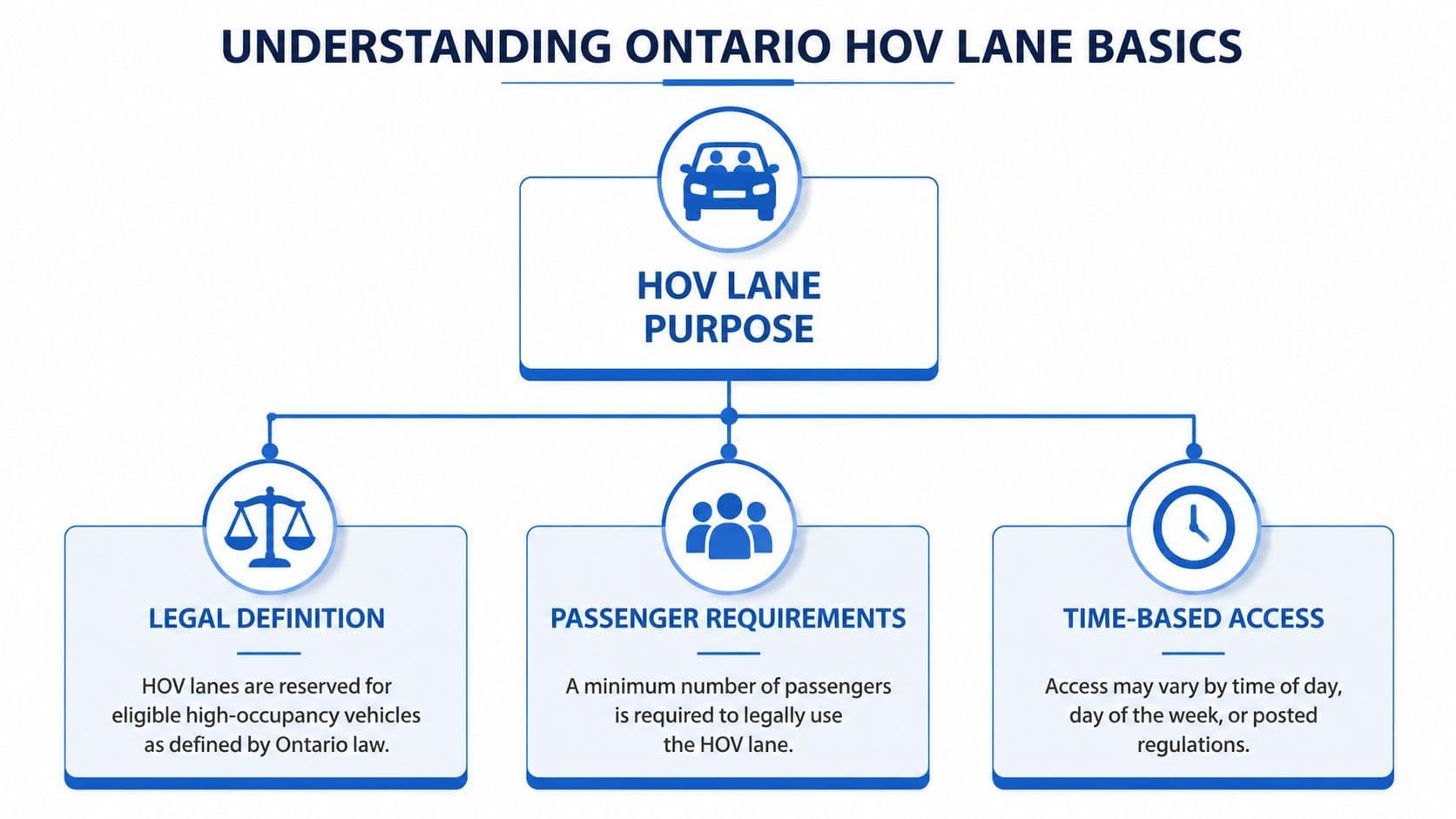
For most vehicles, Ontario requires at least two people, including the driver, before entering an HOV lane. That means a driver travelling alone in an ordinary passenger vehicle usually can't use the lane during the period covered by the posted rules. A passenger sitting beside the driver counts toward the minimum because the driver is included.
Ontario identifies several exemptions from the normal passenger requirement. The exempt categories include:
- Buses
- Licensed taxis
- Airport limousines
- Motorcycles
- Emergency vehicles
- Ontario green-plate vehicles
The exemption belongs to the vehicle category, not to a driver's personal opinion about whether the trip seems important. An ordinary car with one person doesn't become eligible because the driver is late, the lane looks empty, or traffic is moving slowly.
Why the G1 test treats HOV lanes differently
Ontario's official road rules for G1 learners treat HOV lanes as a distinct freeway facility. You need to recognise the lane's signs and markings, understand who qualifies, and know that access is controlled rather than available at every point.
The province also describes HOV lanes as separated from general traffic by a striped buffer zone. Entry and exit are allowed only at designated openings, which are usually spaced every two to four kilometres according to Ontario's HOV lane guidance. The exact posted hours and conditions still matter, so don't rely only on the number of occupants.
G1 memory rule: Count the driver, check the vehicle category, then check the signs and access markings.
A common wrong answer says, “Two passengers are required.” That wording is incorrect because Ontario's minimum normally means two occupants total, not the driver plus two passengers. Another wrong answer says, “Any electric vehicle qualifies.” The relevant exemption is tied to an Ontario green licence plate, not just to a vehicle being described as electric.
Physical Design and Access Points
An HOV lane can look like a normal left lane from a distance, but the markings tell you that it operates under different rules. Ontario uses white diamond markings to identify HOV lanes, while a striped buffer separates the lane from adjacent general-purpose traffic. Continuity markings and designated openings show where a driver may safely move in or out.
The buffer is not an extra lane and it isn't a space for passing. Crossing it outside an opening is illegal and unsafe under Ontario Regulation 620/05. A learner who sees a gap in traffic and cuts across the stripes is making one of the most serious HOV-related errors because the physical separation is designed to prevent sudden weaving.
How to read the lane before moving
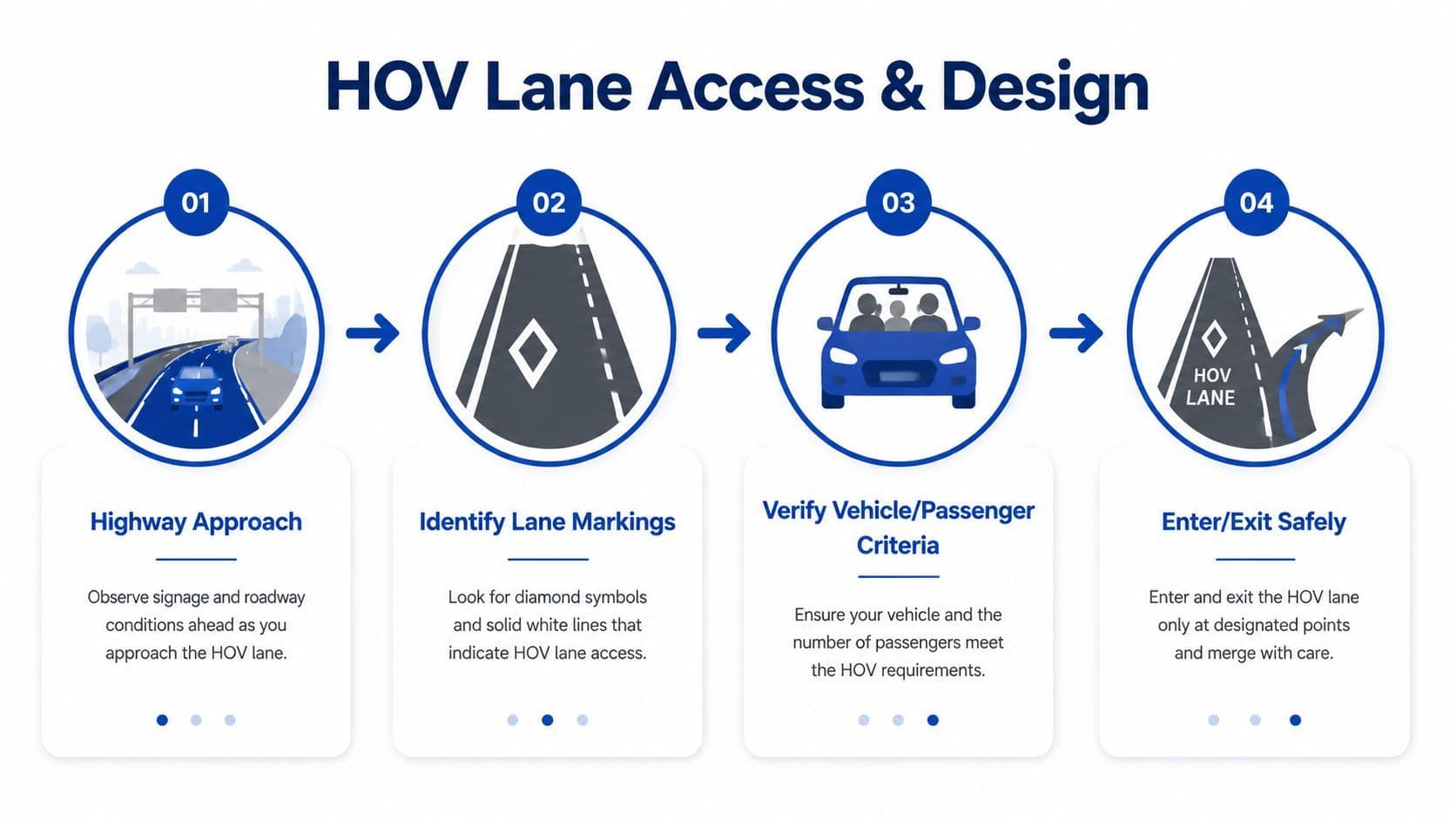
Use a deliberate scan rather than reacting to the first gap you see:
- Identify the diamond marking. Confirm that the lane is an HOV lane rather than an ordinary passing lane.
- Look for the striped buffer. Treat it as a hard separation unless you reach a marked opening.
- Read the signs. Posted hours, vehicle conditions, and other restrictions control how the lane operates.
- Check eligibility. Confirm your occupants and vehicle type before planning the move.
- Wait for the access point. Signal, check mirrors and blind spots, and merge only when the movement is safe.
Designated openings are usually spaced every two to four kilometres, so missing one doesn't justify crossing the buffer. Continue in your current lane, keep scanning, and use the next legal opening.
This design creates a managed merge pattern. HOV traffic remains separated from general traffic for much of the roadway, while marked openings provide controlled points for lane changes. The rule also protects drivers who may not expect a vehicle to move sideways across the striped area.
Use this visual demonstration to reinforce the difference between identifying an HOV lane and entering it legally:
A G1 question may describe a driver who is already beside the HOV lane and wants to move across the buffer. The correct response isn't “move over when traffic is clear.” It's “wait until a designated opening, then make the lane change safely.”
Vehicle Eligibility and Commercial Restrictions
Passenger count is only part of the decision. A vehicle may have two occupants and still fail the applicable HOV requirements because Ontario applies additional conditions to some commercial motor vehicles.
The easiest way to solve a test question is to separate vehicles into two groups. First, identify vehicles that qualify through an explicit exemption. Then check whether a commercial vehicle must satisfy size and weight limits in addition to carrying two occupants.
HOV Lane Vehicle Eligibility Quick Reference
Vehicle Type Occupancy Required Special Conditions Ordinary passenger vehicle At least two occupants, including the driver Must follow posted HOV hours and use designated access points Bus No normal passenger minimum Must still obey lane signs and access rules Licensed taxi No normal passenger minimum The vehicle must be a licensed taxi Airport limousine No normal passenger minimum The vehicle must fall within the recognised airport limousine category Motorcycle No normal passenger minimum Motorcycle status provides the exemption Emergency vehicle No normal passenger minimum Applies to the exempt emergency vehicle category Ontario green-plate vehicle No normal passenger minimum Green licence plate status is the relevant condition Commercial motor vehicle qualifying for the lane At least two occupants, including the driver Must be less than 6.5 metres long and under 4,500 kilograms gross weight Large truck Not eligible Large trucks aren't permitted in the HOV lane
The commercial restriction is a favourite source of confusion. A truck with a driver and passenger doesn't automatically qualify. Under Ontario's MTO truck handbook guidance, the commercial motor vehicle must meet both limits, less than 6.5 metres in length and under 4,500 kilograms gross weight.
A practical comparison
Consider two vehicles carrying two people. A qualifying smaller commercial vehicle may use the HOV lane if it meets the length and weight conditions. A large truck cannot use the lane only because it has a second occupant.
The same principle applies to green-plate vehicles. Their exemption is based on the Ontario green licence plate, so a learner shouldn't replace that fact with a broad assumption about fuel type, manufacturer, or vehicle appearance.
For the G1 test, read every detail in the question. If it names a bus, taxi, motorcycle, emergency vehicle, airport limousine, or green-plate vehicle, look for the exemption. If it names a truck, check the technical restrictions rather than stopping at the passenger count.
Common HOV Lane Misconceptions
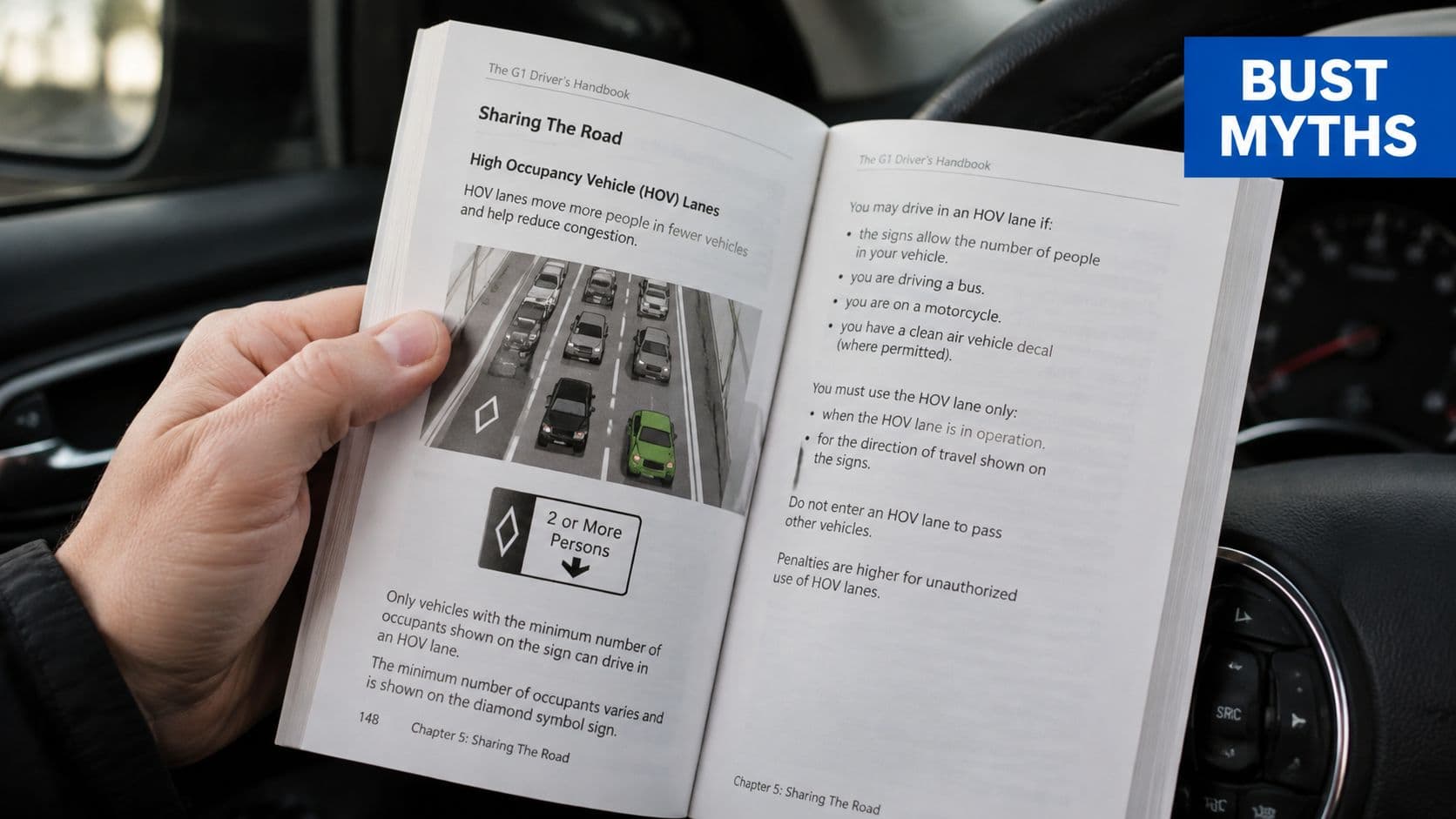
HOV questions often test whether you can reject an attractive but incomplete answer. The wrong choice usually sounds reasonable because it uses part of the rule while ignoring an exception or access condition.
Mistake one, treating the lane as an ordinary lane
Wrong assumption: You can enter whenever traffic is light.
Correction: HOV lanes have controlled access. The striped buffer can't be crossed except at designated openings, even when the roadway appears clear.
Mistake two, counting only passengers
Wrong assumption: The driver needs two passengers.
Correction: The normal requirement is at least two occupants, including the driver. One driver and one passenger generally satisfy the occupancy threshold for an ordinary eligible vehicle.
Mistake three, assuming motorcycles need two riders
Wrong assumption: Every vehicle must carry two people.
Correction: Motorcycles are among the listed exemptions from the normal passenger minimum. Don't apply the ordinary passenger-vehicle rule to every vehicle category.
Mistake four, assuming every electric vehicle qualifies
Wrong assumption: Any electric or low-emission vehicle can travel alone in the lane.
Correction: The relevant Ontario exemption is for vehicles with green licence plates. A vehicle's description alone isn't enough for a test answer.
Mistake five, ignoring truck dimensions
Wrong assumption: A commercial truck qualifies whenever two people are inside.
Correction: A qualifying commercial motor vehicle must meet the occupancy rule and the size-based restrictions. Large trucks aren't permitted in the lane.
Read HOV questions for the exception hidden in the vehicle description. One word, such as “motorcycle,” “green-plate,” or “large truck,” can change the correct answer.
Another frequent failure involves confusing eligibility with access. A vehicle can be eligible but still be driven improperly if its driver crosses the buffer or ignores posted operating conditions. Keep those decisions separate: first ask whether the vehicle may use the lane, then ask whether the driver is entering or leaving it legally.
Enforcement, Fines, and Legal Consequences
A driver may enter an HOV lane for only a moment and still commit an offence. Ontario treats improper HOV use as a traffic violation, so the consequence can include both a fine and demerit points. For a G1 learner, the safest test strategy is to connect the penalty with the action that caused it.
Ontario sources report a $110 fine and three demerit points for improper HOV use, as described in this Ontario HOV enforcement report. The figure may appear among test answer choices. Remember the rule behind it: lane markings, occupancy requirements, and posted operating conditions are legal requirements, not suggestions.
Three scenarios to remember
Scenario one, the solo commuter: A driver in an ordinary passenger vehicle enters the HOV lane alone during its restricted period. The vehicle has no applicable exemption, so the driver has broken the occupancy rule.
Scenario two, the impatient merge: Two people are inside the vehicle, but the driver crosses the striped buffer before reaching a designated access point. The occupant requirement may be satisfied. The entry is still improper because access rules apply separately.
Scenario three, the qualifying exemption: A motorcycle enters with one rider. Its exempt category means the normal passenger minimum does not apply, but the rider must still obey signs, lane markings, and legal entry points.
Demerit points affect a driving record, which makes the issue relevant to G1 learners even when a question focuses on HOV lanes. Review the broader rules in Ontario demerit point practice guidance. A useful memory aid is to ask two questions: does the vehicle qualify, and was the lane entered and used legally?
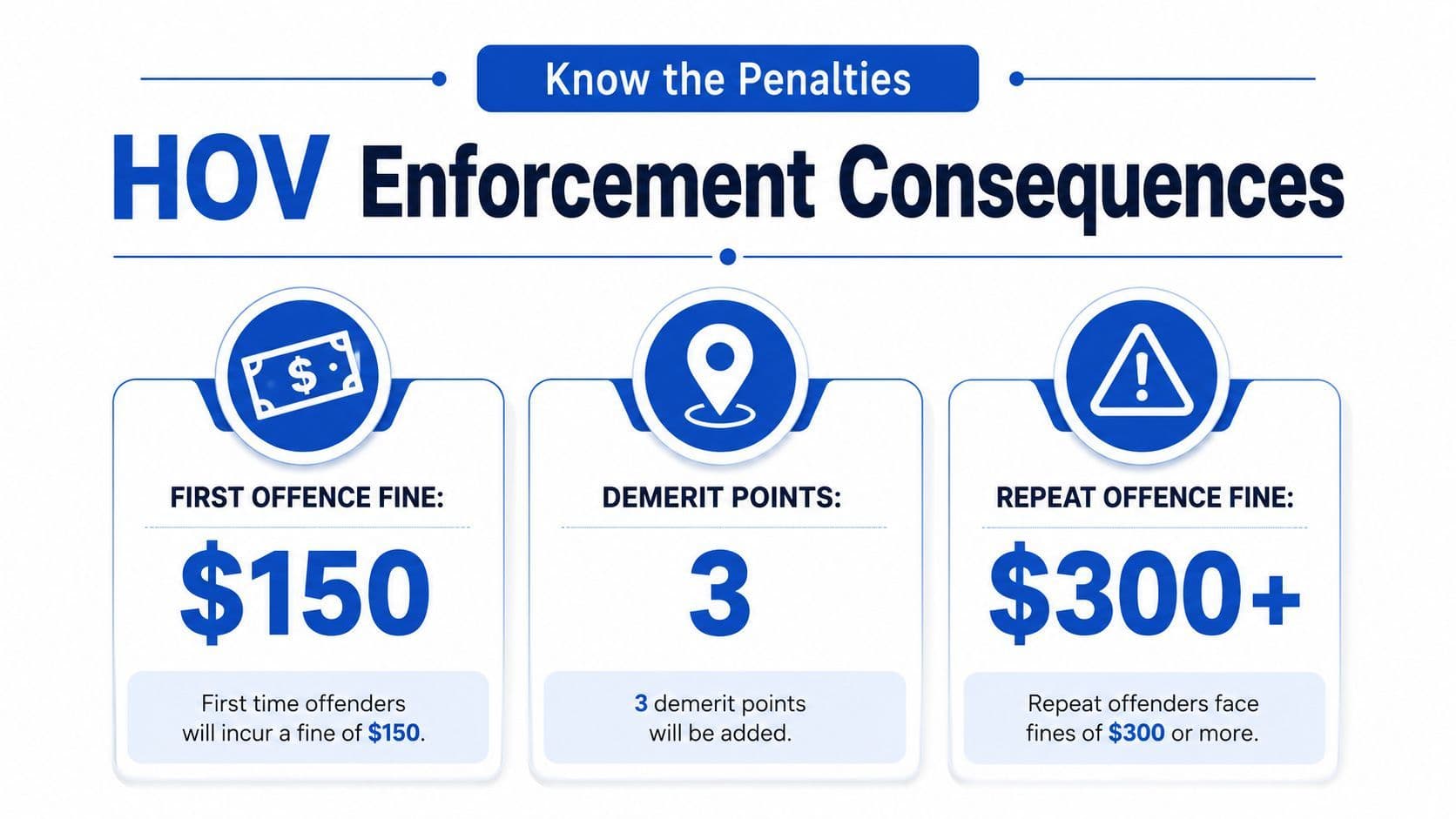
A test question may combine a fine with points, but study the behaviour rather than memorizing isolated figures. Common wrong answers involve solo use by a non-exempt vehicle, crossing the buffer illegally, or ignoring posted lane conditions.
Practice Questions and Real Driving Scenarios
Use these questions as active recall. Cover the answers first, choose an option, and then read the explanation.
Question one
You're driving an ordinary car with one passenger. Can you use an HOV lane during its posted restricted period?
A. Yes, because the lane is open to all cars
B. Yes, because the driver doesn't count
C. No, because the vehicle doesn't have at least two occupants
D. No, because passenger vehicles can never use HOV lanes
Correct answer: C. The driver counts, so one driver and one passenger provide two occupants. The vehicle meets the normal occupancy threshold, assuming the signs permit use and the driver enters through a designated opening.
Question two
You're alone on a motorcycle. Which answer is correct?
A. You can't use the lane without a passenger
B. You may qualify because motorcycles are exempt from the normal passenger minimum
C. You may cross the buffer anywhere
D. You can use only the right lane
Correct answer: B. Motorcycle status provides the exemption. It doesn't remove the requirement to obey lane markings, signs, and controlled access points.
Question three
A truck has two occupants. What must you check?
A. Only the passenger count
B. Whether it's carrying cargo
C. Whether it's less than 6.5 metres long and under 4,500 kilograms gross weight
D. Whether the driver is travelling below the speed limit
Correct answer: C. Commercial vehicle eligibility depends on occupancy plus the stated size and weight limits. Large trucks aren't permitted in the lane.
For more targeted preparation, practise HOV questions alongside other Ontario traffic rules questions. On the road, use the same sequence every time: identify the diamond, read the sign, confirm your vehicle and occupants, locate the opening, and complete the merge only when it's safe.
G1ready.ca offers free, registration-free Ontario practice exams, targeted quizzes, immediate explanations, hints, and progress tracking for learners preparing for the knowledge test. Visit G1ready.ca to practise HOV lane questions, find weak areas, and build confidence before test day.


