You're on an Ontario on-ramp for the first time, mirrors set, signal on, and traffic ahead suddenly brakes. You know how to steer and stop, but you haven't yet built a plan for the gap closing in front of you, the car sitting in your blind spot, or the exit you need in two lanes. That's the moment most learners realise driving well isn't one skill. It's a set of small habits working together.
Ontario's system is built for that reality. According to Ontario's official MTO driver's handbook chapter on getting your licence, Ontario introduced graduated licensing in 1994, and the full pathway through G1 and G2 with two road tests takes at least 20 months. You're meant to build judgment in lower-risk conditions first, not get full privileges on day one.
This guide uses a dual-track approach. Each habit below pairs an in-car routine with a matching G1 knowledge-study routine, so what you practise with a supervising driver is the same thinking you'll need on test questions. Pick a habit, drive it, then quiz it the same week. That's how you learn to drive smart without treating theory and practice as two separate subjects.
1. Scan Ahead and Use the Smith System's Five Keys
Most emergencies give you warning if you're looking far enough ahead. Aim your eyes roughly 12 to 15 seconds ahead, about one or two city blocks in town and several hundred metres on a highway. You'll see brake lights, a pedestrian nearing a crosswalk, or a parked car door starting to open while you still have time to ease off instead of swerving.
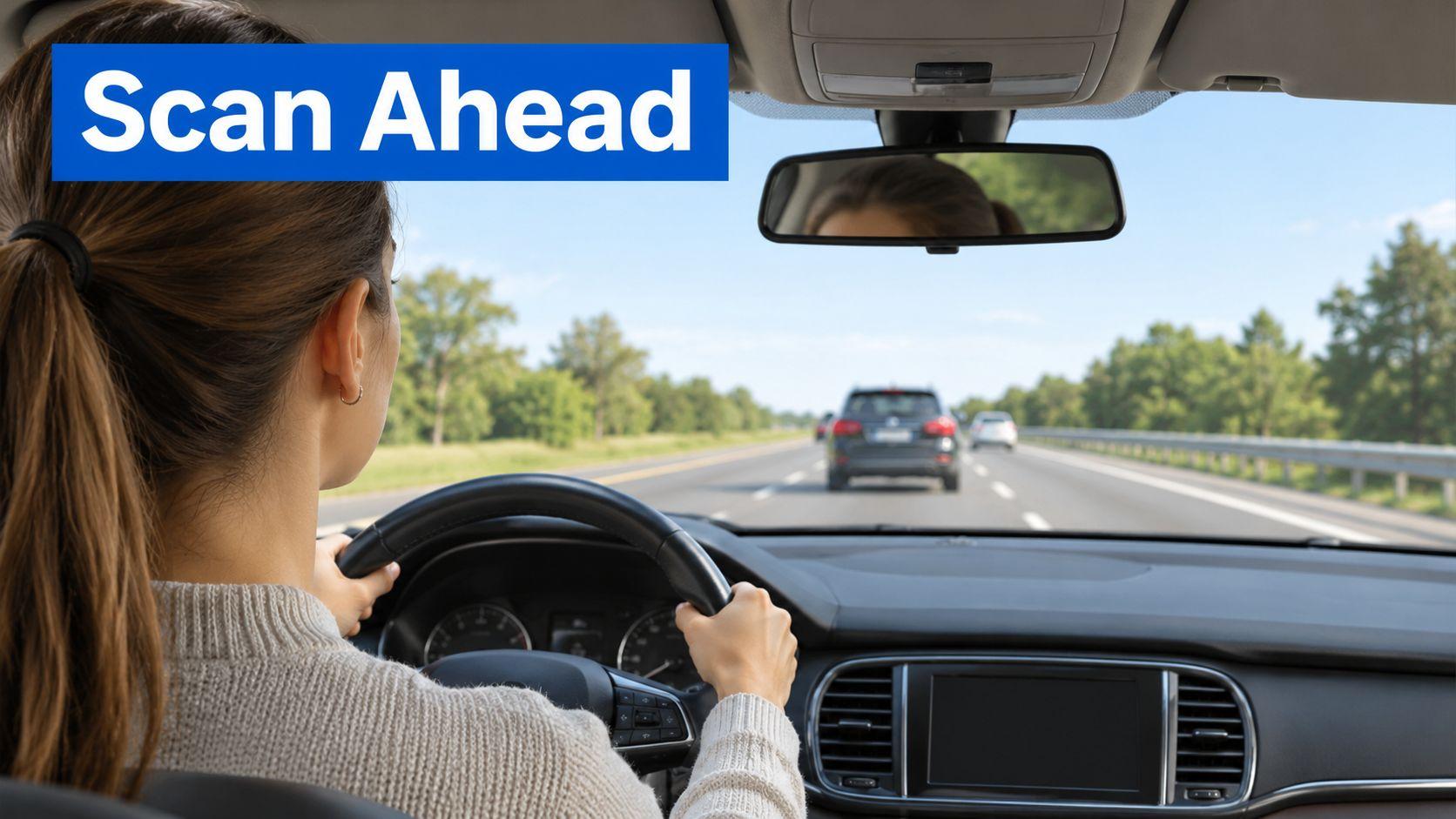
The Smith System, developed by Harold E. Smith in the 1950s, turns scanning into five keys you can repeat until they're automatic.
- Aim high in steering: Look well down your path, not at the hood.
- Get the big picture: Notice traffic flow, not just the car ahead.
- Keep your eyes moving: Sweep mirrors, intersections, and shoulders regularly.
- Leave yourself an out: Keep space where you could move if needed.
- Make sure they see you: Signal early and position so others can read you.
Pair It With Commentary Driving
Say what you see out loud on practice drives. Call out the stale green light, the cyclist preparing to merge several car lengths ahead, and the van blocking your view of a side street. Your supervising driver hears your thinking and can correct gaps before they matter.
Scan intersections for cross traffic even on a green, and check mirrors before slowing, turning, or changing lanes. Then match the habit with study the same day. Run a short set of right-of-way and hazard-awareness questions, and for every answer, say what you'd look at first in the car. If you can't name the first visual check, you haven't learned the rule yet, you've only recognised the wording.
2. Maintain a Safe Following Distance
Say you're on a wet Highway 401 in spring rain and traffic compresses without much warning. If you're two car lengths back, you're braking on hope. If you've built a proper time gap, you can slow progressively and avoid joining a chain reaction.
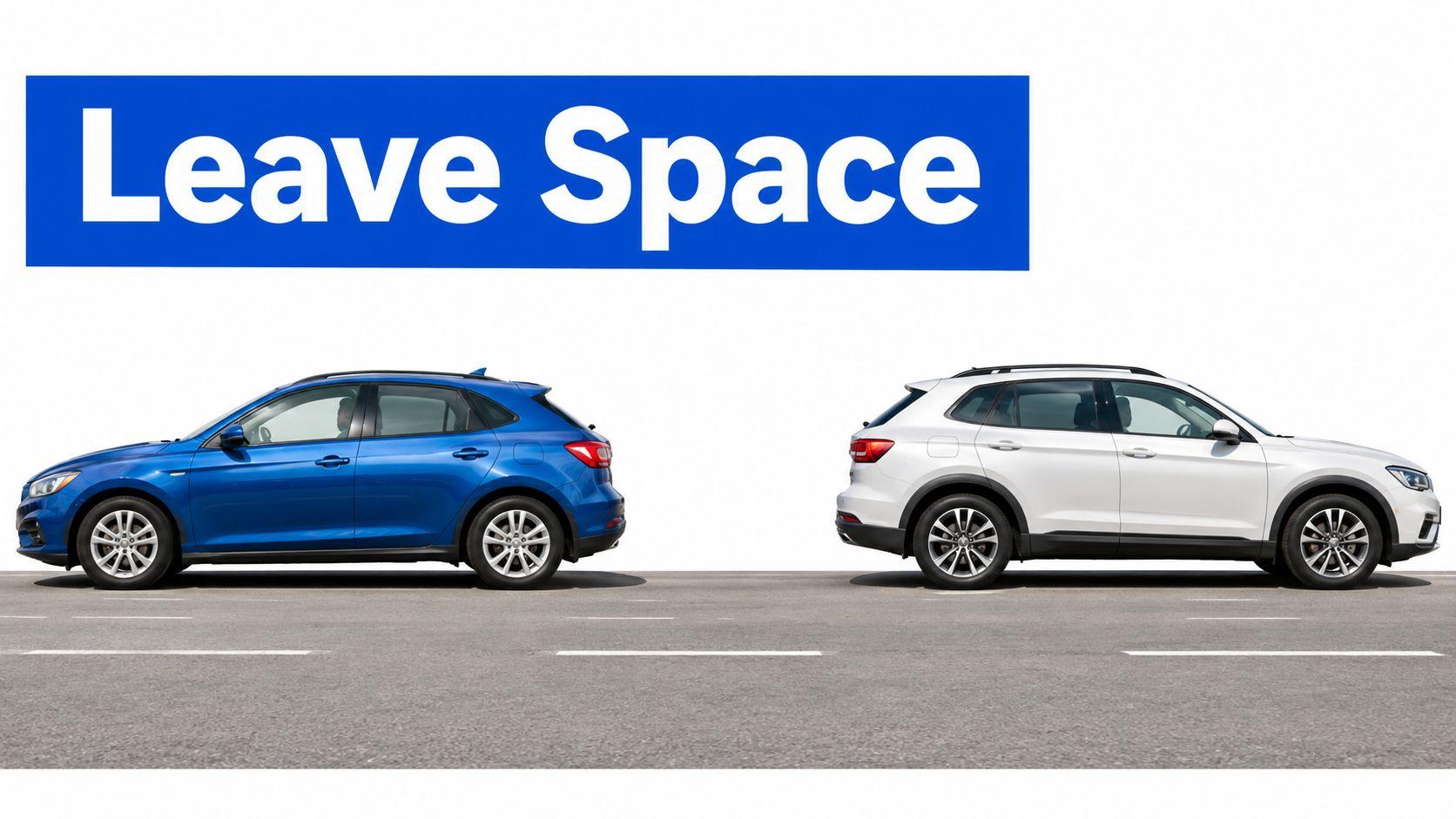
Use the two-second rule in good conditions. Pick a fixed roadside object, watch the vehicle ahead pass it, then count "one thousand one, one thousand two" before you pass the same spot. If you arrive early, you're too close, whatever the distance feels like at that speed.
When Two Seconds Isn't Enough
Increase to three or four seconds in rain, snow, fog, or darkness. Stopping distances grow when tires can't grip, and low visibility steals the reaction time the gap was meant to buy you. Add even more behind large trucks, because they block your view of what's happening beyond them and you can't plan around hazards you can't see.
The trade-off is simple. A bigger gap invites other drivers to fill it in heavy traffic, and that is annoying. Let them. Rebuild the gap by easing off slightly instead of defending space with your bumper.
Practical rule: If you can't count the full gap, you don't have it. Feelings aren't a measurement.
Practise it deliberately. Ask your supervising driver to call out time gaps at random during a drive, including in parking lots where a reversing vehicle can appear with little warning. For study, work through following-distance and stopping-distance questions, then write one sentence for each explaining how weather changes the answer. That links the number on the test to a decision you'll make at speed.
3. Use Shoulder Checks and Make Safe Merging, Lane Changes, and Right-of-Way Decisions
A motorcycle can sit beside your car, outside the mirrors' view. Before changing lanes or merging onto the 401, signal, check your mirrors, then glance over your shoulder toward the lane you plan to enter. Check again before turning right for a cyclist approaching beside you.
Use the same sequence every time, and practise it in a quiet parking lot before drilling it on real roads. A proper blind-spot check should be a brief glance, not a turn that takes your eyes off the road ahead for too long.
- Signal first: Give other drivers time to understand your intention.
- Check mirrors: Look at the speed and position of traffic behind you.
- Shoulder check: Confirm the space beside you is clear.
- Move smoothly: Change one lane at a time, only when there's room.
Match Speed, Then Decide Right-of-Way
On an on-ramp, use the acceleration lane to build speed and find a suitable gap before merging. Entering too slowly can make other drivers brake; rushing into a small gap creates a different risk. On a four-way stop, yield to the vehicle that arrived first, and give way to pedestrians and traffic already in the intersection.
Pair each driving habit with a matching study routine. Practise the signal, mirror, shoulder-check sequence in a quiet area, then work through questions on lane changes and intersections. For right-of-way questions, identify who proceeds first and why. G1ready.ca offers free practice tests with instructor-reviewed answers, so you can check your reasoning and correct mistakes as you study.
4. Manage Speed Based on Conditions, Not Just Posted Limits
The posted limit is a maximum for ideal conditions. It's not a promise that the speed is safe on an icy curve, in heavy rain, or past a row of parked cars where a child could step out.
Say you're on a rain-soaked Highway 17 curve and the sign allows more speed than your visibility does. A smart driver slows before the curve, not in it, so the tires aren't asked to brake and turn hard at the same time. In a residential area with children on the sidewalk, the right speed is the one that lets you stop if someone darts between cars.
The One Question That Sets Your Speed
Ask whether you could stop safely within the distance you can see. If fog, a hill crest, or a large truck cuts that distance, your speed has to come down with it. Slow before hills, curves, and intersections where your view is limited, and watch for reduced-speed and construction signs that change the legal picture.
Driving too slowly in fast traffic creates its own hazard. The goal isn't slow. The goal is speed matched to what you can see and how quickly you can stop.
Mistakes here carry extra weight for novices. Under Ontario's demerit points guidance for novice drivers, a novice driver with two to five demerit points receives a warning letter, and at nine or more points the licence is suspended for 60 days. Speed choices aren't just about comfort. They protect your licence.
For the study track, drill speed-limit, school-zone, and construction-zone questions, then add a conditions twist. Read each scenario again and ask, "What if it's raining?" If your answer changes, you've understood the principle the examiners are really testing.
5. Practise Defensive Driving by Anticipating Other Drivers
Defensive driving starts from an unfriendly assumption. Someone near you will drift, brake late, run a stale yellow, or pull out without looking, and you need a plan that doesn't depend on them behaving.
Say the car ahead is weaving slightly and its speed keeps rising and falling. Don't sit in its blind spot analysing why. Increase your following distance, keep an escape space beside you, and pass only when you can do it cleanly. The same thinking applies when you spot a pedestrian about to step off a curb between parked cars. Slow early and cover the brake, even if you have the right-of-way.
What to Watch For
- Inconsistent speed or lane position: A sign of distraction or impairment.
- Wheels turning at side streets: A driver preparing to pull out.
- Brake lights several cars ahead: Trouble arriving before you reach it.
- Cyclists and pedestrians near parked cars: Limited visibility for everyone.
Right-of-way is something other drivers give you, not something you take. If taking your turn requires someone else to brake hard, you've misjudged it. I recommend reading our Ontario defensive driving course guide alongside practice drives, because the concepts stick faster when you've just handled a real example of each one.
For study, use scenario-based questions rather than definition questions. Our 100-question practice test's safe driving section covers defensive driving, hazard perception, and how to act in an emergency, so work through a set after a drive and compare each scenario to something you saw that day. That comparison is where anticipation becomes a habit instead of a chapter heading.
6. Eliminate Distractions and Follow Ontario's Phone Rules
A phone buzzing at a red light feels harmless. It isn't, legally or practically. Holding a handheld device while driving is prohibited in Ontario, and "while driving" includes sitting at that light. If you need to answer a message, pull over somewhere safe and legal first.
The penalties for novices are sharper than many learners expect. The official MTO handbook guidance on losing your licence states that a first distracted-driving conviction for a G1 or G2 driver produces a 30-day licence suspension, and a second conviction produces a 90-day suspension. Violating a graduated-licensing condition on its own also brings a 30-day suspension.
Set Up Before You Move
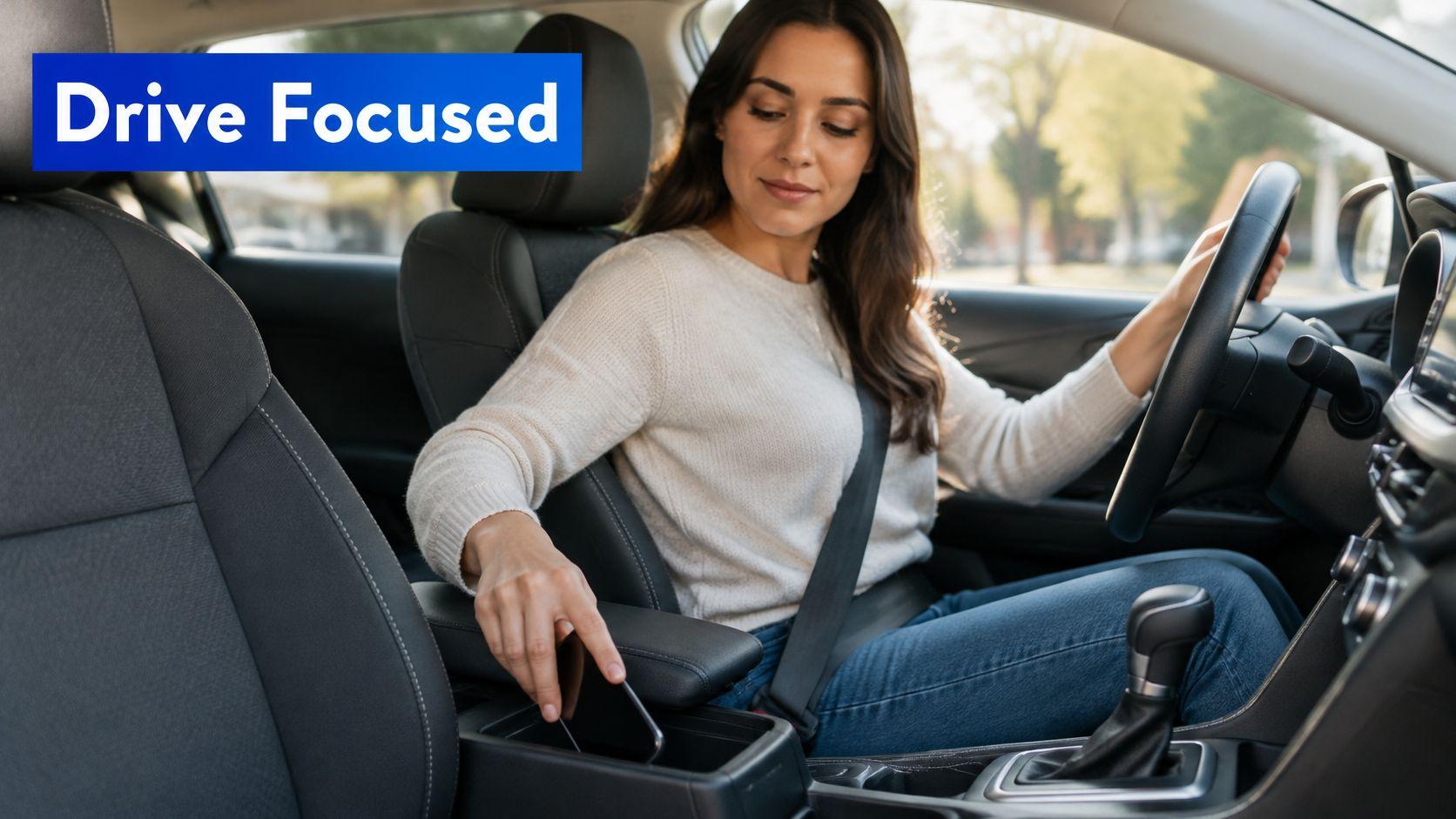
Parents can make this easy by treating setup as part of the lesson. Enter the navigation destination, choose the music, and set climate controls while parked. Put the phone in the console or a bag, switch on a driving focus mode, and agree that the supervising driver handles anything that comes up underway.
Distraction isn't only phones. Eating, searching for sunglasses, and turning to talk to back-seat passengers all take eyes or attention from the road. For a G1 driver still building basic scanning, even a brief glance away can erase the moment a light changes or a pedestrian appears.
Pair the habit with study on distracted driving, fines, suspensions, and penalties. Learn the novice consequences as a sequence, not isolated numbers, so test questions about first and second convictions feel like a story you already know. Then keep the car rule absolute. Devices get handled parked, every time, no exceptions for short trips.
7. Adjust Your Driving for Night, Weather, and Low Visibility
A snowstorm on a rural Ontario road can hide hazards beyond the reach of your headlights. Slow to a speed that lets you stop within the visible distance, increase your following space, and use full headlights so other drivers can see you. Rain, fog, snow, and darkness each reduce visibility or traction, so adjust both speed and space.
Know your licence limits before planning evening practice. Ontario's guide to getting a G licence for new drivers states that a G1 driver may not drive between midnight and 5 a.m. or on 400-series highways and other high-speed expressways, including Highway 401, the Queen Elizabeth Way, and Toronto's Gardiner Expressway. Choose a suitable route and time that follow those restrictions.
A Low-Visibility Routine
- Clear your view: Clean the windshield, mirrors, and headlights before leaving.
- Use low beams in fog: High beams can reflect off fog and make it harder to see.
- Brake early and gently: Bridges can freeze before surrounding road surfaces, so avoid sudden braking.
- Check traction cautiously: A gentle brake check at low speed can help you judge how much grip is available.
Pair each driving habit with a study routine. After practice in poor conditions, review relevant questions on weather, visibility, and safe driving. If a bridge felt slick earlier than the rest of the road, connect that observation to the need for gentle braking and an appropriate speed. For more guidance, read these night-driving tips for Ontario learners.
8. Perform a Pre-Drive Check and Maintain Your Vehicle
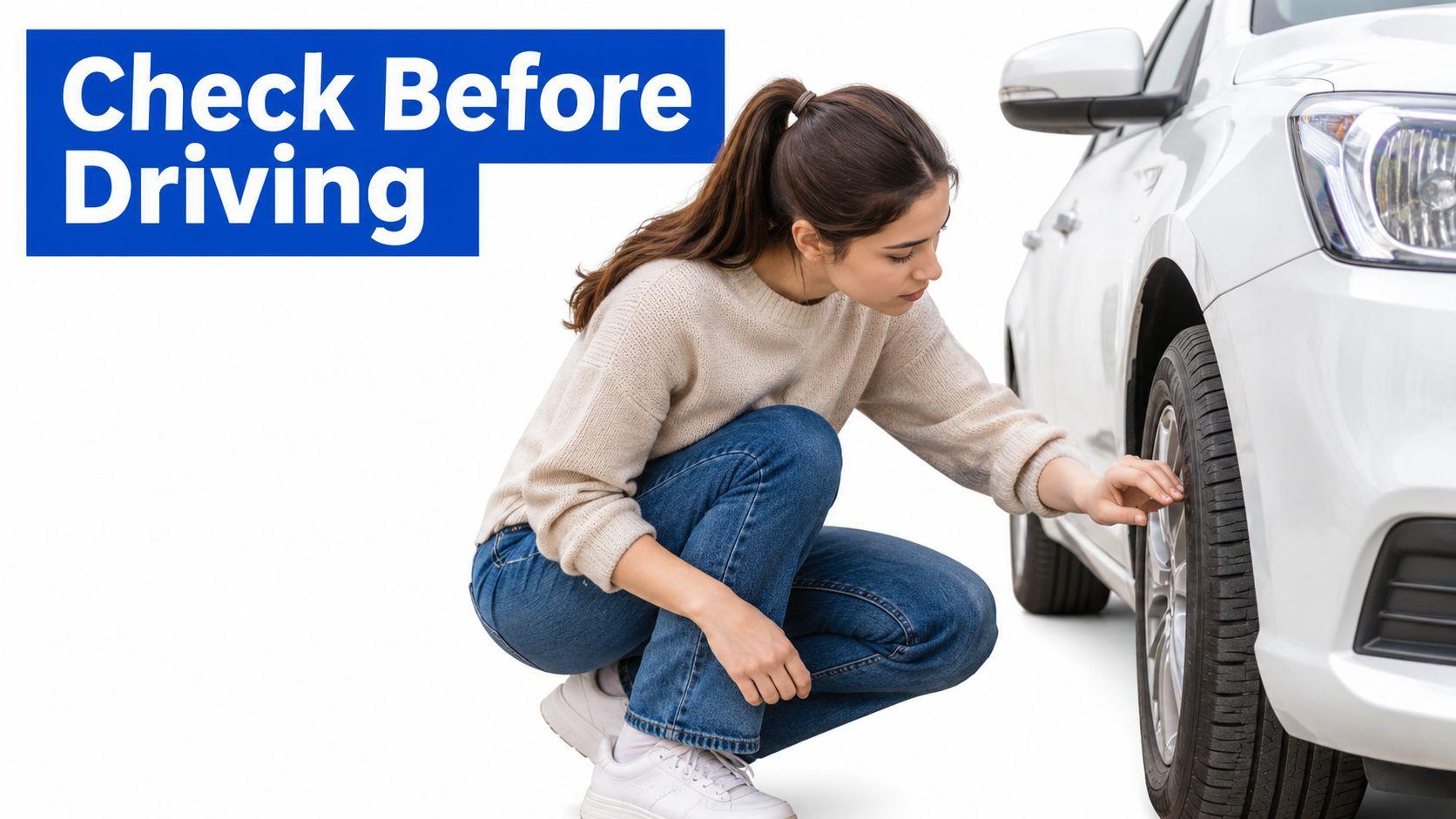
A safe trip starts in the driveway. Walk around the car and look at tires, lights, and visible damage before anyone gets in. A parent who spots a worn tire during that walk can arrange service before a teen takes the car on a longer trip, instead of discovering the problem at highway speed.
Inside, adjust the seat, steering wheel, and all mirrors before starting the engine, every time, even if you were the last driver. Check that signals and lights work, confirm the windshield is clear, and fasten seatbelts before moving. Learners who build this order early don't waste attention fixing their position at the first intersection.
Know Who Can Ride With You
Vehicle checks include legal checks. Ontario Regulation 340/94 on driver's licence conditions requires the accompanying driver to occupy the seat beside the novice driver, and rear passengers cannot exceed the number of operable seat-belt assemblies. If a rear belt doesn't work, that seat isn't available. Check belts like you check tires.
Maintenance goes beyond oil changes, brake inspections, and tire pressure checked monthly and before long trips. Modern safety systems need care too. Reporting on an Ipsos survey of Ontario motorists about ADAS awareness found only 29% of Ontario respondents knew a windshield-mounted ADAS camera must be calibrated to manufacturer requirements after windshield replacement. If a camera-dependent warning behaves oddly after a repair, get qualified inspection instead of assuming the system is accurate.
For study, pair each walk-around with a few vehicle safety and dashboard warning questions. Name what you checked, then answer what you'd do if it failed. Address warning lights promptly and keep maintenance records, because a predictable car lets a new driver spend attention on traffic, where it belongs.
8 Smart Driving Habits at a Glance
Habit Primary Skill When to Use It Difficulty for New Drivers Scan ahead using the Smith System's five keys Hazard awareness and visual scanning Continuously, especially near intersections and changing traffic Challenging while learning vehicle control Maintain a safe following distance Space management and braking judgment At all speeds; increase the gap in poor conditions Moderate; gaps can feel too large in traffic Shoulder-check and make safe merges, lane changes, and right-of-way decisions Blind-spot awareness and decision-making Before moving lanes, merging, turning, or entering intersections Challenging; requires timing and practice Adjust speed to conditions, not just posted limits Speed judgment When weather, traffic, visibility, or road conditions change Moderate; good judgment develops with experience Practise defensive driving by anticipating other drivers Risk anticipation Throughout every drive, especially around unpredictable road users Challenging; predicting others takes practice Eliminate distractions and follow Ontario's phone rules Focus and legal compliance Before and during every drive Moderate; requires consistent self-discipline Adjust driving for night, weather, and low visibility Visibility and traction management At night or in rain, snow, fog, or other reduced-visibility conditions Challenging in severe or unfamiliar conditions Perform a pre-drive check and maintain your vehicle Vehicle readiness and basic maintenance Before driving and at regular maintenance intervals Easy to learn; requires time and consistency
Turn These Habits into Your Test-Ready Routine
You don't need to fix all eight habits in one week. Pick two habits for your next practice drive, say scanning ahead and shoulder checks, and ask your supervising driver to give feedback on just those two. Narrow feedback works because you can act on it. A list of nine corrections at the end of a drive mostly produces a discouraged learner and a tense ride home.
Keep the Ontario framework in view while you build those habits. G1 practice happens with an accompanying fully licensed driver beside you, under novice conditions that carry real suspensions if you break them. That structure isn't bureaucracy for its own sake. It's supervised time to make your mistakes at lower speed, on suitable roads, with an experienced driver who can talk you through them. Use that time deliberately instead of treating practice drives as errands with a passenger.
A Simple Weekly Pattern
- Drive with one focus: Two habits maximum per outing, agreed before you start.
- Debrief for five minutes: What went well, and one thing to change next time.
- Quiz the same topic: A short set of questions matched to those two habits.
- Repeat the weak spot: Next drive and next quiz both revisit whatever felt shaky.
That loop is the whole method. Parents and supervising drivers can support it by giving instructions early, staying calm, and modelling the behaviour they expect, including putting their own phone away. Instructors recommending supplemental study can point learners to chapter-based quizzes that mirror the lesson they just taught, so the theory lands while the drive is still fresh. Newcomers to Ontario benefit from the same loop, because it connects unfamiliar provincial rules to real streets quickly.
On the theory side, our free, registration-free practice exams mirror the official G1 test and are built around the 2026 Ontario MTO Driver's Handbook, with instructor-reviewed answers, a streak system, and unlimited retakes so you can drill weak spots until they disappear. We offer a separate Road Rules Test and Road Signs Test, plus topic tests on distracted driving, demerit points, and intersections, signals, and right-of-way, which map neatly onto the habits above. Thousands of Ontario learners have used the platform to move from first study session to test day with confidence.
Alternate in-car habit practice with short quiz sessions during the week, and keep each session small enough that you'll follow through. By the time you sit the G1 knowledge test, the questions will describe situations you've already handled with a supervising driver beside you. The road feels familiar because you've driven the thinking, not just read it. That's the goal here. Learn to drive smart now, and the habits you build as a learner are the ones that will carry you safely through G2 and well beyond.
Ready to pair your next practice drive with study that matches it? Visit G1ready.ca for free practice tests with instructor-reviewed answers, topic quizzes on everything from blind spots to demerit points, and unlimited retakes built around the 2026 Ontario handbook. Choose two habits from this list, drive them this week, then quiz them the same day and watch both sides click.