$16.00 is the official Ontario M1 motorcycle knowledge test fee per attempt. That's the number most riders want first, but it's only the starting point of what you'll spend to get licensed and ride with confidence.
If you're reading this, you're probably doing what smart new riders do. You've got the idea of riding in your head, maybe you've started looking at bikes, and then one practical question cuts through the excitement. How much is this really going to cost me?
That's where people often get tripped up. They hear one fee, assume that's the whole story, and then get surprised later by course costs, later test fees, gear, and the little add-ons that seem to appear one by one. The good news is that the path is manageable when you budget for it from the beginning.
I always tell new riders to think in layers. First comes the M1 test fee. Then comes the rest of the licensing path. Then come the practical riding costs that make the licence useful, not just official. If you already understand Ontario's broader graduated system, this plain-language guide to Ontario graduated licensing explained helps connect the motorcycle steps to the bigger picture.
Your First Step Into Motorcycling
Most future riders start with a simple budget question and a messy notebook. One line says “M1 test.” Another says “helmet.” Then there's a question mark beside training, insurance, and whether you'll need access to a bike before you're fully licensed.
The first line is easy. The M1 knowledge test costs $16.00 per attempt in Ontario. That makes it feel small and approachable, which it is. But it can also be misleading if you stop there.
Getting your M1 is really the entry ticket, not the whole trip. You're paying for the written step that lets you begin the process. After that, most riders still need to think about training, later test stages, riding gear, and how they'll practise safely.
Practical rule: Treat the M1 test price as your starting cost, not your final budget.
A better way to think about this is to split your planning into three buckets:
- Licence fees first: These are the official charges tied to tests and licence steps.
- Training next: Many riders choose a safety course because it gives them structure, practice time, and a more organised start.
- Riding setup last: Gear, bike access, and insurance are what turn a licence into actual road time.
This approach keeps the process from feeling overwhelming. You don't need to pay for everything on the same day. You do need to know what's coming so nothing catches you off guard.
The Official M1 Test Price Explained
The official M1 test price is straightforward once you separate the written test from the rest of the licensing path. According to the Ontario DriveTest fee schedule, the M1 motorcycle knowledge test costs $16.00 per attempt, and the full M1 licence package is $78.75, which includes one knowledge test, the M2 road test, and a 90-day licence, as shown on the Ontario DriveTest fees page.
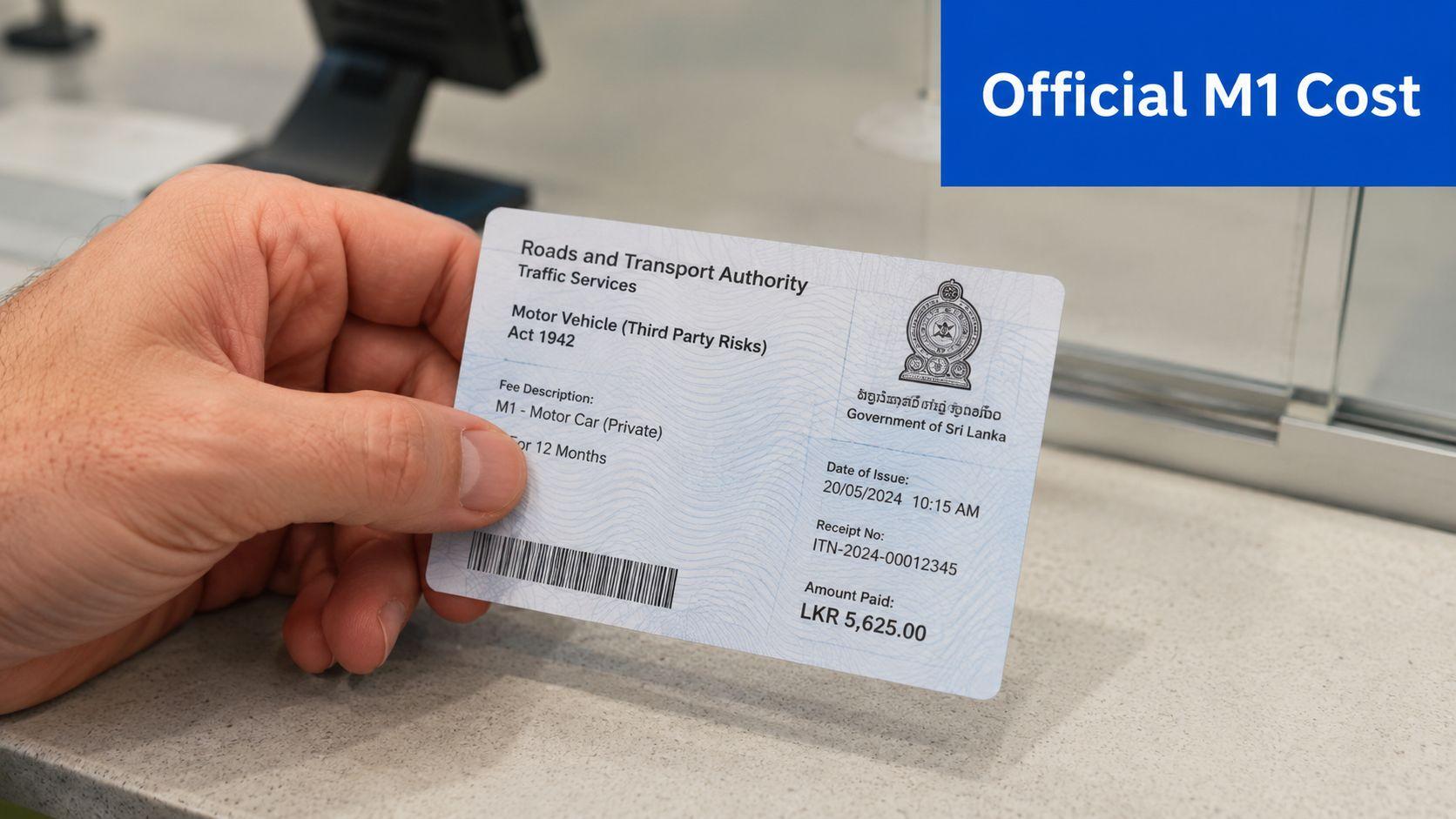
That distinction matters because many learners mix up the single test fee with the package fee. If you only ask, “What's the M1 test price?” the answer is still $16.00. But if you're trying to understand what the government charges across the early stages of motorcycle licensing, the package number gives more context.
What the $16.00 fee actually covers
At its simplest, the fee pays for one attempt at the written M1 knowledge test. It's the charge tied to that testing event at a DriveTest centre.
What it doesn't cover is everything else people often assume comes with “getting your M1.” It doesn't buy riding gear. It doesn't cover a training course. It doesn't solve transportation to the test centre. And it doesn't erase the cost of another attempt if you don't pass.
Where confusion usually happens
People often hear different numbers online because they're looking at different parts of the same journey. One source may refer to the written test alone. Another may refer to a package. Another may be talking about the broader cost of getting fully on the road.
Here's the cleanest way to organise it:
Cost type What it refers to $16.00 One M1 knowledge test attempt $78.75 M1 licence package including one knowledge test, the M2 road test, and a 90-day licence
That's why I tell learners to ask a sharper question. Don't just ask, “What's the M1 cost?” Ask, “Am I paying for the written test only, or am I planning my whole beginner licensing budget?”
The M1 test price is precise. The total cost of becoming a rider is not.
Once you understand that difference, the rest of the planning gets much easier.
Budgeting for Costs Beyond the Test Fee
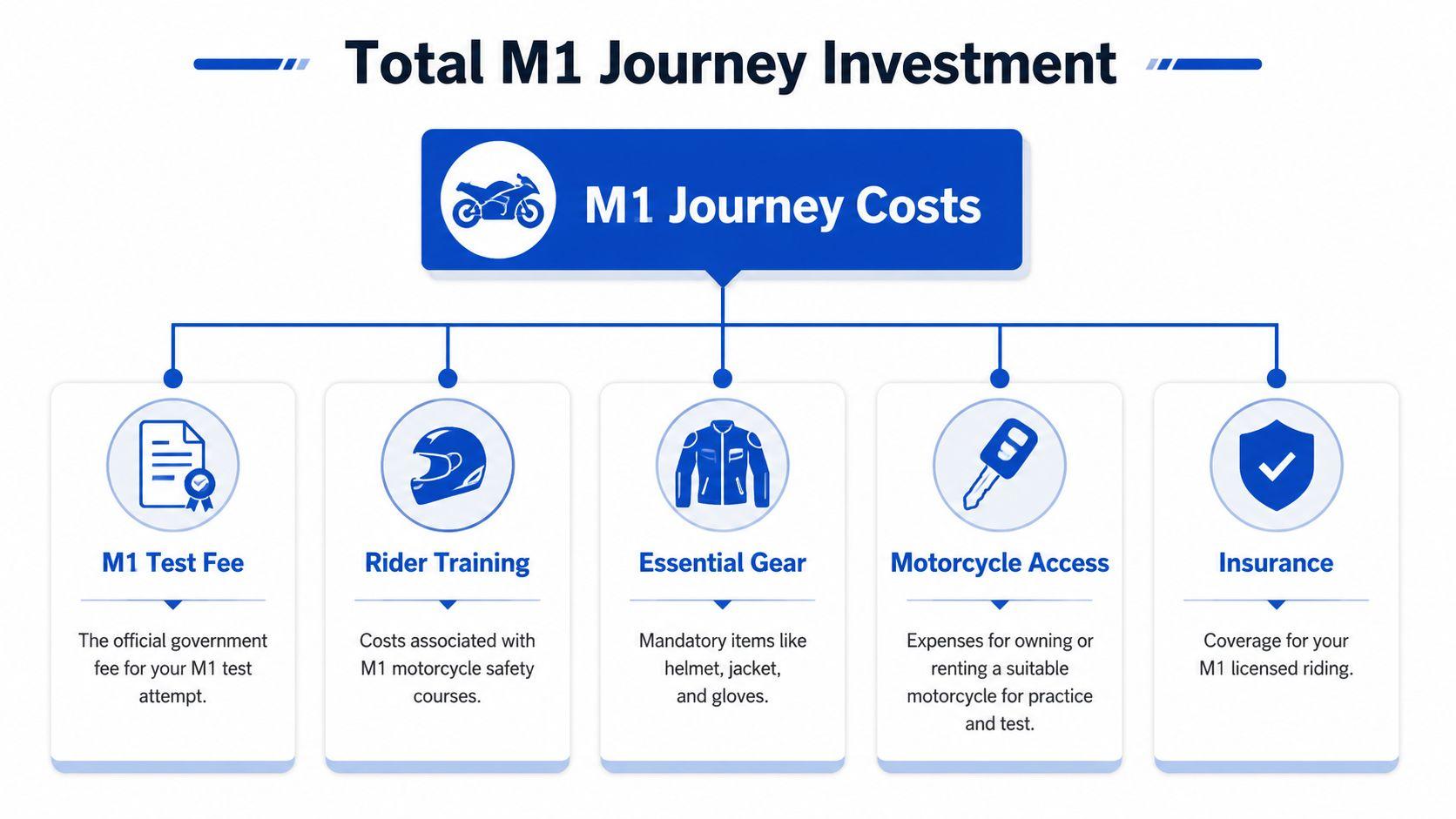
The easiest mistake to make is treating the M1 test fee like the whole iceberg. It isn't. The $16.00 written test is the part you can see right away. The bigger costs usually sit underneath, and they're the ones that determine whether your plan feels smooth or stressful.
A broader cost guide for Ontario riders estimates that the total financial barrier to obtaining an M1 licence can range from $500 to $850+, with government fees around $161 and optional Ministry-approved safety courses ranging from $400–$700+, according to this Ontario motorcycle licence cost guide.
The visible cost and the hidden budget
That range tells you something important. The written test itself is small compared with the full journey. What pushes your budget up isn't usually the M1 test price. It's the collection of choices and requirements that follow.
For most beginners, the biggest budget categories look like this:
- Official licensing costs: These include the government fees tied to your tests and licence steps.
- Rider training: A safety course can be one of the largest single expenses, but many riders see it as money well spent because it gives them guided practice.
- Gear: Helmet, gloves, jacket, boots, and other protective basics matter before your first real rides.
- Bike access: Some riders own a motorcycle early. Others borrow, rent, or train on a course bike.
- Insurance: This is often the cost new riders underestimate most because they focus only on test-day fees.
Where to spend carefully
Not every category deserves the same urgency. If your budget is tight, prioritise what helps you learn safely and avoid repeat costs.
A sensible order often looks like this:
- Licence fees first, because you can't move ahead without them.
- Training second, especially if you want guided instruction instead of figuring everything out alone.
- Core gear next, because safe riding starts before your first trip around the block.
- Everything else after that, once you know your timing and comfort level.
Many learners don't run into trouble because the M1 test price is high. They run into trouble because they budget for the first fee and forget the rest.
If you're trying to keep your overall planning organised, this guide to Ontario licence renewal fees and related costs is useful for understanding how official driving fees fit into the wider licensing picture.
A realistic mindset
The helpful way to budget is to think in stages, not one lump sum. You're not just buying a written test. You're funding your path from “I want to ride” to “I can legally and safely ride.”
That shift in thinking makes the M1 test price easier to understand. It matters. It's official. But it's rarely the number that defines your true starting budget.
How to Book and Pay for Your M1 Test
You don't need to overcomplicate the booking side. The M1 knowledge test is generally taken at a DriveTest Examination Centre, and the process is built around showing up prepared, paying the fee, and completing the written exam.
The test itself has a specific structure. To pass the Ontario M1 test, candidates need 80% in each of three sections for a total of 64 multiple-choice questions. The breakdown is 20 questions on road signs, 20 on rules of the road, and 24 on motorcycle-specific topics, based on this Ontario M1 test format guide.
What happens at the test centre
Most learners feel less nervous once they know the flow. In plain language, the process usually looks like this:
- Arrive with your identification: Make sure your documents are ready before you leave home.
- Go to the counter and check in: Staff will guide you through the next steps.
- Pay the M1 knowledge test fee: This is the point where the written test charge is collected.
- Wait for your turn: Some centres are faster than others, so patience helps.
- Write the test: You'll answer questions across all three knowledge areas.
That last point matters because some riders study only general road rules and forget the motorcycle-specific material. That's one of the most common reasons strong car drivers get surprised by the M1 test.
What your fee is paying for
The fee gives you access to a test that checks three separate areas of knowledge, not just one broad score. You need to be solid across signs, road rules, and motorcycle-specific safety topics.
Here's a simple view of the structure:
Section Number of questions Road signs 20 Rules of the road 20 Motorcycle-specific topics 24
That means your preparation should match the structure. If you only study signs and basic traffic rules, you're leaving a large part of the exam underprepared.
A helpful refresher before test day is this walk-through video:
Show up early, bring the right documents, and study motorcycle-specific material with the same seriousness you give signs and road rules.
A calm test day usually comes from simple preparation. Know where your nearest centre is, give yourself extra time, and don't treat the M1 like a smaller version of the G1. It has its own focus, and your study plan should reflect that.
Smart Ways to Save Money on Your M1 Journey
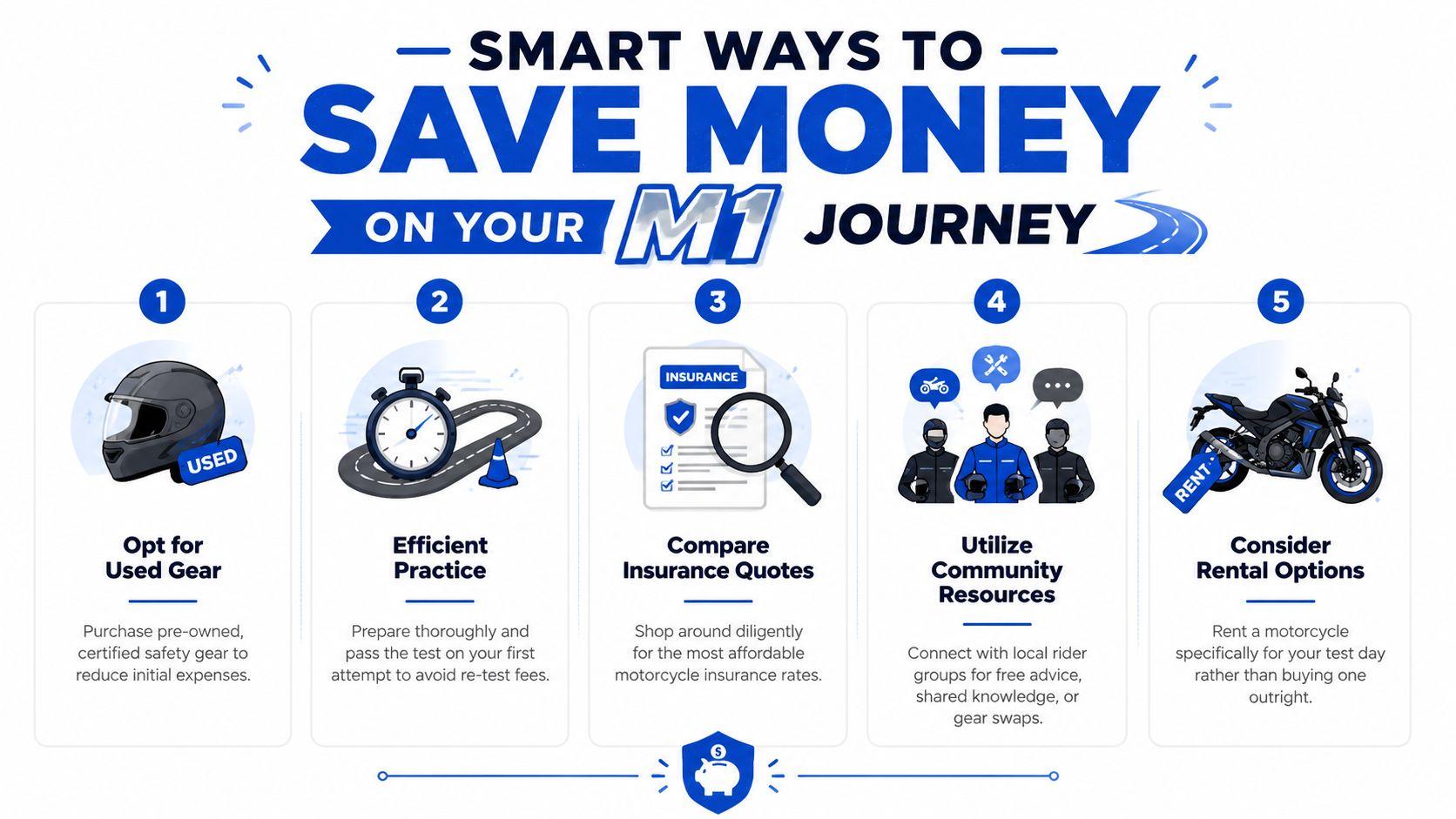
Saving money on your M1 journey usually has less to do with hunting for a cheaper official fee and more to do with avoiding expensive mistakes. The M1 knowledge test fee itself is fixed. What changes is how many times you pay it, how you approach training, and whether you buy carefully in the bigger spending categories.
If a learner fails the written knowledge test, each additional attempt costs exactly $16.00, using the same fee structure seen in the G1 knowledge test, according to this Ontario written test fee breakdown.
Pass once and avoid paying twice
The cheapest retest is the one you never need. That sounds obvious, but it's where many learners end up losing money.
Your best savings move is simple:
- Study the motorcycle section properly: Riders who rely only on general driving knowledge often leave easy marks behind.
- Practise in short sessions: A few organised sessions usually beat one long cramming night.
- Treat the test like three tests: Signs, road rules, and motorcycle knowledge each deserve attention.
- Go when you're ready, not just when you're excited: Enthusiasm helps. Preparation saves money.
Money-saving mindset: Time spent studying is often worth more than money spent retesting.
Be selective with the bigger expenses
After the written test, the larger costs deserve careful decisions. You can't always make them cheap, but you can make them smarter.
For example, many riders choose a safety course because they want structured learning and practice time. If you're exploring that route, it helps to understand the value of careful, defensive habits early. This article on an Ontario defensive driving course gives useful context on why skill-building often pays off beyond test day.
A few practical ways to keep costs under control:
- Buy gear carefully: Fit and condition matter more than buying the flashiest item in the shop.
- Ask what a course includes: Some programmes are more complete than others in how they support beginners.
- Delay unnecessary purchases: Don't rush into buying every accessory before you've even passed the first stage.
- Compare insurance options: Riders who shop around usually make better decisions than riders who accept the first quote out of frustration.
Where being cheap backfires
There's a difference between being careful and being penny-wise in the wrong place. Skipping preparation to save time often leads to a retest fee. Buying poor-quality gear can leave you replacing it too soon. Rushing your way into riding without proper instruction can cost you more in stress than in dollars.
The smart version of saving money is choosing what helps you pass, learn, and ride safely the first time around.
Your Budget-Friendly Roadmap to Riding
When you zoom out, the M1 test price is easy to understand. The official written test fee is $16.00 per attempt. That's the clean, simple number many seek first.
The bigger lesson is that your motorcycle budget shouldn't stop there. A realistic Ontario riding plan includes official licence fees, training choices, protective gear, bike access, and insurance. For many beginners, that full picture matters much more than the first fee at the counter.
Here's the roadmap I'd give any new rider:
Stage What to focus on Start Budget for the written M1 test and prepare properly Build Decide whether rider training fits your learning style and budget Equip Get the protective gear you need before regular riding Ride Plan for bike access and insurance so your licence becomes practical
If you approach the process in that order, it feels less like a pile of random expenses and more like a plan you can control.
Riding becomes much less stressful when you budget for the journey, not just the first receipt.
This is a key takeaway. The M1 test price is affordable. The full path to riding takes more planning. If you go in with clear expectations, study before you pay, and make careful decisions on the larger costs, you'll save yourself money and a lot of unnecessary frustration.
If you want a simple way to build your road-rule knowledge and practise with confidence, G1ready.ca offers free Ontario practice tools designed to help learners study smarter, spot weak areas quickly, and feel more prepared before test day.