Ontario's move over law requires you to slow down and proceed with caution when approaching a stopped emergency vehicle or tow truck displaying the specified flashing lights, then move to a lane farther away only when it's safe on a road with two or more lanes in the same direction.
You're driving with traffic when flashing lights appear on the shoulder ahead. There's a vehicle beside you, someone following behind, and little time to decide what to do. Your first action isn't to force a lane change. It's to ease off your speed, assess the scene and make room without creating another hazard.
For a new driver, the most useful distinction is stopped versus approaching. Passing a roadside response scene and making way for an emergency vehicle coming towards you require different actions.
Move Over Law Ontario at a Glance
Ontario's move over law combines speed reduction with extra space when safe. Reduce your speed below the posted limit and approach cautiously. If you're travelling in the same lane as, or a lane adjacent to, the stopped vehicle, move farther away when you can do so safely.
The Highway Traffic Act's move-over provisions require drivers approaching the specified stopped vehicles to slow down and proceed cautiously, with a safe lane change required on roads with two or more lanes travelling in the same direction. A lane change doesn't replace slowing down.
Required action by situation
Situation Your duty Lane change needed? Stopped emergency vehicle with flashing red or red-and-blue lights, single-lane road Slow down and proceed with caution No Stopped emergency vehicle with flashing red or red-and-blue lights, two or more lanes in the same direction Slow down and proceed with caution Yes, if safe Stopped tow truck with flashing amber lights Slow down and proceed with caution Yes, on multi-lane roads if safe Emergency vehicle approaching with flashing lights or siren Pull to the right and stop as soon as it is safe Not applicable Disabled vehicle or roadside worker such as surveyor, road crew or utility worker Slow down and pass cautiously Move over when safe
The Ontario Driver's Handbook distinguishes the approaching-vehicle procedure from the stopped-vehicle procedure: an approaching emergency vehicle requires you to pull right and stop safely, rather than pass it with more clearance.
When the next lane isn't clear
Speed reduction remains mandatory; the lane change is conditional. Consider traffic, weather and road conditions before moving. If another vehicle occupies the next lane, don't squeeze into its space or swerve to show that you've noticed the roadside scene.
On a road without another lane in your direction, remain in your lane and pass cautiously. An opposing lane isn't an invitation to make an unsafe manoeuvre.
Roadside check: If flashing lights are ahead on the road or shoulder, slow down first, then decide whether a lane change is safe.
Why Tow Trucks and Roadside Workers Are Covered
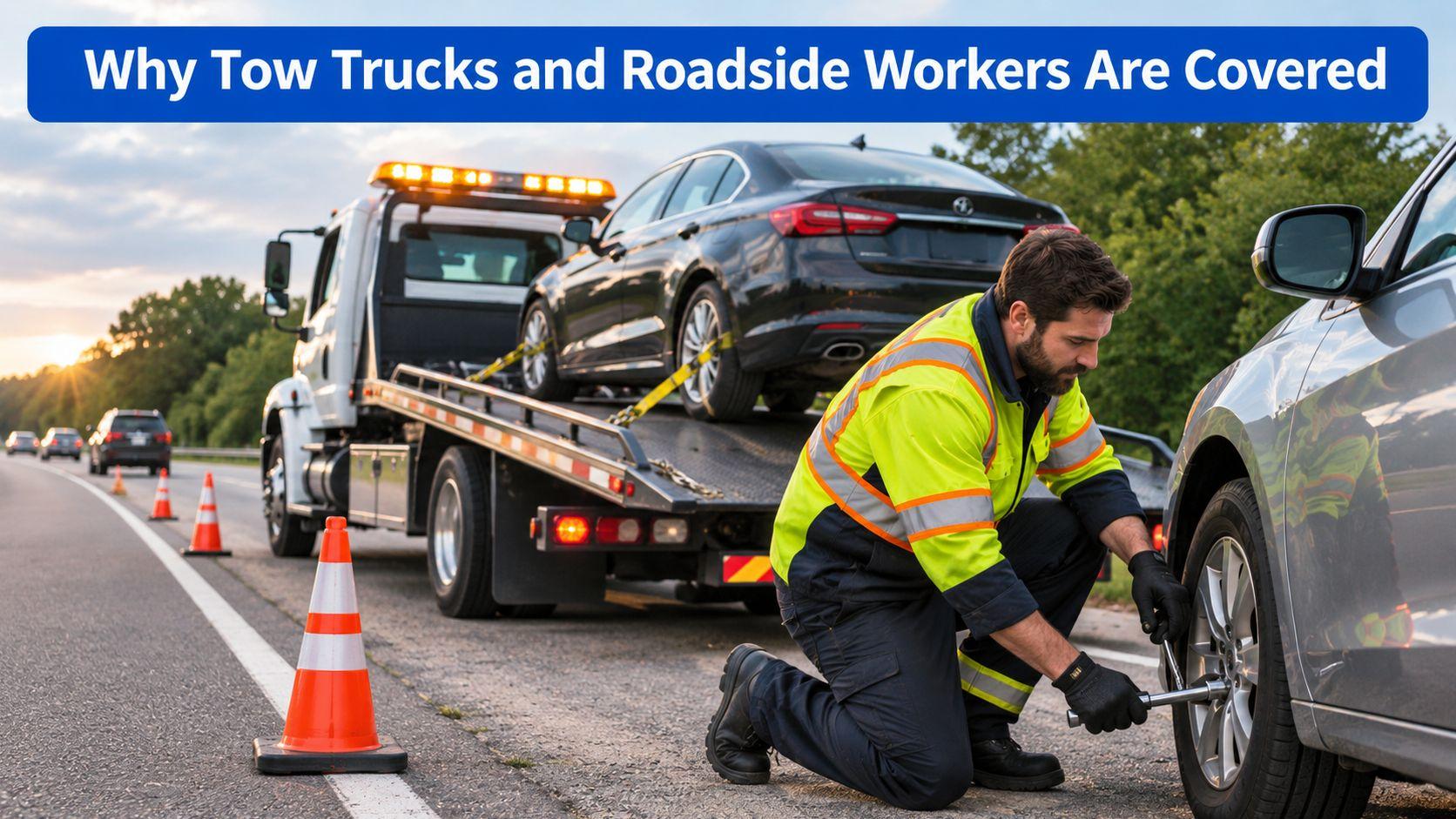
Ontario introduced its Slow Down, Move Over law in 2003 to protect police officers and other emergency responders, then expanded it in 2015 to include tow trucks displaying flashing amber lights, as CAA North & East Ontario explains. That expansion matters because a tow operator can face the same passing traffic as an officer or paramedic.
Say you approach a car with a flat tyre and a tow truck stopped behind it. The operator is crouched beside the car, focused on equipment rather than watching every approaching driver. There doesn't need to be a dramatic collision scene for that person to need protection.
Recognise the roadside exposure
The reason for caution is the worker's position beside moving traffic, not the apparent seriousness of the call. Someone attaching recovery equipment, helping a stranded driver or responding to a crash may need to stand close to a live lane.
Keep these situations distinct:
- Emergency response: Recognise a stopped emergency vehicle displaying flashing red or red-and-blue lights.
- Towing assistance: Treat a stopped tow truck displaying flashing amber lights as a protected roadside operation, not an ordinary parked truck.
- Other roadside work: Slow down, pass cautiously and move over when safe around disabled vehicles, surveyors, road-maintenance crews and utility workers.
The broader roadside-safety guidance doesn't mean every work vehicle has the same statutory status as an emergency vehicle or tow truck. It means you shouldn't wait for a legally protected warning-light combination before responding sensibly to a person working beside traffic.
Understand which side of the highway matters
The Highway Traffic Act applies the stopped-vehicle duty when you approach the protected vehicle on the same side of the highway. Traffic on the far side of a divided highway isn't approaching that roadside scene under this rule.
Don't let a scene across the median distract you from your own lane. Continue watching for traffic slowing ahead of you.
Read the light colour and the vehicle's status together: red or red-and-blue lights identify the emergency-vehicle situation, while flashing amber lights on a stopped tow truck identify the towing situation. Amber lights alone aren't a reason to assume that every vehicle displaying them is a tow truck.
How to Slow Down and Move Over Safely
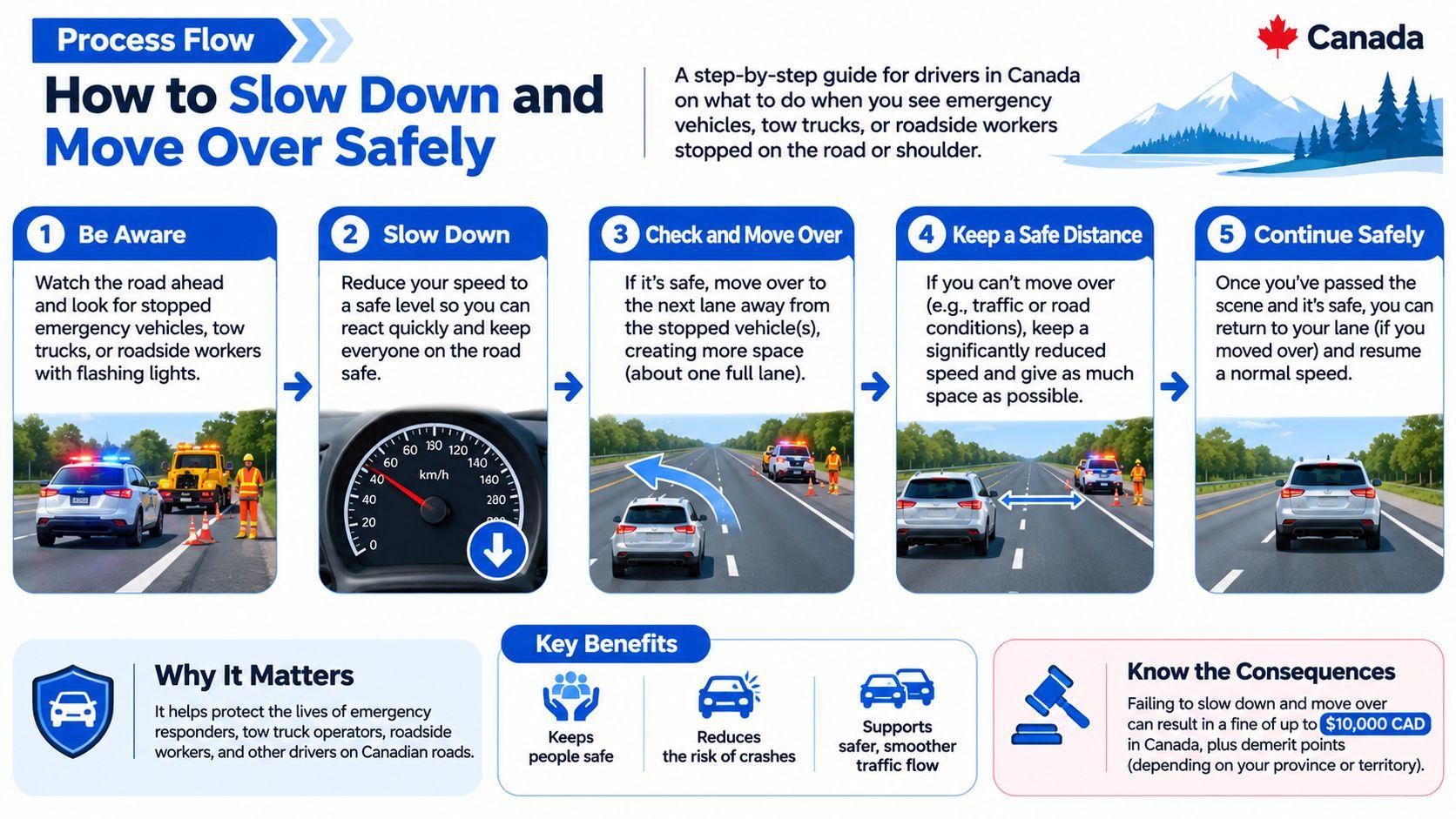
Ontario's move over duty has two parts, and they carry different weight. Slowing down is always required when you approach a protected stopped vehicle. Changing lanes is required only when you can do it safely. Keep them as two separate decisions: first decide how much to reduce your speed, then decide whether a lane change is available.
A safe response begins well before you reach the stopped vehicle. Your aim is a controlled approach that gives surrounding drivers time to understand your intentions and leaves roadside personnel as much clearance as the road allows. Drivers tend to steer toward what they stare at, so keep scanning the road around the scene rather than fixing your eyes on the flashing lights.
A routine you can practise
- Spot the lights early. Flashing red, red-and-blue or amber lights may be visible before you can identify the stopped vehicle. Look ahead for the scene while checking whether traffic in front of you has begun slowing.
- Ease off the accelerator and brake gradually. Start reducing speed early rather than waiting until you are alongside the vehicle. Smooth braking gives the driver behind time to respond and helps you keep control on wet, snowy or low-visibility roads.
- Scan your mirrors and blind spot. Check the lane farther from the stopped vehicle, including traffic approaching from behind. A gap that looks clear in a mirror may hide a vehicle in your blind spot or a driver closing quickly.
- Signal, then move only if the gap is safe. Choose a lane farther from the roadside scene and make a controlled lane change without forcing another driver to brake or swerve. Your signal communicates an intention; it does not give you priority over traffic already in that lane. If no safe gap opens, stay in your lane and keep the reduced speed.
- Maintain clearance as you pass. Watch the road ahead and the edge of the scene, where a worker, an open door or recovery equipment may sit close to moving traffic. Return to the nearer lane only once the stopped vehicle and the people around it are well behind you.
Apply the routine without rushing
Suppose a truck is beside you as you approach a tow operator on the right shoulder. The first part of the duty still applies: reduce your speed. The second part does not, because squeezing ahead of the truck would make the lane change unsafe. Stay predictable in your lane and take the gap only if one develops.
Now consider heavy rain. You may see the warning lights but struggle to judge the shoulder edge or the speed of traffic behind you. Begin slowing earlier and avoid abrupt braking or steering, because poor visibility makes last-second decisions harder for everyone on the road.
The law sets no single passing speed, so there is no number to memorise. Reduce your speed below the posted limit and approach cautiously at a pace that suits the hazard, the visibility, the traffic around you and the road surface. A brief lift off the accelerator while you continue past at normal traffic speed does not meet the slowing half of the duty.
Slow first, look second, move third. Never swerve to make a lane change that isn't safe.
If you are unsure whether the situation calls for passing cautiously or pulling over to stop, review the emergency-vehicle rules. Make the stopped-or-approaching decision before choosing your manoeuvre.
Common Mistakes and What Enforcement Shows
Recognising the slogan doesn't guarantee that a driver recognises every protected vehicle. In a 2026 survey of 2,500 Ontario drivers, 82% had heard the phrase Slow Down, Move Over, yet only 55% knew the duty covers stopped tow trucks displaying flashing lights, and while 91% said they always slow down and move over for police vehicles, 92% for fire trucks and 93% for ambulances, just 49% said the same for tow trucks, according to CAA North & East Ontario's survey findings.
That gap points to a specific learning problem: drivers may know how to respond to an ambulance while overlooking a tow operator performing roadside assistance. Part of the confusion comes from treating the rule as one action. It works as two duties. Reducing speed is always required when you pass a protected vehicle on the roadside. Changing lanes is the second duty, and it applies only when you can do it safely. Most mistakes happen when a driver skips the first duty or forces the second.
Replace assumptions with actions
- "It's a courtesy for police cars." Treat the required response as a legal duty and recognise flashing amber lights on stopped tow trucks rather than reserving your caution for police.
- "It only matters on major highways." Respond to roadside personnel on other roads too, where a narrow shoulder or confined lane can leave little separation from passing vehicles.
- "Changing lanes is enough." Reduce your speed before passing rather than moving sideways and continuing at your previous speed.
- "The scene isn't active unless I can see an officer." Respond to the stopped vehicle's warning lights without waiting for a person to become visible.
The last mistake is especially easy for a learner to make. You may look for a person to confirm that there's a hazard, but the person could be behind a vehicle, beside a wheel or partly hidden by equipment. Waiting for that confirmation delays the action you need to take.
Don't use other drivers' behaviour as your answer key either. A driver ahead may pass without slowing, while a driver behind may become impatient when you reduce speed. Neither changes your responsibility to make a controlled, cautious approach.
Read enforcement figures carefully
During an August 2025 campaign, Ontario Provincial Police officers in the West Region recorded 19 charges for failing to move over for emergency vehicles, compared with 12 in the comparable 2024 campaign, according to CambridgeToday's account of the OPP enforcement results.
Those charges were laid over an ordinary long weekend on regular roads, which tells you enforcement reaches everyday driving situations. Learners gain little from trying to predict where officers will be watching. Build recognition of roadside lights into your normal observation routine instead, and let the two duties follow in order: slow down every time, then move over when a safe gap exists.
Self-test: Can you identify the warning-light colours for stopped emergency vehicles and tow trucks, then explain how your response changes when an emergency vehicle is approaching?
Practise that distinction aloud with an instructor or supervising driver while safely parked. If you can explain the action without relying on the vehicle's familiar shape or markings, you're better prepared for an unfamiliar roadside scene.
Penalties for Failing to Slow Down or Move Over
Penalties for failing to move over in Ontario
Offence Fine Other possible consequences First offence $400 to $2,000 Licence suspension of up to 2 years Subsequent offence within 5 years $1,000 to $4,000 Licence suspension of up to 2 years and imprisonment of up to 6 months
The Ontario Ministry of Transportation's emergency-vehicle guidance sets out these fines and states that a conviction also adds three demerit points to your record, with imprisonment of up to six months possible for a subsequent offence within five years.
Why the consequences are serious
The penalty structure reflects what the law asks of you. Slowing down is always required when you approach a stopped emergency vehicle or tow truck with flashing lights. Moving into another lane is required only where that lane change can be made safely. A driver who fails either part of that duty leaves a roadside worker with less room to work and less time to react, often with nothing more than a hi-vis vest between them and passing traffic.
Three demerit points may sound modest next to a four-figure fine. It isn't. Points become part of your driving record, and a suspension removes your ability to drive legally at all. For a learner who depends on supervised practice, school transport or a commute, losing driving privileges can disrupt plans for months.
What to do after receiving a ticket
A charge does not answer itself. Work through it in order:
- Read the offence wording. Identify exactly what the ticket alleges, including which part of the duty it says you breached: the requirement to slow down, or the requirement to change lanes where safe.
- Record the circumstances promptly. Note the location, traffic, weather, lane positions and what you remember seeing while those details are fresh.
- Keep the paperwork together. Retain the ticket and any related notices, and check the stated payment, response or court deadline.
- Get advice if needed. If you're unsure how to respond or what a conviction could mean for your licence, seek qualified legal advice before deciding.
That distinction in the first point matters. If the adjacent lane was occupied or unsafe to enter, the law did not require you to move into it; it required you to slow down and pass with caution. Whether a lane change was available can be central to what the ticket alleges.
For related offences, the guide to Ontario Highway Traffic Act fines and points separates the monetary penalty from the licensing consequences. Paying a ticket does not make every other consequence disappear.
Test Your Move Over Knowledge Before Test Day
Before your G1 test, check whether you can apply the rule to a situation rather than recognise its name. The move over law belongs with the road-rules material you're studying, and the handbook wording matters when similar-looking answers describe different actions.
At G1ready.ca, we're built for Ontario learners preparing for the G1 test in Ontario. Our practice tests are built around the 2026 Ontario MTO Driver's Handbook, with four options: the Road Rules Test, Road Signs Test, 200-Question Test and Diagnostic Test.

Study the decision, not just the slogan
Use a short, deliberate study routine:
- Start with the Diagnostic Test. Identify whether your weak spots involve observation, yielding, lane changes or distinguishing moving emergency vehicles from stopped ones.
- Work through the Road Rules Test. Pay particular attention to questions where the safest answer changes because the next lane isn't clear.
- Review the Road Signs Test. Refresh your recognition of signs warning about road work and changing conditions near roadside activity.
- Explain each missed answer. State which detail you overlooked and why the correct action fits that particular situation.
For additional scenario-based revision, use the traffic-rules questions guide. Focus on the facts that change the answer rather than memorising the position of an answer choice.
Practise with contrasting situations
Ask a parent, instructor or study partner to change a single detail in a practice scenario. A stopped ambulance becomes an approaching ambulance. A clear adjacent lane becomes an occupied lane. A tow truck displaying amber lights becomes a disabled car with someone standing beside it.
Then explain your action in your own words. Identify what you've seen, what you must do immediately and which manoeuvre requires a safety check.
This approach helps an instructor check understanding without needing a long quiz. It also gives parents and newcomers to Ontario a straightforward way to discuss provincial road rules without substituting habits learned elsewhere.
This week, complete a Road Rules Test and review every move over question you miss. Use the situation table and driving steps to explain your corrections, then confirm any uncertainty against the official handbook before your next supervised drive.
G1ready.ca offers Ontario-focused practice tests to help you work through road rules, signs and situations such as passing a stopped tow truck safely. Visit G1ready.ca, complete a Road Rules Test this week and review every missed move over question until you can explain the correct action.