You're stopped at a red light on a narrow downtown street, third in line, left signal ticking. The car ahead rolls forward and turns left while the light is still red. Nobody honks. The driver behind you doesn't move. So you sit there wondering whether you just watched an illegal turn or a perfectly legal one.
The answer depends on details you can't see from your seat: whether the street you're on is officially one-way, whether the street you're turning onto is one-way too, whether a sign at the corner bans the turn, and whether that driver came to a full stop first. Change any single one of those and the same manoeuvre flips from legal to a ticket.
That's why the one way street rules Ontario learners memorise as isolated sign facts tend to collapse at a real intersection. A legal turn isn't one rule. It's a stack of conditions that all have to be true at the same moment. What follows builds that stack from the ground up, starting with a reference table you can check in five seconds at the light.
One Way Street Rules at a Glance
Situation Rule in Ontario Extra check One-way sign on the street Travel only in the signed direction Confirm the sign at the near-side entrance Left turn on red, one-way to one-way Allowed after a full stop, yielding and confirming the movement is safe No no-turn-on-red sign posted Left turn on red, one-way to two-way Not permitted Stop and wait for the green light Left turn on red, two-way to one-way Not permitted as an ordinary exception Stop and wait for the green light Lane-use arrow Use the lane the arrow shows for your movement Follow the arrow over the default lane Divided highway Opposite directions on physically separated roadways Not the same as a one-way street
Read it in three moves. Find the row that matches what you're about to do, read the rule in the middle, then run the check in the last column before the wheels move. The check is where learners lose marks, because the rule can be true and the check can still fail.
Take row two. A left turn on red from one one-way road onto another one-way road is permitted, but only after a full stop, only after yielding to pedestrians and approaching traffic, and only while the movement stays safe. The check, a posted no-turn-on-red sign, can remove the permission entirely. Rows three and four look almost identical on paper and behave the same way in the car: a one-way to two-way turn and a two-way to one-way turn are both ordinary red-light stops with no exception attached.
Row six catches a definition error worth fixing before test day. A divided highway carries opposite directions on physically separated roadways. It isn't a wide one-way street.
The table also keeps two separate jobs apart. A one-way sign controls the direction of travel along the street, while lane-use arrows and turn-control signs can impose restrictions on top of it, as the provincial handbook's sign chapter sets out. One sign tells you where traffic flows. The other tells you what your lane must do.
Before you move: find the no-turn-on-red sign first. If it's there, the exception is gone and you're looking at an ordinary red light.
What Makes a Street One-Way and How to Spot It
Direction of travel in Ontario doesn't start with the paint on the road. It starts with designation and signage. A one-way street is a highway officially designated for traffic moving in only one direction, and the requirement only applies once official signs have been erected. Section 153 of the Ontario Highway Traffic Act requires vehicles and streetcars to be driven only in the direction those signs designate, and proceeding against the signed direction can be an offence.
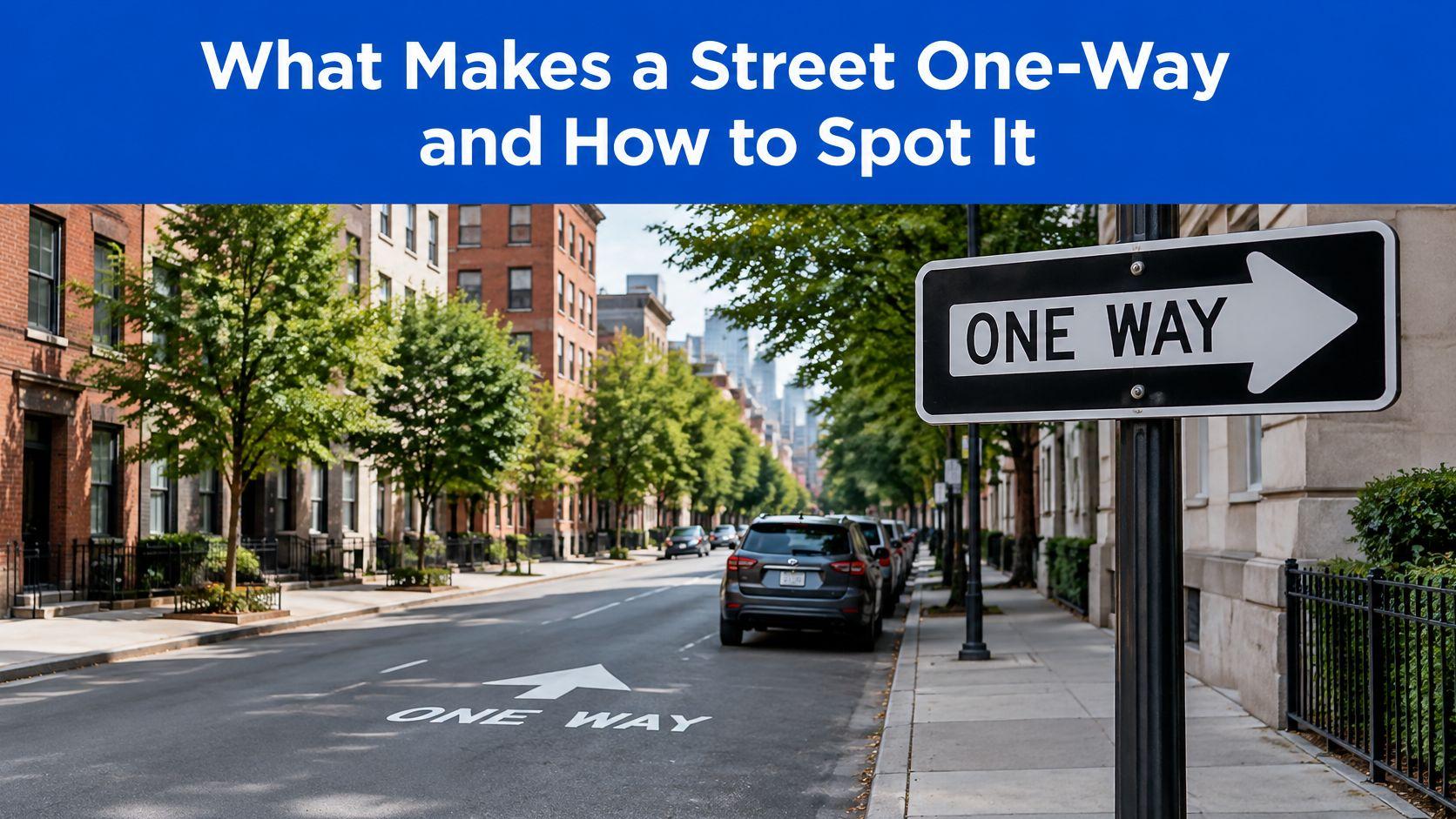
The sign you're hunting for usually sits low on a post at the near corner, not overhead in the middle of the block. Narrow, quiet, busy and familiar are not legal categories. A street that feels like it should run both ways still follows its designation, and the Ministry of Transportation's sign guidance builds the requirement on official designation plus erected signs, not on how the street looks. A road with a median and traffic on both sides is a divided highway, which means opposing traffic is expected, not something you've misread.
Reading the Street Before You Enter It
- Check the near-side entrance. The one-way sign is posted where you enter, so look at that corner before you commit to a turn or a lane change.
- Read the markings in your lane. Arrows and painted lines tell you which direction your lane moves.
- Hunt for prohibitions. A sign that bans opposing traffic or restricts a lane changes what's allowed, even if the street itself stays one-way.
- Ignore other drivers. The car ahead may be parked, turning, or breaking the rule, and none of that makes a movement legal.
- Treat navigation apps as guidance. An app arrow isn't a legal authority, and it can be out of date after a street is reconfigured.
If you want to sharpen that sign recognition before test day, our guide to regulatory signs in Ontario walks through the shapes and meanings you'll meet at the corner.
Temporary setups override the usual pattern. Construction zones, detours and temporary lane signs are the rules in force on the day, so follow what's posted on site even when it contradicts the route you drive every morning.
Lane Positions for Left Turns at One-Way Intersections
Every left turn in Ontario has a lane pair: one lane to start from, one lane to finish in. The pair changes with the road types on either side of the intersection, and its whole purpose is keeping your car out of lanes that belong to someone else.
Turn Starting lane Ending lane One-way road to one-way road Left curb lane Left curb lane of the receiving street One-way road to two-way road Left curb lane Lane immediately right of the centre line Two-way road to one-way road Lane nearest the centre line Left curb lane
The one-way to one-way turn is the tidiest of the three. Start in the left curb lane, finish in the left curb lane of the receiving street, and the car never crosses a lane that matters. The Ministry of Transportation's chapter on changing directions lays out all three paths, and the reasoning behind them is conflict reduction: preserving the turn's matching lane keeps you clear of opposing and adjacent traffic instead of sweeping across them.
Here's the same geometry worked through on video, which is easier to follow than a diagram when you're learning the path.
Working Out a Case the Table Doesn't Show
Don't memorise the rows as text. Name the origin road out loud, name the destination road, then pick the pair that matches. One-way into one-way: curb to curb. One-way into two-way: curb to the lane right of the centre line. Two-way into one-way: centre-adjacent lane to the curb lane.
If you want these turns placed alongside right turns and lane changes, our guide to left turn rules in Ontario covers the wider set.
Painted arrows outrank the default pair. If the arrow in your lane shows straight ahead only, you don't turn left from that lane no matter what the geometry says.
How to Turn Left on Red Safely From a One-Way Road
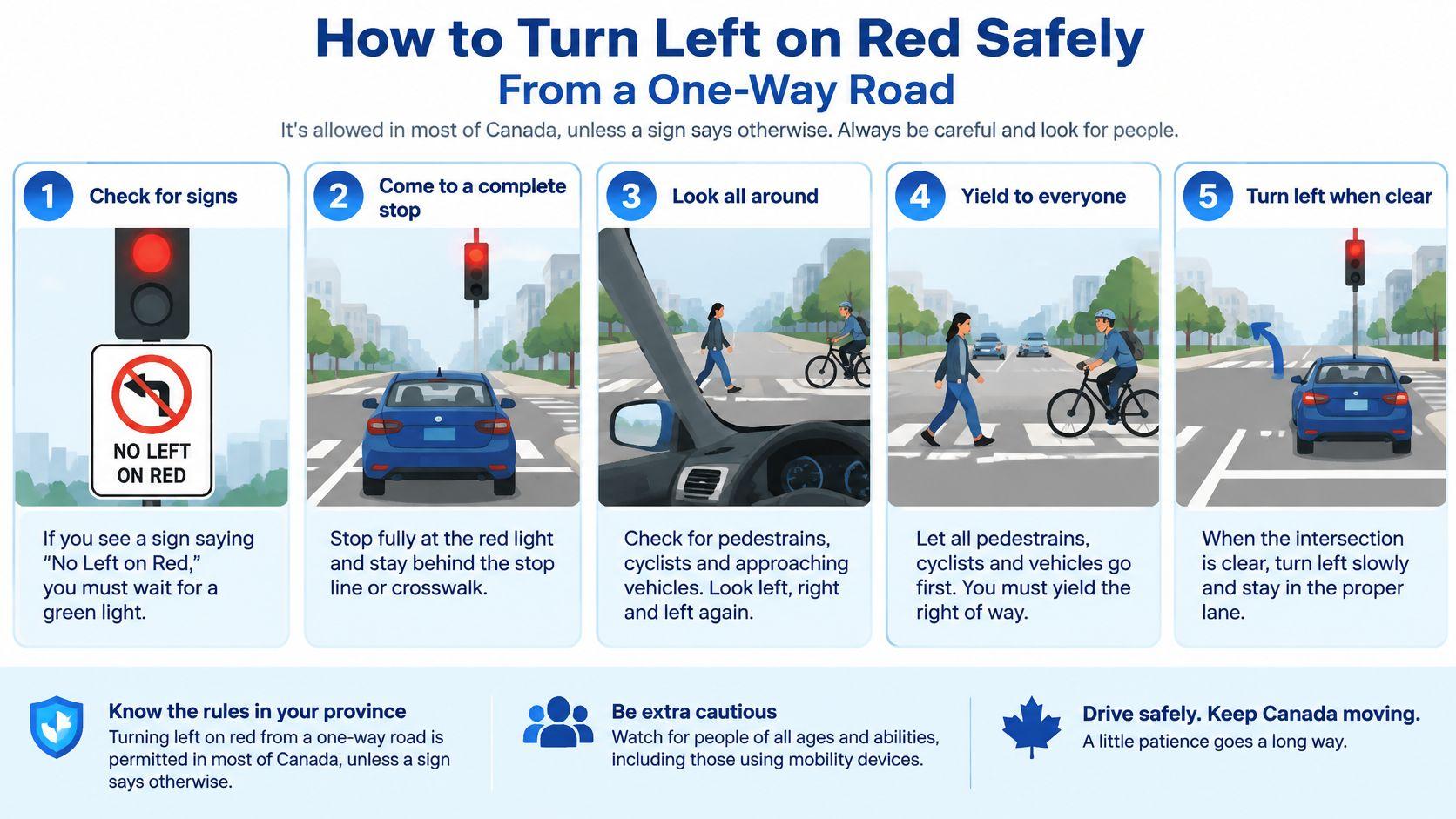
You roll up to a red light on a familiar one-way street, signal left, and the cross street also looks one-way. The turn is still legal only when every condition is true at once: your road is one-way, the receiving road is one-way, no posted sign forbids the move, you stop fully, you yield, and you use the curb-to-curb path.
The Five-Step Sequence
- Confirm both roads are one-way. Check the street you are leaving and the street you are entering before the bumper moves. A one-way sign on the cross street does not help if your own street is two-way.
- Check for a no-turn-on-red sign. Scan the signal pole and the far corner while you are still stopped. Permission disappears the moment a posted sign prohibits the turn.
- Stop completely behind the stop line. The Ontario Driver's Handbook's traffic light rules tie the exception to a full stop. Wheels paused in a crawl or past the line do not count.
- Yield to pedestrians and approaching traffic. Look first at the crosswalk you will cross, then at the lane you will enter. If a vehicle is close enough that turning would create an immediate hazard, stay put.
- Turn only when it is clearly safe, using the curb-to-curb path. Start from the left curb lane and finish in the left curb lane of the receiving street. If either street's direction is uncertain, wait for green.
What It Costs to Get It Wrong
Breaking the traffic-light rule can result in a fine and a conviction, a steep price for saving a few seconds. The habit that protects you here is simple: when the signs leave doubt, treat the red as a full stop.
When in doubt about either street's designation, treat the light as a normal red. Doubt is not a defence, and the driver behind you can wait.
Common One-Way Mistakes That Cost G1 Candidates Marks
Learner errors on one-way questions are rarely about not recognising a sign. They're about applying one rule and forgetting the ones stacked on top. Here are the seven beliefs that cost marks, each with the correction and a question you can ask yourself to check the fix.
- "A left turn on red is always allowed." It's allowed only from one one-way road onto another one-way road, after a complete stop, with no prohibitive sign. Practice question: can you name both road types before the car moves?
- "The one-way sign only matters at the entrance." The designation governs the whole street, so the direction applies at every intersection along it, not just the first one you meet.
- "I can ignore the lane arrow if my lane looks clear." A lane-use arrow can require you to turn left, continue straight or turn right, and an empty lane doesn't cancel the instruction.
- "I can finish the turn in whichever lane is free." The lane pair is fixed by the road types, so finishing wide fails the turn even when nothing is coming.
- "A rolling stop is close enough." The exception applies after a complete stop and not before. Practice question: where exactly is the stop line, and did your bumper cross it?
- "A divided highway is just a wide one-way street." Opposite directions run on physically separated roadways, so the lane you're in may be facing oncoming traffic you haven't looked for.
- "Other drivers show me the direction." Signs decide. A car ahead can be turning, parked or breaking the rule, and copying it teaches you nothing about the street.
The check that fixes most of these: before you turn, say the two road types out loud. One-way onto one-way is the only combination that unlocks the red-light left.
Practise One-Way Rules Before Your G1 Test
A single long cram session won't hold this material. Short sessions across several days will, because the goal is a sequence you can run under pressure rather than a list you can recite once.
A Study Session That Sticks
- Read the glance table aloud. Every row in turn, rule and check together. Saying it once out loud catches the rows you've been skimming.
- Redraw the lane table from memory. Blank page, three rows, no peeking. Check your version against the original, then redo the ones you missed the next day.
- Walk the red-light procedure as a sentence. Both roads one-way, no no-turn-on-red sign, full stop behind the stop line, yield to pedestrians and traffic, turn only when clearly safe. If you can't say it in order, you can't drive it in order.
- Quiz the neighbouring topics. Intersections, signals and right-of-way questions pull these rules in sideways, which is how the test presents them. Our traffic rules practice questions cover that mix.
- Check anything uncertain against the current handbook. The Ontario MTO Driver's Handbook is the reference the test is built on, and a rule that doesn't match the handbook is a rule you shouldn't trust.
Once the sequence feels solid, put it under time pressure on G1ready.ca. The site runs four practice tests, the Road Rules Test, the Road Signs Test, the 200-Question Test and the Diagnostic Test, all built around the 2026 Ontario MTO Driver's Handbook, so the one-way and turning questions match the wording you'll meet on test day. Retake every question you miss until the answer arrives without hesitation.
If you'd rather make these mistakes in practice than at the test centre, G1ready.ca offers free practice tests with instructor-reviewed answers covering intersections, signals, right-of-way and the turning rules in this guide. Every question comes with an explanation, so a wrong answer on a one-way turn becomes a correction you remember instead of a guess you repeat. Work through a set at G1ready.ca tonight, then retake the ones you missed until the five-step sequence runs without thinking.