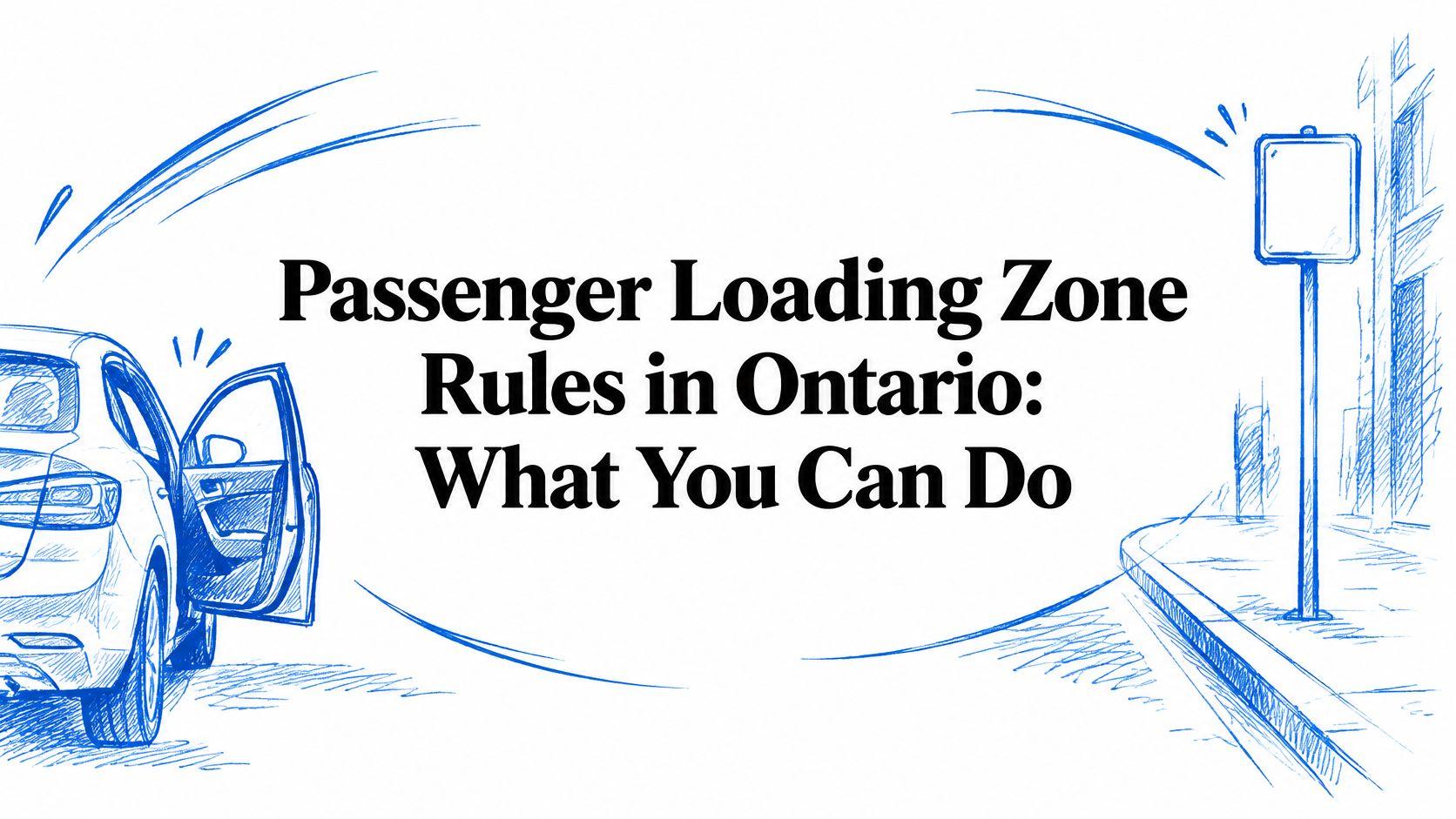
You're outside a school, a station, or a shop entrance. Your passenger texts that they're nearly ready, traffic is building behind you, and there's a clear stretch of curb beside a sign. Do you pull in and wait, or keep moving?
That's where passenger loading zone rules catch learners out. The zone isn't a waiting space. It's a handoff space, and the same car, in the same spot, can be lawful one minute and unlawful the next. What changes isn't where you're sitting. It's whether someone is actively entering or leaving your vehicle right now.
Keep that one question in mind and the signs start to make sense.
What Each Passenger Loading Sign Allows
Say you pull toward a curb outside a medical centre. Your passenger is at the door with a bag, ready to get in. Before you stop, read the sign, because three similar signs give you three different answers.
Ontario's Official MTO Driver's Handbook signs guide distinguishes Do not stop, Do not stand, and Do not park signs, and the differences are precise. A Do not stop sign prohibits stopping even momentarily. A Do not stand sign permits stopping only while you're loading or unloading passengers. A Do not park sign permits stopping only to load or unload passengers or merchandise.
What Each Ontario Passenger Loading Sign Permits
Sign Stopping allowed Who or what the stop may serve Waiting or unattended parking Do not stop No, not even momentarily Nobody Not allowed Do not stand (No Standing) Yes, only while actually loading or unloading Passengers Not allowed Do not park (No Parking) Yes, to load or unload Passengers or merchandise Not allowed
Notice what the table doesn't offer. None of these signs gives you a few minutes to wait. None lets you leave the car and go inside to find your passenger. Hazard lights don't change that, and neither does staying behind the wheel with the engine running.
The signs also work as a set, not as single posts. They're generally used in pairs or groups to mark the beginning and end of the restricted area, so the rule applies to the whole space between them. If you only read the sign beside your window, you may miss where the zone starts or ends. Our guide to regulatory signs in Ontario is worth reviewing until these three feel distinct rather than interchangeable.
Simple test: If nobody is entering or leaving your vehicle, you're not loading. Under all three signs, a car that isn't loading may not stay.
That's the habit to build. Read the exact wording, check whether a passenger is ready at the curb, and only stop where the sign allows that handoff.
Reading the Zone and Its Time Limits
Start your reading before you reach the space, not after you've already stopped in it. Walk the curb with your eyes from the first sign to the last one, because the restriction covers the full stretch in between.
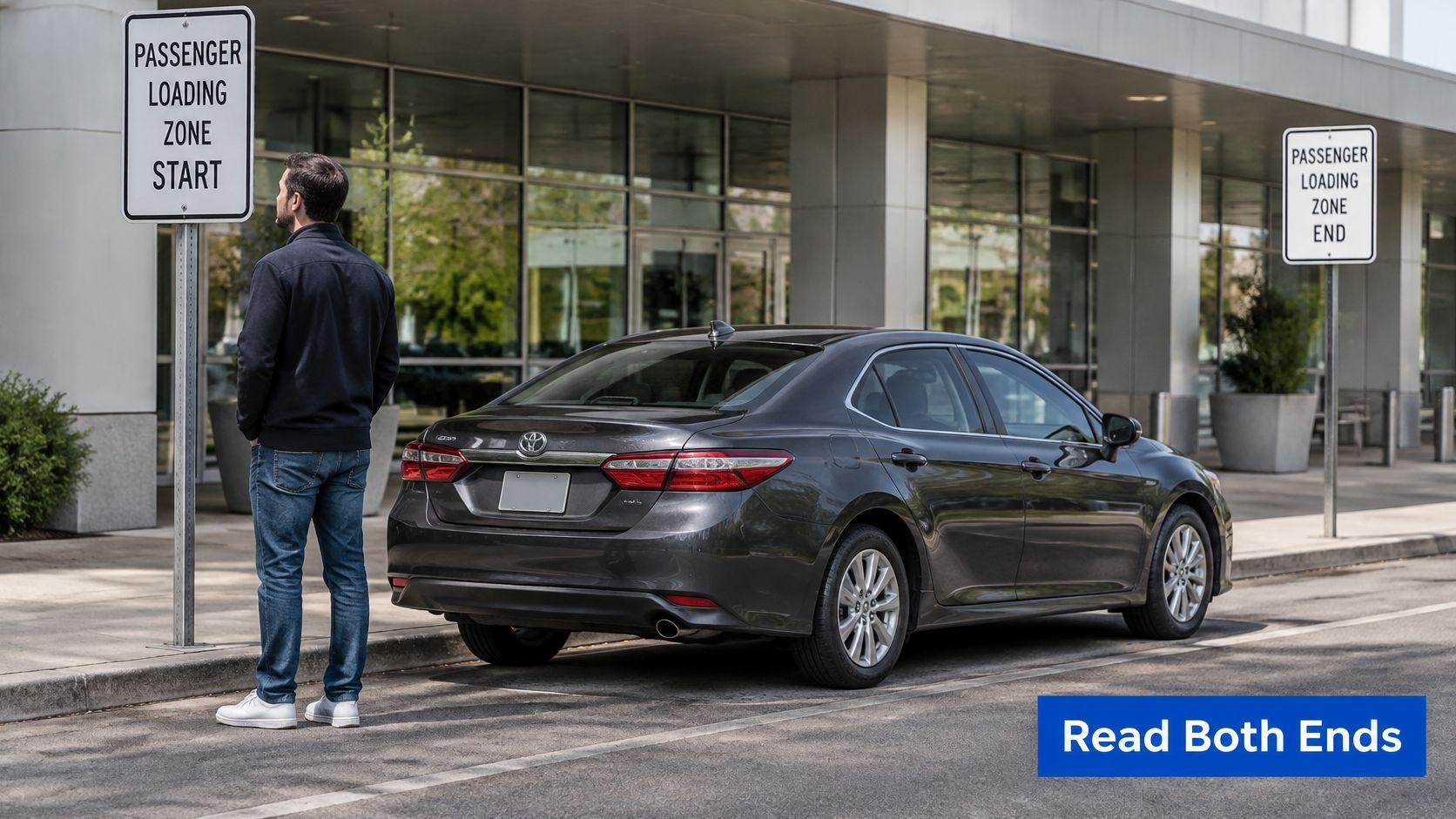
Read the Curb in Order
- Note the start sign and its exact wording. Do not stop, Do not stand, and Do not park have distinct meanings, so name the one you see before you decide anything.
- Check every panel along the zone. Look for hours, days, arrows, or a time limit plate. A panel can narrow what the main sign seems to allow, and a restriction that applies at 8 a.m. on a weekday may read differently on a Sunday.
- Confirm the end sign. Make sure you're inside the marked stretch and that no panel in between changes the rule partway along the curb.
- Treat missing time plates carefully. If no plate shows a limit, the sign type still governs, and your stop is limited to the loading activity itself. You don't gain open ended waiting time just because no number is posted.
A stop that runs past a posted limit is a violation even if your passenger is nearby, nearly ready, or visible through a doorway. The clock on the sign and the activity at your door both matter. When either one ends, your right to stay ends with it.
Ontario's Official MTO Driver's Handbook explains that a No Standing sign permits stopping only while loading or unloading passengers, while a No Parking sign permits stopping only to load or unload passengers or merchandise. It also notes these signs are normally used in pairs or groups, so you interpret the restriction across the area between them. Under the Highway Traffic Act, parking generally excludes a vehicle temporarily standing while engaged in loading or unloading, but that doesn't authorise ordinary waiting, unattended parking, or blocking traffic.
What the Sign Doesn't Tell You
Here's the part learners miss. Local parking rules can vary by road and municipality, and some bylaws aren't posted on signs at all. An open, empty curb is therefore not proof of a legal loading area. It may be a curb where nobody has parked yet.
If you'll regularly pick someone up at the same school, clinic, or downtown address, look up that municipality's parking bylaw or city website before you rely on the space. Do it once, at home, rather than guessing under pressure with traffic behind you.
School bus loading zones are marked separately and follow their own rules, so don't treat them as general pickup space because they look similar. Read the exact sign, stay with the vehicle when required, complete loading promptly, and leave as soon as your passenger has entered or exited.
What You May and May Not Do in the Zone
Most learners get this wrong in the driver's seat. They think, "I'm still in the car, so I'm not parked." Ontario law doesn't work that way.
The Ontario Highway Traffic Act defines park or parking, when prohibited, as the standing of a vehicle whether occupied or not, except when it's standing temporarily for the purpose of and while engaged in loading or unloading merchandise or passengers. Once your passengers have entered or exited, that exception ends. Sitting behind the wheel doesn't extend it.
Think of the zone as a bus stop for cars. A bus pulls in, people get on or off, and the bus leaves. It doesn't sit there because the next passenger is probably on the way.
Common Scenarios in a Passenger Loading Zone
Scenario Allowed in an active loading zone? Reason Dropping off a passenger who is exiting now Yes Active unloading, if the sign allows stopping Unloading a passenger's luggage during the stop Yes Part of the same unloading activity, done promptly Waiting in the driver's seat for a passenger still inside No The stop is no longer active loading Circling the block to collect someone No Not a loading stop, and it blocks traffic Leaving the vehicle unattended No Standing or parking that is not loading Quick stop for a passenger under a Do not stop sign No No stopping is permitted at all Loading merchandise under a Do not park sign Yes The No Parking sign permits merchandise loading
Luggage is the scenario that worries people most, so let's settle it. Helping a passenger lift a suitcase out as they exit is part of that same unloading. Going inside to help them pack, then returning to the car, isn't. The difference is whether the handoff is happening at the vehicle, now, without a break.
Our Ontario parking rules guide covers the wider stopping and parking picture, but for a loading zone you only need two tests.
- Purpose test: Are passengers actively boarding or leaving at this moment?
- Duration test: Is the stop no longer than that handoff takes?
If either answer is no, keep moving and find a lawful spot. Don't negotiate with the sign because your passenger is "just a minute away." That minute is exactly what the rule is about.
How to Pull In, Load and Pull Out Safely
A legal stop can still be a poor stop if you swing in late, sit at an angle, or open a door into traffic. Work through it as a planned manoeuvre.
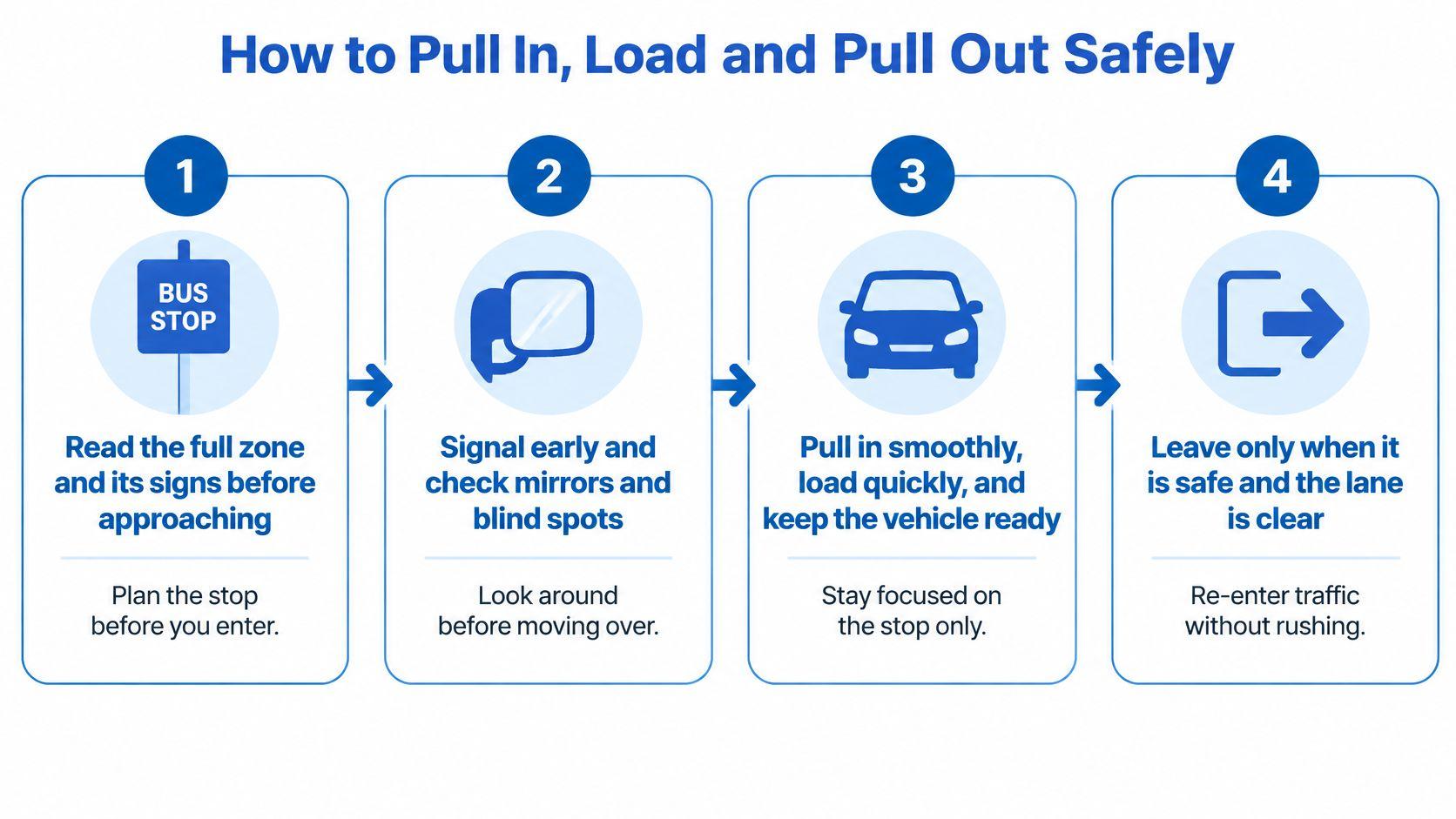
- Read the full zone before approaching. Decide whether you'll stop while you still have room to drive past. A stop you plan is calmer than one you improvise at the last second.
- Signal early, then check mirrors and blind spots. Shoulder check before you slow and move over. Cyclists and following drivers need that warning as much as you need the space.
- Pull close to the right curb and parallel with it. This keeps your vehicle out of the travel lane and gives your passenger a short, direct path to the door on the curb side.
- Stop only where the signs allow it. Never position the car where it blocks an entrance, a crosswalk, a driveway, or other traffic, even if that spot is closest to your passenger.
- Load promptly. Have bags ready, keep the stop as short as the handoff requires, and don't start a conversation through the window while the lane behind you waits.
- Check again before leaving. Mirrors, blind spot, signal, then rejoin traffic once your passenger is clear of the vehicle and the lane is safe.
Ontario's MTO guidance on parking along roadways states a vehicle must never be parked on the travelled part of a road, and if a driver must stop, the vehicle should be driven off the road onto the shoulder where that's possible and lawful. A short passenger stop doesn't override a local prohibition or make stopping in a live lane acceptable.
Watch for these slips:
- Pulling in at an angle: Your rear corner stays in the lane and forces traffic around you.
- Stopping in the travel lane: This turns your pickup into everyone else's obstruction.
- Opening a door into traffic: Check before anyone opens a door on the road side.
From outside, a clean stop looks unremarkable. Parallel to the curb, short, and gone.
Penalties and What to Do After a Ticket
Tickets in a loading zone can come from police or parking enforcement. Fines are set through municipal bylaws and the Highway Traffic Act, so amounts vary by municipality and offence. Don't rely on a figure someone quotes from another city. Check the municipal fine schedule for the exact place where you stopped.
A vehicle left in a zone can be towed, particularly where it blocks access or traffic. Stopping in a no stopping zone, and repeat offences, may also be treated more seriously than a brief overstay past a posted limit. Our guide to Ontario Highway Traffic Act fines and points explains how penalties fit together.
If you receive a ticket, stay methodical:
- Read the notice fully. Note the offence, amount, and the deadline to pay or dispute.
- Check the sign and bylaw for that exact spot. Confirm the wording, hours, and where the zone started and ended.
- Photograph the curb and signs if wording or markers were unclear. Clear photos support a dispute far better than memory.
- Meet the deadline whether you pay or contest it. Missing it removes your options.
G1 Practice Questions on Loading Zone Rules
Answer each one aloud before you read the reason. Saying it out loud shows whether you know it or just recognise it on the page.
Q1. A Do not stand sign marks the zone. You're dropping off a passenger who is getting out now. May you stop? Answer: Yes. You're actively unloading, which is what the sign permits. Let the passenger exit, then leave promptly rather than watching them walk to the door.
Q2. Your passenger is still inside a shop. You wait in the driver's seat in a Do not stand zone with the engine running. Is that allowed? Answer: No. Nobody is entering or leaving, so you're waiting, not loading. Staying in the seat doesn't change the purpose of the stop.
Q3. A Do not stop sign covers the curb. You only need a few seconds to let someone out. May you stop briefly? Answer: No. No stopping is permitted at all in that area, not even momentarily. A quick stop is still a stop, and the sign leaves no exception for passengers.
Q4. A Do not park sign covers the zone. You need to unload a box of merchandise. Is that allowed? Answer: Yes. A No Parking sign permits stopping to load or unload passengers or merchandise. Finish the unloading promptly and move on.
Q5. The curb is open and there are no signs. You leave the car to collect a delivery. Is the space legal? Answer: Don't assume so. Check for an unposted municipal bylaw first, because some parking rules aren't shown on signs. An empty curb isn't evidence that parking is allowed there.
Q6. You must drop someone off, but the only option is stopping on the travelled roadway outside any zone. What should you do? Answer: Don't stop there. Stopping on the travelled part of the road isn't safe or lawful for loading. Continue to a place where you can stop off the road, where that's possible and lawful.
If you hesitated on Q2, that's the one to revisit. It's the commonest real world mistake and the one examiners can test from several angles.
Practise Loading Zone Questions Before Test Day
Reading the rules once gives you understanding. Answering questions under mild pressure tells you whether that understanding holds up.
This screenshot shows the kind of focused practice that helps before you book your test.

Our practice tests are built around the 2026 Ontario MTO Driver's Handbook, so the questions follow the same rules you've just worked through. Start with a one section Road Signs Test and drill the three regulatory signs until you can separate them without thinking. Then take the Road Rules Test for stopping and parking, and use the Diagnostic Test to find weak areas before you attempt a mixed set. Once loading zone questions feel reliable, the mixed 200-Question Test covers a broader range of topics.
The short video below is a useful way to hear the same distinctions explained before you test yourself.
Do one thing today. Reread the sign table, take the Road Signs Test, then retake only the questions you missed. And check local municipal bylaws for the places you'll drive, because practice tests don't replace posted signs.
You've now got the core distinction down, so put it to work at G1ready.ca, where Ontario learners can practise road signs, road rules, diagnostic questions, and a full 200-Question Test built around the 2026 Ontario MTO Driver's Handbook. Run the Road Signs Test today, fix the loading zone questions you miss, and walk into your G1 test able to tell stopping, standing, and parking apart without hesitating.