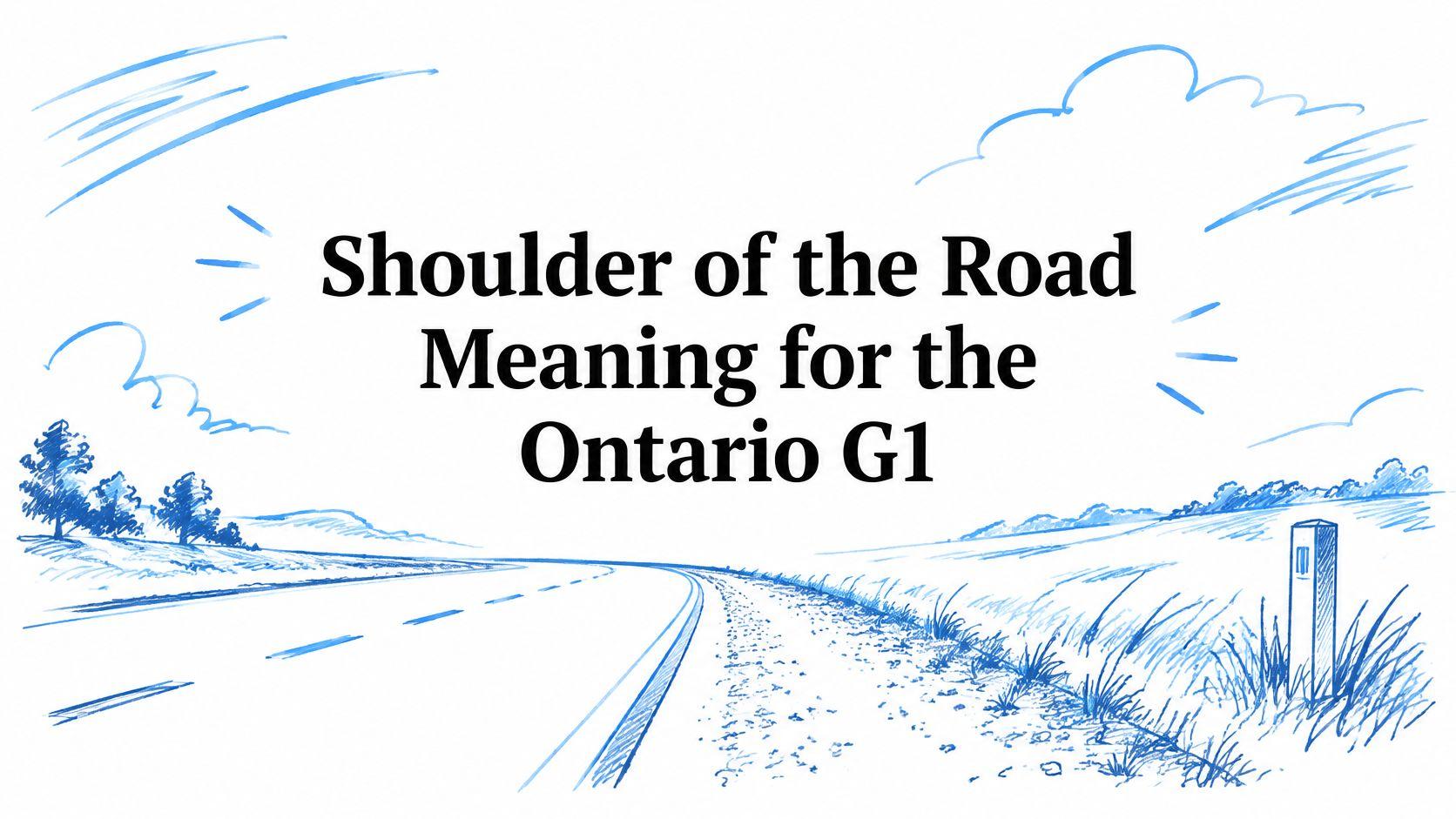
In Ontario, the shoulder is the area beside the travelled roadway and it isn't a traffic lane. The only uses the handbook and signs allow are narrow ones: passing a vehicle that is turning left when the right shoulder is paved, pulling over during a genuine vehicle emergency, stopping where police direct you, and obeying a sign that designates the shoulder for specific vehicles.
You're second in line on a concession road, the car ahead brakes and signals left into a laneway, and the paved strip on your right sits empty. Most learners freeze there. A few swing into the oncoming lane, some wait a full minute, and one or two treat the strip as a spare lane for the rest of the drive. Only one of those moves is legal, and it's the one that uses the strip in the narrowest possible way.
The confusion isn't a comprehension problem. Most plain-language explanations of the shoulder of the road meaning stop at "the edge of the road" and leave it there. In Ontario, that strip changes legal identity depending on which side it's on, whether it's paved, what kind of road you're on, what the signs say, and who needs the space at that moment. A driving instructor doesn't teach a definition. They teach a decision.
Shoulder of the Road Meaning at a Glance
Strip the decoration off and the meaning is short. The shoulder is the side area of a highway, outside the part that is improved, designed, or ordinarily used for vehicular traffic. It exists for drainage, for recovery space, for emergency vehicles, and for the rare signed exception. It doesn't become a lane because the asphalt looks smooth.
Two calls flip the average learner's instinct, so start there.
Two calls that flip the instinct
The first is passing. The Ontario Ministry of Transportation driver's handbook allows a driver to use the paved right shoulder to pass a vehicle that is turning left. The same guide prohibits passing on the left shoulder, whether that shoulder is paved or gravel. A manoeuvre that feels like cheating is lawful on one side and unlawful on the other, and the surface matters as much as the side.
The second is the emergency vehicle reversal. When an ambulance, fire truck or police vehicle approaches with lights or siren, the instinct is to tuck onto the gravel and wave it past. Ontario's rule is the opposite, and the reason is practical: responders may be using that shoulder as their route.
Practical rule: the shoulder's verdict comes from the side, the surface, the road type and the reason for the move. Never from how drivable it looks.
What to do on the shoulder in Ontario
Situation Correct action Why Vehicle ahead turning left, paved right shoulder Pass on that paved right shoulder only Handbook allows this narrow pass Left shoulder, paved or not Do not pass Passing on the left shoulder is prohibited Your own vehicle emergency Pull to the nearest shoulder, hazards on Shoulder is a refuge when staying in the lane is dangerous Traffic jam or shortcut Stay in your lane Shoulder is not a travel or passing lane Approaching emergency vehicle with lights or siren Stop near the right edge of the roadway, not on the shoulder Responders may use the shoulder Police stop Pull onto the shoulder where possible Move away from moving traffic
Read the table once and the pattern is obvious. Every lawful use is either brief, safety-driven, or ordered by someone with authority, and every unlawful use is about saving time. That single distinction answers more practice questions than any memorised sentence about the edge of the road.
The test line worth carrying into the exam room is this. Legality depends on side, paving, road type, signs and the immediate reason for the move. If a question gives you all five and the strip looks wide and empty, the answer is still governed by the reason, not the scenery.
Why the Shoulder Is Not Part of the Roadway
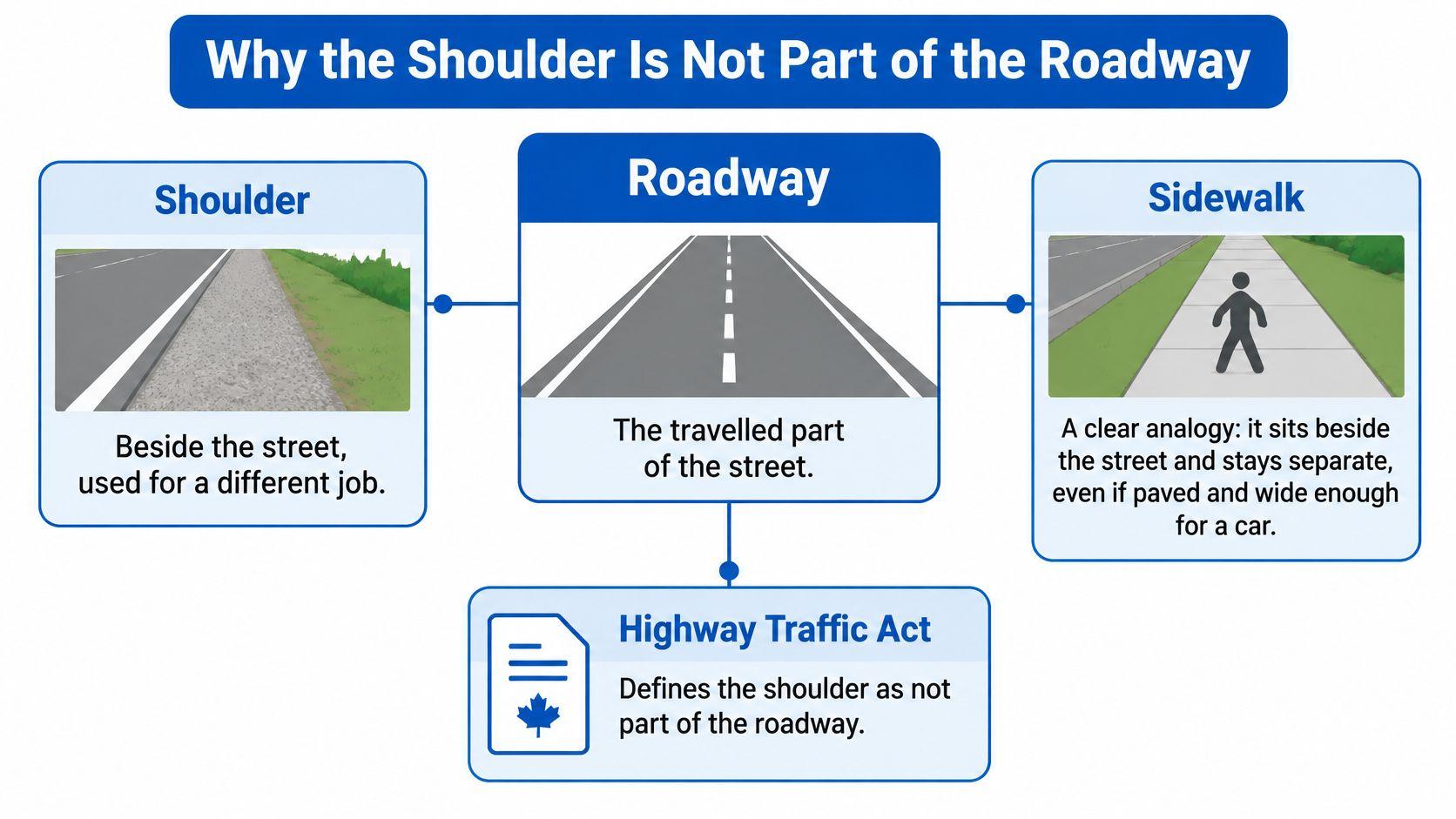
A sidewalk sits beside the street and does a different job. It can be wide, paved, clear for a hundred metres and perfectly capable of fitting a car, and it's still not a driving lane. The shoulder works the same way. Ontario built it beside the traffic and gave it a separate function.
That separation is legal, not just conventional. Ontario's Highway Traffic Act defines a roadway as the part of a highway that is improved, designed, or ordinarily used for vehicular traffic, and it specifically leaves the shoulder out. When a question asks what the shoulder means, the authoritative answer is the road area outside the normal vehicular roadway, subject to signs and specific exceptions.
Where section 151 adds a second layer
Section 151 handles a case that trips up experienced drivers too. On a designated part of the King's Highway, a paved shoulder can be restricted to prescribed vehicles under official signs, and that designated paved shoulder is still deemed not to be part of the roadway. Restricted use doesn't promote the strip into a lane. It keeps it outside the roadway while letting a named group use it under named conditions.
The practical consequence is that a paved strip grants nothing by itself. Permission lives in the regulation and on the sign.
What a sign changes
Function changes by highway segment. One shoulder may exist purely for emergency stopping. A signed stretch elsewhere may admit restricted vehicles under set conditions, and unless a regulation says otherwise, the Act and its regulations still apply, with necessary modifications, to any vehicle operating on that designated shoulder.
So a driver's job at the start of a divided highway is not to judge the pavement. It's to read the sign for that stretch and obey it. Where signage governs a stretch, the guide to pavement markings on Ontario roads helps you tell the edge line apart from a lane line at a glance, which is often the first visual cue that you're looking at a shoulder and not a travel lane.
A shoulder doesn't become a lane because the sign is missing. It becomes one only when a sign says so, for the vehicles the sign names.
Paved Right Shoulder Rules and Special Vehicles
Take a rural two-lane road with a laneway on the right. The car ahead slows and signals left. Your right side is paved and clear, and you pass there rather than swinging into oncoming traffic. That move is lawful, and it's lawful only because the shoulder is paved.
Change one detail and the verdict changes with it. If that right edge is gravel, you wait. If the empty space is on your left, you wait regardless of the surface, because passing on the left shoulder is prohibited whether it's paved or not. A police stop is a separate permission again: when an officer pulls you over, you move onto the shoulder where you can, away from moving traffic, and that's a directed stop rather than a travel choice.
The limits on a signed exception
Ontario's guidance gives a worked example of how narrow a designated shoulder exception can be. Certain all-terrain vehicles may travel on designated highway shoulders only when they meet every condition below, according to the Ontario Ministry of Transportation driving guidance.
Requirement Limit Weight no more than 450 kilograms Width no wider than 1.35 metres, excluding mirrors Occupants driver only Equipment meets required safety standards Location designated portions of the King's Highway only
Read that table as a warning about how legislation works, not as trivia about ATVs. A designated shoulder isn't an open door with a weight sticker on it. It's a list of conditions, and missing any one of them puts the vehicle back outside the law. The Minister can designate portions of the King's Highway, and regulations can name which vehicles qualify, when they qualify, and which rules of the road are modified for them.
For a learner in a sedan, none of those conditions apply, and that's the point. The default answer for ordinary driving is the same one every time: stay in the normal lane unless Ontario law, a posted sign, or an authorised safety situation specifically permits shoulder use.
Practical rule: if you can't name the rule that lets you use the shoulder, you don't have permission to use it.
How to Pull onto the Shoulder in an Emergency
This section is about your own vehicle failing, not about traffic being slow. A flat tyre, a engine that quits, steam from under the hood, a warning light that means you can't hold a safe speed. Those are the conditions that turn the strip from forbidden lane into refuge, and the MTO handbook's emergency guidance gives the order to do it in.
- Check the mirrors first. You need to know what's beside and behind before the car changes direction. An unseen cyclist or a passing van is how a shoulder stop becomes a sideswipe.
- Switch on the hazard lights. They tell the drivers behind that you're slowing for a reason and that this is a refuge stop, not a lane change.
- Take your foot off the accelerator. Coasting down is predictable. Standing on the brake mid-lane is how a mechanical problem becomes a rear-end collision.
- Steer steadily to the nearest shoulder. Move as quickly as you safely can, and commit once you start. Hesitating half on and half off the pavement is the worst of both positions.
- Stop parallel to the edge, as far from the travelled lane as the surface allows, so passing traffic has room and you have a stable place to stand.
- Stay alert to fast traffic before anyone opens a door, especially on a freeway where a stopped car sits exposed to vehicles still doing highway speed.
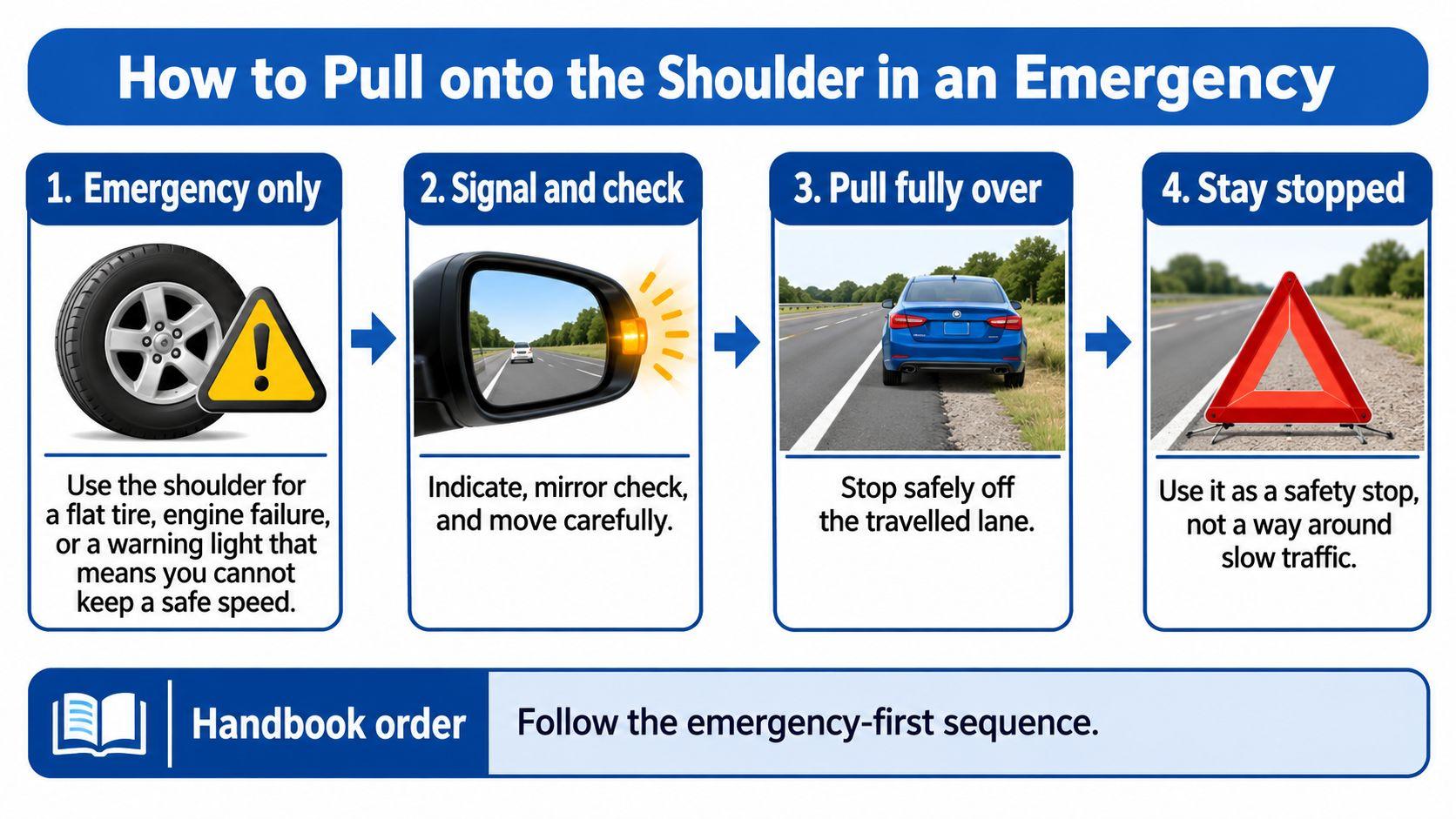
The order matters because each step buys the next one. Mirrors buy you a safe gap, hazards buy you following distance, coasting buys you time, and stopping parallel buys you a clear lane for everyone else. The guide to driving on a highway is worth a read before your first freeway trip, because freeway shoulders concentrate every one of these risks into a few seconds.
The boundary is worth saying plainly. These steps authorise pulling over during an actual vehicle emergency. They don't authorise a shortcut, a passing lane, or routine travel along the strip, and the handbook's emphasis stays on doing it quickly after the mirror check and the hazard lights.
A shoulder stop is a stop. If you're still moving along it after the emergency is over, you've stopped being a refuge and started being a hazard.
The next section covers the mirror image of this situation, where the emergency belongs to someone else and the correct move is to stay off the strip entirely.
Do Not Stop on the Shoulder for an Ambulance
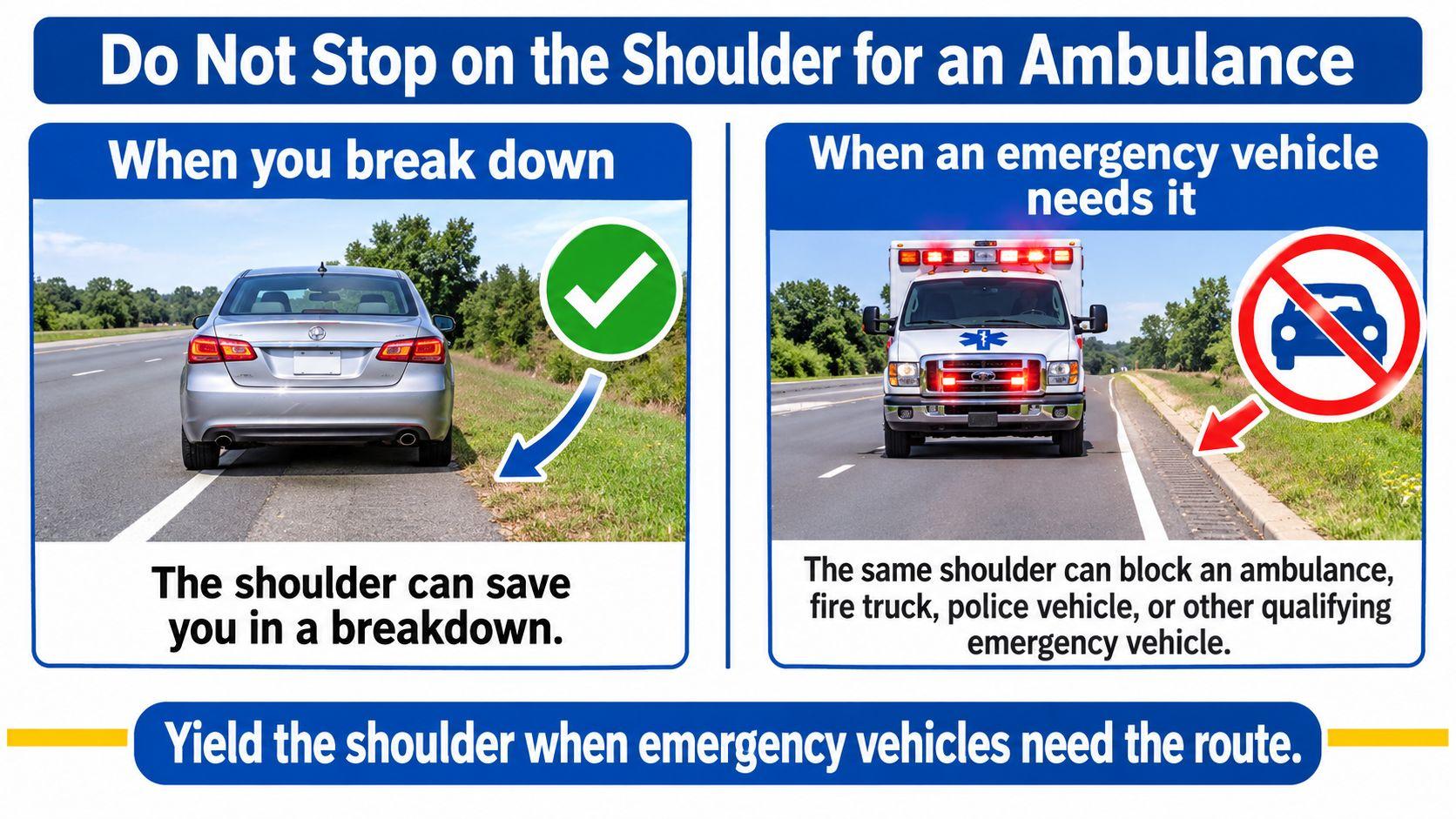
The shoulder that saved you in a breakdown can block the ambulance that needs it ten minutes later. That's the reversal learners find hardest, because the instinct learned in one situation is exactly wrong in the other.
When an ambulance, fire truck, police vehicle or other qualifying emergency vehicle approaches using the required lights or siren, Ontario's rule is to stop as near as practicable to the right-hand curb or edge of the roadway, stay parallel to it, and keep clear of intersections and highway ramps. The MTO handbook's guidance on particular situations then adds the line that catches people: don't move onto or stop on the shoulder merely to yield, because emergency vehicles may themselves be travelling along that shoulder.
Move to the nearest edge, not the gravel
On a divided highway with more than two lanes running in your direction, the instruction shifts slightly in a way that matters. You move toward the nearest edge of the roadway rather than automatically crossing several lanes to reach the far right. Crossing lanes in response to a siren creates the very conflict the rule exists to prevent.
The sequence the test expects is undramatic. Signal early so drivers behind read your intention, check the mirrors, reduce speed smoothly instead of stabbing the brake, and stop only where the roadway edge is safe and legal. Visibility and access are the whole point. An apparently clear shoulder may be the responder's fastest path when the traffic lanes are obstructed, and a private car parked there is both a collision risk and an obstruction.
This isn't a courtesy that drivers can extend or withhold. Section 159 of the Highway Traffic Act sets out the duty, which is why the behaviour shows up in the road rules portion of the test rather than in a section on manners.
Practical rule: your breakdown goes to the shoulder. Their emergency doesn't.
The checking habit is the same one that governs breakdowns and left-turn passes. Notice who else might need the space, and the answer tends to arrive before the question does, which is exactly the skill the emergency vehicle rules guide drills.
G1 Traps about Driving on the Shoulder
The G1 doesn't ask you to recite a definition. It drops you into a scene, offers a tempting move and waits to see whether you take it. Four scene types cover most of the shoulder wording you'll meet.
The left-turning truck with a paved right shoulder
A truck ahead on a two-lane road signals left, and the right edge is asphalt. The correct answer is to pass on that paved shoulder. The tempting wrong answer is to wait indefinitely, which some learners pick because they've been told shoulders are off limits, and the other wrong answer is to swing around on the left.
The same scene with a gravel right edge
One material change and the answer inverts. On gravel the correct move is to wait, and the trap is treating any shoulder as a usable lane. Questions like this test whether you noticed the surface word at all.
The freeway with an open shoulder
Traffic is jammed, a stalled car sits in the left lane, and the right shoulder is clear for a kilometre. Using it to skip the queue is wrong, and the reasoning is the same one that makes the ATV exception so conditional. A clear strip isn't an invitation, it's an absence of prohibition you haven't checked yet.
Sirens behind you on a freeway
Here the trap is confidence. A learner who has just studied breakdown procedure moves onto the shoulder out of habit, and the question was never about breakdowns. It's about responder access.
Study check: for every shoulder question, name the side, the surface, the reason for the move, and who else might need the space.
That four-part check catches nearly every shoulder wording the road rules half of the test can produce, including the ones that hinge on signage changing a designated paved shoulder. Any answer that treats every paved shoulder as open fails the fourth part immediately. Write the four words on a sticky note, side, surface, reason, access, and run them before you tap an answer.
Practise Shoulder Rules before Your G1
Sit one short session on the road rules material and apply that four-part check to every shoulder item you meet. When an answer goes wrong, restate the four points out loud before the next attempt, because most misses come from ignoring the side or the surface, not from misunderstanding the concept.
That approach fits the format you'll face. The Road Rules Test on G1ready.ca has 20 questions and lists 4 as allowed to pass, so a handful of careless shoulder misses can change your result. Our practice tests are built around the 2026 Ontario MTO Driver's Handbook, which means the shoulder reasoning you rehearsed here matches the wording you'll meet on test day.
Start with the Diagnostic Test to find the weak areas, then return to the Road Rules Test for repetition on them. Once shoulder items come out clean in isolation, move to a mixed set such as the 100 Questions Test or the 200-Question Test so shoulder rules sit next to signs and right-of-way questions in realistic order, matching the assessment format.
Rereading the statute isn't necessary for G1 shoulder questions. The handbook reasons are enough to answer them, and the four-part check converts those reasons into a habit you can run in a few seconds per question.
Shoulder questions become easier once you've encountered them in the same order the test uses, and G1ready.ca offers this without requiring registration. The Road Rules Test, the Road Signs Test, the 100 Questions Test, the 200-Question Test, and the Diagnostic Test all provide immediate feedback with explanations, so a wrong shoulder answer teaches you the rule instantly instead of leaving you to guess. Visit G1ready.ca and start with the diagnostic, then practice the road rules set until the side, the surface, and the reason become automatic.