

A G2 is Level Two of Ontario's graduated licensing system, and it lets you drive alone on any Ontario road. Age-based passenger restrictions, zero-alcohol rules, and seatbelt requirements still apply, so passing the test doesn't mean every restriction disappears.
You may be asking what is G2 because you've just passed the road test, you're helping a teenager prepare, or you're trying to understand what changes after the G1 stage. The practical answer is simple: G2 removes the requirement for a supervising driver, but it keeps new drivers inside a controlled licensing system until they qualify for the full G licence.
That distinction matters most in ordinary situations. A solo drive to work may be legal, while a late-night trip with several young passengers may not be. The licence gives you more independence, but it also expects you to manage risk without treating that independence as unlimited freedom.
Where G2 Fits in Ontario's Graduated System
Walking out of a DriveTest centre with a new G2 licence can feel like the end of the process. It's the middle stage. Ontario's graduated licensing system moves new drivers through G1, G2, and the full G licence, with each level adding experience and responsibility.
Ontario makes the G1 the first licence stage. Applicants must be at least 16, pass a vision test, and pass a knowledge test covering road signs and rules before entering Level One and receiving a Class G1 licence. The official Ontario driver licensing handbook explains that G1 holders remain in Level One until they progress through the system.
Think of the stages as learning with training wheels. G1 is the training-wheel stage: you practise only with a qualified accompanying driver. G2 is the stage where one wheel comes off: you can drive alone, but age-based and novice-driver restrictions remain. Full G is the stage where the remaining training limits are removed, after you pass the second road test.
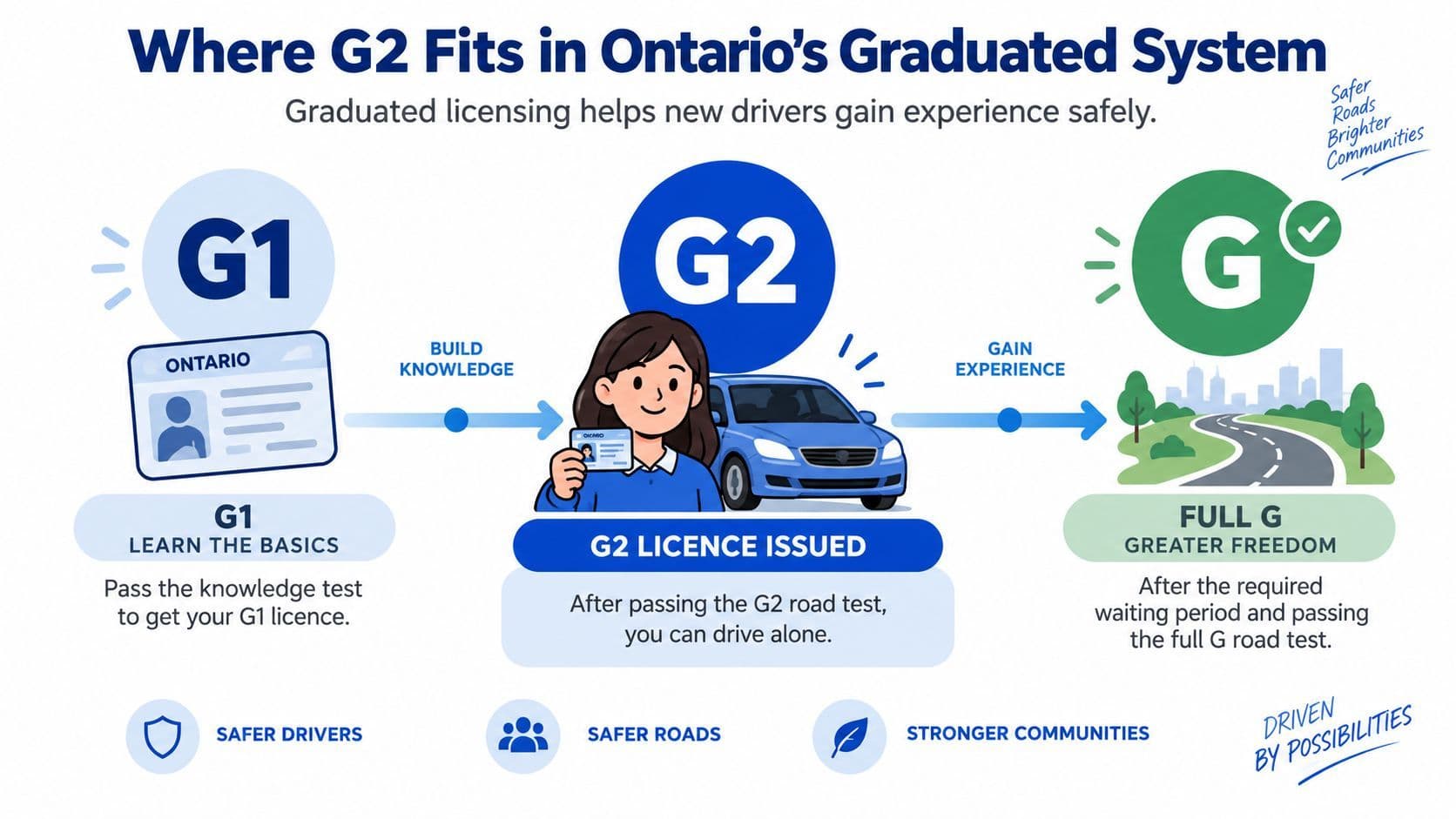
G1, G2, and full G in plain language
At G1, the supervising driver is part of the safety system. You're not permitted to drive alone, and the accompanying driver must meet Ontario's requirements. The official rules for G1 drivers state that the accompanying driver must hold a valid Class G or higher licence, have at least four years of driving experience, and have a blood-alcohol level below 0.05%.
At G2, the supervisor leaves the front passenger seat. You're responsible for the vehicle, route, speed, observations, and decisions. That freedom is earned through the G2 road test, not automatically granted after holding a G1.
Ontario's pathway includes two road tests before full licensure. The first moves you from G1 to G2. The second moves you from G2 to the full G licence. A plain-language guide to Ontario's graduated licensing system can help you see how the stages connect without treating G2 as a standalone licence.
Eligibility Rules Before You Can Take the G2 Test
G2 eligibility follows a chain. You must be old enough to apply, hold the G1 for the required period, remain medically and visually fit to drive, and complete the road test successfully.
Ontario sets the minimum licensing age at 16. Before receiving a G1, applicants must pass both a vision test and a knowledge test about traffic signs and rules of the road, as outlined in Ontario's new-driver licensing information. The knowledge test belongs to the G1 stage, so the G2 appointment is centred on practical driving rather than another written exam.
The waiting period is part of preparation
Ontario novice drivers must hold each novice level for a minimum of 365 days before becoming eligible to advance, according to Ontario novice-driver regulations. In everyday terms, that's a full year of supervised practice between receiving G1 and becoming eligible for the G2 road test.
Some driver education programs may affect the applicable waiting period, so check your eligibility directly with DriveTest and confirm that your course has been recognised for that purpose. Don't book based only on a school's general advertising. Your licence record and official appointment information determine whether you can take the test.
Your vision and medical fitness also matter at the appointment. Passing the G1 vision screening doesn't mean you should ignore a later change in eyesight or health. If a condition could affect safe driving, discuss it with the appropriate professional and follow Ontario's licensing requirements.
Requirement Standard Path Driver Education Path Minimum age 16 years old, with vision and knowledge tests completed for G1 16 years old, with the same G1 entry requirements G1 holding period Minimum 365 days before G2 eligibility under Ontario's novice-driver rules Confirm whether an approved course changes the applicable waiting period Test at this stage Practical G2 road test Practical G2 road test Fitness to drive Vision and medical fitness must still support safe driving Vision and medical fitness must still support safe driving
Failing the G2 test doesn't erase the experience you've gained or send you back to the beginning of the licensing pathway. You'll need to follow the applicable re-test rules and use the result to target practice, especially if the examiner identifies recurring observation, control, or positioning problems.
What G2 Lets You Do Compared With G1
The biggest change is the empty front passenger seat. With a G1, you can't drive alone. With a G2, you can drive without an accompanying driver, on Ontario roads, including highways, subject to the restrictions that apply to your licence.
That means a solo evening trip from one Ontario community to another can be legal with a G2. The same trip would be illegal with a G1 if no qualified accompanying driver were present. The licence changes who may supervise you, not whether you still need to drive carefully.
A practical comparison
G2 drivers can drive at any time in most cases and on all Ontario roads. G1 drivers remain subject to the learner-stage conditions, including the requirement for a qualified accompanying driver and the other conditions attached to Level One driving.
Ontario's highway guidance for G2 drivers is useful when you're planning your first independent highway route. Before leaving, check your vehicle, choose a route you understand, and practise merging and lane changes with supervision while you still have access to it.
Driving Activity G1 Licence G2 Licence Drive alone Not permitted Permitted Drive on Ontario roads Only under G1 conditions Permitted on all Ontario roads, subject to G2 restrictions Drive on a highway Requires the appropriate qualified accompanying driver and G1 conditions Permitted, with safe planning and normal road rules Drive at night Not independently permitted Permitted in most cases, with age-based passenger restrictions applying where relevant Front-seat supervisor Required Not required Passenger, alcohol, and seatbelt rules G1 conditions apply G2 conditions continue and must be followed
The word alone is important. It means you no longer need a supervising driver, not that you're exempt from the Highway Traffic Act, insurance requirements, safe driving duties, or novice-driver rules. G2 is a practical licence with guardrails, not a full licence.
Age-Based Restrictions That Still Apply at G2
A new G2 driver may pass the test, receive the card, and then make a mistake before leaving the parking lot: assuming every passenger arrangement is now allowed. Ontario's rules are more specific, especially for drivers 19 and under.
For those drivers, the first six months after receiving G2 limit the number of passengers aged 19 and under between midnight and 5 a.m. to three. After that first six-month period, the midnight-to-5-a.m. limit changes to one passenger aged 19 or under until the applicable restriction period ends. Family-member exemptions apply under the provincial rules, so check the official wording before relying on a particular passenger arrangement.
Match the rule to the moment
A Sunday morning drive with one friend doesn't create the same issue as a Friday-night carpool. The relevant time window is midnight to 5 a.m., so a driver aged 19 or under needs to think differently about a trip leaving late at night or arriving home before dawn.
Consider three ordinary examples:
- Friday night: You're 19 or under, within the first six months of G2, and planning to take several young friends home after midnight. Count the eligible passengers before starting the engine, and check whether a family exemption applies.
- Sunday morning: You're driving alone to work after sunrise. The night passenger restriction isn't the issue, but your zero-alcohol and seatbelt duties still apply.
- Early shift: You leave before dawn with a young passenger. The clock matters even if the roads are quiet and the trip is short.
Restriction G2 Drivers 19 and Under G2 Drivers 20 and Older Midnight-to-5-a.m. passengers First six months, no more than three passengers aged 19 or under; after that, no more than one passenger aged 19 or under, subject to family exemptions The age-based passenger restriction described here doesn't apply in the same way Alcohol Zero blood alcohol every time you drive Zero blood alcohol every time you drive Seatbelts Every passenger must wear a seatbelt Every passenger must wear a seatbelt
Ontario's official new-driver rules separate the freedom to drive independently from the restrictions that remain. Read the passenger rules carefully rather than relying on what another new driver remembers.
The G2 Road Test and How the Wait Year Helps
The G2 road test is a demonstration of practical control and judgement. An examiner rides with you and watches how you handle ordinary city driving, including observation, lane changes, turns, stopping, positioning, and parking.
The test is about 20 minutes, according to the road-test process described in the accompanying DriveTest preparation material. It isn't designed as a surprise challenge. The examiner wants to see whether you can make safe, repeatable decisions in normal traffic.
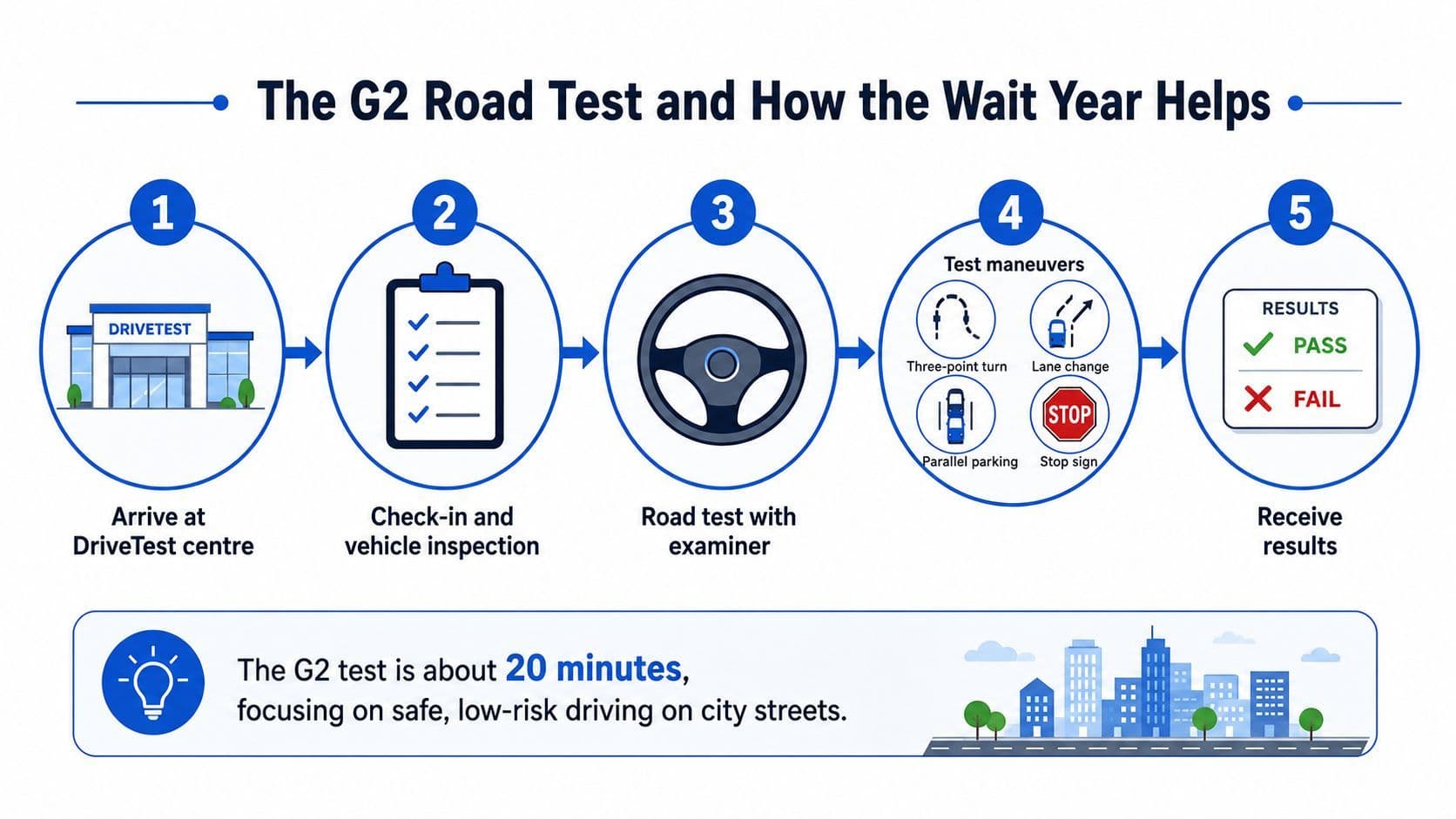
What the examiner is watching
Common test elements include three-point turns, lane changes, parking on a hill, and intersection judgement. Small errors can matter when they reveal a pattern, such as failing to check a blind spot, approaching too quickly, signalling late, or stopping beyond the proper point.
Use the mandatory waiting year as a practice runway. A supervised drive through a busy intersection builds a different skill from a quiet residential loop. Highway merging develops another set of habits, while winter driving teaches you to create more space and reduce speed when conditions demand it.
Practical rule: Don't practise only the route near the test centre. Practise the decisions that the route is likely to require.
The G2 driver test guide can help you organise practice around the road-test skills rather than around memorising a route. A route can change. Safe observation, signalling, speed control, and vehicle positioning remain useful wherever you drive.
For a visual walkthrough of the test sequence and the waiting year, review the process below.
Practice Strategies That Build Real Test-Day Confidence
Reading about driving doesn't create steering control. The G2 test evaluates behaviour behind the wheel, so your practice should reproduce the moments that cause hesitation.
Start with one weak area at a time. An empty lot can give you space to practise tight turns without rushing. A quiet road can help you repeat mirror, signal, and blind-spot checks until they happen in the correct order. Hill parking should include a curb reference, correct wheel positioning, and a final check that the vehicle is secure.
Turn mistakes into drills
Parallel parking improves when you use repeatable reference points rather than guessing. Cones can help you practise the space and steering sequence away from traffic. For lane changes, say the sequence at first: mirror, signal, blind spot, smooth movement. Then repeat it until the checks become consistent rather than performative.
A certified driving school can provide a mock test and an outside observer. Ask the instructor to identify patterns, not just isolated mistakes. Online quizzes can refresh road rules, but they can't replace time spent judging gaps, controlling speed, and scanning intersections.
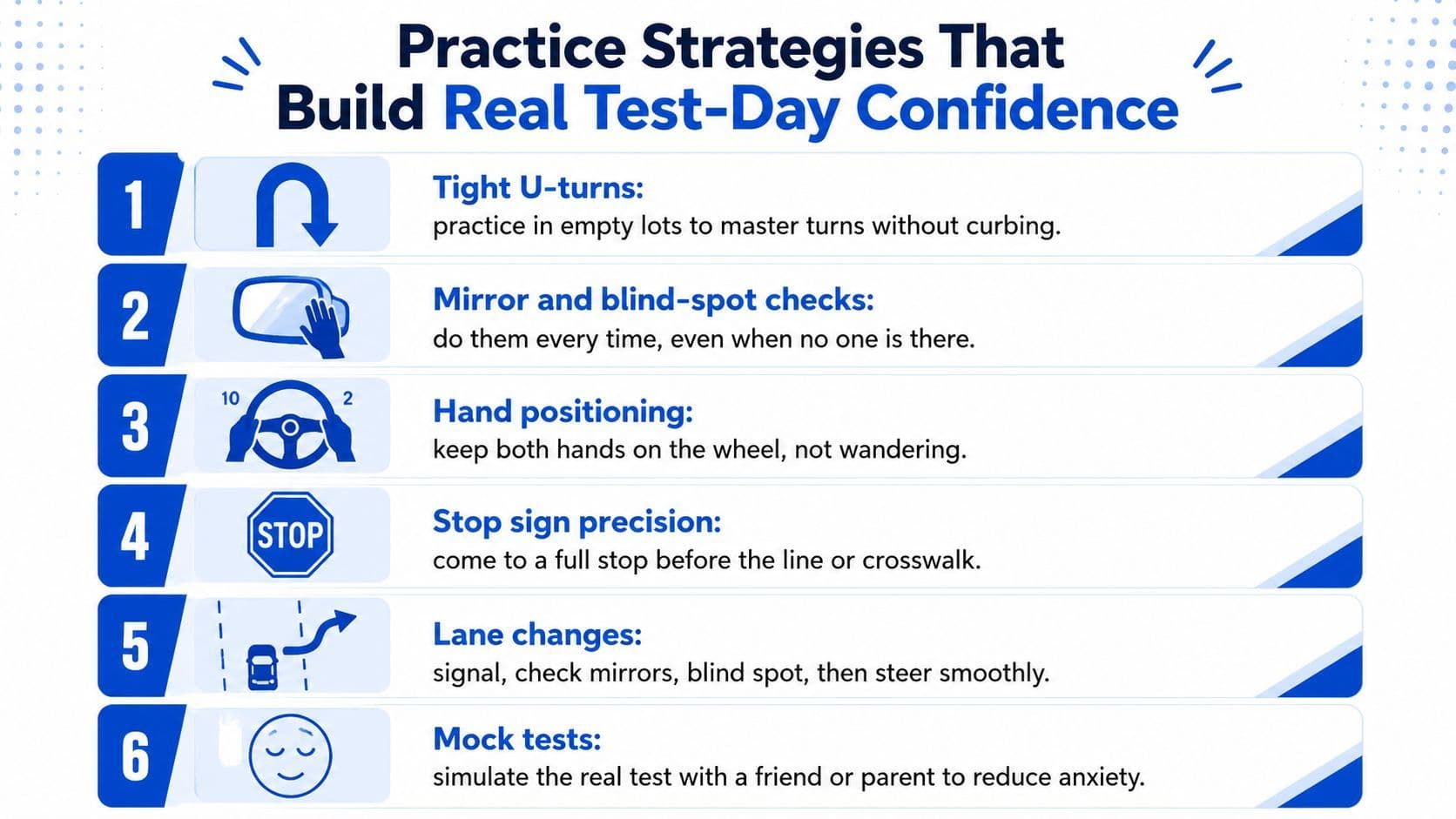
Keep a useful practice record
After each supervised drive, write a short note about the conditions and one mistake or success. Record whether you drove in rain, heavy traffic, darkness, on a highway, or in winter conditions. You'll start to see whether you avoid a particular manoeuvre or lose concentration in a particular setting.
A platform such as G1ready.ca offers registration-free G1 practice exams, targeted quizzes, mixed tests, a diagnostic test, and an exam simulator aligned with Ontario handbook material. It's useful for refreshing the written rules that support your road decisions, while actual driving practice develops the physical skills the G2 test measures.
Finish your preparation with a realistic timed session. The official-style practice should confirm that you understand the question format and rules, not introduce a completely new subject on the eve of your appointment.
Your First Solo Year on the Road
Your first solo year should be treated as a transition from supervised learning to independent judgement. Keep your G2 card and insurance slip with you, and confirm that the vehicle you drive is insured in your name or that you're listed as a driver on the policy.
Before accepting passengers, know the restrictions attached to your age and the time of day. Keep the zero-blood-alcohol rule simple: if you're driving with G2, don't drive after drinking. Every passenger must wear a seatbelt, and demerit points still apply if you commit offences.
A carrying checklist
- Carry the documents: Have your G2 card and insurance slip available whenever you drive.
- Check the clock: If you're 19 or under, review the midnight-to-5-a.m. passenger rule before accepting young passengers.
- Practise difficult settings: Log highway, night, heavy-traffic, and winter drives so you can identify gaps instead of avoiding them.
- Refresh defensively: Schedule a defensive-driving review during the year, particularly if you haven't driven regularly.
- Plan the next test: The G2 exit road test becomes the route to the full G licence after you've met the mandatory holding period.
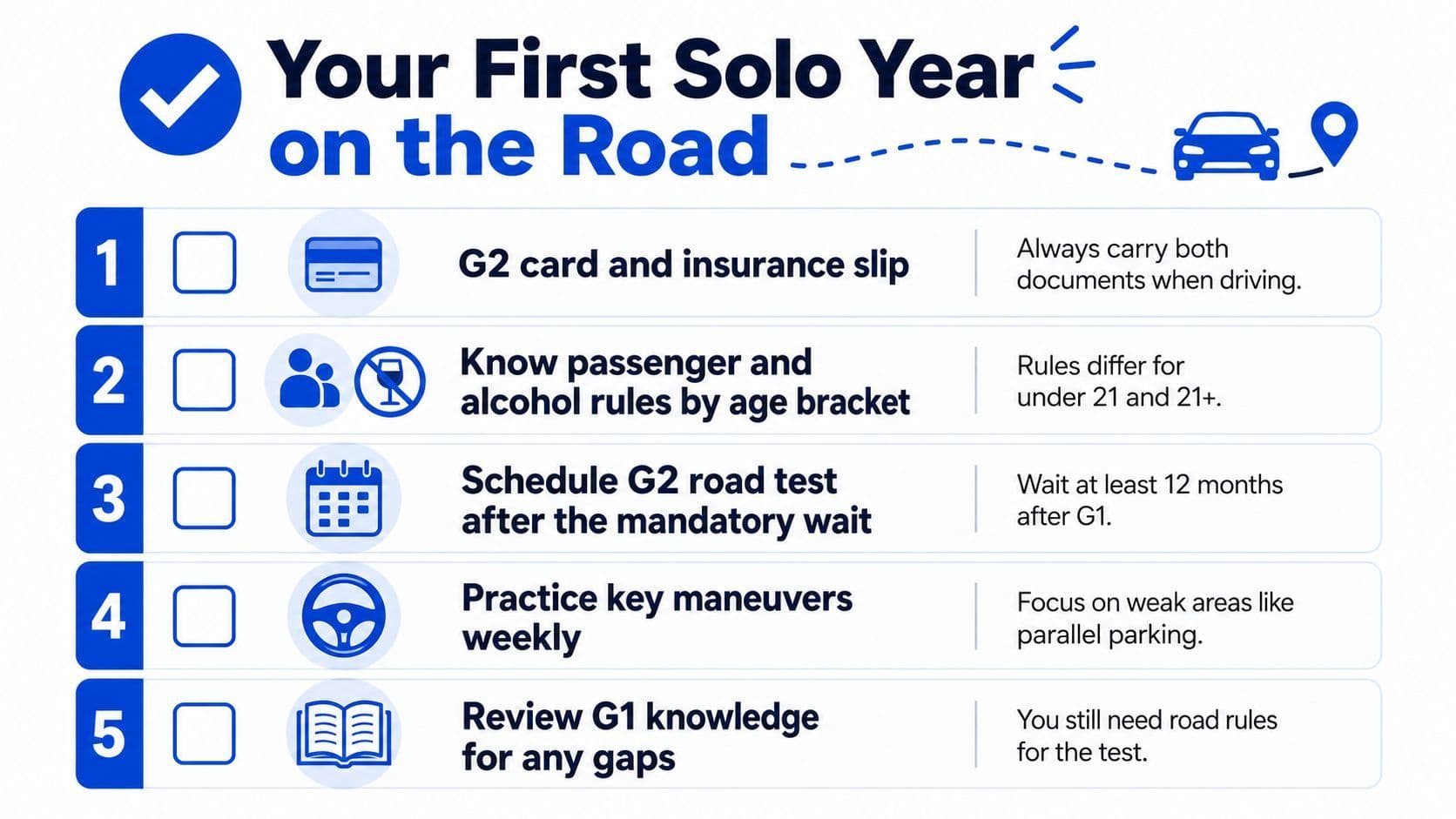
For the first two weeks, keep every drive purposeful. Practise one manoeuvre, one observation habit, and one route condition during each session. At the six-month mark, review your notes, check whether any age-based passenger restriction still applies, and choose the skills that need another round of supervised practice.
G2 gives you independence, but it also gives you responsibility for every decision that a supervising driver once helped you make. Use the licence as a structured year of experience, then book the next road test only when your habits are reliable in more than one setting.
Visit G1ready.ca to practise Ontario road rules with targeted quizzes, mixed tests, diagnostic practice, and an exam simulator that supports your G1 foundation. Use those tools alongside supervised driving practice so your knowledge and on-road decisions develop together.


